
THE VOICE OF INTERNATIONAL LITHUANIA

|
VilNews has its own Google archive! Type a word in the above search box to find any article.
You can also follow us on Facebook. We have two different pages. Click to open and join.
 Click on the buttons to open and read each of VilNews' 18 sub-sections Click on the buttons to open and read each of VilNews' 18 sub-sections  |

|


Lithuania today
- Posted by - (7) Comment
every day? Why cannot we create
Christmas miracles
all year long?
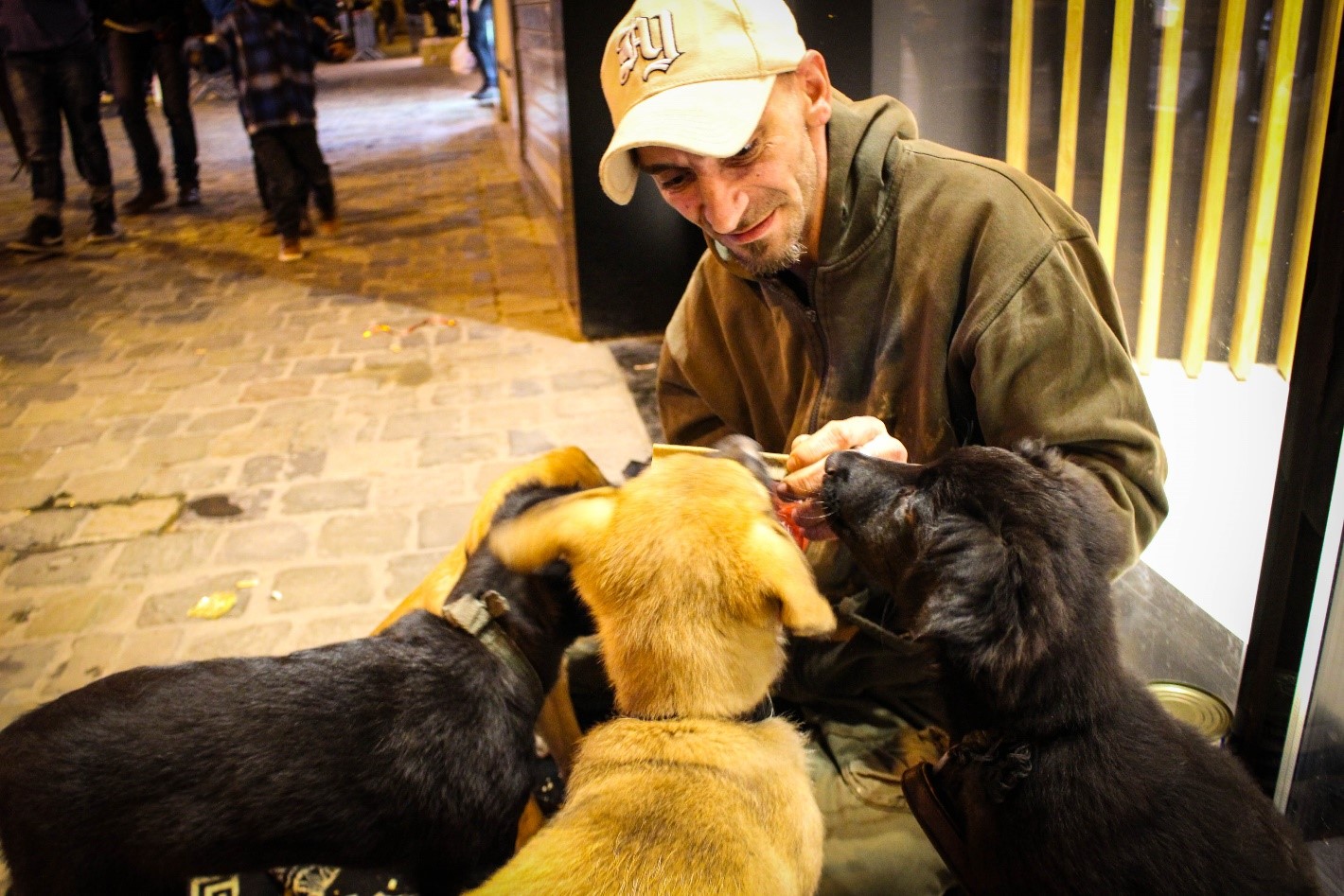
By Rugilė Šablinskaitė
Brussels – Belgium
...It's a time for giving, a time for getting,
A time for forgiving and for forgetting.
Christmas is love, Christmas is peace,
A time for hating and fighting to cease’…
sings Cliff Richard.
I guess everyone knows this cliché Christmas song as well as many more others that talk about this special time of the year when everyone becomes just a little bit better, a little bit more understanding, more giving, less angry. Oh, and we shouldn’t forget about the so called Christmas miracle. So many ads and campaigns shouting: ‘Help someone have their Christmas miracle’.
Read more...- Bookmark :
- Digg
- del.icio.us
- Stumbleupon
- Redit it

- Posted by - (14) Comment
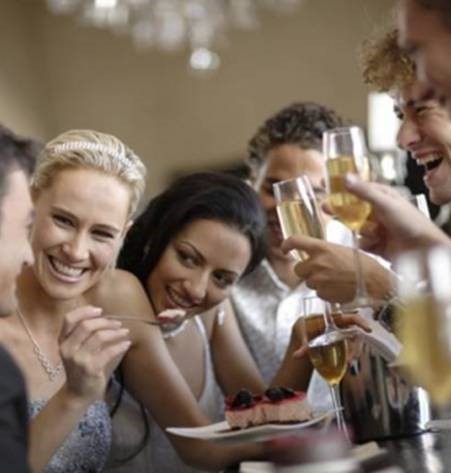
Text: Saulene Valskyte
In Lithuania Christmas Eve is a family event and the New Year’s Eve a great party with friends!
Read more...- Bookmark :
- Digg
- del.icio.us
- Stumbleupon
- Redit it

- Posted by - (0) Comment
The professors who showed
Lithuania the path to its future
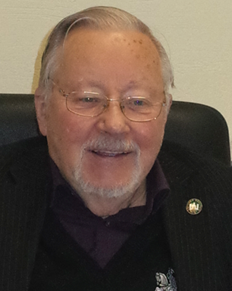
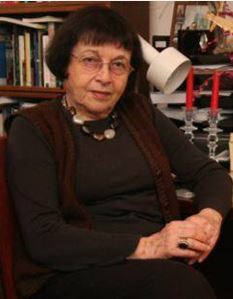
PROFESSOR VYTAUTAS LANDSBERGIS – PROFESSOR IRENA VEISAITE
Journalist: Dalia Cidzikaite
Photographer: Patrick Murphy
Questions prepared by Aage Myhre
A few days ago we sat down with two of Lithuania's most famous professors for a so-called double interview. We wish in the future to run similar double interviews here in VilNews; with leading Lithuanians in politics, economics, culture, science and so on. Simply because we think this may give you, dear readers, new insights and knowledge about the persons and also about historical and contemporary Lithuania.
Professor Vytautas Landsbergis and Professor Irena Veisaite were both born in Lithuania’s interwar capital Kaunas around 1930 – she a Jew who miraculously survived Holocaust, he a genetic Lithuanian who came to lead Lithuania’s revolution against the Soviet occupiers 25 years ago.
The interview with the professors will be published in our next edition of VilNews.
- Bookmark :
- Digg
- del.icio.us
- Stumbleupon
- Redit it

- Posted by - (0) Comment
Fearful of Russia, Lithuanian
volunteers sign up fearing
a repeat of Ukraine
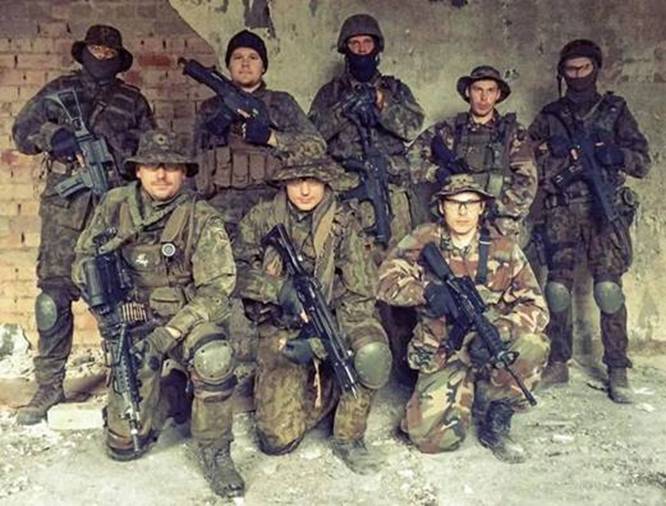
MEMBERS OF THE LITHUANIAN RIFLEMEN’S ASSOCIATION ON A WEEKEND EXERCISE
Finishing his working week as a lawyer, Robert Juodka puts on his fatigues, loads his assault rifles into the car and heads off to the woods to take part in training. He and his comrades regard their “war games” as deadly serious; preparations for resisting a Russian invasion.
The Lithuanian Riflemen’s Union, which was disbanded by the country’s communist government, now has 10,000 members. New recruits join every week. The age range is wide, but a hard nucleus is being formed of former service personnel. And experienced foreign volunteers may be admitted in the future. Many fear that what has happened to Ukraine may be revisited in Lithuania.
THIS IS FROM AN ARTICLE IN THE BRITISH NEWSPAPER “INDEPENDENCE”.
Read the full article here: http://www.independent.co.uk/news/world/europe/fearful-of-russia-lithuanian-volunteers-sign-up-fearing-a-repeat-of-ukraine-10126321.html
- Bookmark :
- Digg
- del.icio.us
- Stumbleupon
- Redit it

- Posted by - (0) Comment
All Saints’ Day in Lithuania
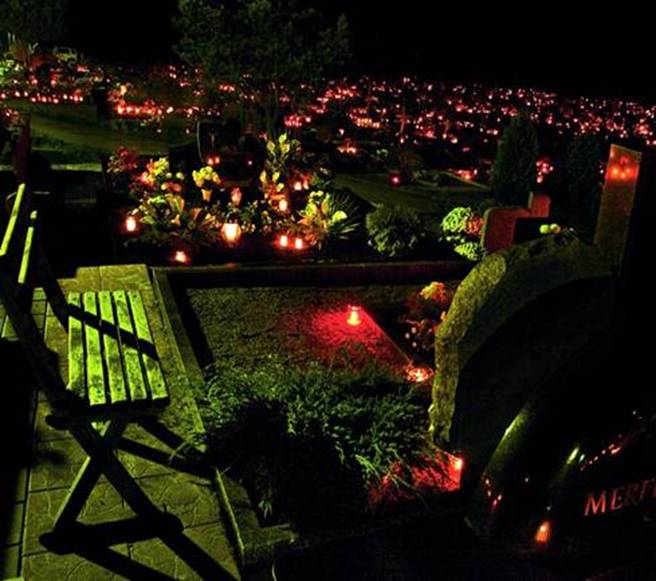
PHOTO: WWW.LIETUVA.LT
November 1st, people of the Christian Faith all over the world celebrate All Saints’ Day. In
While in modern times, this day involves visits to cemeteries to decorate graves, attending Church and get
Read more at https://vilnews.com/2011-01-all-saints-day
- Bookmark :
- Digg
- del.icio.us
- Stumbleupon
- Redit it

Three Lithuanias
- Posted by - (10) Comment
|
|
|
|
|
|
By Kestutis Eidukonis
In my travels and musings about Lithuania and Lithuanians it has become quite clear to me that there is no such entity as a single Lithuania anymore. Any serious writing or treatment of the subject matter has to recognize this reality.
The singular Lithuania my parents knew and described to me no longer exists. Lithuania has been transformed into at least three different and distinct entities. Each with its own good and bad characteristics. When I discuss Lithuania with friends and relatives it is like the blind men describing the elephant. Depending on who you talk to. Lithuania is either beautiful, hopeful or beyond redemption.
Last week I my wife Siga, and a mutual friend from Japan, Sakae Wade were privileged to get a tour of the Palace of the Dukes of Lithuania (Valdovū Rūmai). Over the years we have watched as this palace was reconstructed amid controversies and supposed scandal. A lot of Lithuanian media was very critical of the expense, delay and fraud and corruption associated with the Palace. One could not turn on the TV without hearing negative comments about this undertaking. I am ashamed to admit, even I, was taken in by some of this "agitprop". The Palace will open to the public in a few days and I believe visitors will be pleasantly surprised by the beauty and history that will confront them. After taking the tour I was no longer surprised by the amount spent on the Palace.
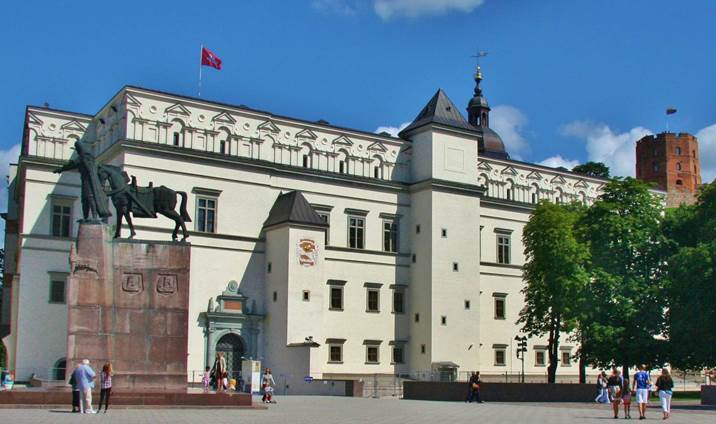
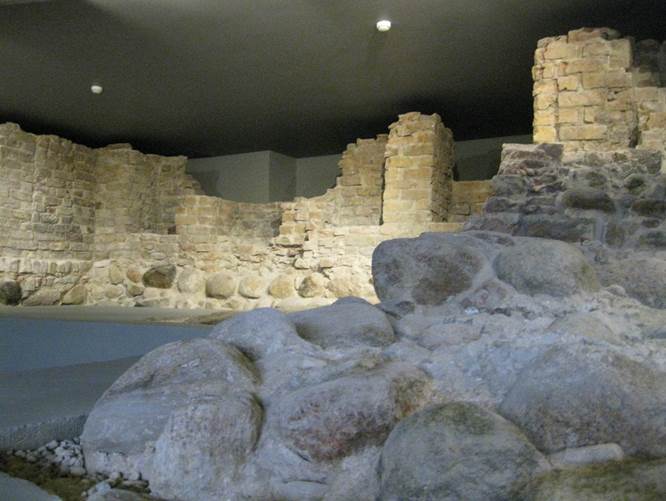
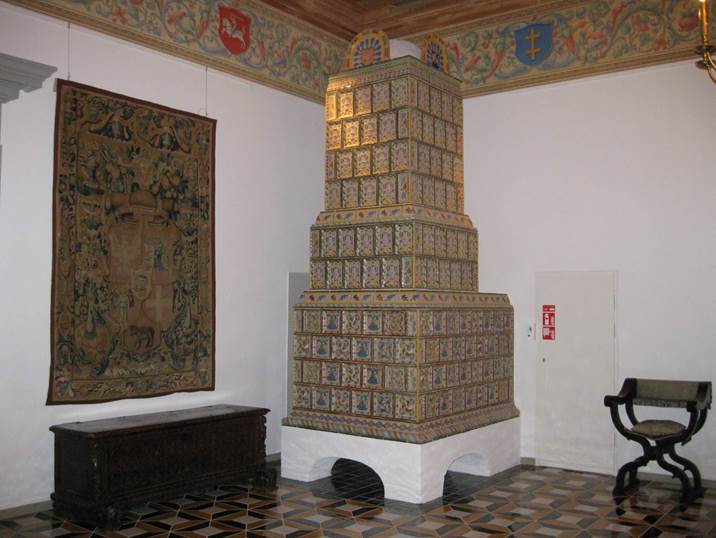
Had it been a simple question of re-creating the Palace a la Disneyland, I don't think it would have cost the amount of money it did. Fortunately for the posterity of Lithuania, the past as much as possible, was preserved along with the re-creation. The Palace rests on the original foundations and mirrors them as much as possible. The preservation of the original must have cost a fortune. The basement chambers are all climate controlled to preserve the original foundations and other fragile findings. I strongly advise every tourist to Lithuania to deeply explore this marvel. The work done to preserve the original archeology has been praised by experts from all over the world. Yes a lot of things could have been done cheaper - but I think the results were worth it. I and Siga were very much touched by the passionate words of the Deputy Director of the Palace, Dr. Jolanta Karpavičienė, who challenged anyone who wanted to spit on this work and on Lithuanian history to come and take the tour and then if they still wanted to do so to go ahead! I was very impressed by the passion of all the people associated with not only the Palace, but the entire staff who worked in State Cultural Reserve of Vilnius Castles. A lot of very dedicated people fighting very hard to preserve Lithuanians heritage with limited funds and lots of political strings.
The Palace to me symbolizes Vilnius. Vilnius is one of the Lithuanias, it is a charming city seething with prosperity, renovation, construction, pride and liberal doses of corruption and politics. The amount of money being lavished on this city is phenomenal. Tourists in the thousands flock to the Old Town every day! It is truly one of the most architecturally beautiful and unique cities of the world. Vilnius truly is an international city. As one meanders through its winding cobblestone streets one hears a cacophony of languages. Spanish, Italian, German, Russian, Polish, Yiddish, English and many others being spoken. I feel very good and comfortable when I come back to this city. All of Vilnius is not this nice. There are indeed many Soviet style apartments and areas that indeed are a little bit depressing. I have been told that Kaunas is just as nice and more Lithuanian than international, but that is another story. I think Kaunas is more like Vilnius than the rest of Lithuania.
The rest of Lithuania is symbolized by the area where my mother-in-law lives. She lives in a beautiful area of Lithuania that happens to contain the highest point in Lithuania. There farmers are eking out a living. The area is reachable only by turning off of the highway and following first a rock paved road, then a dirt road. First to the town of Stakliškės where Midus is made, than to the farming village of Užuguostis, and finally turning of the rock road onto a dirt road passable by only one car. The wooden carved sign at this point says Gedanonių Kalva, 4.2 km. Arriving at Gedenonių Kalva one is struck by the difficulty of reaching the place, the isolation, the greatness,, and the natural beauty, the wild flowers, the plowed fields and the overgrown fields surrounding the place. One is also struck by how abandoned and overgrown this recently constructed land mark has become. Over a hundred thousand Euros were spent on this "Landmark". The already bad road was further ruined by the construction and a very bad winter, along with improperly done maintenance. I have only seen tourists there once. They did not have much good to say about this monument. The rumor among most of the inhabitants is that this was simply a money-laundering proposition to obtain money from the EU.
The area is administered by a district administrator who has her hands full. The population is declining. From about 3000 inhabitants during Soviet times to about 500, nowadays. She still has to plow the roads, keep culverts clean handle local disputes and other headaches. Half of the population works hard, the other half hardly works. They get by on 350 LT a month unemployment. When one lives in the countryside, getting food and firewood is not a problem. Most people grow their own or a relative grows something and shares it for helping out in the fields. Some people still live in dirt floor homes, others are a bit more prosperous, The only bill some people have to pay is for electricity. This leaves quite a bit left for moonshine and contraband cigarettes. People do odd jobs for some of the more prosperous people in the area, but for the most part it is very difficult to find help or to get people to work. The feeling most of the people have here is that they are not a part of Lithuania. The politicians only look after Vilnius and each other. The EU is looked upon as a waster of money, and a creator of lazy people, who figure out to milk the system. The feeling one gets when one visits this area is that the abandonment will only accelerate. There are already quite a few abandoned farmhouses, where people don't come or only visit occasionally. The contrasts could not be more stunning - beautiful nature - abandoned farms. This area is such a contrast to Vilnius. Some people might prefer this to living in Vilnius. I hope they do make the move. I am sure there are a lot of opportunities for people who want to tame the countryside.
I know for a fact that there are a lot of Lithuanias like this out there. But here in some of these villages I sometimes find the Lithuania of my parents - the people who take care of each other. While some of these people long for the bygone Soviet era - most are patriotic Lithuanians who happen to be totally disenchanted by their government and their representatives and the promises that were made to them. Gedanonių Kalva symbolizes the Lithuanian Government to these people.
The third Lithuania is the diaspora - what a story that is. If the diaspora ever decides to return then Lithuania will be an unbeatable and unstoppable country. I know all the arguments for why they should have stayed in Lithuania. I also know the reasons most of them left. It is truly a desperate step to voluntarily exile oneself from the land of your birth, the land of your friends and relatives. What kind of person does this. Well, let me tell you that most of the people of the Lithuanian diaspora I have met truly only did it as a last resort. I do not think leaving Lithuania was a first choice for any of them. The thing that amazes me the most is that most of these third wavers still love Lithuania, even after all the agonizing things Lithuania has put them through, they still talk and dream of someday returning to a different Lithuania one that doesn't say to them you left - don't come back. You are no longer one of us. I remember a conversation with a Lowlander (Żemaitis) who told me, "Kestuti, you don't understand - they (the people in government) do not want dual citizenship - they do not want you and other Lithuanians who grew up elsewhere. They are afraid that a lot of you will vote. They are afraid that a lot of you will run for office. They are afraid of losing their power base. After all over a third of Lithuania is the diaspora, just think of what this diaspora could do if they all retained or got their citizenship. What if they all voted? It would change the political dynamic of this country. That is why the politicians will never let it happen!"
I believe my friend had a point. If I were sitting in Russia, I could not have devised a better strategy to insure Three Lithuanias! Divided between rural, city and diaspora. A Lithuania I can easily dominate with my oil money! Where my agents will be leaders. Where corruption of the legal system is allowed to flourish. Where people do not trust their government. Where crooks and embezzler's rights are more important than the ordinary Lithuanian's desire to maintain his citizenship and his links to Lithuania. Where is the Leadership of Lithuania? Where is the person or persons who can unite the country? Ah but that is why we have three Lithuanias, a dozen parties - more emigration, more loss of economic freedom. Divide and conquer! E Unum Pluribus!
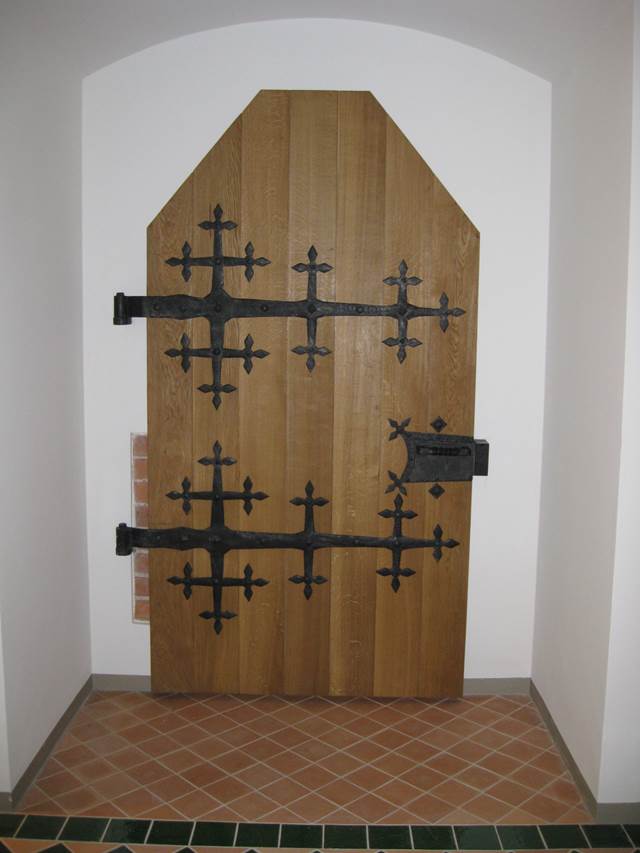
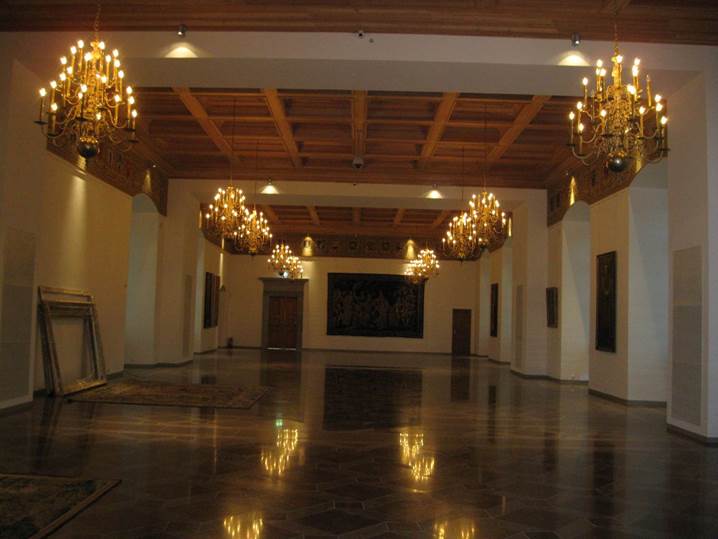
PICTURES FROM THE ROYAL PALACE:
LITHUANIAN COUNTRYSIDE:
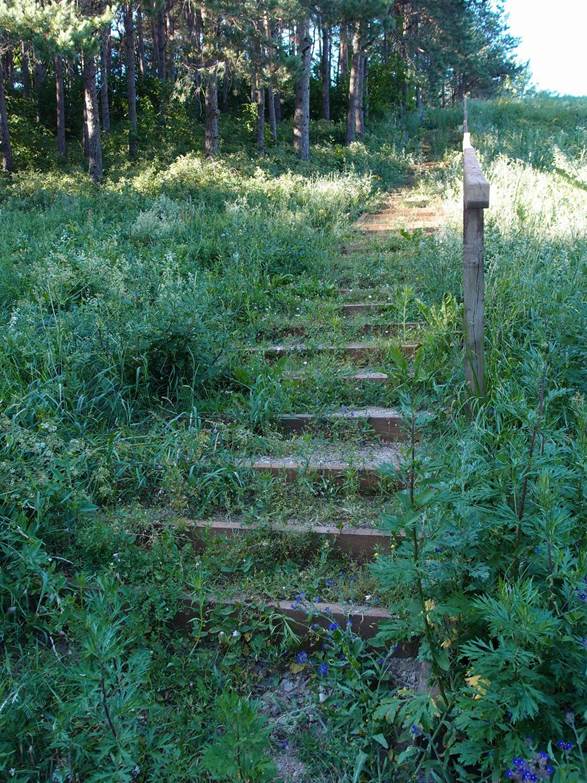
Arriving at Gedenonių Kalva one is struck by the difficulty of reaching the place, the isolation, the greatness,, and the natural beauty, the wild flowers, the plowed fields and the overgrown fields surrounding the place. One is also struck by how abandoned and overgrown this recently constructed land mark has become. Over a hundred thousand Euros were spent on this "Landmark". The already bad road was further ruined by the construction and a very bad winter, along with improperly done maintenance. I have only seen tourists there once. They did not have much good to say about this monument. The rumor among most of the inhabitants is that this was simply a money-laundering proposition to obtain money from the EU.
LITHUANIA’S DIASPORA:
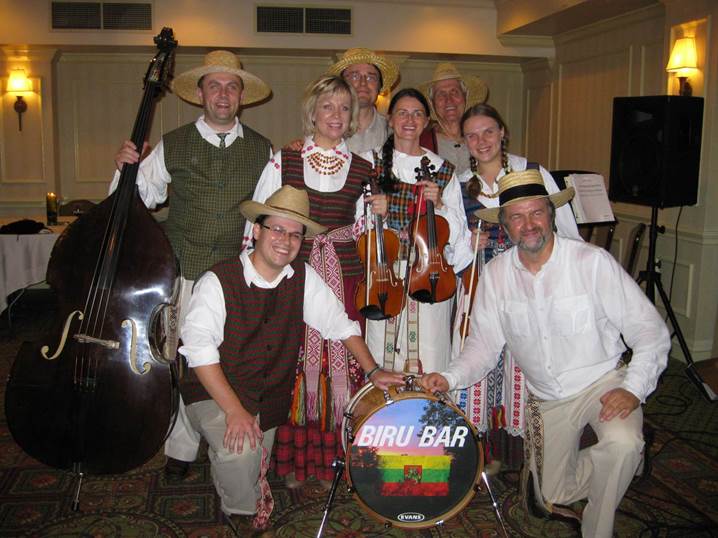
Faces of the Lithuanian diaspora.
Photo; Justinas Bartkevicius.
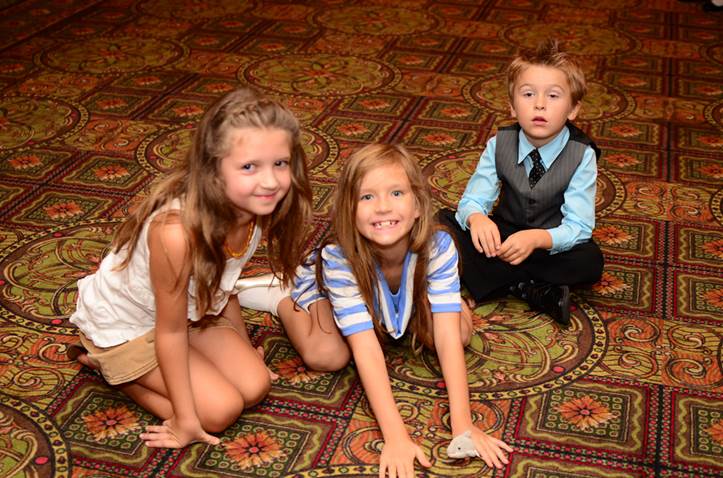
Faces of the Lithuanian diaspora.
Photo; Justinas Bartkevicius.
- Bookmark :
- Digg
- del.icio.us
- Stumbleupon
- Redit it
- Posted by - (1) Comment
Lithuania’s European Presidency
It’s an honour!
|
Lithuania will hold the Presidency of the Council of the European Union in the second half of 2013, starting from the 1st of July. VilNews has on this background asked readers to annotate and analyze factors that have to do with Europe, the EU, the euro and Lithuania. This is one of the posts we have received. An article by Dr. Rimas Slavickas |
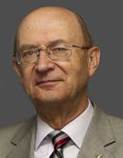 Dr. Rimas Slavickas |
It is an honour for such a small country like Lithuania to fulfill the role of EU Presidency. By accepting this responsibility to diligently fulfill this task may further enhance EU’s unity to be as ‘one’, yet retaining the strengths, resiliencies and differences of autonomous ‘individual nations’ with their own respective historical identities. Lithuania has an opportunity, during its tenure, to raise the European bar – standards, even higher by setting examples for others to follow. The further pursuance of practical ideals and solutions which include government and economic stability, wrapped in democratic principles of justice, freedom of expression and human rights would provide even a greater global attention and exposure for both EU and Lithuania. Namely, by setting aside human frailties of individual self serving political esteem and associated benefits and thereby provide a perception of greater national unity and strong leadership to further enhance the positive moral direction by affectively addressing European challenges. Such efforts would be globally recognized that integrity, sincerity, goodwill and determination of purpose, even from a relatively small nation, can achieve much. This attribute is especially relevant to Lithuania which historically has seen many years of political turmoil, world wars and more than half a century of suppressed occupation and yet has retained its rich cultural heritage, religious beliefs and basic democratic principles. Such national determination initiated the ending of the official Soviet system and today stands out to others as an example of perseverance and that ‘it ‘can be done’, irrespective of the magnitude of the perceived challenge.
Therefore, let the Lithuanian decision makers brace themselves to this privileged task and recognize that this tenure is not only a challenge but also an opportunity to help both the EU concept and also the Lithuanian nation. The strengthening of the idealistic concepts of European Union would also enhance Lithuania’s global credibility and fundamental concepts of national unity abroad and at home.
It is my sincere hope that through this governance process, during and after Lithuania’s term has expired, the experiences gained and results obtained will include a greater recognition, by all Lithuanians, the importance of political unity and greater national bonding. That also political leaders and other Lithuanians of national influence will gain a greater recognition of the importance of differentiating between what is essential and what is not and what should change and what should remain the same in both the short and long term national best interest.
Such comprehensive endeavours would provide a further stimulus for Lithuanians to better understand their obligations and more effectively address the many challenges within and outside this relatively small, yet very gifted Baltic country. Therefore, irrespective where we reside or are separated by either large or small geographical distances and irrespective with what accent we speak, nevertheless as Lithuanians and associated descendants, let us all boldly and passionately support this undertaking.
Therefore at the end of Lithuania’s EU presidency, the judgement should not be a polite whisper by some but boldly proclaimed by all:
“WELL DONE LITHUANIA!”
Dr. Rimas Slavickas
Director
Energy Infrastructure and Partnerships
Power Center for Utility Explorations
Department of Electrical Engineering
University at Buffalo
332 Bonner Hall
Buffalo, NY, 1420-1920
Direct: 905 – 735 – 5600
Can. Cell: 905 – 932 – 5127
USA Cell: 716 – 361 - 7570
Office: 716 – 645 – 1052
Email: lpa@collaborative-research.com
http://www.eng.buffalo.edu/Research/PCUE/PCUE/Home.html
Vice President
Energy Initiatives and Collaboration
Global Energy Institute
Buffalo Niagara Medical Campus Innovation Center
640 Ellicott St
Buffalo, NY, 14203
Direct: 905 – 735 – 5600
Can. Cell: 905 – 932 – 5127
USA Cell: 716 – 361 - 7570
Office: 716 – 645 – 3064
Email: lpa@collaborative-research.com
http://www.bnmc.org/energizebnmc/global-energy-institute/
- Bookmark :
- Digg
- del.icio.us
- Stumbleupon
- Redit it
The world is about to discover Lithuania!
- Posted by - (3) Comment
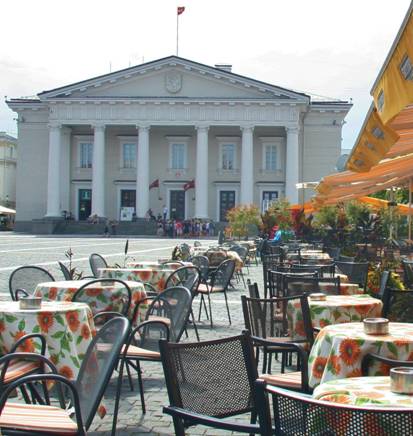
Until recently, Vilnius was often called Europe's best kept secret. Very few knew that here lies one of the world's best-preserved cultural treasures, namely Eastern Europe’s largest and most attractive old town. Few knew that Vilnius is considered the world's most Italian city outside Italy and the world’ most Baroque city north of the Alps. This is now changing rapidly. The world population has become aware of both the city and the country and the number of travelers here is the sharp increase.
Vilnius is the city Lonely Planet colourfully calls "eccentric and soulful," and one that offers the best overall hotel prices in all of Europe. According to Hotels.com's Hotel Price Index, Vilnius in Lithuania has an average per-night hotel price of $80, putting accommodations costs within reach of budget travelers. Sweeten the pot with a favorable exchange rate, quirky attractions, and Eastern Europe's largest old town, and you've got an intriguing and affordable destination.
Here are some recent articles:
 |
Vilnius – Baltic beauty |
 |
Vilnius: The cleanest air in Europe |
 |
Lithuania among “The World’s Ten Best Ethical Destinations – 2013” |
 |
Vilnius is one of Europe’s most affordable cities for 2013 |
- Bookmark :
- Digg
- del.icio.us
- Stumbleupon
- Redit it
- Posted by - (1) Comment

The green Soviet bridge in Vilnius
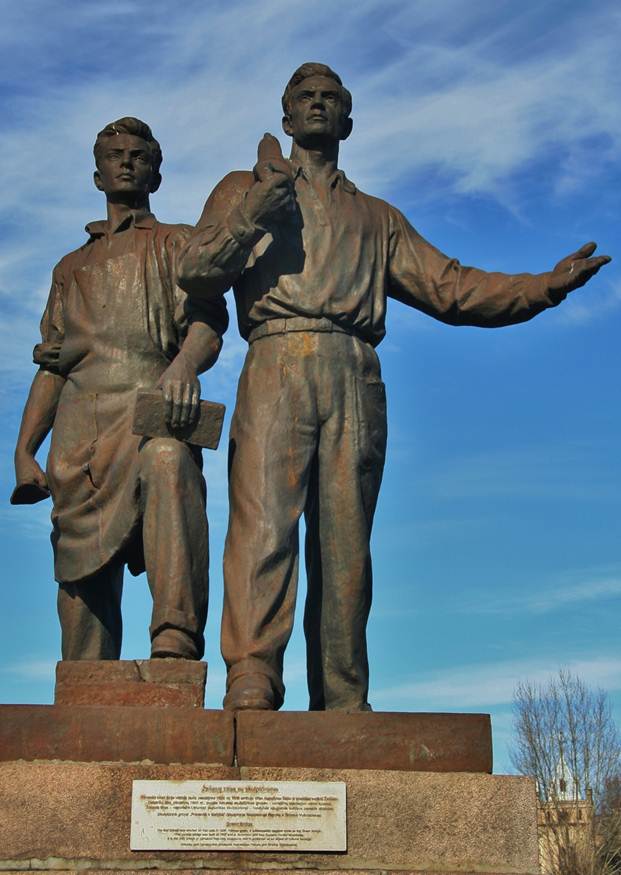
The Green Bridge sculpture "Industry and Construction (Pramonė ir statyba)"
by Bronius Vyšniauskas and Napoleonas Petrulis.
Photos: Aage Myhre.
The Green Bridge (Lithuanian: Žaliasis tiltas) is a bridge over the Neris River in Vilnius, Lithuania. It is the oldest bridge in the city and connects city centre with the so-called right river bank and the Kalvariju g that leads to several of the city’s Soviet suburbs north of the city centre.
The first bridge is known from 1536. It stood closer to the present-day Mindaugas Bridge. It was a wooden covered bridge with brick and stone piers. It had a second floor with apartments for toll collectors. Because its builder Ulryk Hozjusz wanted to recoup the cost by collecting tolls, Grand Duke Sigismund I granted him a privilege prohibiting others to build any other bridges between Kernavė and Bistrica or to offer other crossing services between Verkiai and Paneriai. The bridge was burned by retreating Lithuanian Army after the Battle of Vilnius (1655).
A new project was prepared in 1673, which envisioned a span of 73 metres (240 ft) between piers—the longest known span at the time. However, an early spring and ice jam destroyed the piers. Therefore the old piers from the first were reused and the second bridge was complete in 1679. In 1739 another wooden bridge was erected and painted green. Since then it is known as the Green Bridge. In 1789 a new project of a brick bridge was prepared by Laurynas Gucevičius, but the builders selected another proposal. The construction was supervised by Marcin Knackfus. The project was not successful as the bridge burned in 1791. It was rebuilt according to a project by Michael Schulz in 1805, but burned again on orders from Michael Andreas Barclay de Tolly during the French invasion of Russia of 1812.
The bridge was rebuilt in 1827–1829. A steel bridge was designed by Nikolai Belelyubsky and completed in 1894. It survived World War I, but was blown up by the Wehrmacht in 1944. The present-day bridge was completed in 1952 and named after Soviet General Ivan Chernyakhovsky. After the declaration of independence in 1990, the bridge regained its historical name.
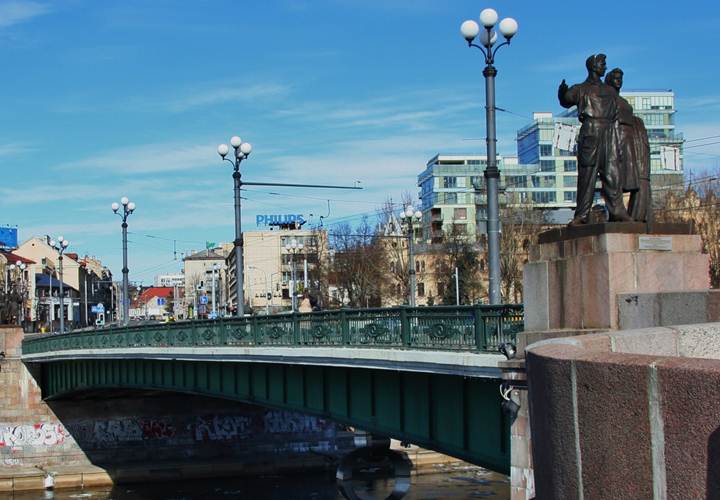
The bridge features four sets of sculptures—prominent examples of Soviet realism. They all feature two people, representing social classes idealized by the Soviet authorities (soldiers, workers, farmers, students). Three sculptures are 3.2 metres (10 ft) in height (including the pedestal); the soldiers reach 4 metres (13 ft) due to the raised flag.
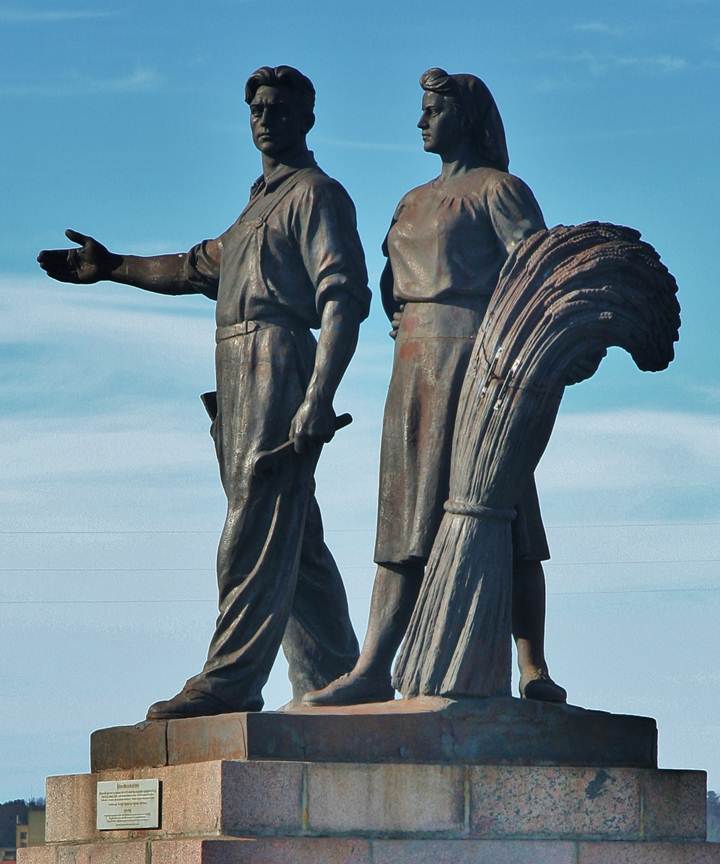
The sculpture "Agriculture (Žemės ūkis)" by Bernardas Bučas and Petras Vaivada.
- Bookmark :
- Digg
- del.icio.us
- Stumbleupon
- Redit it
Lithuanians fall in love
- Posted by - (1) Comment
“Let's do it” by Cole Porter
From the Show: Paris 1928
Birds do it, bees do it
Even educated fleas do it
Let's do it, let's fall in love
In Spain, the best upper sets do it
Lithuanians and Letts do it
Let's do it, let's fall in love
The Dutch in old Amsterdam do it
Not to mention the Fins
Folks in Siam do it - think of Siamese twins
Some Argentines, without means, do it
People say in Boston even beans do it
Let's do it, let's fall in love
Romantic sponges, they say, do it
Oysters down in oyster bay do it
Let's do it, let's fall in love
Cold Cape Cod clams, 'gainst their wish, do it
Even lazy jellyfish, do it
Let's do it, let's fall in love
Electric eels I might add do it
Though it shocks em I know
Why ask if shad do it - Waiter bring me
"shad roe"
In shallow shoals English soles do it
Goldfish in the privacy of bowls do it
Let's do it, let's fall in love
- Bookmark :
- Digg
- del.icio.us
- Stumbleupon
- Redit it
- Posted by - (0) Comment
Associate Editor Vin Karnila:
My Lithuanian Easters –
in Massachusetts, USA
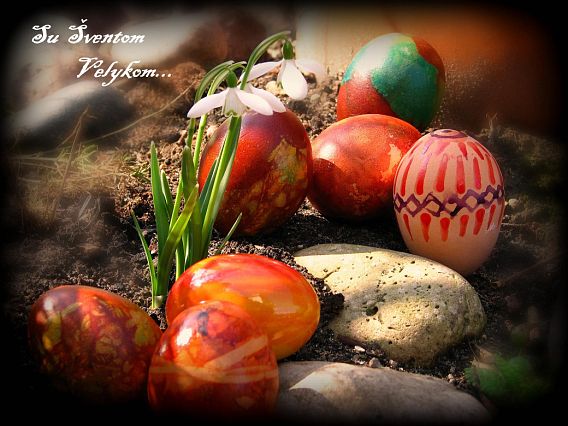
By Vin Karnila, Associate Editor
Thinking about Lithuanian Easter traditions transforms me back in time to when I was a young boy growing up in the Boston area of Massachusetts, USA. Being the son of a Scottish mother and Lithuanian father I had the great fortune of experiencing the wonderful traditions of not only the Lithuanian people but that of the Highland Scott‘s as well.
While along with the Lithuanian Christmas traditions we practiced many of the Scottish customs for Christmas and New Year as well but Easter is seemed was a time for the traditions of our Lithuanian ancestors. These were the traditions the Karnila family took with them from our ancestral home in Lithuania, the village of Guronys.
While occasionally we would visit members of my mother’s family on Easter, most often on Easter we would go to the home of my father’s sister, Ana (Karnilytė) Savanovich. This I think was by no small coincidence since months before Easter my brother and I would plead to our parents that it was an absolute requirement that we celebrate Easter at Aunt Ana’s house – as you read on you will understand why!!!
When we arrived at Ana’s house my brother and I were greeted with a basket of decorated Easter Eggs and sweets. This was of course, in true Lithuanian tradition, AFTER we had we had completely passed through the door and were standing inside the house and had also gone through all the kisses, hugs and pinches on the cheeks (from Ana) and handshakes from her husband John. As my brother and I started to go to work on the sweets and admire the eggs next came another big treat. Ana would come out with a tray of freshly baked, still warm cookies baked by you guessed it – the Velykos Kiškis!!! Now I guess the story behind the cookies got changed a bit on its trip across the Atlantic Ocean but it seems that the Easter Bunny / A.K.A. Velykos Kiškis baked these cookies just this morning and brought them to Ana‘s home knowing that me and my brother would be there.
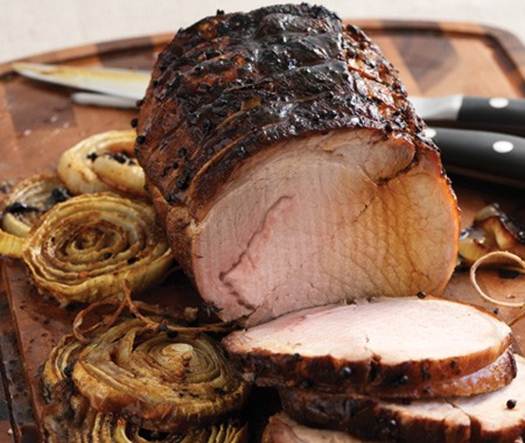
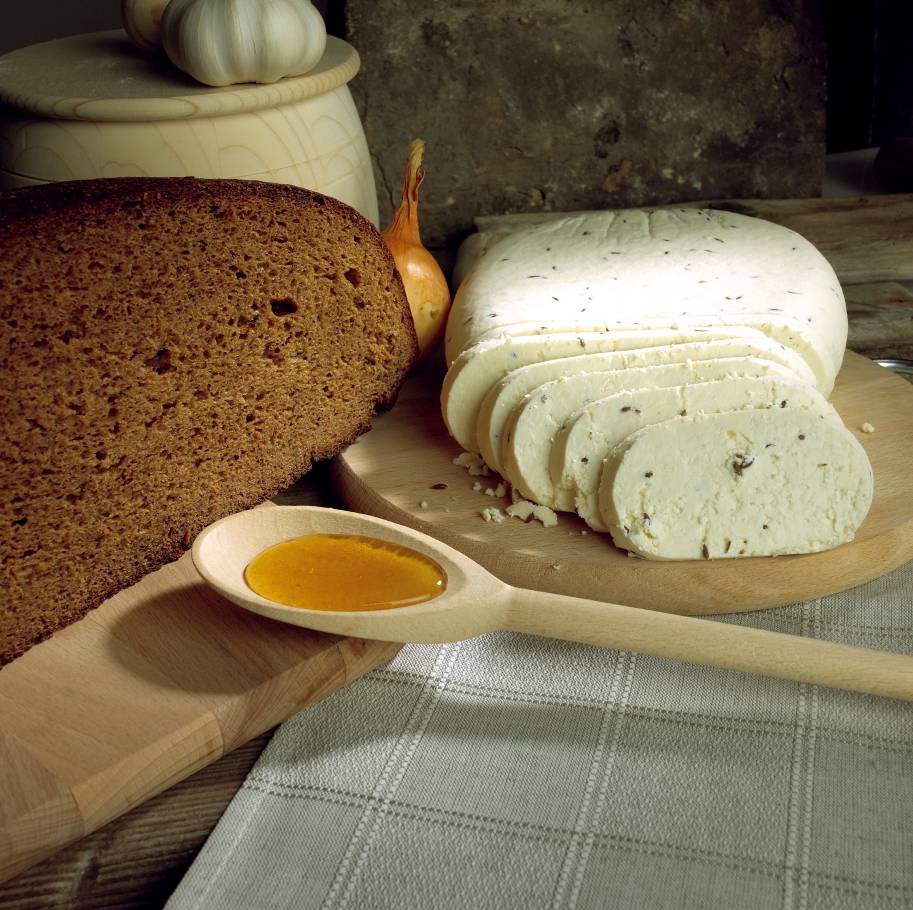
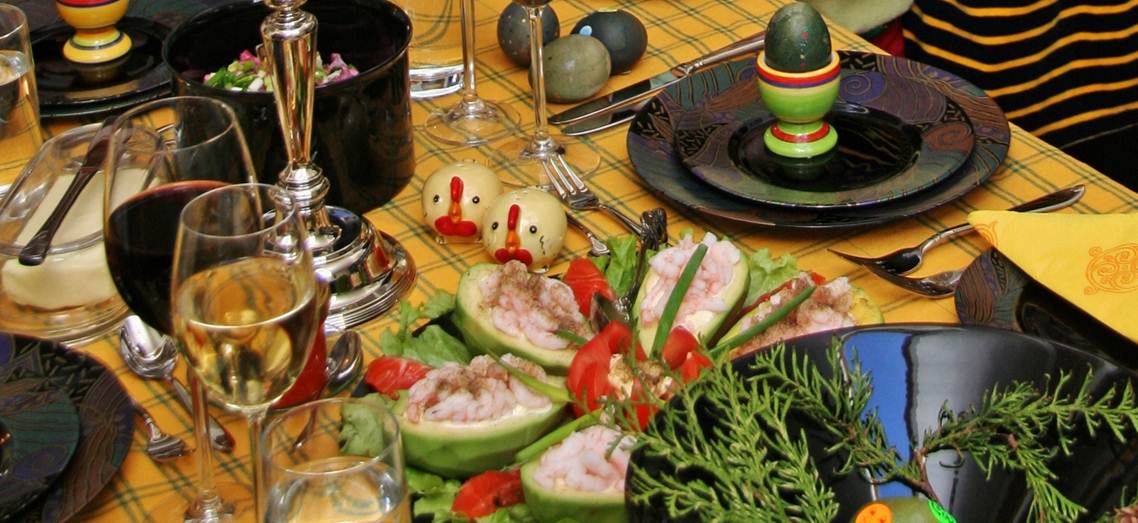
After enjoying ourselves on the sweets and cookies next came the what was probably one of the biggest events of the day – EASTER DINNER!!! I grew up enjoying Lithuanian traditional food but at Easter this was something completely different. Easter Dinner was the jack pot, the mother load, the meal to end all meals, the trip to the mountain top. Never at any one time were there so many Lithuanian dishes on the table at any one time. Remember on Chirstmas Eve there is no meat. For Easter there was every kind of meat you could think of. Roast pork, roast ham, roast chicken, roast anything you could possibly roast and maybe a few things you wouldn‘t want to roast. In addition blynai, dumplings, kugelis, salads of every variety you could imagine and of course mushrooms used in almost every dish. The table cloth was always white and always was adorned with some greenery. Now of course before we partook in this wonderful feast an egg was cut and a piece was given to everyone seated so that as we all ate of this egg we joined as a family and bonded our love and dedication to each other. I must mention that the cutting of the egg became an art form if we had the pleasure of being joined by uncles Kaziemiras (Charles) and Jonas (John) and aunts Marytė (Mary) and Alicija (Alice) and their families. To cut one egg into about thirty equal pieces is truly an endeavor. After the meal came an incredible assortment of cakes, pies and sweets. Oh, did I mention that to wash this all down Ana had made some homemade gira?
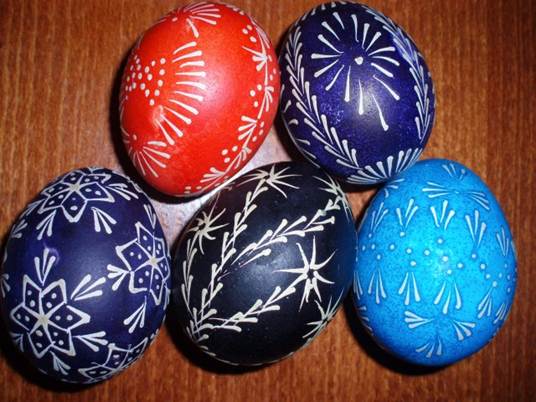
After stuffing ourselves to the max came some activities to work off all the food. It seems that the Velykų Senelė/Easter Grandmother had stopped by earlier that morning and left some beautifully decorated eggs for me and my brother. The problem was that she had hidden them outside and our task was to find them. As a very young child this was a little confusing because I thought it was the Easter Bunny’s responsibility to deliver all the eggs to everyone. So I kind of sorted things out and came to the conclusion that yes in fact delivering the eggs was the Easter Bunny’s job however the eggs used in the egg hunt was the responsibility of Velykų Senelė. As I got older we then understood that this was another wonderful tradition of our people. I can say one thing about Ana and John, when it came to hiding eggs they displayed some incredible imagination not to mention athletic ability. You would not believe what we had to go through to get some of these eggs!!! To be honest, I don’t know who had more fun, the children finding the eggs or Ana and John watching us.
After finding all the eggs or let me put it this way, after finding all the eggs we could find (I think after fifty years there are still some unfound eggs sitting around there somewhere) we went back inside. All the children counted up the eggs they had found and the one with the most received some sweets as their prize for being the best egg hunter.
What came next was to me the most special event of the day. Of everything we did this is what I most fondly remember of our Easter traditions. For every child Ana had made a specially decorated egg. She would go around and present each child with this incredible work of art. All the children had the same reaction. We would just sit there with our mouths agape and admire this wonderful creation. As you can imagine, it is difficult for young children to appreciate hand crafted beauty, especially little boys, but these eggs where so magnificent it truly got our attention. We would hold the egg in our hands and just stare at it in wonderful admiration. In addition to the eggs beauty we also were appreciating the love that aunt Ana had put in to making this egg for us but most of all, as we sat there admiring the beautiful Easter egg we, even as little children knew we were holding the tradition of the Lithuanian people and of Lithuania in our hands. I so vividly remember holding these special eggs in my small hands and saying to myself – This is Lithuania and I am Lithuanian.
I would please ask you to understand that what I wrote of is not about me and not about the Karnila family. What I wrote about was a Lithuanian family, Lithuanian traditions and Lithuania. For every people, their traditions and customs are not only an important part of their past but also an important part of their future. This is so true of Lithuania. The preservation of beautiful ancient traditions has been one of the things that helped the Lithuanian people remain strong and preserve their identity as a people and a nation through so many adverse situations. Unfortunately, every year some of these traditions tend to slip away one by one. While we still practice some of these traditions many have become just a memory.
I wrote this as an invitation to all our readers to write to us telling us about the beautiful Lithuanian Easter traditions that you remember from years gone by and also tell us of the traditions you, your family, friends and neighbors still practice to this day. It is our hope that in sharing these traditions with all our readers you will be reminded of some wonderful tradition from the past and this Easter and for many Easters to come you will again include these traditions in your Easter celebrations. We would also like to remind you that there are many people of Lithuanian nationality living around the world that are desperately trying to find out more about their heritage and about the culture and traditions of their Lithuanian ancestors. By sharing your traditions with all our readers it is very possible that a person, intensely proud of their Lithuanian ancestry, somewhere in the world this Easter will for the first time in their lives be able make some Lithuanian Easter traditions a part of their family’s celebration of the resurrection of Christ.
So dear readers, we invite you to please send to us some of the Lithuanian Easter traditions that are or were an important part of your family so that we can share them with Lithuanians around the world.
Su Dieva
Vin / Vincas Karnila
Associate editor
- Bookmark :
- Digg
- del.icio.us
- Stumbleupon
- Redit it
- Posted by - (2) Comment
|
Lithuanian Velykos (Easter) traditions
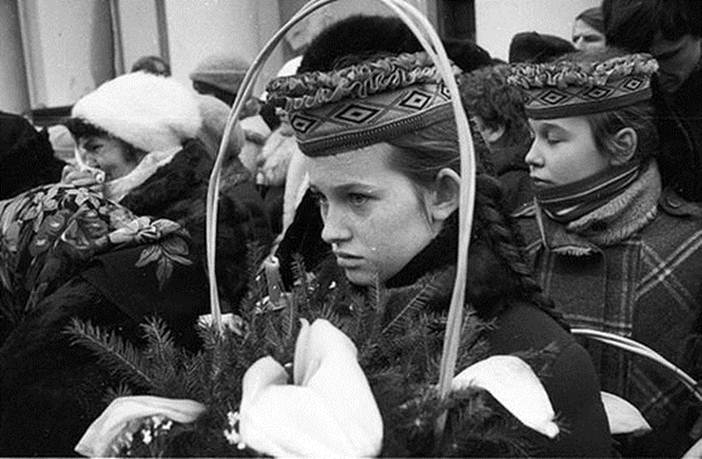
The word for Easter, Velykos, has been borrowed from Byelorussian and means "important day." The word is very accurate because Easter is the year's most solemn feast in Lithuania. Easter is not only the feast of Christ's Resurrection, but also nature's awakening from the winter's sleep. The early Eastern morn, just before dawn, abounds with magical power. Much of this magic is concentrated in flowing water. Bathing in such water before sunrise prevents all boils, sores, rashes and other skin ailments. If it rains on Easter morning, it is necessary to stand bareheaded in the rain to ensure good growth. Small children who want to grow quickly are reminded of this. As the sun rises on Easter morning, it "dances" swaying from side to side and changing colour: from green to blue, to red and then golden yellow. This phenomenon can be seen by rising before dawn and watching for the sun's first appearance on the horizon. Earlier everyone went to the Resurrection services. If on the way you passed a woman, you'll have an accident. To avoid calamity it was necessary to turn around, return home and then take another road to church. In Lithuania the Easter morning procession was usually conducted around the church. It was very solemn: church flags were held high, girls strewed flowers, the choir and all the people sang, alternating with a brass band, and the church bells pealed loudly. Three turns were made while singing the Lithuanians' favourite Easter Hymn Linksma diena mums prašvito (A Happy Day Has Dawned for Us). After the services, a blessing was made over the Easter food which was arranged in baskets decorated with greens and placed on the altar-rails. At the conclusion of the liturgy in Church, the people hurried home. In fact, all large and small roads, every path was the scene of races: whoever arrived home first would be successful all year and would complete all work on time. Even persons walking tried to pass those ahead and reach home first. It is not surprising that accidents happened during such races. Perhaps that is why it was said that a woman met on the road brings disaster (someone had to be blamed!).
At home, Easter breakfast was eaten. The meal began when the homemaker peeled a blest Easter egg, cut it and gave a piece to every member of the family. This was done so that peace and love would always reign within the family and everyone would live in harmony. Afterward, a variety of other dishes were consumed: meat, sausages, and cakes. On Easter it was necessary to eat well and to satiety, to "recover from Lent" because of the fast all through Lent. If the area had poor families with no Easter food, their neighbours shared what they had and brought the disadvantaged families everything they need to be satisfied and happy. Children hunted for hidden Easter eggs left for them by the Velykų Senelė (Easter Granny) or Velykė. Bunnies who painted Easter eggs were also a familiar fixture, but they were only helpers for theVelykų Senelė. Very early Easter morning they loaded Easter eggs into a beautiful little cart pulled by a tiny swift horse. The Velykų Senelė used a sunbeam as a whip. Sometimes the bunnies themselves pulled the cart laden with Easter eggs. The Easter Granny travels around the country, stopping in every child's yard to leave eggs in baskets placed or hung for that purpose. When they awake, good children find beautifully decorated Easter eggs (and in. more recent times even sweets). Bad children only find a single plain completely white egg. If this happens, the child is disgraced. His friends and family laugh at him. Sometimes bunnies accompany the Granny and help her distribute the Easter eggs. They are kept busy not only before Easter and on Easter day, but all year round baking cookies for children. When parents leave their children behind, they promise to bring them a gift, bunny cookies. Upon their return, they tell the following tale: "I'm walking through the woods (or orchard or past the bushes) and I see a bunny wearing an apron and hat, his sleeves rolled back, taking sweet-smelling cookies from an oven. I say to him: 'May the Lord help you!' He answers, 'Thank you, thank you. Would you like a taste? They're still hot.' Of course, I dol They smell so good, they look so good. . ." In the meantime the-child can hardly control himself: "What kind of oven was it?" "Tiny, pretty." "Did you get to taste any cookies?" "Yes, of course." "Did you bring me any?" At this point, the father, mother or other family member pulls out the goodies and distributes them to the children who are extremely impressed not only by the bunny cookies but also by the baking method itself. They can practically see the flushed, rushing bunny mixing the dough and stoking the oven. How wonderful that morn or dad just happened to be passing at the very time the cookies were done! Bunny cookies are famous throughout Lithuania. It would be good to remember them outside Lithuania as well. A variety of games were played with Easter eggs. The simplest is an egg-breaking contest. Two players face off, each holding an Easter egg and hit each other's egg. The one whose egg remains intact is the winner. The egg is held in the fist so that only its tip protrudes. The other player hits it with the tip of his egg. If the egg breaks on the side, the impact was wrong and the owner of the broken egg is not considered the loser. The winner claims the broken egg. After the game the number of eggs won was tallied. It was of paramount importance to have a hard-shelled egg that withstands breaking. In selecting a strong egg, the contestant taps an unboiled egg against his teeth. If the sound is clear and sharp the shell is hard: if dull and muffled, the egg will break quickly; it's not even worth colouring. Some smart alecks devised an "unbreakable" egg. It was made this way: a raw egg's shell is pricked at both ends. A thin straw is inserted into one end and used to blow out the contents through the opposite end. Another straw with one end shaped as a funnel is then placed into the hole and melted pine or fir sap is poured until the egg is full. If the sap does not flow smoothly, a helper inserts a straw into the opposite hole and draws the air out of the egg. After the egg is filled with sap, the holes are carefully concealed and the egg is then tinted along with others. It weighs about the same as a real boiled egg. Sometimes the empty shell was filled with melted sugar, but it was much heavier and the sugar hardened unevenly making it more difficult to play. Of course, if caught, the cheat was punished. The direst penalty was to eat the "Easter egg."
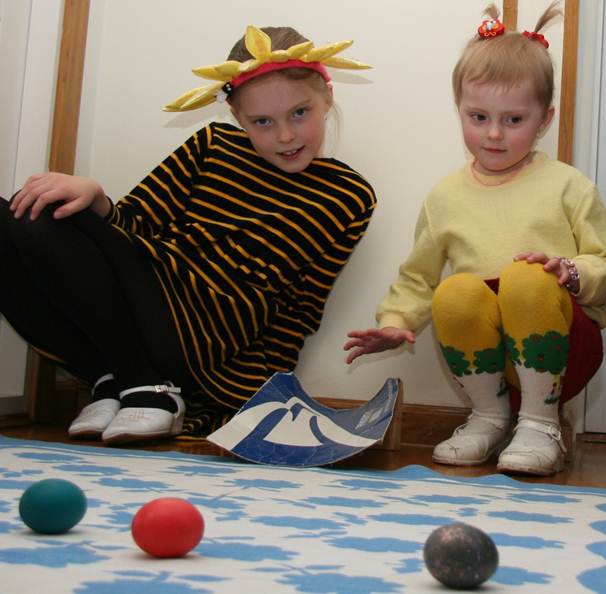
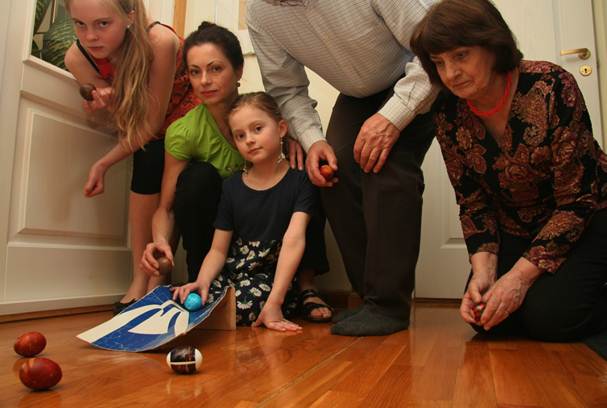
Another amusing Easter game was egg rolling (pictures above). This was best done outdoors, but also could be played in a larger room. A trough is made from pieces of wood or bark to measure about 10 cm long and 15 cm wide (it can also be much longer). One end of the ramp is propped up to produce a downward incline, but not too steep. A small circle is drawn at the bottom of the slope for the playing field into which the eggs will roll. When the game is played outdoors, the trough must be placed on a smooth surface because the eggs will not roll in the circle if there are pebbles, high grass, etc. When played indoors, the surface of the circle must not be too slippery for the eggs will roll out. A low wall or enclosure may be built around the circle. When all the preparations are completed, the players begin the contest. Four to eight persons play. Each uses an egg of a different colour to tell them apart. Eggs may also be marked in different ways. The egg is let down the incline. After one contestant finishes, the next rolls his egg aiming to reach the other's egg and tap it. If the egg hits the first one, its owner wins and takes the first egg. The eggs are rolled down the slope in turn. A contestant who wins egg rolls out of turn until his egg fails to hit another. Another player then takes his egg from the circle and rolls it. Eggs used in the rolling contest may already be cracked (for instance, already used and won in an egg-breaking contest), but their sides should be intact because eggs with cracked sides do not roll well. The trough may be straight or curved in different ways to make the eggs roll longer. The slope may also be made of cardboard from an old box, plastic or any other material strong and rigid enough to support the weight of an egg. A simpler egg-roll is done without a trough. A circle at least one meter in diameter is traced on a smooth surface. Barriers or enclosures are placed around the circle to keep the eggs from rolling out (crumpled newspaper may be used). A gate is kept open on one side through which the players push their eggs. The first player is chosen by lot. He rolls his egg into the circle. The second player attempts to roll his egg so that it will tap the first one. The game is played like the one using an incline, but in this case the eggs are rolled into the circle by hand with the player kneeling or sitting on the ground. Because the egg does not roll down a ramp, the entire game depends on the contestant's skill, how he rolls his egg into the circle. If the egg is rolled so hard that it leaves the playing field, the contestant loses his turn. In the past, only young men and adolescents played egg-rolling contests. It was not proper for girls to do so. They provided their beaus with eggs, cheered the contestants on and guarded the eggs won. Today mostly children (boys and girls) roll eggs. If guests arrive on Easter, they are given Easter eggs as gifts. The guests also bring an Easter egg for each family member (or at least the hosts and sweets for the children). Easter morning children go "egg begging" but only to the homes of acquaintances, close neighbours or godparents. When they arrive, they say hello and stand silent at the door. It is quite obvious to everyone that an Easter egg is required. The children politely say thank you, wish a Happy Easter and continue on. When Easter was celebrated for three days, no one went visiting the first day; it was unacceptable to intrude upon people on such a holy day as if someone had thrown you out of your own home. The first day of Easter was said to be dedicated to God, people were expected to conduct themselves seriously and quietly, spend time with their family, eat well and "recover from Lent." The second day was for recreation, visiting friends and having company. The third day was devoted to relaxation. People slept late, recovered from all the merrymaking because work was waiting in the wings. For Easter, homemakers set out Easter dishes which remained on the table all day. When guests arrived, the women could then spend time with the company and did not need to work. The table was covered with a white cloth and decorated with greens or fruit tree branches (mostly cherry) which were cut and set in water several weeks earlier so they would bloom for Easter. (Easter lilies were unknown.) Greens were also attached to the tablecloth hem which hung down from the table. The table was laden with cold Easter dishes: baked ham, goose, suckling pig, a basket or plate full of Easter eggs, sweet cheese, bread, cakes, etc. Beer (mostly homemade), liqueurs and cider were served as beverages. Everyone who arrives to extend Easter greetings must be served. It was considered very impolite for the guest to refuse refreshment. Everything had to be at least sampled and the cook praised, else she would feel insulted.
The young who behaved with such solemnity all during Lent wanted to have fun on Easter. They assembled at a larger house to sing and dance. This usually was done in late afternoon or evening. During the day, it was popular to swing in swings and sing. If the Easter weather was warm and fair, the swings were hung from a tall tree so the young could swing higher. Given inclement weather, the swing ropes were tied from barn rafters. People swung not only for the fun of it but to ensure a good harvest next summer, just as on Shrove Tuesday. While swinging, the girls and young men sang special songs. A group of young men assembled to practice singing Linksma diena mums prašvito (a popular Easter hymn), some other songs and make the rounds. These are the so-called lalauninkai (from lalauti — to talk loudly and much). In many other countries, such as the United States or England, carolers make the rounds before Christmas singing Christmas carols and songs. They may be compared to Lithuania's Easter lalauninkai. These singers are usually unmarried men sometimes accompanied by a fiddler or harmonica-player. Upon arriving at a house, they first sing an Easter hymn; convey their Easter wishes and then carol. The homemaker gives them cake, sausages, Easter eggs while her husband serves liquid refreshments. The Easter eggs are handed out by the young girls of the household. Although most homes were visited, it was predominantly those with unmarried girls. They were told before Easter that the singers would arrive and tried to make beautiful Easter eggs. This was a perfect opportunity to display their talents and show off before the other village girls. It sometimes happened that the singers refused to accept an Easter egg judged to have a poor appearance and this was considered a major disgrace. The songs these carollers sang were noted for the refrains repeated after every verse. The verses were short, usually composed of only two lines. The refrain had no connection with the song's overall content. These singers were especially well-known in Dzūkija which is famous for similar types or harmony songs. On the hill a pear tree stood; under the pear tree lay silvery dew. . . The refrain — vynelis vyno žaliasai — refers to new wine. It is not necessary for lalauninkai to sing the customary ditties, other songs may be selected. On Easter, a person can learn the following summer's weather, about his personal happiness and gain protection against various pests if he knows what to do and what guesses to make. If he wishes to avoid seeing snakes all summer, he must avoid seeing a needle the first day of Easter. If an accident or calamity occurs on Easter, things will go wrong all year, the year will be unlucky. We've already mentioned the races home from church on Easter morning: anyone who arrives home first will be first to complete all work, everything will go well for him (especially work in the fields). Prayers are said to be really heard on Easter, it is therefore necessary to pray a great deal. If Easter morning is sunny and beautiful, the summer will be fair and the weather good; if it rains (or snows) bad weather is to be expected. The worst sign is to hear thunder on the first day of Easter but even this evil may be found to have a "silver lining." If thunder rumbles before leaves have sprouted (trees very rarely had leaves in Lithuania at Eastertime), thieves will have a difficult time plying their trade that year. If the sunset is very red, dangerous thunderstorms may be expected that summer. http://lithuanian-american.org/educate/tradicijos/velykos.html EASTER EGGS – MARGUČIAI
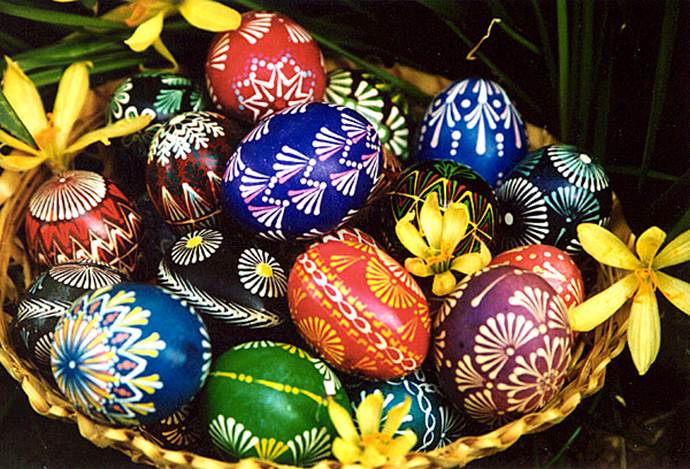
Basket of Lithuanian Easter eggs.
|



- Bookmark :
- Digg
- del.icio.us
- Stumbleupon
- Redit it
- Posted by - (3) Comment

Scandinavian option
for the Baltic States?
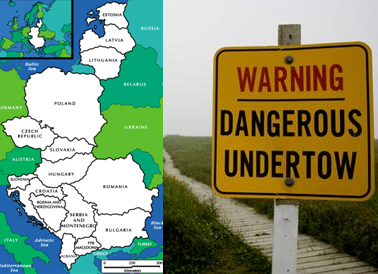
Dangerous undertows erode the stability
of Central and Eastern Europe
By Dr. Stasys Bačkaitis, P.E, CPSM
Board Member of the Central and Eastern European Coalition
Washington Representative of the Lithuanian American Council
Political and social stability of the Central and Eastern European (CEE) region is being slowly eroded by dangerous undertows. They tend to undermine the confidence and trust of the people in their governments and in the European Union (EU). The undertows, originating mostly in Russia, are sowing seeds of political, economic, energy and ethnic discontent as a way of gaining influence in and dominance over the countries that were once controlled by the USSR.
But history doesn’t have to repeat itself, say scholars, government officials, and foreign affairs analysts from a whole host of European and NATO countries. They have been meeting over several past years to not only support the high degree of momentum these former Soviet occupied countries have maintained in working together to realize a range of shared regional priorities and initiatives, but also to address concerns to potential threats before they become problems. While the region has attained considerable cohesion, significant challenges remain and new ones have emerged from disagreements and diverging perspectives on threats to security, the Euro-zone crisis, relative importance within the EU, and revival of submerged historical-political friction between some of the countries. Furthermore, resurging Russia and its aggressive political as well as military posturing is creating anxiety in the CEE region and particularly serious in the Baltic countries. This paper highlights some of these issues addressed in several important conferences during the last couple years and discusses alternatives that could possibly lead to some realignment of power structures within the region.
The
conferences
The
Center for European Policy Analysis (CEPA), held in Washington a Strategy Forum
on September 20-21, 2012, to discuss U.S. strategic policy regarding Central
Europe. Among the participants, presenters included several undersecretaries
from the UNITED STATES government, presidents from several U.S. Think Tanks, officials
from the U.S. Foreign Relations Council, the Minister of Foreign Affairs of the
Czech Republic, heads of the departments of foreign affairs of Poland, Hungary,
Slovakia, Croatia, Slovenia, Romania, a number of ambassadors and important
scholars of political affairs of numerous countries throughout the world. This
forum was preceded by a Conference on "Transatlantic Relations" organized
by the Washington based Atlantic Council on September 11, 2011. The Conference
addressed the need for creation of the Baltic-Scandinavian alliance (NB8) and
its benefits to the security of the entire Baltic Sea region and particularly
the Baltic States. A similar topic was discussed on October 9, 2012 at the international
conference organized by the University of Vilnius in cooperation with the Swedish
Atlantic Council and the Swedish Academy of Military Science.
Reflections
on discussions and their findings
The ongoing economic crisis and the threat to
"euro’s" survival as the
single currency is shaking the
foundations of the European integration
project, influencing relationships and shared aspirations of the EU member
nations, and significantly
affecting the image and future prospects of CEE countries. Surprisingly, these changes
may also alter the symbolic perception
of the geography of the CEE region from the Western European perspective. The economic crisis in Europe has shown that political and
economic viabilities of CEE countries
are no longer a drag on beneficial cooperation within EU.
The economic downturn has by now significantly reduced international
ambitions of the Brussels based EU bureaucracy, and at the same time has greatly
diminished illusions of grandeur of some CEE countries. All these lead to more balanced policies among all EU countries.
One of important developments in the European debt crisis and its effect on EU economy is that for the first time in more than six decades, the CEE region is not seen as a symbol of instability and inefficiency, and therefore, not a major threat "to the framework of the civilized European Community". This change in perception was brought about by the faltering economies, major social unrest, unemployment and inability of dealing with financial problems by peripheral countries of Southern Europe.
Surprisingly, some of the new northern EU member countries, such as Poland, the Czech Republic, and the Baltic States, suddenly showed up as exemplary hardworking, disciplined and stable. “At least for now, this northern region seems to be finally starting to replace a well entrenched image of the west European citizenry that east of the Elbe begins the dark side of the European continent”, remarked assistant director Jan Havranek of the Czech Ministry of Defense at the CEPA conference
Such an altered image will remain in the long-term, if the CEE region will be able to continue successfully managing its economy, energy, finances, its social affairs and engage constructively in EU policies. Until 2004, the CEE region expended all efforts to distance itself from the communist past in order to join the North Atlantic Treaty Organization (NATO) and the European Union. It succeeded in this. At the same time, the economic crisis in the southern EU region helped to highlight differences between the various EU regions such as income levels, productivity of the working sectors, infrastructure and cultural gaps, and social responsibility. Noted examples might be comparisons between Poland and Spain, the Baltic countries and Greece, etc.
Seeking common positions
Now,
more than since joining the EU, national and personal political ambitions of
some of the leaders of several CEE countries have hindered the establishment of
common positions on key issues within the EU agenda. The region’s countries did
well when they had to follow the guidance and directives of the EU. However,
reaching agreements by themselves on common CEE regional issues were up to now rarely
successful. Even most vitally important, but logically simple issues, succumb
to seemingly insurmountable obstacles. For example, Lithuania chose to build a
Liquid Natural Gas (LNG) terminal by itself, rather than wait for the agreement
to build a EU funded common terminal serving all of the Baltic countries; Latvia
and Poland are delaying the construction of Via Baltica which is vitally important
for rapid surface transportation into western part of the EU; Latvia decided to
expand rail links to Russia rather than giving priority to the construction of
Rail Baltica (a European rail connection in south-north direction through the
Baltic states and Poland); Lithuania is prolonging disputes with Poland over
use of the letter “w” in Lithuania’s passports, etc. The region is also widely
divided regarding the European Monetary Union (EMU). Estonia upon implementing
drastic economic and financial reforms rushed to join the EMU, while the Czech
center-right government and its president Klaus Vaclav boasted about the wisdom
of keeping the country out of “euro”, said prof. Petr Suchy of the Masaryk
University’s International Relations and European Studies Department. While
Poland is striving to become the region’s leader in the EU corridors in
Brussels, the Czech Republic and Hungary have at times become negative, sniping
at Poland’s ambitions, and often challenging proposed EU policies. The Hungarian Foreign Minister
János Martonyi said in Berlin in November 9, 2012, “Hungary has a
"vested interest in a strong Euro-zone but will only support its
transformation if its members are allowed to take their own path and the zone
as a whole remains open to applicants wishing to join it”.
Because
of inability by CEE countries to reach consensus on some key issues, the region
is not able receive appropriate attention and weigh-in with sufficient influence on matters of international
importance in Brussels, Berlin or
Paris. Due to different national political ambitions, the voice of the
region at the EU is almost inaudible,
even though in terms of the size of the population, it could equal at a minimum that of France or even Germany.
Unlike dissent regarding closer political integration and monetary union of the EU,
the CEE regional cooperation is most visible at the technical level, i.e. on security and defense issues, scientific and cultural projects.
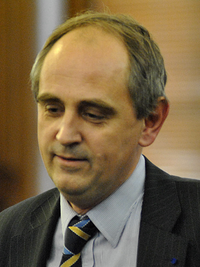
Ed.
Lucas of the Economist magazine noted
that the European economic crisis has developed, particularly in the
Southern region of the EU, into wholesale distrust of EU
institutions.
Ed. Lucas of the Economist magazine noted that the European economic crisis has developed, particularly in the Southern region of the EU, into wholesale distrust of EU institutions. As a result, the self-inflated bubble of the EU as a political and military superpower just vanished. Consequently, the European security and defense ambitions are now much more realistic. The economic crisis has led to search for cost savings, pooling and sharing in defense projects, joint military developments of more modest capabilities with the aim to contribute to NATO’s international security capabilities. To be loyal members of NATO and to participate in deeper EU integration are no longer mutually exclusive goals.
Changes in NATO and EU defense
concepts
Unlike in the
past, NATO and EU now accept the formation of separate regional defense
subgroups which can naturally grow, strengthen and assure their own security,
defense, environmental, and energy interests, particularly with more modest support
of such efforts by the U.S. Poland is trying to construct such a subgroup
based on Visegrad countries’ participation. The Nordic countries consisting of
Denmark, Finland, Iceland, Norway and headed by Sweden, aim to include in its block
the three Baltic countries (Estonia, Latvia, and Lithuania).
Involvement in the Nordic block is less complicated to Latvia and Estonia, because of their affinity to the Protestant ethics and almost a thousand years contact with Germanic and Scandinavian cultures. In contrast, Lithuania’s religious and cultural backgrounds are closer associated with those of Poland. Moreover, Lithuania shares a common border with Poland. Its land transport to Western Europe is through Poland. Although it can connect to Western Europe through the Baltic Sea, the seaway is not an efficient and sufficient substitute for vehicular and rail transport.
Lithuania in Poland’s and Russia’s shadow
Lithuania, according to its geographic proximity and cultural and religious
similarities, was inclined up to now to work closely with Poland. However, in
the last several years, relations with this “‘strategic” partner have begun to
deteriorate. The tragic death of President Lech Kaczynski and many of his cabinet
members in the 2010 plane crash has brought about significant changes in
Poland’s political orientation. The new government has assumed a role of
supremacy in the region and began to look down not only on Lithuania, but also on
its smaller Visegrad partners. Poland began to see itself as a decisive player
in Central and Eastern Europe and of parallel importance to France and Germany
with a deciding voice in shaping the future of Europe.
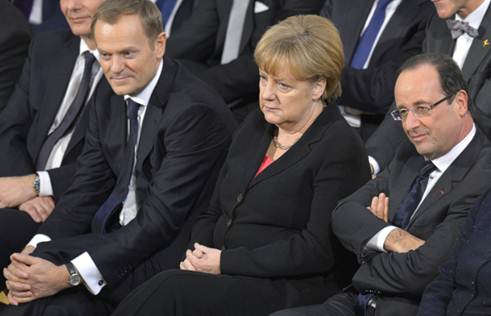
The Polish government has assumed a role of
supremacy in the region and began to look down not only on Lithuania, but also
on its smaller Visegrad partners. Poland began to see itself as a decisive
player in Central and Eastern Europe and of
parallel importance to France and Germany with a deciding voice in shaping the
future of Europe. (Polish Prime
Minster Donald Tusk is pictured above at the Nobel Prize ceremony with German
Chancellor Angela Merkel and French President Francois Holland.)
While Lithuania is seeking recognition from Poland by acknowledgement of partnership at equal terms, the deterioration in good neighbor relations offers at this time no bright prospects for the future. The post Kaczynski government’s friendly flirtation with Russia, has apparently diminished Poland’s concerns towards security of the Baltic States. They appear to be left to fend for themselves visa-vi Russia. This Polish attitude is not expected to change in the near future unless the current government is forced to modify its attitude either by some external events or by a policy change of a new government. Similar concerns have been voiced also at the above cited CEPA Conference by the Czech, Slovak and Hungarian speakers noting of difficulty to find in many instances a common language with Poland. As a result of deteriorating relations with Poland, and the U.S. showing less interest in the European region, Lithuania’s political attention began to drift towards improvement of relations with Russia and neighboring Belarus, and the establishment of a much closer collaboration with the Nordic-Scandinavian block.
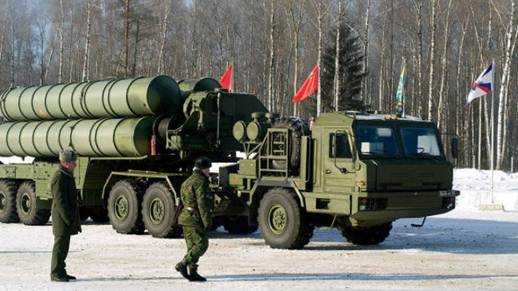
While
improvement of relations with Russia and Belarus is important, the Baltic
States nevertheless cannot close their eyes as Russia is rapidly modernizing
and strengthening its armed forces and continues threatening military exercises
near their borders. (PICTURE: A military truck
carries sections of Russia’s new
S-400 anti-aircraft missile system).
While improvement of relations with Russia and Belarus is important, the Baltic States nevertheless cannot close their eyes as Russia is rapidly modernizing and strengthening its armed forces and continues threatening military exercises near their borders. At the same time, the Baltic States must take into account that a large part of their economic well-being depends on trade with and transit through Belarus and Russia (“Lithuania’s Role in the Northern Distribution Network”, Eurasia Daily Monitor February 1, 2013). For example, Lithuania’s Department of Statistics reports that 25% to 30% of Lithuania's exports are to these countries, and even a larger proportion is imported from them. Transit of cargo through territories of Belarus and Russia into Asian countries depends on the willingness, particularly Russia, to allow the Baltic countries’ transport companies to use their road and rail infrastructures. Similar to Latvia’s and Estonia’s seaports handling substantial Russian cargo, Lithuania’s port of Klaipeda (Klaipeda port authority information) transships more than 12 mln. tons per year of Belarus cargo of a total of 36 mln. tons handled yearly by this port. Lithuania earns from Belarus over 75 litas for each handled ton of cargo. Accordingly, the port of Klaipeda receives for these services from Belarus alone about 1 bln. litas. Thus Lithuania has little choice than to set its relations with Russia and Belarus based on pragmatic economic interests without compromising its sovereignty. According to parliamentarian V. Gapšys "In dealing with these countries we must be smart and weigh every word we say, remembering that the neighbors can interpret any of our expressions in their own way with long lasting consequences to follow and many years needed to mend them.”
Nordic Countries: assured security
or illusion?
In view of Poland’s newly adopted indifference towards the future of the Baltic
States and uncertainty of its future political direction as well as aggressive military
posturing of Russia and Belarus at their borders, Lithuania is turning for
security purposes towards closer affiliation and possible alliance with the
Nordic block. While an effective alliance would be very desirable, it is
fraught with distrust of Sweden’s sincerity to come to the aid of the Baltic
States in the event of external aggression. It arises from the fact that Sweden
neither helped Finland to defend itself when attacked by Russia in 1939, nor protested
the invasion and subsequent occupation of the Baltic States by the Soviet Union
in 1940 and for nearly 50 years thereafter. While championing human rights
issues in the United Nation’s corridors during post World War II years, Sweden
did not voice any concern about the terror, mass annihilation and fate of the Baltic
people inflicted by the Soviet Union. Even after the Baltic people began their
quest for independence in late 1980s, Sweden was a silent bystander for several
years as the struggle continued against the Russian occupation. Only after the
Baltic States restored their independence, Sweden’s financial institutions
began a massive inflow into the Baltic countries
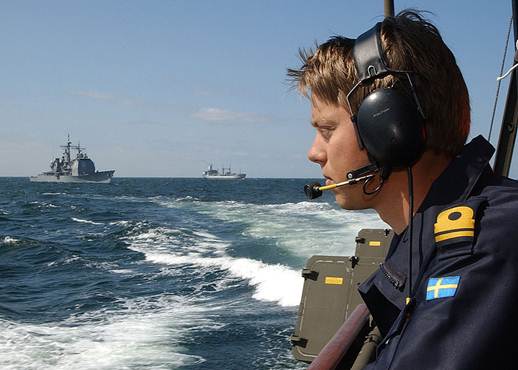
According
to the Swedish reserve Major General K. Neretnieks, Sweden has begun to realize
that its own security is no greater than that of the entire Baltic and Nordic
region. Sweden came to the conclusion three years ago that its security is
inseparable from the security of their neighboring countries. As a result,
Sweden began to change its position on neutrality and entertain thoughts
on how, in the event of military crises, it could help
their neighboring Baltic countries.
As the U.S. begins to focus its attention away from Europe, and as EU's financial support of NATO began to diminish (“In Europe Moment of Truth on Defense, Wall Street Journal”, 02/01/2013), Russia started flexing its military muscle in the region (Latvia’s prime minister Dombrovski, Baltic News Service, 01/28/2013). According to the Swedish reserve Major General K. Neretnieks, Sweden began to realize that its own security was no greater than that of the entire Baltic and Nordic region. Sweden came to the conclusion three years ago that its security is inseparable from the security of their neighboring countries. As a result, Sweden began to change its position on neutrality and entertain thoughts on how, in the event of military crises, it could help their neighboring Baltic countries. Possible examples of such conflicts and potential resolutions are found in the Swedish Academy of Military Science research collection entitled "Friends in Need: Towards a Swedish Strategy of Solidarity with her Neighbors”, Oct 12, 2012). “Although chances of the Baltic countries being attacked by military force are relatively small, it is important not to be submerged in self-deception by assuming that the heads of Russia will always act rationally”, noted Neretnieks. The basis of their decisions may be different than ours. They might conclude that certain form of aggression at some point in time is most convenient for them to attain their strategic goals, such as occurred most recently in the invasion of Georgia. Also, no one can say what Russia will be in five, ten, and fifteen years from now. In their study, the Swedish researchers considered three possible scenarios of confrontation and/or conflict:
First: Crisis arising in peace time. As an example, K. Neretnieks cites Russia’s inspired unrest in Estonia in 2007 created by the relocation of the statue of the bronze soldier.
Second scenario: Peacetime escalation of tensions due to appearance of threatening military posturing. According to the visiting in Vilnius Swedish military reviewers, such a situation is very delicate, because it cannot be established with any assurance if this is merely a Russian military exercise or preparations for serious military action. According to K. Neretnieks, the final resolution of such apparent threats might depend on promptness of NATO with a commensurate response. For example, in an appearing threatening scenario, NATO might deploy limited contingency of troops to Sweden. Here, however, political and bureaucratic problems would be encountered, because Sweden is not a member of NATO.
The third scenario is open military aggression against the Baltic countries. K. Neretnieks notes that initial defense would fall on the Baltic States themselves. They would have to resist long enough until their NATO allies come to the rescue. The control over the entire Baltic Sea and the staging point for countering military operation would be from the Swedish island of Gotland. While use of Swedish territory by NATO forces without declaring war would still be very tricky, in real threat to the Baltic countries use of Gotland would be justified and supported by the Swedish constituency..
Such Swedish defensive thinking is welcome to Lithuania and the other Baltic countries, particularly that it is planned at the level of the entire Nordic partnership. However, Lithuania’s slowness to jump instantly at this opportunity is due to its dissimilar historical, geographical, cultural and ethnic backgrounds from its northern neighbors. To overcome such lack of enthusiasm, political analysts suggest raising public awareness on topics that would be of concern and benefit to constituencies of all countries. Ed. Lucas cites as examples cooperation in energy projects, protection of environment, ecology, NGO activities, educational and cultural exchanges, and health and safety issues. Substantial orientation by the Baltic States towards Scandinavia can have not only defensive but also significant other benefits. "Acting in agreement as the entire region and raising jointly our concerns at the EU, we would be heard. In contrast, by acting alone, we relinquish the final decisions to the great powers in the European Parliament and other EU institutions”, says Paksas, the former president of Lithuania. Political scientist T.Janeliūnas agrees that “…the Scandinavian block could become a very close partner to Lithuania, but at the same time good relations with Scandinavia do not have to be an alternative to Poland. It is just a new power balancing factor.”
Considerable attention was created by the British
Prime Minister David Cameron convening a Nordic-Baltic Summit in January 2011. However,
the discussions focused primarily on social and economic ideas, instead of security
that is of most urgent concern to the Baltic States. Ed. Lucas notes, “that although
England's interest would be a positive indicator of the NB8 growing importance,
the British armed forces would be neither credible nor of substantial defense
value to the Nordic and Baltic Bloc”.
In Search of Ways to Strengthen Nordic and Baltic Ties
Ed. Lucas suggests imminent
efforts to strengthen the Nordic and Baltic cooperation by working together on
matters of lesser and shorter range significance and addressing the more
complicated theoretical issues at an appropriate future time. He encourages
expanding communications and beginning to address issues that are of common concern
to all involved parties, such as energy, pollution of the Baltic Sea, ecology, narcotics
traffic, law enforcement, public safety and terrorism, migration, common research
projects, economic cooperation, tourism and other areas. Such initiatives
would open the two regions to better familiarity with and trust of each other
as well as increased confidence in each other integrities. It would also demonstrate
to the world that this region not only knows how to live in peace, but also how
to assure each other’s safety and security.
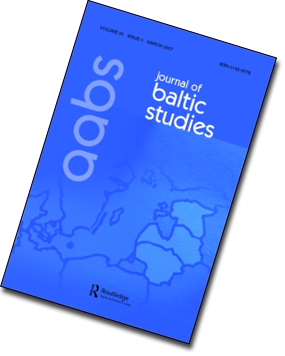
Analyzing compatibility of the
Nordic-Baltic countries, Alf. Vanags observes in a study published in the 2012
AABS journal under the title "Economic Integration and Cohesion in the
Baltic Sea Region", that a huge difference exists not only between the
Nordic and Baltic blocks, but also between the Baltic countries themselves
Analyzing compatibility of the Nordic-Baltic countries, Alf. Vanags observes in a study published in the 2012 AABS journal under the title "Economic Integration and Cohesion in the Baltic Sea Region", that a huge difference exists not only between the Nordic and Baltic blocks, but also between the Baltic countries themselves. His analysis showed that:
· The Baltic states, even after twenty years of independence, are considerably poorer than the Scandinavian countries, and are much more affected by the economic crisis;
· Significant cultural, political and societal maturity differences exist between the Nordic and the Baltic blocks;
· From the point of view of the Baltic countries, it is evident that the integration agenda of the Baltic states into the Nordic block is largely at the convenience of their rich neighbors;
· The Baltic countries lack cohesion and willingness to cooperate on tasks of mutual interest;
· There is neither a shared vision nor approach towards Russia;
· There are no or only very
weak institutions working towards promotion of integration of the two blocks.
Overall conclusion of the study: there is considerable asymmetry and only very narrow common interests between the two blocks other than commonality of the Baltic Sea and its ecology.
Even in the face of such significant differences, Sweden and other Scandinavian countries understand that in case of a conflict in the neighborhood, they cannot remain just bystanders. They will have to be prepared to react accordingly. Of first importance is preparation of an overall plan by all of the Nordic and Baltic partners, followed by the establishment and coordination of leadership for operational and management functions, compatibility of organizational structures and weaponry, followed by joint exercises. Although some activities in this direction have already been started, they are far from sufficient. “It requires substance, rather than declarations on paper of solidarity. Good intentions do not have much credibility, if they are not backed up by joint planning, joint exercises, etc”, says Colonel Bo Hugemark, member of the visiting Swedish delegation.
Of even more importance is the need to secure consent of populations of affected countries. The only way to move forward is through building public awareness of why integration of the Baltic States into the Nordic block is needed and of benefit. Public and political support is essential for success. Ed. Lucas points out the need to focus on demonstration of beneficial accomplishments such as making fragmented practical progress on least controversial elements. More complex issues should be addressed when they are less volatile to deal with.
Beneficial interactions between the smaller Baltic and the larger Scandinavian blocks can more readily occur on military issues, such as joint defense planning, procurement sharing, information exchange in cyberspace and energy management, intelligence sharing, maritime and air surveillance, planning and execution of joint emergency/rescue operations, cross-participation in military exercises, etc. Although Sweden and Finland are not members of NATO, cooperative, limited participation in joint exercises in the Baltic Sea region, joint rescue/disaster/humanitarian projects are items that will find wide public support. In parallel, for example, the Baltic countries could be invited to play a more active role in Norway’s annual "Cold Response" and other Nordic defense exercises. Cooperative activities in various projects would allow military officers from different countries the opportunity to relate to each other at personal levels, build mutual trust, and learn of reactions and interactions in emergency situations. Such steps will prepare the five Nordic and the three Baltic countries to respond with integrated and well coordinated defense.
In a cautionary note, Gen. K. Neretnieks said, the Nordic countries will not drag their Baltic neighbors kicking and screaming into joining the partnership. The Baltic countries will have to do their best to catch-up and become equals to their Nordic counterparts. The Nordic countries realize great difficulties for the Baltic countries to catch-up in the near future at the economic level. However, there is little reason for not partnering at the political level while also proportionally sharing expense burdens for common defense. Achieving equivalency is the key to full and successful integration of the Nordic and Baltic Blocks.
And what is in the future?
The euro crisis has shown that economic and financial problems within the EU
are difficult to resolve and cooperation for common defense is not very well
organized. In view of EU’s inability to provide adequate funding for NATO's
defense needs and while the U.S. is redirecting its attention and energy to
Asia, there is no guarantee that Russia will not try to take the opportunity to
reclaim the territories that at one time were controlled by the USSR. Its initial
targets might be the more vulnerable countries or regions to defend, particularly
those having little significance to major EU players.
Russia’s first choice might be political, social, military and ethnic vulnerabilities of the free Caucasus countries and Ukraine. Second in line of importance are the Baltic States, followed by former satellites of the USSR. Of course, a lot will depend on how quickly can Russia modernize its armed forces and rebuild their striking potential. It also depends on Russia’s success to undermine the confidence of target populations in their respective governments, their social stability, and their national consciousness, as well as the EU’s resolve to support democratic processes of countries at and/or beyond its current borders.
Russia already fired the first shots towards Caucasus, by successfully annexing parts of Georgia and subsequently, influencing the voters in Georgia in October 2, 1012 to elect a parliament favorable to Russia. Some political scientists believe this to be an initial step in neutralizing Georgia to the level of Ukraine. Only a couple of weeks later, an agreement of close cooperation was signed on October 13, 2012 in Jeravan between the presidents of Russia and Armenia. Armenia agreed to extend Russia’s military presence "to assure protection" of its territory”. Elections in Lithuania on October 14, 2012 resulted in a sharp left turn in its political direction with the Russian born Viktor Uspackich leading Lithuania’s Labor party to the second most popular rank in the number of votes received. Russian influence in the Lithuanian parliamentary election was confirmed by the news agency Ria Novosti in an article by V.Dubnovo in which he described Viktor Uspaskich as “Our man in Lithuania". The article notes of the Labor Party leadership’s dependence on support by the Russian gas giant Gazprom. According to Dubnovo, President Grybauskaite may be forced to allow Uspackich to play a dominant role in shaping Lithuania’s government. And Uspackich, like the siren in Greek mythology, lured Lithuania’s voters with melodious promises to nearly doubling the minimum wage level, raising the nation’s economic vitality, and eliminating unemployment. That this may lead debt plagued Lithuania to full economic and social upheaval, and drive Lithuania into Russia’s arms, is not mentioned. Only the future will tell if the elected parliament in 2012 will be able to keep Uspackich at bay and the new political leadership will firmly steer Lithuania towards safer shores of the Nordic partnership.
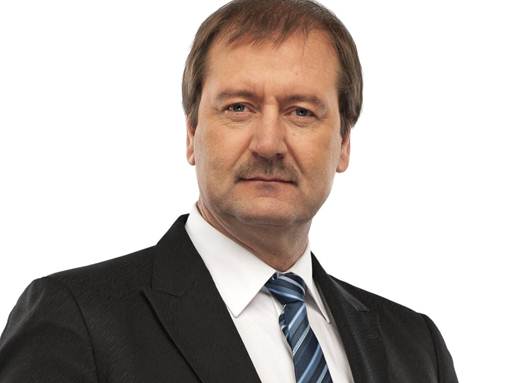
Elections
in Lithuania on October 14, 2012 resulted in a sharp left turn in its political
direction with the Russian born Viktor Uspackich leading Lithuania’s Labor
party to the second most popular rank in the number of votes received. Russian
influence in the Lithuanian parliamentary election was confirmed by the news
agency Ria Novosti in an article by V.Dubnovo in which he described Viktor
Uspaskich as “Our man in Lithuania".
- Bookmark :
- Digg
- del.icio.us
- Stumbleupon
- Redit it
- Posted by - (0) Comment
My encounter with the Dalai Lama
Madhurkankana Roy about her meeting with Dalai Lama in Delhi last Sunday:
There was immense positivity felt in the room. His graceful presence ushered in happiness, a smile on everyone’s face. Awestruck by his presence, the energy generated was beyond comprehension.
|
My good friend in New Delhi, India, Madhurkankana Roy, told me with excitement last Sunday that she had met the Dalai Lama that same day and had been holding his hands not once but twice. His Holiness had come to India to participate in the celebration of Swami Vivekananda*, the Indian Hindu monk who was the key figure in the introduction of Indian philosophies of Vedanta and Yoga to the western world more than 100 years ago. I asked her to write down her thoughts and feelings after the meeting, so here they are, her warm and sensitive considerations after her encounter with the world’s spiritual leader ... Read more about Swami Vivekananda at http://en.wikipedia.org/wiki/Swami_Vivekananda |
“Smile Legacy”
By Madhurkankana Roy. New Delhi, India
The legacy of Swami Vivekananda is relevant to India at a time when the Indian society in particular and world at large is redefining itself to changing times and becoming more just and equitable.
Commemorating 150th birth anniversary celebrations of Swami Vivekananda, the Indian Council for Cultural Relations had organised for an interfaith conference titled 'One World Religions: Diversity, Not Dissension’ to understand the essence of religious faiths and how ‘Religion should be a weapon for self-transformation as well as transformation of the society’ in this age of religious animosities.
Spread out over three days, the conference had magnanimous personalities in the likes of His Holiness Dalai Lama, Maulana Wahiduddin Khan, Rev Mpho Tutu, Dr.Karan Singh and others following nine different faiths, address member audience.
My association with the Conference happened at a professional level. Initially it was more like any other conference organised by ICCR and that my participation would solely be for coordination purpose. With much work to finish I was not really looking at some spiritual upliftment of the self. It was more like a task to be finished successfully. However things started moving at a different pace as the conference gradually moved towards the Valedictory function on the 9th of March 2013.
I was asked to be at the reception for receiving guests. The multipurpose Hall of India International Centre was almost full. The fully packed house reverberated with anticipation, eagerness of people wanting to listen to His Holiness Dalai Lama. As the clock struck 10, the fleet of security vehicles arrived, and after them followed a white sedan. It stopped just in front of the Hall. A man stepped out of the car. People flocked towards him. His Holiness had arrived. I had once read somewhere that his mere presence has touched and transformed millions of lives. Perhaps I was one of them. I was awestruck by his presence. I did not know how to react. His aura almost pushed me to a trance like state for a few moments, until I felt a sudden adrenaline rush and I walked towards him. Amidst the crowd, I saw him smiling at me. He forwarded his right hand. I looked at his eyes and his eyes spoke to me. They had the expression “I am glad to meet you”. I felt blessed.
And he walked ahead of me. I followed.
There was immense positivity felt in the room. His graceful presence ushered in happiness, a smile on everyone’s face. Awestruck by his presence, the energy generated was beyond comprehension. Like the Buddha himself, His Holiness too, with his ever-smiling face, reaches out to people in ways that connect to their individual mental dispositions, abilities, and everyday realities.
His Holiness spoke about Buddhism, co-existence with other faiths, self criticism and reasoning. As was discussed in the Conference, his main concern along with others present there, was how to arrive at a common platform of universal brotherhood. He emphasised on Love and Compassion as the primary weapon to win hearts across the globe. Indeed everyone of us sitting there that day were hit by the weapon of his smiling face. The radiance of his compassionate face transported us to a different level of consciousness. His humour is the hallmark of His Holiness and speaking in plain simple English, without mincing words, he made the philosophy of life and living so easily understandable. His words weighed and deep and yet so light that they seemed to be flying up to the shining eternity.
My short stint with His Holiness made a huge impact on me. His presence, shaking hands, infused some kind of calmness in me. My unstable, restless mind, felt a kind of peace within, that it was almost like a healing touch. His smile was infectious! I carried it forward, as if I had to preserve and promote his legacy to share a smile as long as I lived.
--
When you are motivated by the desire to transcend suffering, to get out of a difficult situation, and to help others to do the same, you become a powerful source of energy that helps you to do what you want to do to transform yourself and to help people.
- Bookmark :
- Digg
- del.icio.us
- Stumbleupon
- Redit it
- Posted by - (1) Comment
|
VIC
|
|
Is the KGB still walking VIC meeting (free entry)
Background reading:
|
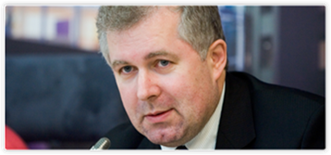
|
VIC Wednesday 13 March, 18:00
Arvydas Anušauskas (born 29th September 1963 in Vilnius) is a Lithuanian historian, writer, screenwriter, public and political activist.
1983-1985 studied at Vilnius University, Department of History
Arvydas Anusauskas investigates the history of terror, genocide and secret service. Also, he is the author and co-author of 26 books that published around 90 studies and articles in scientific journals of Lithuania, Poland, Latvia, France and Germany. From 1989 there are more than 100 articles published in Lithuanian periodicals.
|

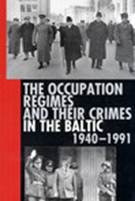
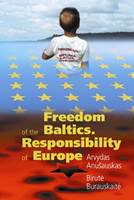
- Bookmark :
- Digg
- del.icio.us
- Stumbleupon
- Redit it
- Posted by - (5) Comment
11 MARCH 1990
THE DAY LITHUANIA WOKE UP
FROM ITS 50 YEAR NIGHTMARE
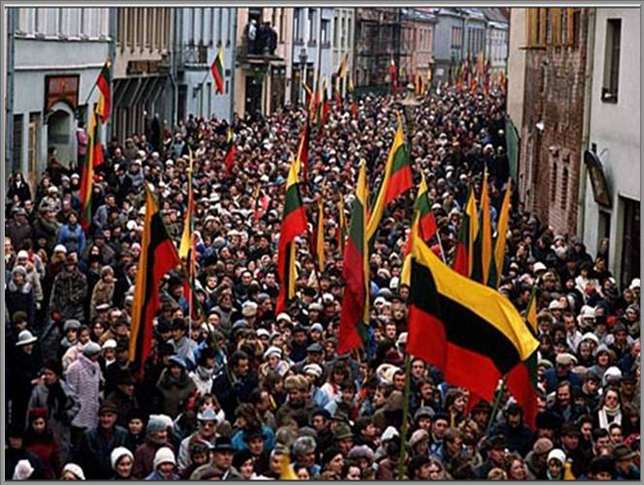
Lithuanians rejoice over their newfound independence, 11 March 1990.
Here from Pilies Street in Vilnius Old Town.
By Aage Myhre, Editor in Chief
aage.myhre@VilNews.com
11 March 1990 is one of the most important days in Lithuanian history. It was on this day 23 years ago that the Lithuanian parliament declared renewed freedom and independence for Lithuania, after the country had been occupied by the Soviet Union since World War II. 124 Parliament delegates voted for the declaration, while six were absent.
In that same session, the Parliament elected Professor Vytautas Landsbergis, the leader of the liberation movement Sajūdis, as Parliament President. He won over the Communist Party leader Algirdas Brazauskas with a 91 to 38 vote.
11 March 1990 became a milestone in Lithuania's history because the Lithuanian politicians that day clearly demonstrated the country’s willingness to again become free and independent. Although it took another 18 months before the international community approved the nation’s independence from the Soviet occupying power, it was the 11 March actions that made it clear to the world that Lithuania no longer accepted to be incorporated into a system and a Commonwealth it had been involuntarily incorporated into when the World War II drew to an end.
11 March 1990 was in many ways the day when Lithuania’s new freedom began, and we must believe that this country now will remain free and sovereign forever, based on democratic principles and values corresponding to those having been developing in Western Europe after World War II ended in 1945.
I can very well imagine that many of the 1990 politicians signed the declaration act with trembling pens. They knew what power they challenged, and were fully aware of what reprisals they and the people they represented could expect from the big bear in the east. The Soviet Union was not a superpower to tease or irritate, and they knew that they would not be treated with kid gloves if the bear decided to strike back, reacting to the severance requirement they signed that day.
But they signed. They were brave. Without their signatures on the document shown below, it is quite possible that Lithuania, Latvia and Estonia still today would be unfree republics under the 'protective' bear paws.
Lithuania’s independence declarations of 1918 and 1990 were both signed by wise and courageous political leaders who did not want to accept that their beloved homeland should remain occupied.
They deserve our respect and gratitude!
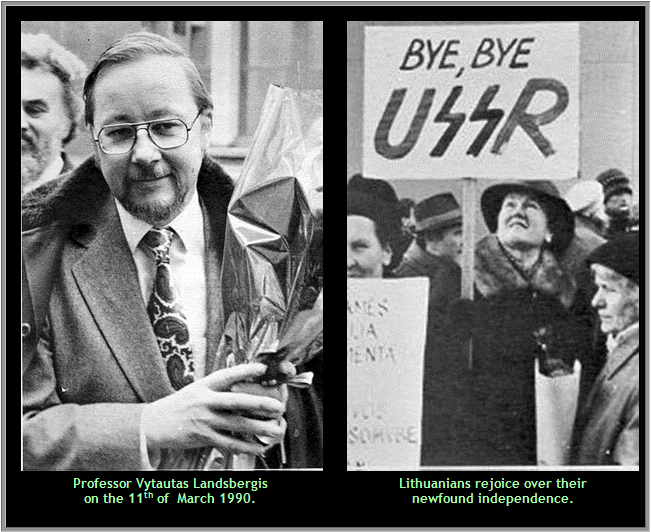
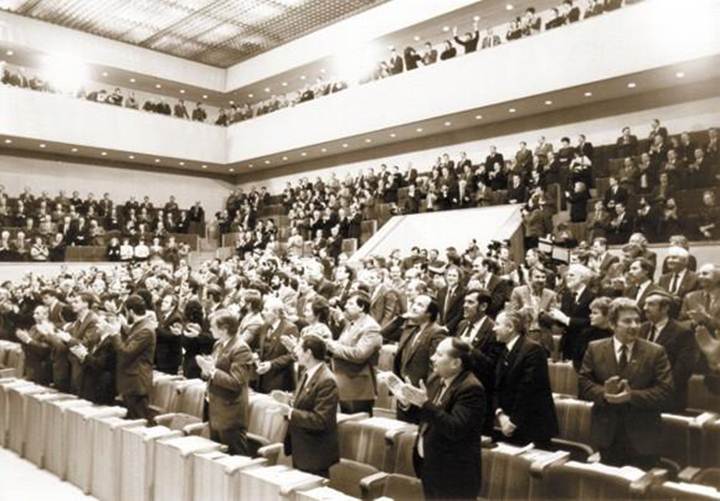
ABOVE: Seimas, 11 March 1990, the day Lithuania re-claimed its independence.
BELOW: The same Parliament Hall today.
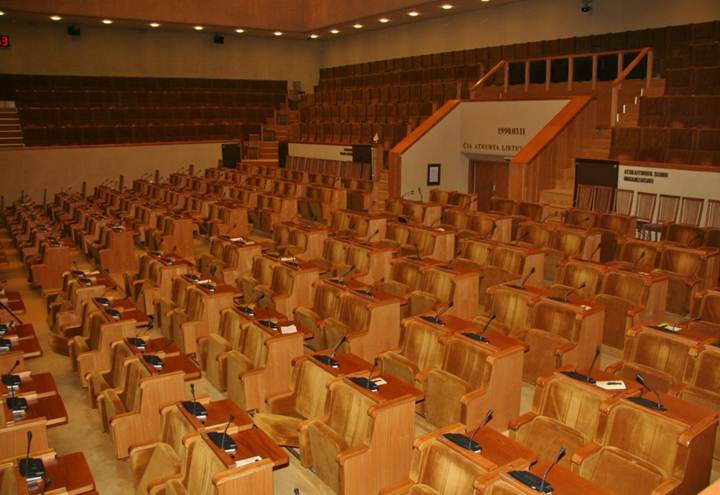
11 March 1990
11 March 1990 is one of the most important days in Lithuanian history. It was on this day 23 years ago that the Lithuanian parliament declared renewed freedom and independence for Lithuania, after the country had been occupied by the Soviet Union since World War II. 124 Parliament delegates voted for the declaration (copy below), while six were absent.
In that same session, the Parliament elected Professor Vytautas Landsbergis, the leader of the liberation movement Sajūdis, as Parliament President. He won over the Communist Party leader Algirdas Brazauskas with a 91 to 38 vote.
11 March 1990 became a milestone in Lithuania's history because the Lithuanian politicians that day clearly demonstrated the country’s willingness to again become free and independent. Although it took another 18 months before the international community approved the nation’s independence from the Soviet occupying power, it was the 11 March actions that made it clear to the world that Lithuania no longer accepted to be incorporated into a system and a Commonwealth it had been involuntarily incorporated into when the World War II drew to an end.
11 March 1990 was in many ways the day when Lithuania’s new freedom began, and we must believe that this country now will remain free and sovereign forever, based on democratic principles and values corresponding to those having been developing in Western Europe after World War II ended in 1945.
While this March day 23 years ago was the beginning of the new time in and for Lithuania, the day was also symbolising that nearly 200 years of tragedies of and for this country had come to a final end.
Through more than 500 years, from the 1200s when King Mindaugas declared Lithuania one nation, until it was occupied by the Russian Empire in 1795, Lithuania had been a proud and free nation, through some 300 years also one of the world’s greatest powers, stretching from the Baltic to the Black Sea (known as the Grand Duchy of Lithuania).
The 123 years of occupation from 1795 to 1918, however, became a long and sad chapter for Lithuania, since much of the good qualities this nation once represented in the world community were attempted to be systematically broken down by the Russian Empire occupants.
When Lithuania at the end of World War I (1914-1918) on 16 February 1918 again could declare itself a free nation, most Lithuanians probably believed that the newly won freedom would remain, but sadly, the new freedom lasted only for 22 years. Vilnius and the surrounding area was occupied by Poland already in 1920 and remained under Polish rule until the Second World War started in 1940, and Kaunas was therefore the capital of Lithuania for the years 1920 – 1940.
Nevertheless, Lithuania grew to become a strong nation during the interwar years, guided by, among others, the most famous Lithuanian leader of those days, President Antanas Smetona.
World War II and the years just after became extremely tragic for Lithuania, when the nation was torn apart under alternate German and Russian occupation, and virtually all the large Jewish population was wiped out, and Lithuania thereby lost a population group that had meant so much for this nation since the 1300s.
Also, during the war, tens of thousands of Lithuanians fled to the west, many who today live in the United States, Australia and other countries. Lithuanians were also exposed to extremely tragic abuse from Stalin's Soviet troops and his secret police (known as the KGB), when more than a hundred thousand Lithuanians were deported to Siberia and other areas in the Soviet Union where many of this country’s great citizens were killed or died during very shameful and cruel conditions.
Already during the WWII years a strong resistance movement occurred, known as the Forest Brothers, who until the middle of the 1950s fought a heroic struggle against the Soviet power from their hiding places in the Lithuanian forests. It is suggested that around 20,000 Lithuanians and 70,000 soldiers from Stalin's Red Army and the KGB were killed during those post-war years.
Lithuania became in 1990-1991 the first country that managed to detach itself from the Soviet Union. Latvia and Estonia followed soon after. We should all today be proud that this little country so bravely dared to stand up against the powerful Soviet powers. We should all be extremely happy that this little nation again enjoys freedom and democracy under the principle of equality for all its citizens, and we should be happy about the fact that 11 March 1990 was the day when Lithuania could finally put behind itself nearly 200 years of atrocities and suffering for its people – a people that had deserved so much better due to its proud history.
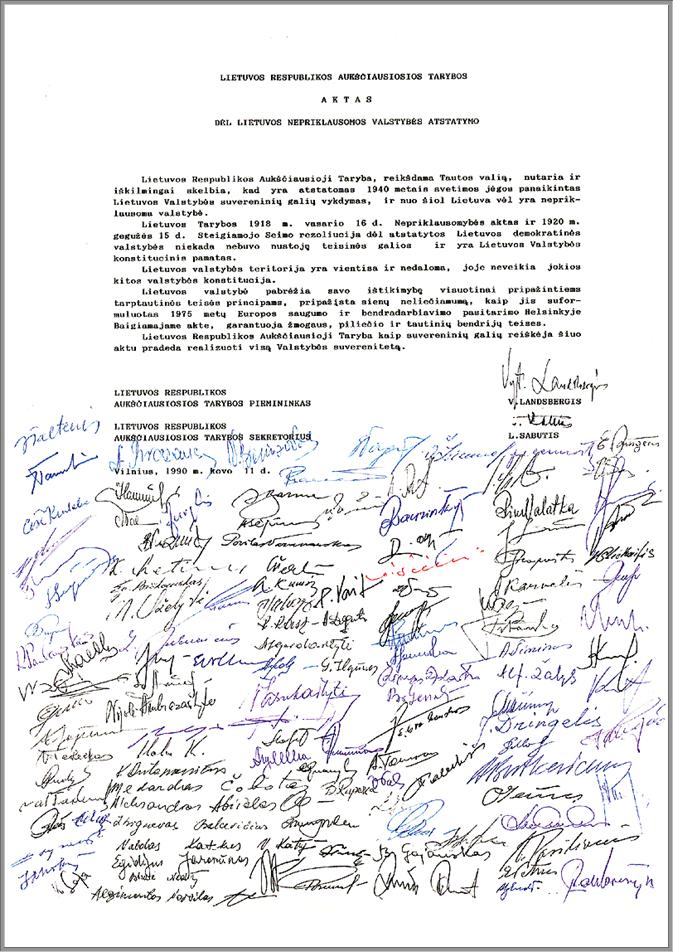
The Lithuanian Independence Act from 11 March 1990.
- Bookmark :
- Digg
- del.icio.us
- Stumbleupon
- Redit it

OPINIONS
Have your say. Send to:
editor@VilNews.com
Ph. D., Chicago
A wave of unity sweeps the international Lithuanian community on March 11th every year as Lithuanians celebrated the anniversary of the Lithuanian Parliament's declaration of independence from the Soviet Union in 1990. However, the sense of national unity engendered by the celebration could be short-lived.
Human beings have a strong tendency to overgeneralize and succumb to stereotypical us-them distinctions that can shatter even the strongest bonds. We need only search the internet to find examples of divisive thinking at work:
- "Those who fled Lithuania during World II were cowards -- and now they come back, flaunt their wealth, and tell us 'true Lithuanians' how to live."
- "Lithuanians who work abroad have abandoned their homeland and should be deprived of their Lithuanian citizenship."

In Lithuania Christmas Eve is a family event and the New Year's Eve a great party with friends!
Lithuanian say "Kaip sutiksi naujus metus, taip juos ir praleisi" (the way you'll meet the new year is the way you will spend it). So everyone is trying to spend New Year's Eve with friend and have as much fun as possible.
Lithuanian New Year's traditions are very similar to those in other countries, and actually were similar since many years ago. Also, the traditional Lithuanian New Years Eve party was very similar to other big celebrations throughout the year.
The New Year's Eve table is quite similar to the Christmas Eve table, but without straws under the tablecloth, and now including meat dishes. A tradition that definitely hasn't changes is that everybody is trying not to fell asleep before midnight. It was said that if you oversleep the midnight point you will be lazy all the upcoming year. People were also trying to get up early on the first day of the new year, because waking up late also meant a very lazy and unfortunate year.
During the New Year celebration people were dancing, singing, playing games and doing magic to guess the future. People didn't drink much of alcohol, especially was that the case for women.
Here are some advices from elders:
- During the New Year, be very nice and listen to relatives - what you are during New Year Eve, you will be throughout the year.
- During to the New Year Eve, try not to fall, because if this happens, next year you will be unhappy.
- If in the start of the New Year, the first news are good - then the year will be successful. If not - the year will be problematic.
* If New Year's night is cold and starry - look forward to a good summer!
* If the during New Year Eve trees are covered with frost - then it will be a good year. If it is wet weather on New Year's Eve, one can expect a year where many will die and dangerous epidemics occur.
* If the first day of the new year is snowy - the upcoming year will see many young people die. If the night is snowy - mostly old people will die.
* If the New Year time is cold - then Easter will be warm.
* If during New Year there are a lot of birds in your homestead - then all year around there will be many guests and the year will be fun.
Christmas greetings
from Vilnius
and epic battle for the
future
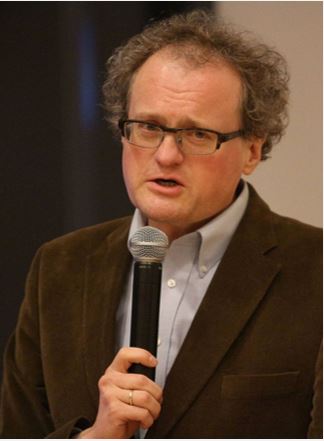
Philosopher, political theorist, historian of
ideas, social analyst, and political
commentator
Ukraine was and continues to be perceived by the EU political class as a sort of grey zone with its immense potential and possibilities for the future, yet deeply embedded and trapped in No Man's Land with all of its troubled past, post-Soviet traumas, ambiguities, insecurities, corruption, social divisions, and despair. Why worry for what has yet to emerge as a new actor of world history in terms of nation-building, European identity, and deeper commitments to transparency and free market economy?
Right? Wrong. No matter how troubled Ukraine's economic and political reality could be, the country has already passed the point of no return. Even if Vladimir Putin retains his leverage of power to blackmail Ukraine and the West in terms of Ukraine's zero chances to accede to NATO due to the problems of territorial integrity, occupation and annexation of Crimea, and mayhem or a frozen conflict in the Donbas region, Ukraine will never return to Russia's zone of influence. It could be deprived of the chances to join NATO or the EU in the coming years or decades, yet there are no forces on earth to make present Ukraine part of the Eurasia project fostered by Putin.
want to learn about the
new, scary propaganda
war between Russia,
The West and the
Baltic States!
believe their government
is corrupt
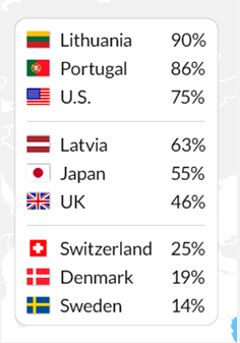
students say no to
bribes for doctors
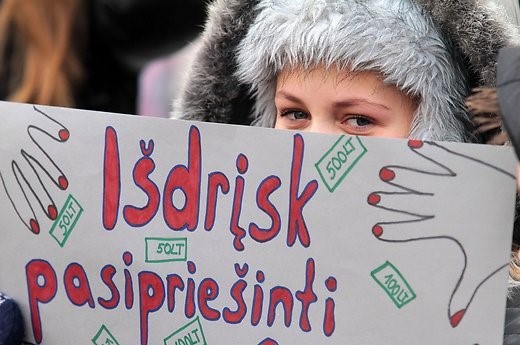
During Soviet times, government was administered for the people in control, not for the local population, court decisions were decreed, they were not the administration of justice, and academia was the domain of ideologues. 25 years of freedom and openness should have put those bad experiences behind Lithuania, but that is not so.
Today, it is a matter of expectation that court pronouncements will be governed by ideological dictates. Few, if any Lithuanians expect real justice to be effected. For foreign companies, doing business in Lithuania is almost impossible in a situation where business people do not expect rule of law, so, surely Government would be a refuge of competence?
Lithuanian Government has not emerged from Soviet styles. In an attempt to devolve power, Lithuania has created a myriad of fiefdoms of power, each speaking in the name of the Government, each its own centralized power base of ideology.
Chepstow, Wales
Doesn't that sound suspiciously like Lithuania? Ah, but I didn't mention the mountains of Snowdonia, which would give the game away.
I'm talking about Wales, that part of the UK which Lithuanians used to call "Valija", but later named "Velsas" (why?). Wales, the nation which has welcomed two Lithuanian heads of state to its shores - firstly Professor Vytautas Landsbergis, who has paid several visits and, more recently, President Dalia Grybauskaitė who attended the 2014 NATO summit which was held in Newport, South Wales.
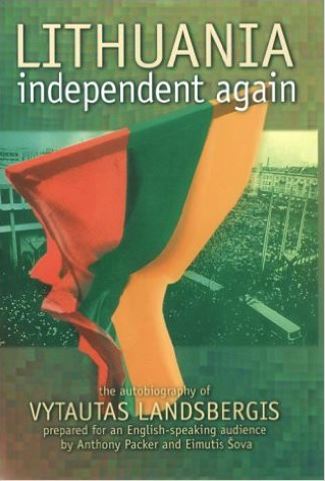
ENGLISH VERSION OF THE
AUTOBIOGRAPHY OF VYTAUTAS LANDSBERGIS.
Although Lithuanian activities have thinned over the decades as that postwar generation died out, the Lithuanian Martyrs' parish hall is crowded with many, many hundreds of visitors who come to the Lithuanian cemetery for All Souls' Day. Similarly, the Franciscan parish has standing room only for Christmas Eve mass.
Although I am firmly embedded in the literary culture of Canada, my themes are usually Lithuanian, and I'll be in Kaunas and Vilnius in mid-November 2015 to give talks about the Lithuanian translations of my novels and short stories, which I write in English.
If you have the Lithuanian language, come by to one of the talks listed in the links below. And if you don't, you can read more about my work at
www.anatanassileika.com
http://www.vdu.lt/lt/rasytojas-antanas-sileika-pristatys-savo-kuryba/ https://leu.lt/lt/lf/lf_naujienos/kvieciame-i-rasytojo-59hc.html
"My love and best wishes to all. As long as VilNews exists, there is hope for the future,"" she writes.
Irena Veisaite means very much for our publication, and we do hereby thank her for the support and wise commitment she always shows.
You can read our interview with her
Facing a new reality
Dear readers of VilNews,
For a number of years, the EU and Russia had assumed the existence of a strategic partnership, based on the convergence of values, economic integration and increasingly open markets and a modernisation agenda for society.
Our agenda was positive and ambitious. We looked at Russia as a country ready to converge with "European values", a country likely to embrace both the basic principles of democratic government and a liberal concept of the world order. It was believed this would bring our relations to a new level, covering the whole spectrum of the EU's strategic relationship with Russia.
The likelihood of Putin
invading Lithuania
.jpg "lithuania today")
Founding Director at Summer Literary Seminars
Are all Lithuanian energy
problems now resolved?
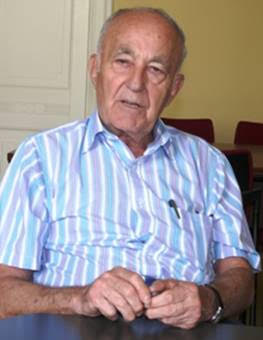
Lithuania as a country does not have significant energy resources. Energy consuming infrastructure after WWII was small and totally supported by energy imports from Russia.
First nuclear reactor begins power generation at Ignalina in 1983, the second reactor in 1987. Iganlina generates enough electricity to cover Lithuania's needs and about 50%.for export. As, prerequisite for membership in EU, Ignalina ceases all nuclear power generation in 2009
The Klaipėda Sea terminal begins Russia's oil export operations in 1959 and imports in 1994.
Mazeikiu Nafta (current ORLEAN Lietuva) begins operation of oil refinery in 1980.
Have Lithuanian ties across
the Baltic Sea become
stronger in recent years?
The two decades that have passed since regaining Lithuania's independence can be described as a "building boom". From the wreckage of a captive Soviet republic, a generation of Lithuanians have built a modern European state, and are now helping construct a Nordic-Baltic community replete with institutions intended to promote political coordination and foster a trans-Baltic regional identity. Indeed, a "Nordic-Baltic community" - I will explain later in my text the meaning of this catch-phrase.
Since the restoration of Lithuania's independence 25 years ago, we have continuously felt a strong support from Nordic countries. Nordics in particular were among the countries supporting Lithuania's and Baltic States' striving towards independence. Take example of Iceland, country which recognized Lithuania in February of 1991, well in advance of other countries. Yet another example - Swedish Ambassador was the first ambassador accredited to Lithuania in 1991. The other countries followed suit. When we restored our statehood, Nordic Countries became champions in promoting Baltic integration into Euro-Atlantic institutions. To large degree thanks Nordic Countries, massive transformations occurred in Lithuania since then, Lithuania became fully-fledged member of the EU and NATO, and we joined the Eurozone on 1 January 2015.
Have you heard about the
South African "Pencil Test"?
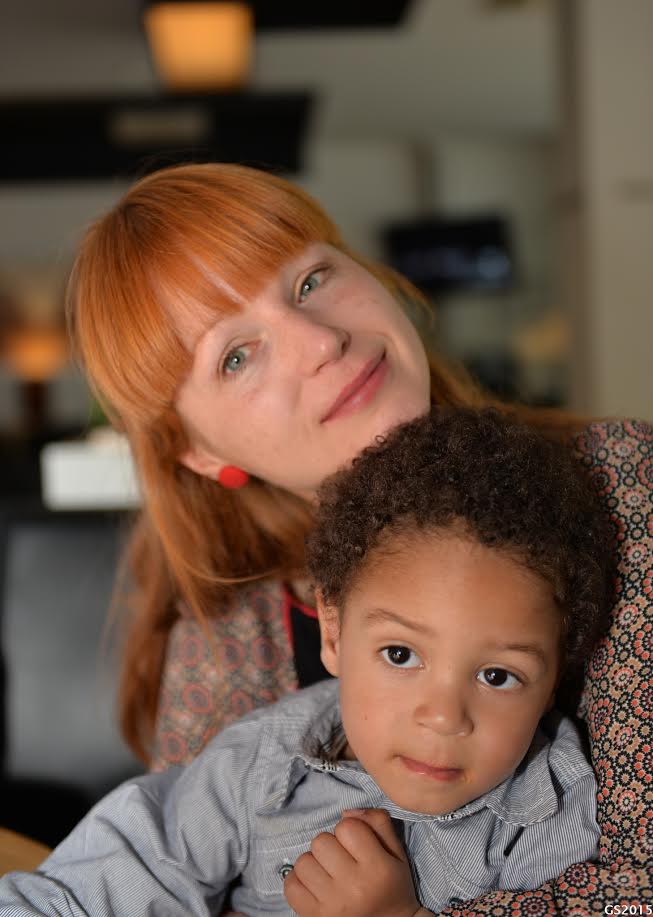
But that is exactly what happened to me when I came back from South Africa. I will tell you how.
VilNews e-magazine is published in Vilnius, Lithuania. Editor-in-Chief: Mr. Aage Myhre. Inquires to the editors: editor@VilNews.com.
Code of Ethics: See Section 2 – about VilNews. VilNews is not responsible for content on external links/web pages.
HOW TO ADVERTISE IN VILNEWS.
All content is copyrighted © 2011. UAB ‘VilNews’.