VilNews section 10: HISTORICAL LITHUANIA
The section also focuses on books, music and products that somehow represent ancient Lithuania, even today.

![]() THE VOICE OF INTERNATIONAL LITHUANIA VilNews has its own Google archive! Type a word in the above search box to find any article.

You can also follow us on Facebook. We have two different pages. Click to open and join.
|
Sat, 4th May, 2013 - Posted by - (3) Comment

Prince Inigo of Urach, born 12 April 1962, with his wife –
Daniela Freiin von und zu Bodman, born 28 August 1963.
By Liudvikas Jakavičius-Grimalauskas
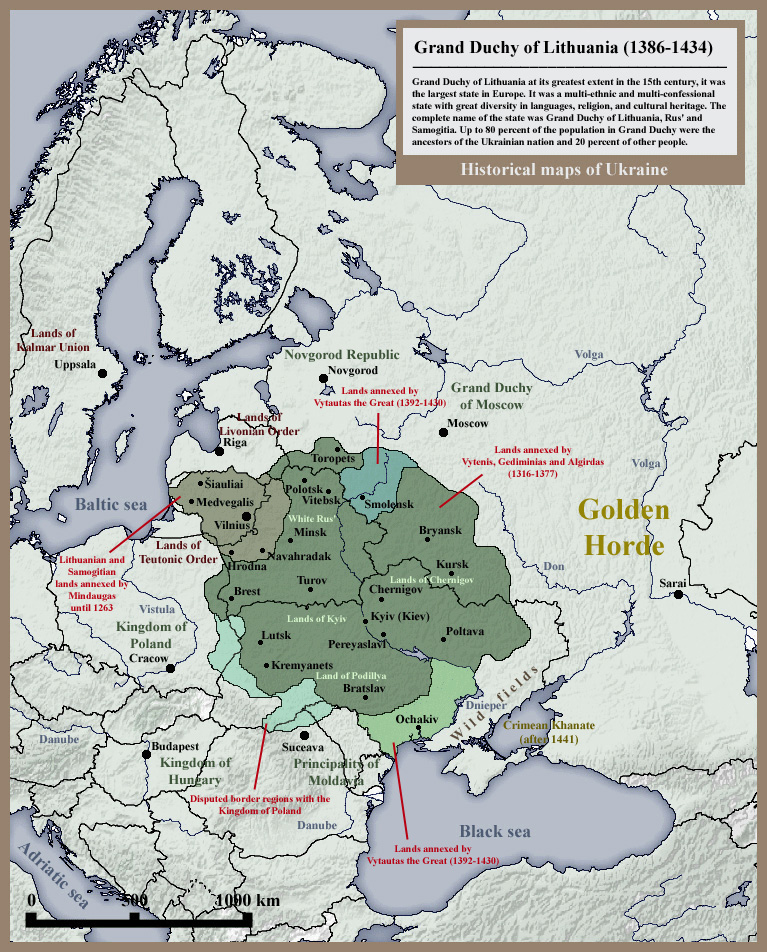
Today Lithuania is a modern and dynamic North European nation of high technologies and innovations, with the second fastest growing economy in the European Union. But the territory that belongs to Lithuania has a large and old tradition as a Monarchy, tracing its political origins to 1219 as an independent Grand Duchy (The Grand Duchy of Lithuania), created by Mindaugas, a warrior who unified the territories that he conquered, proclaiming himself Grand Duke of Lithuania.
Sat, 4th May, 2013 - Posted by - (0) Comment

The Seal of King Mindaugas (1203-1263, reign 1251-1263) is a medieval
seal affixed to the October 1255 act by Mindaugas, King of Lithuania,
granting Selonia to the Teutonic Knights.
Historically, The Kingdom of Lithuania is rooted in the 13th Century when Mindaugas was crowned by Pope Innocent IV as King of Lithuania. Over the next five hundred years the storms of war and politics rendered its toll. Expansion and alliances with Poland and other nations, were not strong enough to keep the transformed Grand Duchy of Lithuania independent. In 1795 it was all but consumed by Russia.
After two centuries, in 1918 the strong will of the Lithuanian people gained independent statehood but this was also short lived. Twenty years of autonomy again ended with Russian and Nazi occupation.
Today’s Republic of Lithuania declared Independence (again) as a parliamentary democracy on March 11, 1990 and was internationally recognized in September 1991.
After the Freedom Declaration in 1918, there were many who wanted the monarchy reinstated in Lithuania. In 1990-1991 there was hardly anyone who dared to come up with such an idea. But today more and more people want attention to Lithuania’s proud, royal history, and many believe the royal idea and past has wrongfully been swept under the rug …
Here are some interesting articles, absolutely worth reading!
The trampling of Lithuania’s history
Restoring Lithuania’s Royal Titles
Official site of His Imperial Majesty King Roman
King Roman of Lithuania sells titles from his house
Tue, 19th March, 2013 - Posted by - (0) Comment

Photos: Aage Myhre, March 2013
Gediminas’ Tower (Lithuanian: Gedimino pilies bokštas) is the only remaining part of the Upper Castle in Vilnius, Lithuania.
The first fortifications were built of wood by Duke of the Grand Duchy of Lithuania, Gediminas. Later the first brick castle was completed in 1409 by Grand Duke Vytautas. Some remnants of the old castle have been restored, guided by archeological research.
It is possible to climb to the top of the hill on foot or by taking a funicular. The tower houses an exposition of archeological findings from the hill and the surrounding areas. It is also an excellent vantage point, from where the panorama of Vilnius’ Old Town can be admired.
Gediminas’ Tower is an important state and historic symbol of the city of Vilnius and of Lithuania itself. It is depicted on the national currency, the litas, and is mentioned in numerous Lithuanian patriotic poems and folk songs. The Flag of Lithuania was re-hoisted atop the tower on October 7, 1988, during the independence movement that was finalized by the Act of the Re-Establishment of the State of Lithuania on March 11, 1990.
Sat, 16th February, 2013 - Posted by - (0) Comment

The original 20 members of the Council of Lithuania
after signing the Act of February 16, 1918
RESOLUTION
The Council of Lithuania in its session of February 16, 1918 decided unanimously to address the governments of Russia, Germany, and other states with the following declaration:
The Council of Lithuania, as the sole representative of the Lithuanian nation, based on the recognized right to national self-determination, and on the Vilnius Conference’s resolution of September 18–23, 1917, proclaims the restoration of the independent state of Lithuania, founded on democratic principles, with Vilnius as its capital, and declares the termination of all state ties which formerly bound this State to other nations. The Council of Lithuania also declares that the foundation of the Lithuanian State and its relations with other countries will be finally determined by the Constituent Assembly, to be convoked as soon as possible, elected democratically by all its inhabitants.
Sat, 16th February, 2013 - Posted by - (1) Comment

Jonas Basanavičius (23 November 1851 – 16 February 1927) was an activist and proponent of Lithuania’s National Revival and founder of the first Lithuanian language newspaper Aušra. He was a signatory of the Act of Independence of Lithuania on 16 February 1918 Basanavičius is often given the unique informal honorific title of the “Patriarch of the Nation” for his contributions and help in re-establishing the Lithuanian state.
“A man’s country is not a certain area of land, of mountains, rivers, and woods, but it is a principle; and patriotism is loyalty to that principle.”
- George William Curtis
It is 16 February 2013. It is today exactly 95 years since a group of brave men wrote the Lithuanian declaration of independence after the country had been under Tsarist Russia’s iron heel through more than 100 years. These men represented a generation that certainly felt an overwhelming sense of pride at the dawn of renewed independence. The Act of February 16 was signed by all 20 representatives of the Council of Lithuania, proclaiming the restoration of an independent State of Lithuania, governed by democratic principles. The meeting and signing procedures were chaired by Jonas Basanavičius, the man often given the unique informal honorific title of the “Patriarch of the Nation” for his contributions and help in re-establishing the Lithuanian state.
What these men presented from the balcony of a house in Pilies street here in Vilnius Old Town was not much more than a piece of paper. But it was a paper that symbolized a nation willing to throw off the yoke.
A nation that had won back its self respect and dignity in spite of the injustice and oppression that had been going on since the Russian occupation started in 1795.
We salute these men for their courage and foresight. We salute them because they, in faith, hope and dignity clearly showed that Lithuania wanted to live up to its proud history as a nation of greatness.
Great nations are founded on self-belief!
Sat, 19th January, 2013 - Posted by - (2) Comment
![]() |
Commemorating January 1991
|

21 January 1991: Soviet military vehicles dominated the streets of Vilnius. Dag Andersen and I presented a letter from Oslo Municipality, signed by Mayor Michael Tetzschner. Oslo offered Vilnius to become its first friendship city in the West. The letter was enthusiastically received by the Vilnius Mayor Arunas Grumadas and Deputy Mayor Regimantas Ciupaila.
Photo: Aftenposten, Norway.
Aage Myhre, VilNews Editor-in-Chief
aage.myhre@VilNews.com
We were two Norwegians working very much with Lithuanian affairs during autumn/winter of 1990-91, Dag Andersen and me. During our visit to Vilnius in January 1991, we showed our respect to President Vytautas Landsbergis in his Parliament office and worked with journalists to spread the message about the Soviet assault to the world.
We also brought with us a letter from the City Council Leader of Oslo, Michael Tetzschner inviting the Mayor of Vilnius to sign a sister city agreement. We handed the letter over to Mayor Arunas Grumadas on 21 January while Soviet troops were standing around in the streets and armoured vehicles roared around us.
The twin city agreement was signed a few months later, and Oslo became thus the first Western city to enter into such an agreement with Vilnius. I saw it as an important symbol of friendship and solidarity at a difficult time for a country under tremendous pressure and terrible abuse from Lithuania’s power loving neighbour to the east.
We came via Riga
We were a small group of Norwegians who travelled from Oslo to Vilnius a few days after the infamous Soviet attack and its killings on the 13th of January 1991. It was originally planned as a larger delegation, with parliamentarians, but they had to postpone their trip due to the death of our Norwegian King Olav.
We came to Vilnius via Copenhagen and Riga, whereto Scandinavian Airlines as the first western airline had established a route a few months earlier. Travel insurance cover was 400% higher than normal. The Baltic States were now defined as a war zone.
In Riga we first visited the Radio and Television House. The smoke from the many bonfires around the building lay like a blanket over the area, with a penetrating but good smell of firewood. It was an impressive sight to see the thousands of Latvians who camped around the territory in tents and primitive shelters to protect the freedom of peaceful broadcast against the Soviet perpetrators.

We, our Norwegian team, together with journalists travelled to Latvia and Lithuania as soon as we could after the Soviet attack in January 1991. The Balts refused to accept the Soviet invasion. They did their utmost to protect their governments and media. Here we are with ‘activists’ in Riga. For several weeks they made bonfires, staying here in tents night after night to demonstrate against the new Soviet assault.
Photo: Aage Myhre, January 1991.
Thu, 17th January, 2013 - Posted by - (1) Comment


Lithuanian Foreign Ministry issued primitive passes for us,
and we managed to get through a long maze of controls,
barbed wire, concrete blocks and barricades that surrounded
the Lithuanian Parliament those January days in 1991. We got
the opportunity to visit this brave Parliament President,
Professor Vytautas Landsbergis, in his office. Here he
lived day and night for weeks while the Soviets
surrounded the building with troops and tanks.
Text and photos: Aage Myhre, Editor-in-Chief
aage.myhre@VilNews.com
This year I marked 13 January in the Lithuanian Parliament Building, 22 years after I in 1991 stood here in this building, along with Professor Landsbergis and looked out the window at the bonfires, barricades and the huge crowd of unarmed people who had gathered to protect their president and the country’s future as a free nation.
I came here today with a group of young Lithuanians, most of them so young that they do not have their own memories of what happened here 22 years ago. Yet the memories of the sad events in January 1991 are very much alive and present for them. They want to remember that freedom and independence is not something you can take for granted, and they want to pursue a political career. They are Lithuania’s future politicians. They are the future of young, well-educated, smart leaders that this country a few years ago could only dream about.
I walked around with them in the Parliament this 13th January. I saw their interests, and their pride in belonging to a great nation like this.
I also saw large photographs on the walls, with Lithuania’s parliamentary history of the interwar time and from the years after the Declaration of Independence 11 March 1990. The sadness I felt when I walked around in these corridors 22 years was gone, now I felt only joy, and optimism regarding the country’s future and its political leaders for the years to soon come.

Entrance to the old part of the Parliament.
VilNews e-magazine is published in Vilnius, Lithuania. Editor-in-Chief: Mr. Aage Myhre. Inquires to the editors: editor@VilNews.com.
Code of Ethics: See Section 3 – about VilNews. VilNews is not responsible for content on external links/web pages.
Advertisements: SEE SECTION 8 – HOW TO ADVERTISE IN VILNEWS.
All content is copyrighted © 2011. UAB ‘VilNews’.
Powered by Skubi.lt.