Section 9: LITVAK FORUM
|
|
|
|
|
|
|
|
|
|
|
|
|
|
|
|
|
|
|
|
|
|
|

THE VOICE OF INTERNATIONAL LITHUANIA

|
VilNews has its own Google archive! Type a word in the above search box to find any article.
You can also follow us on Facebook. We have two different pages. Click to open and join.
 Click on the buttons to open and read each of VilNews' 18 sub-sections Click on the buttons to open and read each of VilNews' 18 sub-sections  |

|
|
|
|
|
|
|
|
|
|
|
|
|
|
|
|
|
|
|
|
|
|
|
|
- Posted by - (2) Comment
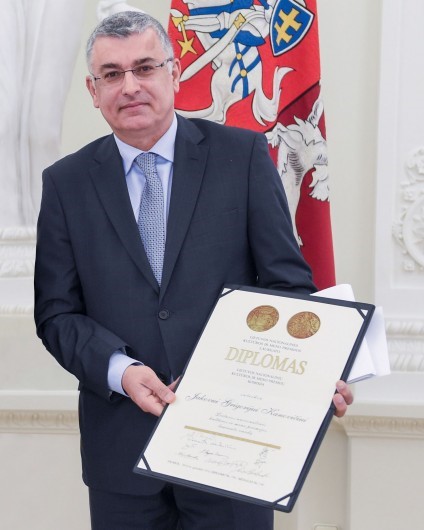
SERGEY KANOVICH
Photo R. Dačkaus
- Posted by - (1) Comment
|
and their formidable position in world history By Aage Myhre
Editor-in-Cief I have on various occasions, in several countries, asked people if they know of the Litvaks (Lithuanian Jews) and their special place in world history and in many of today's countries and societies around the world. The answer is usually negative, which has puzzled me – in view of the unprecedented and exceptional role the Litvaks have had within a very wide range of fields, in politics, economics, business and science, to prominent roles in music, movies and many other cultural fields. Go to our SECTION 9 to read more Litvak stories ... |
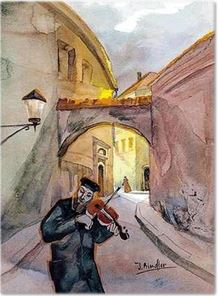 Vilnius Old Town |
The Litvaks
Jews trace their origins in Lithuania back to the days of Grand Duke Gediminas in the early 14th century, and by the late 15th century there were already thriving Jewish communities here. In time, Vilnius became known as the "Jerusalem of the North," a centre of Jewish religious learning. The Jews of Lithuania lived an intense Jewish life, and their role and influence in the major Jewish political and cultural movements were far greater than their numbers would have suggested. Vilnius became a prominent international, intellectual centre. Here there were once as many synagogues (totally 96) as churches—including the Great Synagogue, built in 1573, a vast complex of prayer spaces and schools.
|
 |
Vilnius was like
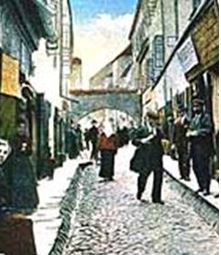
a Mediterranean city EMMANUEL ZINGERIS: “Vilnius was like a Mediterranean city. Lithuania before Holocaust was a society of love, full of colourful life and warm interaction between people. Imagine that here, in the street we are sitting, the windows would now be open, the mothers would be shouting to their children, and the street would be filled with joyful people discussing, singing, reading and mingling in a happy crowd of friends, colleagues and visitors.”
|
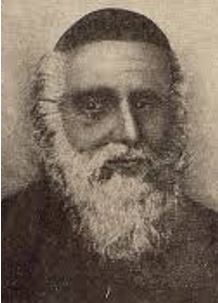 Rabbi Eliyahu of Vilna was born in Vilnius in 1720 and died in 1797. |
“If you seek wisdom,
Vilnius is the place to go” Before WWII there was a saying among European Jews: if you are keen on earning money, go to Lodz; if you seek wisdom, Vilnius is the place to go. “I live in this city with a feeling that it does not belong to me and that I have only come here for a visit – as a human being, a poet and a Lithuanian. In this respect Vilnius could be compared only to Jerusalem. Only Jerusalem is the city of God, whereas Vilnius is the city of a dream. Trivial as it might seem, it was founded after Gediminas has a dream. It’s as if Vilnius was not created by man – you have the feeling that Vilnius has risen from the ground, from the confluence of the rivers, from the landscape – it rises on its own, possibly with some support by man. It is also in the details that the beauty of Vilnius lies. On the one hand, the Vilnius of the dream lets its citizens merely touch it; on the other hand, Vilnius sucks them in and swallows them”
|
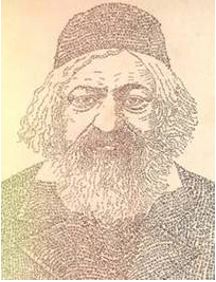 Elchanan Spector (1817-1896), served as chief rabbi of Kovno, the most prominent rabbinical position at the height of 19th century Lithuanian Jewry. |
Kaunas was an
important centre of Jewish life Jews are first known to have lived in Kaunas (Kovno) as early as 1410 when they were brought forcibly as prisoners of war by the Grand Duke Vytautas. Many of those Jews were later active as traders between Kovno and Danzig (today's Gdansk, Poland). Living conditions for many Jews were squalid. In 1858, archaic living restrictions were relaxed and all but 6,000 of the city's 35,000 Jews flocked to the Old Town in search of something better. In July 1941, however, the Nazis expelled all the Jews from the town and sent them back to Slobodka. The Kovno Ghetto was thus established. Kaunas became an important center of Jewish cultural life in the latter half of the 19th century. Distinguished Jewish leaders moved here from Vilnius, the capital, to establish yeshivas. Influential thinkers also moved to Kaunas.
|
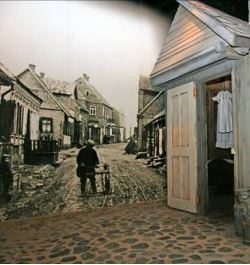 is more Lithuanian than Lithuania itself. |
90% of all Jews in
South Africa are Litvaks It is considered that around 90% of the approximately 80,000 Jews living in South Africa are of Lithuanian descent (the so-called Litvaks), which thus constitutes the largest pocket of Litvaks in the world! You are hereby invited to learn more about this unique Jewish community that still holds Lithuania alive in their hearts, museums and synagogues. The Jewish Museum in Cape Town offers visitors a journey back in time. Most museums do. The striking feature of this museum, however, is that the journey to the past also brings us to a completely different part of our world, from Africa's southern tip to a seemingly modest little country far to the north.
|
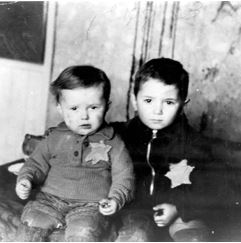 (Kovno) Ghetto, Lithuania. Yad Vashem Photo Archive, 4789 |
Kaunas Ghetto (1941-1944):
An entire urban district
turned into a merciless death camp What happened to the Jews in Lithuania during World War II is a matter of grim record. Of the 250.000 Jews in 1939, only between 12.500 and 17.500 survived; of those, only about 200 remain today. It has been estimated that of the 265.000 Jews living in Lithuania in June 1941, 254.000 or 95% were murdered during the German occupation. No other Jewish community in Nazi-occupied Europe was so comprehensively destroyed.
|
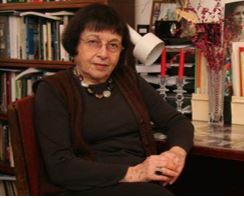 a Holcaust survivor. . |
“I do not remember the faces of
any evil people from my past, but I do very well remember the faces of those that expressed goodness. We have to learn to love and to understand.” |
 |
Litvaks of today
During the 19th and 20th century, tens of thousands of Lithuanian Jews emigrated to the United States of America. Many Lithuanian Jews also emigrated to South Africa which became famous as a haven for its 100.000 Jews who were spared the Holocaust. A small number also emigrated to the British Mandate of Palestine. The rise of the Nazis in Germany and the ensuing Holocaust destroyed the vast majority of Jews who had not managed to leave Lithuania and its environs.
Jews of Lithuanian origin are today in leading roles and positions around the world – some of our nowadays most famous politicians, scientists, businessmen, economists, actors, writers and singers have Litvak background. |
- Posted by - (9) Comment
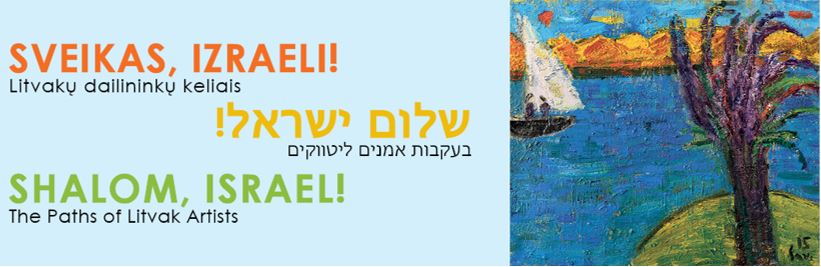

- Posted by - (11) Comment
"The Eternal Question” / “DI ALTE KASHE”
FRAIDY KATZ sings in Yiddish
- Posted by - (3) Comment
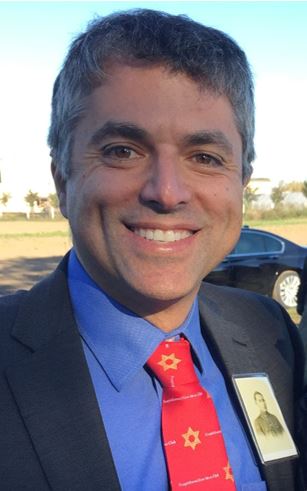
By Grant Arthur Gochin
California - USA
Lithuania emerged from the yoke of the Soviet Union a mere 25 years ago. Since then, Lithuania has attempted to model upon other European nations, joining NATO, Schengen, and the EU. But, has the Soviet Union left Lithuania?
During Soviet times, government was administered for the people in control, not for the local population, court decisions were decreed, they were not the administration of justice, and academia was the domain of ideologues. 25 years of freedom and openness should have put those bad experiences behind Lithuania, but that is not so.
Today, it is a matter of expectation that court pronouncements will be governed by ideological dictates. Few, if any Lithuanians expect real justice to be effected. For foreign companies, doing business in Lithuania is almost impossible in a situation where business people do not expect rule of law, so, surely Government would be a refuge of competence?
Lithuanian Government has not emerged from Soviet styles. In an attempt to devolve power, Lithuania has created a myriad of fiefdoms of power, each speaking in the name of the Government, each its own centralized power base of ideology.
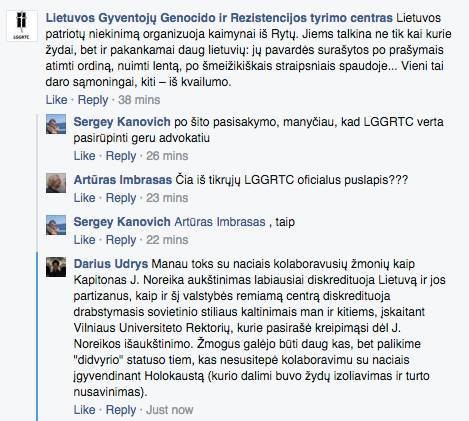
Since 2013, a debate has raged within Lithuanian society about a Holocaust perpetrator named Noreika. There is no question of his guilt, his signature is on Holocaust documents, witness statements place him squarely as a perpetrator, yet honors for him remain littered throughout the country, a complete absence of morality and accountability, rather, the elevation of a bigot, a murderer and a thief.
- Posted by - (5) Comment
Letter from a Lost Shtetl
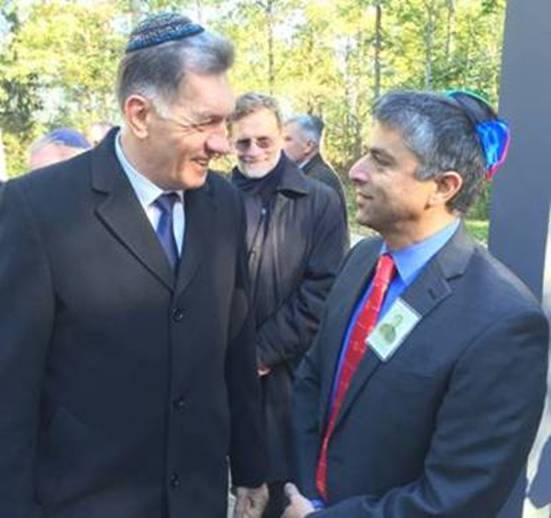
GRANT ARTHUR
PRIME MINISTER ALGIRDAS BUTKEVICIUS
By Grant Arthur
California, USA
Lithuania is changing. Clearly, my Grandfather would be proud to be here.
Nothing stays the same. Lithuania is experiencing a defined period of rediscovering its roots as an open and tolerant society. However, there is still a long way to go.
As I write on this crisp autumn morning, standing in the gentle sunlight, amongst recently restored Jewish tombstones of a lost shtetl in Northern Lithuania called Seduva, I am struck by the societal changes I see evolving.…
- Posted by - (1) Comment
NEW book by Yves
Her intelligence
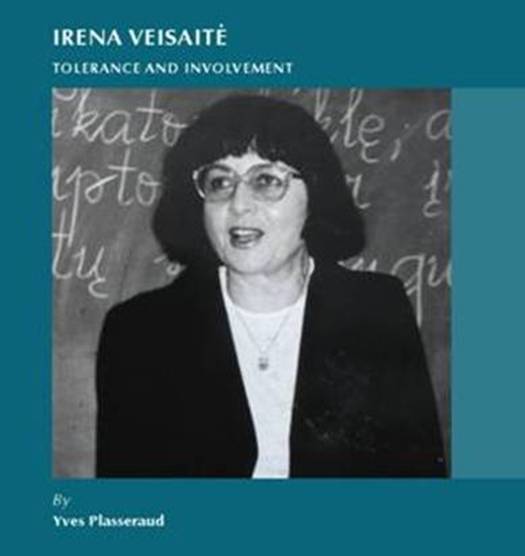
THE NEWLY PUBLISHED BOOK ABOUT IRENA VEISAITE
By Yves Plasseraud,
Paris, France…
- Posted by - (1) Comment
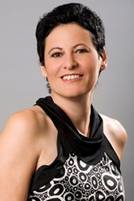 |
Adv. Marcelle Juliet Saul Sheiman, an attorney to the Supreme Court of the Republic of South Africa and Israeli advocate, who attended the World Lithuania Economic Forum in Vilnius earlier this month. Marcelle Juliet Saul Sheiman (MS) currently serves as Chairman of the Israel-South Africa Chamber of Commerce. |
South African attorney Marcelle Juliet Saul Sheiman:
Lithuanian Impressions 2010
15.05.2010
I am in Lithuania now and described my thoughts last night when I went along to the Shabbat dinner hosted by the Vilna Chabad Rabbi Krinsky: ones of belonging and identity.
I described these thoughts and feelings to the guests there - a community of English Jews who came as part of Jewish Journeys, a Canadian Rabbi and his wife, the Israeli now living in Lithuania and studying at its universities, and to the very elderly community members who were there (a meager amount of people). This followed the short lecture by the Rabbi as to Shavuot, and numbers - and how people were and are counted and the meaning of numbers in our life. He spoke of the being part of the Jewish people and how some no longer want to be a part of it and of the many dead.
I started telling the people about my feelings on landing in Lithuania – one of sadness in what was – the rise and fall of Yiddish civilization and how much had been and how many had lived and then also the feeling of belonging, something in me of belonging here. There was a part of me that was here.
I also very much felt a sense of belonging that night – interestingly enough juxtaposed to what was expressed by one person – his sense of alienation in Lithuania.
- Posted by - (0) Comment
Text and photos: Aage Myhre
It is considered that around 90% of the approximately 80,000 Jews living in South Africa are of Lithuanian descent (the so-called Litvaks), which thus constitutes the largest pocket of Litvaks in the world! You are hereby invited to learn more about this unique Jewish community that still holds Lithuania alive in their hearts, museums and synagogues.
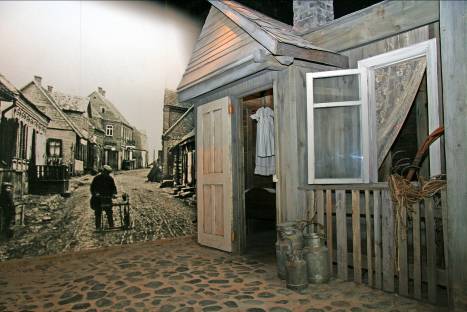
The Jewish Museum in Cape Town is more Lithuanian than Lithuania itself.
The Jewish Museum in Cape Town offers visitors a journey back in time. Most museums do. The striking feature of this museum, however, is that the journey to the past also brings us to a completely different part of our world, from Africa's southern tip to a seemingly modest little country far to the north, to a country where around 90% of South Africa's Jewish population has its roots (there are today about 80,000 Jews in South Africa).
The museum's basement is dominated by a village environment (shtetl) from the late 1800s. A few houses are reconstructed in full scale, and you can clearly see how people lived and co-existed at the time. The village is called Riteve. It was recreated in the museum on the basis of entries made in the 1990s by a group of experts who went from South Africa to Lithuania to find traces of the family of the museum's founder, Mendel Kaplan.
The village is called Rietavas in Lithuanian. It is there to this day, less than a half hour drive from Klaipeda, at the highway direction Kaunas and Vilnius. The Kaplan family emigrated from here in the 1920s, while the village's population was still 90% Jewish. Today, no Jews live in Rietavas.
- Posted by - (0) Comment
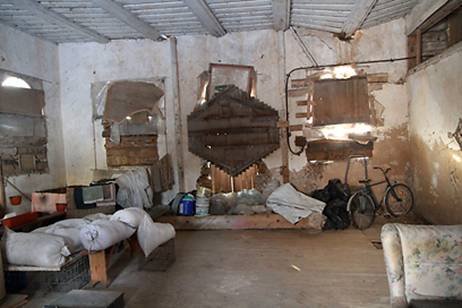
Inside of former synagogue. Used for storage (Photo: AFP)
Lithuania's wooden synagogues, the vestiges of a Jewish presence which was wiped out in the Holocaust, are falling into ruin from a lack of funding and support.
Hidden behind a row of houses, the wooden synagogue in the eastern town of Alanta looks more like a barn than a former house of worship.
This rundown building, which served as a fertilizer warehouse during the days of state farms, is now used for storage by Algis Jakutonis, a farmer living next door.
"I store my stuff there, and we still find traces of the Soviet era," said the 60-something Jakutonis, while displaying the large iron key to the former synagogue, which he acquired before Lithuania's independence in 1990.
- Posted by - (1) Comment
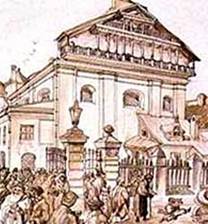
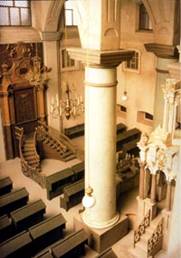
- Posted by - (7) Comment
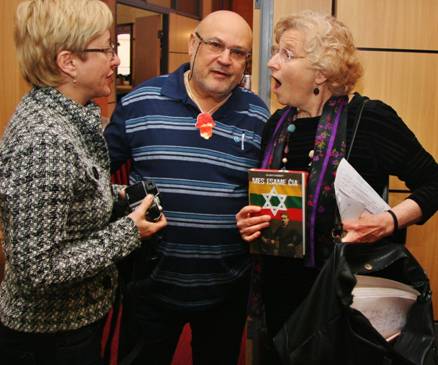
The U.S. author of the book "We are here" (Mes esame čia), Ellen Cassedy (right), was in Lithuania last month. Here in eager discussion about Jewish life in Lithuania before the Holocaust and now today.
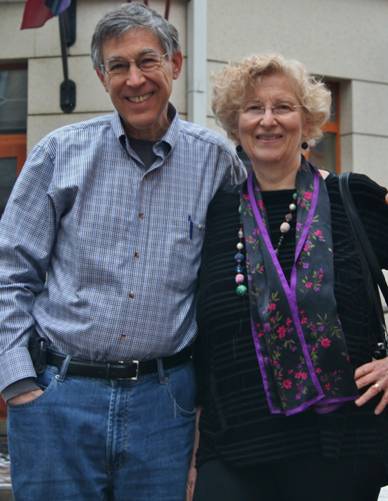
Ellen Cassedy in Vilnius last month, with her husband Jeff.
- Posted by - (1) Comment

Daniel Day-Lewis has received widespread critical acclaim for his
performance in the movie Lincoln.
VilNews has previously written that Hollywood largely was created by Litvaks, the Lithuanian Jews who have had so endlessly huge influence on world culture, science, business and politics.
Go to our VilNews Section 12 for case examples.
Now it turns out that the star of this year's major film, Lincoln, also has Lithuanian ancestry. And not only that; his Lithuanian grandfather, Michael Balcon, had enormous influence on the British film industry in its startup phase in the early 20th century.
His mother, Jill Balcon, was a leading English film and radio actress.
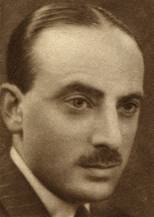 Sir Michael Balcon (1896 – 1977) grandfather. |
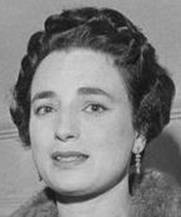 Jill Balcon (1925 – 2009) mother. |
About Sir Michael Balcon
Michael Balcon is considered one of the most important figures in British Cinema. It was his vision that brought international prestige to Gainsborough in the 20s and 30s. and he was a vigorous spokesman for the industry for most of his career.
Michael Balcon's career began in Birmingham in 1920, where, with Victor Saville he was a film distributor. Within two years they had begun producing feature films in London - Woman to Woman 1923 was the first. He formed Gainsborough Studios the following year. He visited the Ufa studios in Berlin in 1924 and began a co-production association with The Blackguard that was to last 10 years. German technical staff populated Gainsborough films through the 20s and early 30s giving them a slick, sophisticated veneer to match any film produced in Hollywood, Balcon was aiming for a product of international interest unlike many other British studios in the silent and early talkie era.
Read more: http://en.wikipedia.org/wiki/Michael_Balcon
About the movie “Lincoln”
Lincoln is a 2012 American historical drama film directed and produced by Steven Spielberg, starring Daniel Day-Lewis as United States President Abraham Lincoln and Sally Field as Mary Todd Lincoln. The film is based in part on Doris Kearns Goodwin's biography of Lincoln, Team of Rivals: The Political Genius of Abraham Lincoln, and covers the final four months of Lincoln's life, focusing on the President's efforts in January 1865 to have the Thirteenth Amendment to the United States Constitution passed by the United States House of Representatives. Lincoln premiered on October 8, 2012, at the New York Film Festival, and has since received widespread critical acclaim, with major praise directed to Day-Lewis' performance. In December 2012, the film was nominated for seven Golden Globe Awards including Best Picture (Drama), Best Director for Spielberg and winning Best Actor (Drama) for Day-Lewis. The film has been nominated for twelve Academy Awards, including Best Picture, Best Director for Spielberg and Best Actor for Day-Lewis.
- Posted by - (1) Comment
 |
IN MEMORY OF JEWISH KAUNAS |
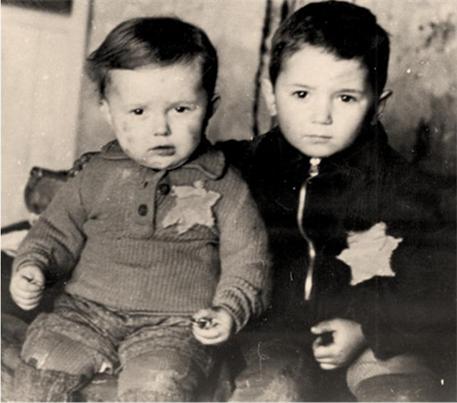
Two children in the Kaunas (Kovno) Ghetto, Lithuania.
Yad Vashem Photo Archive, 4789
What happened to the Jews in Lithuania during World War II is a matter of grim record. Of the 250.000 Jews in 1939, only between 12.500 and 17.500 survived; of those, only about 200 remain today.
It has been estimated that of the 265.000 Jews living in Lithuania in June 1941, 254.000 or 95% were murdered during the German occupation. No other Jewish community in Nazi-occupied Europe was so comprehensively destroyed.
The Red Army occupied Lithuania in June 1940, and the country remained under Soviet control until June 1941, when it fell to the invading German Army (Wehrmacht). On 8 July 1941 an order was issued stating that all Jews had to wear a special patch on their back; subsequently they were ordered to wear the patch on their chest. In addition Jews were forbidden to walk along the main streets of the city, and shops were ordered to sell them food in limited amounts. Jewish people were fired from their jobs, deprived of the means of personal transportation and radios, forbidden to use public transport, and prohibited from public places. Jews were arrested on the streets, at their work places, and in their houses.
The Kaunas (Kovno) Ghetto
Between 1920 and 1940, Kaunas (Kovno) was Lithuania's capital and largest city. It had a Jewish population of 35.000-40.000, about one-fourth of the city's total population. Jews were concentrated in the city's commercial, artisan, and professional sectors.
Kaunas was also a centre of Jewish learning. The yeshiva in Slobodka, an impoverished district of the city, was one of Europe's most prestigious institutions of higher Jewish learning, with a rich and varied Jewish culture. The city had almost 100 Jewish organizations, 40 synagogues, many Yiddish schools, 4 Hebrew high schools, a Jewish hospital, and scores of Jewish-owned businesses. It was also an important Zionist center.
Kaunas‘ Jewish life was disrupted when the Soviet Union occupied Lithuania in June 1940. The occupation was accompanied by arrests, confiscations, and the elimination of all free institutions. Jewish communal organizations disappeared almost overnight. Soviet authorities confiscated the property of many Jews. Meanwhile, the Lithuanian Activist Front, founded by Lithuanian nationalist emigres in Berlin, clandestinely disseminated antisemitic literature in Lithuania. Among other themes, the literature blamed Jews for the Soviet occupation. Hundreds of Jews were exiled to Siberia.
Following Germany's invasion of the Soviet Union on 22 June 1941, Soviet forces fled Kaunas. Immediately before and following the German occupation of the city on June 24, anti-Communist, pro-German Lithuanian mobs began to attack Jews (whom they unfairly blamed for Soviet repression), especially along Jurbarko and Krisciukaicio streets. These right-wing vigilantes murdered hundreds of Jews and took dozens more Jews to the Lietukis Garage, in the city center, and killed them there.
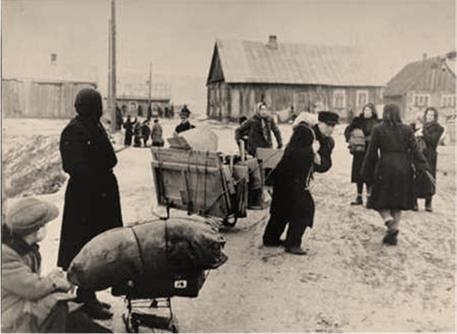
Moving into the Kovno Ghetto.
George Kadish, photographer, George Kadish, Florida.
- Posted by - (3) Comment
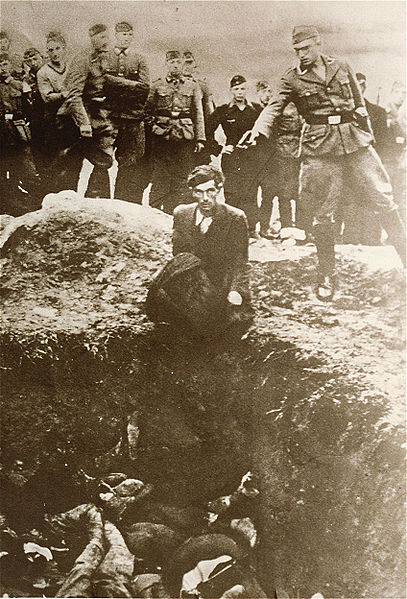
Thousands of Jews were killed to fall in pits like these.
Kaunas massacre of 29 October 1941, also known as the Great Action, was the largest mass murder of Lithuanian Jews.
By the order of SS-Standartenführer Karl Jäger and SS-Rottenführer Helmut Rauca, the Sonderkommando under the leadership of SS-Obersturmführer Joachim Hamann, and 8 to 10 men from Einsatzkommando 3, in collaboration with Lithuanian henchmen, murdered 2,007 Jewish men, 2,920 women, and 4,273 children in a single day at the Ninth Fort, Kaunas, Lithuania.
With the arrival of the SS Einsatzgruppen, the 'Great Action' began on October 28th. The Jewish inhabitants of the Ghetto were assembled on Democrats Square and all those fit for work were allowed back into the Ghetto. The others, over 9,000 men, women and children were marched to the SS execution centre in the Ninth Fort and there, stripped of their clothes and in the freezing cold, they awaited their fate. In groups of 200, they were stood on the edge of large pits, dug previously by Russian P.O.W.s, and were systematically machine-gunned to death.
- Posted by - (7) Comment
 How I escaped from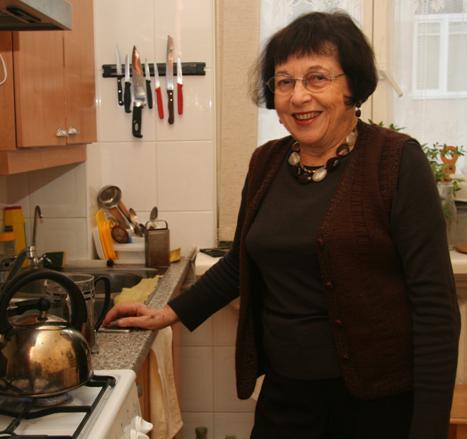
My coffee chat with Irena Veisaite (84) started here in the kitchen of her
cosy apartment in the outskirts of Vilnius Old Town. What a life story
hasn’t this gentle lady got to tell...
Text/photos: Aage Myhre
A room full of books. A desk covered with pamphlets, documents, newspaper clippings. Walls and bookshelves overcrowded with framed photographs of friends and relatives. Her today’s home in Vilnius is filled with warmth and wisdom.
Was this the way they lived? The Lithuanian Jews, often named as the Litvaks. Before the World War II horrific events so brutally took them and their culture here in Lithuania away forever? Or perhaps not forever?
Because here she lives, Irena Veisaite, born in this country in 1928. She is one of the few Litvaks who survived the Holocaust in Lithuania. A living evidence of cruelty and injustice. Yet with less bitterness and anger than you might think.
"Love," she says, "love is so much more important than hatred. Hatred is the most destructive feature that humanity possesses and even in the most difficult times I experienced a lot of kindness".
Irena was born in 1928 in Kaunas, the inter-war Lithuanian capital when Vilnius and the south-western part of the country was occupied by Poland. Her parents had a liberal European education and she grew up, as she describes, surrounded by very different people. She was playing with the neighbourhood children and never thought much of what nationality the other kids were. It was only when rumours of a potential war grew in strength that she began to feel a certain degree of insecurity.
Have your say. Send to:
editor@VilNews.com
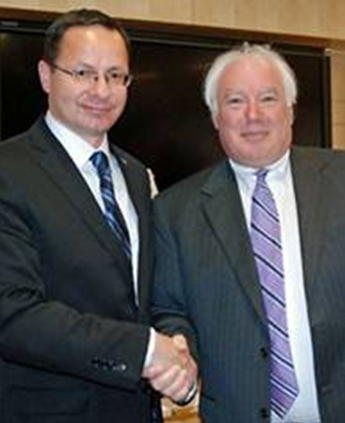 Harley Felstein, chair and founder of the Sunflower Project in USA, hits back:
 By reading Israeli newspapers one can hear more sobering voices. I say, It is time to heal the wounds and start living in peace again, as we have done for hundreds of years



 Lithuanian Jewish CommunityLietuvos Žydų Bendruomenė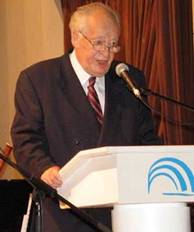
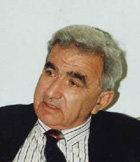
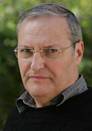
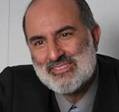
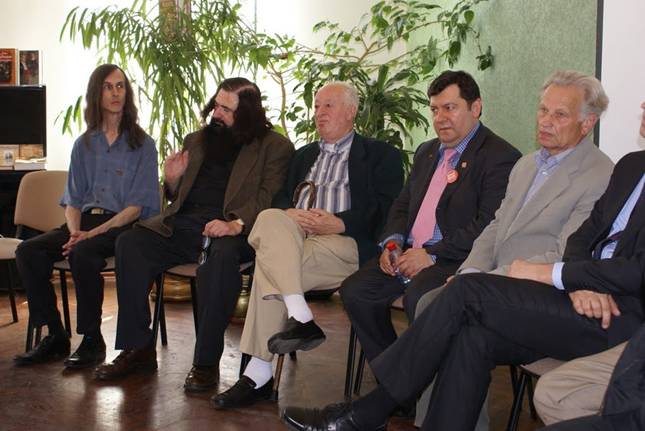 Jewish culture returns to VilniusWyman Brent, book collector, Professor Dovid Katz, director of the Litvak Studies Institute, Dr. Simonas Alperavičius, head of the Jewish Community of Lithuania, Emmanuel Zingeris, Member of Seimas (Parliament), Žibartas Jackūnas, Vilnius City Councillor.
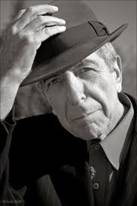 World famous LitvaksMany famous Jewish people lived and created in Lithuania. It was not for nothing that Vilnius was called "Jerusalem of the North" - as the wealth of its sages and of its religious scholarship competed with that of Jerusalem. The Jews made a large cultural and economic contribution, to both the Jewish people and to Lithuanians....
Congratulations on the VilNews debut in this new, expanded format. It looks very good indeed, is highly informative, and I wish you much success with it. The sheer amount of effort and dedication that must have gone into getting this undertaking off the ground is quite awe-inspiring. You are doing an important, noble thing for the beautiful country you love. It is indeed an exceptionally interesting, genuinely fascinating country, with a turbulent past and difficult present -- a place that, despite (and in part, due to) the many still-unresolved issues of history, never is not-interesting, where "the past is not dead. It isn't even past," to quote Faulkner -- and as someone who also has been held under its thrall for many years, I share your desire to see as many people as possible the world over to discover it, come visit -- and fall in love with it, too, and keep coming back. My very best wishes to VilNews.
Mikhail Iossel, Professor, Montreal, Canada
I am not sure about the source of the information entitled Jews in South Africa. Especially with regards to point 3, which clearly, in my opinion, is aimed at marginalising the involvement of Muslims in the anti-apartheid struggle... Read more...
Further to my comment above, one also has to acknowledge that Jews were regarded as White in Apartheid South Africa and enjoyed the benefits afforded to them as White South Africans. Some chose to oppose it, who have been duly honoured, and some chose to ride the wave of these benefits. Read more...
I appreciate that White South Africans, who chose to join the struggle had everything to lose. That is not what I dispute about the article. The article, in my opinion, does a direct comparison between Muslim and Jewish participation in the anti-apartheid movement, resulting in the Muslim involvement being marginalised. Why does it not measure Hindu, Buddhist or Christian involvement? I do not think that this forum, should be used as an instrument to spruce up anyone's involvement in the anti-apartheid movement at the expense of others. If the intention was to highlight the contribution of the Jewish community, then that's fine, as it is the Litvak forum, but definitely not at the expense of the Muslims or any other religious sect. Read more...
Correct – Jews were regarded as white in South Africa and did enjoy all the privileges. What made their sacrifices even more remarkable was that they put themselves at risk and all the privileges at risk to fight a fight where they were not victims themselves. Read more...
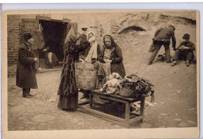
Stephanie Comfort's Jewish Postcard Collection has been featured in the premier launch of the online Lithuania News called the "VilNews e-magazine". The VilNews e-magazine was just launched on February 15, 2011 and hopes to be one of the most comprehensive online resources for Lithuania. We were very impressed with the scope of the articles, photos and vast scope of coverage of all things Lithuania and wish them much success.
JEWISH POSTCARD COLLECTION
http://jewishpostcardcollection.com/
VilNews e-magazine is published in Vilnius, Lithuania. Editor-in-Chief: Mr. Aage Myhre. Inquires to the editors: editor@VilNews.com.
Code of Ethics: See Section 2 – about VilNews. VilNews is not responsible for content on external links/web pages.
HOW TO ADVERTISE IN VILNEWS.
All content is copyrighted © 2011. UAB ‘VilNews’.