
THE VOICE OF INTERNATIONAL LITHUANIA

|
VilNews has its own Google archive! Type a word in the above search box to find any article.
You can also follow us on Facebook. We have two different pages. Click to open and join.
 Click on the buttons to open and read each of VilNews' 18 sub-sections Click on the buttons to open and read each of VilNews' 18 sub-sections  |

|


Archive for April, 2011
Stimulating publication
- Posted by - (0) Comment
Congratulations for the recent transformation of Vilnews. You have turned it into one of the most stimulating electronic publications on Lithuania. Well done indeed.
Yves Plasseraud, Writer, Paris - France
- Bookmark :
- Digg
- del.icio.us
- Stumbleupon
- Redit it

Beautiful piece of writing
- Posted by - (0) Comment
Many thanks. That is a beautiful piece of writing and a well laid out story perfectly befitting the January 13th. May I have permission to send this to the Lithuanian daily 'Draugas' for publication in Lithuanian and 'Bridges' for publication in English.
Stasys Backaitis, Washington dc – USA
- Bookmark :
- Digg
- del.icio.us
- Stumbleupon
- Redit it

Amazing but chilling stories
- Posted by - (0) Comment
Your Knowledge Fascinates me no end Aage, amazing but chilling stories.
Rajinder (Raj) Chaudhary
- Bookmark :
- Digg
- del.icio.us
- Stumbleupon
- Redit it

These realizations have given me a strong sense of kinship to the Indian people
- Posted by - (0) Comment


As an undergraduate student at Michigan State, I studied Asian Theatre History, and one of my favorite professors was C.C. Mehta, of the University of Baroda in Mumbai. We had to read the Mahabarata, a great epic poem, which had Varuna and Arjuna as characters. I remember thinking that this was the source of my brother’s name – Arunas. I also was intrigued by Hindu Aesthetic theory -Rasa- as one of mys sister’s has this name. These realizations have given me a strong sense of kinship to the Indian people.
Jurate Burns
- Bookmark :
- Digg
- del.icio.us
- Stumbleupon
- Redit it

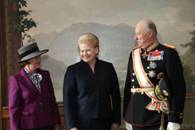
President Dalia Grybauskaitė at the Norwegian Royal Palace, where she met with King Harald V and Queen Sonja
After the meeting with the Royal Family, the President gave a lecture ‘Energy Geopolitics: Reasons and Achievements of Nordic-Baltic Cooperation' in the Norwegian Institute of International Affairs, dealing with geopolitical aspects of energy-related problems in Europe and underlining the need and mutual benefit of promoting active cooperation with Norway and other Nordic countries. The President also answered questions put by the students, the professoriate and guest experts.
"By this first state visit to Norway I wanted to underline and draw attention to the fact that the Northern dimension is one of Lithuania's foreign policy priorities and that our relations with Northern Europe are acquiring a shape of a very concrete and productive dialogue. Lithuanian-Norwegian relations are a perfect example of cooperation based on interests of the two peoples. Norway's political and financial support to Lithuania is very valuable and we have very good prospects of cooperation in the field of energy," President Dalia Grybauskaitė said.
Grybauskaitė also had a meeting with the President of the Storting (the Parliament) and Norway's Prime Minister Jens Stoltenberg.
During the visit, memorandums of understanding concerning the implementation of the Norwegian and the European Economic Area (EEA) Financial Mechanisms 2009-2014 providing for support in the amount of 84 million euros to Lithuanian projects, and a bilateral agreement concerning the transfer of sentenced offenders to serve sentence in their home country were signed.
Sad to see, though, that Norwegian media hardly have mentioned the visit.
- Bookmark :
- Digg
- del.icio.us
- Stumbleupon
- Redit it

- Posted by - (2) Comment
|
|


Text and photos: Aage Myhre
|
|


|
MADHUR ROY waits for me at the Delhi International Airport when I fly in from Mumbai in the late evening. She represents the Ministry of Foreign Affairs, and has been given the responsibility to show me around and introduce me to people I have special interest in meeting during my visit. On the way to the hotel she tells me about the programme. She also talks about her hobbies; filmmaking and singing. During my days in Delhi, she does a very good job, every day from early morning to late evening. A few days later, on the way to the airport, she sings a quiet, melodic song about herself, a song about the little girl from a village up in the mountains far to the north who came to live in the big city. I see tears rolling down her cheeks, and I feel very touched having got to know a person who not only performs her job in a very professional manner, but also dares to show her feelings in such a way. My visit to India got a new dimension after the meeting with Madhur. Thanks a lot!! |
|

|
|
INDIA India, officially the Republic of India, is a country in South Asia. It is the world’s seventh-largest country by geographical area, the second-most populous country with over 1.18 billion people, and the most populous democracy in the world. Mainland India is bounded by the Indian Ocean on the south, the Arabian Sea on the west, and the Bay of Bengal on the east; and it is bordered by Pakistan to the west, the People's Republic of China, Nepal, and Bhutan to the north; and Bangladesh and Burma to the east. India is in the vicinity of Sri Lanka, and the Maldives in the Indian Ocean, its Andaman and Nicobar Islands are also in the vicinity of the Indonesian island of Sumatra in the Andaman Sea, and in the Andaman Sea India also shares a maritime border with Thailand. India has a coastline of 7,517 kilometres (4,700 mi). |

Home to the ancient Indus Valley Civilisation and a region of historic trade routes and vast empires, the Indian subcontinent was identified with its commercial and cultural wealth for much of its long history. Four major religions, Hinduism, Buddhism, Jainism and Sikhism originated here, while Zoroastrianism, Judaism, Christianity and Islam arrived in the first millennium CE and shaped the region's diverse culture. Gradually annexed by the British East India Company from the early eighteenth century and colonised by the United Kingdom from the mid-nineteenth century, India became an independent nation in 1947 after a struggle for independence that was marked by widespread non-violent resistance.
India is a federal constitutional republic with a parliamentary democracy consisting of 28 states and seven union territories. Apluralistic, multilingual and multiethnic society, India is also home to a diversity of wildlife in a variety of protected habitats. The Indian economy is the world's eleventh largest economy by nominal GDP and the fourth largest by purchasing power parity.
Since the introduction of market-based economic reforms in 1991, India has become one of the fastest growing major economies in the world; however, it still suffers from poverty, illiteracy, corruption, disease, and malnutrition. India is classified as a newly industrialised country and is one of the four BRIC nations. It is a nuclear weapons state and has the third-largest standing armed force in the world, while its military expenditure ranks tenth in the world. It is a founding member of the United Nations, the East Asia Summit, the South Asian Association for Regional Cooperation and the Non-Aligned Movement and a member of the Commonwealth of Nations and the G-20 major economies.
|
|
DELHI (official name: National Capital Territory of Delhi - NCT) is the largest metropolis by area and the second-largest metropolis by population in India. It is the eighth largest metropolis in the world by population with more than 12.25 million inhabitants in the territory and with nearly 22.2 million residents in the National Capital Region urban area The name Delhi is often also used to include some urban areas near the NCT, as well as to refer to New Delhi, the capital of India, which lies within the metropolis. It is the capital of India and its political and cultural centre. Located on the banks of the River Yamuna, Delhi has been continuously inhabited since at least the 6th century BCE. |
|
|
MUMBAI, also known as Bombay is the capital of the Indian state of Maharashtra. It is the most populous city in India, and one of the most populous cities in the world, with a population of approximately 20 million. Along with the neighbouring urban areas, including the cities of Navi Mumbai and Thane, it is one of the most populous urban regions in the world. Mumbai lies on the west coast of India and has a deep natural harbour. Mumbai is also the richest city in India, and has the highest GDP of any city in South or Central Asia.
|


|
|


|
|


|
|
||||||||||||


 Incredible business growth

Geeta and Gulu Mirchandani in their beautiful Mumbai home
During my stay in Mumbai I get one night invited to the home of Geeta and Gulu Mirchandani. Gulu is an old acquaintance who since 1981 has developed and been in the forefront of the electronics giant ONIDA (Mirc Electronics). I consider Gulu one of the masterminds behind the impressive development India's economy has undergone over the last 30 years. He is also one of those behind the initiative 'Mumbai Angels' that provides a unique platform to start-up companies by bringing them face to face with successful entrepreneurs, professionals and executives, also helping with start-up funding. I believe this kind of support and team-work is what brings India quickly forwards in today’s harsh economic climate. Ref. www.mumbaiangels.com
|
|
The Gross Domestic Product (GDP) in India expanded at an annual rate of 8.80 percent in the 2nd quarter of 2010. From 2004 until 2010, India's average quarterly GDP Growth was 8.37 percent reaching an historical high of 10.10 percent in September of 2006 and a record low of 5.50 percent in December of 2004. India's diverse economy encompasses traditional village farming, modern agriculture, handicrafts, a wide range of modern industries, and a multitude of services. Services are the major source of economic growth, accounting for more than half of India's output with less than one third of its labour force. The economy has posted an average growth rate of more than 7% in the decade since 1997, reducing poverty by about 10 percentage points.
|

- Bookmark :
- Digg
- del.icio.us
- Stumbleupon
- Redit it
- Posted by - (21) Comment
 Incredible Indian-Lithuanian relations

Professor Lokesh Chandra (84), one of India’s leading experts on Sanskrit and Buddhism
It’s early morning in Delhi. I have been invited to the small, dark office of Professor Lokesh Chandra, one of India’s leading experts on Sanskrit and Buddhism. “The same year I was born, 1927, my father went to London to get a degree in Lithuanian language. He spoke the language fluently, but he never visited Lithuania,” tells the elderly professor, still with his Kashmir coat and cap on despite the outside temperature of close to 300 Celsius.
I soon learn that the professor’s knowledge about the connections between Old Sanskrit and Lithuanian language and ancient cultural ties between India and Lithuania is nothing but amazing. He confirms that there since ancient times have been unique ties between India and Lithuania, not only with regards to language. Also the songs, the medieval cultures and more were extraordinary closely connected to each other.
Here is what he tells me this early morning at his New Delhi office: “The very mention of Lithuanian opens up an image, a vision that gives a people their identity through language. It shows how the darkness of dreams becomes the new embodied hope. My father was stimulated and strengthened in his work on the development of Hindi by the history of Lithuanian language. It has been the eternal continuity of these people; - it rustles something deep in their being. My father felt that we in India share with our distant Lithuanian brothers the silent geography of lost frontiers. Political freedom is inseparable from language.”
And the professor continues with his amazing story: “My father would relate how grandmas in the remote villages narrated folk-tales to eager grandchildren in their Lithuanian language which was despised by the Slavised nobility and punished by the Czarist regime. My father also told me how the Lithuanian daina (songs) were abandoned by the courts, but still continued to live on in the villages, faithfully preserved by the poorest people of Lithuania, guarded by the mothers of the families even during the darkest periods of Lithuania’s history.”
“Such was my first contact with Lithuania, in 1937, at an age of ten,” smiles Professor Chandra.

 Sanskrit and Lithuanian are closely related
Since the 19th century, when the similarity between Lithuanian and Sanskrit was discovered, Lithuanians have taken a particular pride in their mother tongue as the oldest living Indo-European language. To this day, to some Lithuanians their understanding of their nationality is based on their linguistic identity. It is no surprise then that they proudly quote the French linguist Antoine Meillet, who said, that anyone who wanted to hear old Indo-European should go and listen to a Lithuanian farmer. The 19th century maxim - the older the language the better - is still alive in Lithuania.

Professor Shashiprabha Kumar, and her amazing team of specialists at the Centre for Sanskrit Studies at the Jawaharlal Nehru University in New Delhi, is convinced that there is a very strong connection between Old Sanskrit and Lithuanian
It is a common belief that there is a close similarity between the Lithuanian and Sanskrit languages; Lithuanian being the European language grammatically closest to Sanskrit. It is not difficult to imagine the surprise of the scholarly world when they learned that even in their time somewhere on the Nemunas River lived a people who spoke a language as archaic in many of its forms as Sanskrit itself. Although it was not exactly true that a professor of Sanskrit could talk to Lithuanian farmers in their language, coincidences between these two languages are truly amazing, for example:
SON: Sanskrit sunus - Lithuanian sunus
SHEEP: Sanskrit avis - Lithuanian avis
SOLE: Sanskrit padas - Lithuanian padas
MAN: Sanskrit viras - Lithuanian vyras
SMOKE: Sanskrit dhumas - Lithuanian dumas
These Lihuanian words have not changed their forms for the last five thousand years.
The relationship between Sanskrit and Lithuanian goes even deeper. Take, for example, the Lithuanian word 'daina' that usually is translated as 'song'. The word actually comes from an Indo-European root, meaning ‘to think, to remember, to ponder over’. This root is found in Sanskrit as dhi and dhya. The word also occurs in the Rigveda (ancient Indian sacred collection of Vedic Sanskrit hymns) in the sense of ‘speech reflecting the inner thoughts of man’.
Apart from its Indo-European background as word and term, the ‘daina’ incorporates the idea of the Sun-Goddess who was married to the Moon-God, reminiscent of goddess Surya in the Rigveda.
|
|
OM (also spelled AUM) is a Hindu sacred sound that is considered the greatest of all mantras. The syllable OM is composed of the three sounds a-u-m (in Sanskrit, the vowels a and u combine to become o) and the symbol's threefold nature is central to its meaning. |

- Bookmark :
- Digg
- del.icio.us
- Stumbleupon
- Redit it
You have presented a wonderful overview of India
- Posted by - (0) Comment


Madhur Roy
First of all a VERY BIG THANK YOU. I never ever imagined in the wildest of my dreams, that you would allow space for me in the esteemed VilNews. I am overwhelmed! It’s been one of the best birthday gifts, I must say.
As far as the content is concerned, you have presented a wonderful overview of India. No doubt India is much more then one could comprehend, nevertheless, you have very articulately in a compact manner put forward India as a whole, which as per my perspective is enough to understand the magnanimity of the country.
It’s been an honour!!
Madhur Roy
Delhi, India
- Bookmark :
- Digg
- del.icio.us
- Stumbleupon
- Redit it
As a person with Lithuanian roots it makes me proud to have some kind of connection to the greater humanity called India
- Posted by - (0) Comment
This is just so fascinating ! I have a love for India and the contrasts that I experienced there. It is a land like no other and one that no one can prepare you for when you land there.
The smells, taste and feel is and only belongs to India – a place I deeply respect. Whose people have an essence and a space in time that the West cannot imagine.
Thank you so much for sharing this. As a person with Lithuanian roots it makes me proud to have some kind of connection to the greater humanity called India.
Kim Feinberg
Johannesburg, South Africa
- Bookmark :
- Digg
- del.icio.us
- Stumbleupon
- Redit it
Thank you for this and many other marvellous articles. After perusing them, I take the liberty of sending them to over seventy friends all over the world.
Yours very sincerely,
Ambassador Algirdas Zemaitis
Rome - Vilnius
- Bookmark :
- Digg
- del.icio.us
- Stumbleupon
- Redit it

In February 2011, compared with January 2011, the volume of retail trade fell by 0.1% in both the euro area (EA17) and the EU27. In January retail trade rose by 0.2% and 0.4% respectively.
Among the Member States for which data are available, total retail trade fell in eleven and increased in ten. The largest decreases were observed in Slovenia (-1.3%), France (-1.1%) and Belgium (-0.8%), and the highest increases in Lithuania (+2.2%), Malta(+1.8%) and Estonia (+1.6%).
In February 2011, compared with February 2010, the retail sales index grew by 0.1% in the euro area and by 0.9% in the EU27.
In February 2011, compared with January 2011, “Food, drinks and tobacco” remained stable in both the euro area and the EU27. The non food sector decreased by 0.1% and 0.4% respectively.
In February 2011, compared with February 2010, “Food, drinks and tobacco” fell by 0.5% in the euro area and by 0.9% in the EU27. The non food sector increased by 0.9% and 2.4% respectively.
Among the Member States for which data are available, total retail trade rose in thirteen and decreased in eight. The highest increases were observed in Poland (+12.6%), Luxembourg (+8.8%) and Lithuania (+6.1%), and the largest decreases in Spain (-5.6%), Romania (-4.8%) and Portugal (-4.5%).
These first estimates come from Eurostat, the statistical office of the European Union.
- Bookmark :
- Digg
- del.icio.us
- Stumbleupon
- Redit it
Poll shows major drop in support for nuclear power in Lithuania after Fukushima catastrophe
- Posted by - (0) Comment
By: The Associated Press
A new poll shows nearly half of Lithuania's population have turned against nuclear energy following the catastrophe at a Japanese reactor.
A poll for Lithuanian magazine Veidas released Monday showed 88 per cent of Lithuanians, traditionally supportive of nuclear power, now oppose plans to build a new power plant — an increase of 47 per cent since January.
Some 42 per cent of those polled said the Fukushima Dai-ichi disaster had made them change their minds.
The March 28-30 poll surveyed 500 people and had a margin of error of 3 per cent.
Lithuania was one of the world's most nuclear-energy dependent countries before it closed its Soviet-era plant in Ignalina and has over some time been planning to build a new nuclear facility.
- Bookmark :
- Digg
- del.icio.us
- Stumbleupon
- Redit it

OPINIONS
Have your say. Send to:
editor@VilNews.com
Ph. D., Chicago
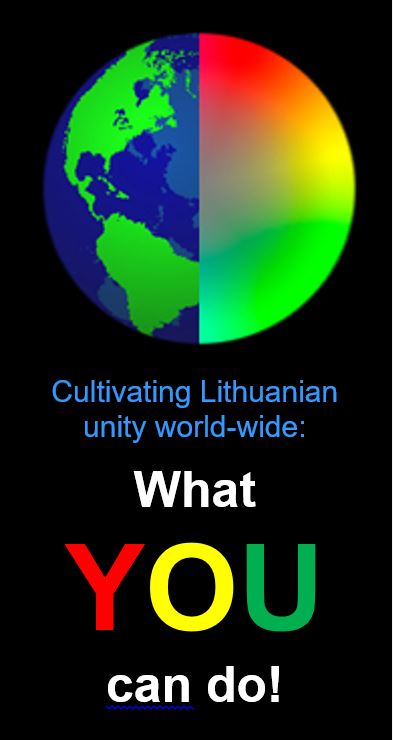
A wave of unity sweeps the international Lithuanian community on March 11th every year as Lithuanians celebrated the anniversary of the Lithuanian Parliament's declaration of independence from the Soviet Union in 1990. However, the sense of national unity engendered by the celebration could be short-lived.
Human beings have a strong tendency to overgeneralize and succumb to stereotypical us-them distinctions that can shatter even the strongest bonds. We need only search the internet to find examples of divisive thinking at work:
- "Those who fled Lithuania during World II were cowards -- and now they come back, flaunt their wealth, and tell us 'true Lithuanians' how to live."
- "Lithuanians who work abroad have abandoned their homeland and should be deprived of their Lithuanian citizenship."

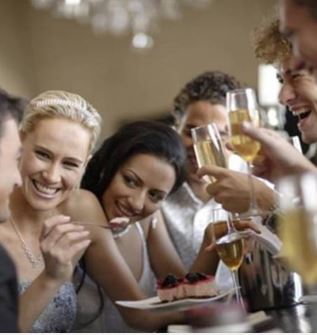
In Lithuania Christmas Eve is a family event and the New Year's Eve a great party with friends!
Lithuanian say "Kaip sutiksi naujus metus, taip juos ir praleisi" (the way you'll meet the new year is the way you will spend it). So everyone is trying to spend New Year's Eve with friend and have as much fun as possible.
Lithuanian New Year's traditions are very similar to those in other countries, and actually were similar since many years ago. Also, the traditional Lithuanian New Years Eve party was very similar to other big celebrations throughout the year.
The New Year's Eve table is quite similar to the Christmas Eve table, but without straws under the tablecloth, and now including meat dishes. A tradition that definitely hasn't changes is that everybody is trying not to fell asleep before midnight. It was said that if you oversleep the midnight point you will be lazy all the upcoming year. People were also trying to get up early on the first day of the new year, because waking up late also meant a very lazy and unfortunate year.
During the New Year celebration people were dancing, singing, playing games and doing magic to guess the future. People didn't drink much of alcohol, especially was that the case for women.
Here are some advices from elders:
- During the New Year, be very nice and listen to relatives - what you are during New Year Eve, you will be throughout the year.
- During to the New Year Eve, try not to fall, because if this happens, next year you will be unhappy.
- If in the start of the New Year, the first news are good - then the year will be successful. If not - the year will be problematic.
* If New Year's night is cold and starry - look forward to a good summer!
* If the during New Year Eve trees are covered with frost - then it will be a good year. If it is wet weather on New Year's Eve, one can expect a year where many will die and dangerous epidemics occur.
* If the first day of the new year is snowy - the upcoming year will see many young people die. If the night is snowy - mostly old people will die.
* If the New Year time is cold - then Easter will be warm.
* If during New Year there are a lot of birds in your homestead - then all year around there will be many guests and the year will be fun.
Christmas greetings
from Vilnius
and epic battle for the
future
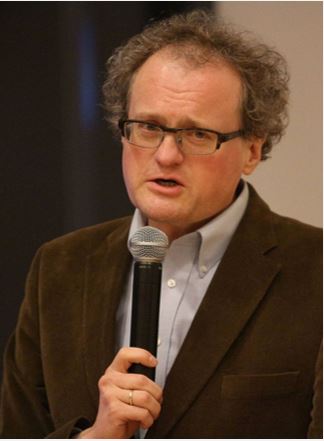
Philosopher, political theorist, historian of
ideas, social analyst, and political
commentator
Ukraine was and continues to be perceived by the EU political class as a sort of grey zone with its immense potential and possibilities for the future, yet deeply embedded and trapped in No Man's Land with all of its troubled past, post-Soviet traumas, ambiguities, insecurities, corruption, social divisions, and despair. Why worry for what has yet to emerge as a new actor of world history in terms of nation-building, European identity, and deeper commitments to transparency and free market economy?
Right? Wrong. No matter how troubled Ukraine's economic and political reality could be, the country has already passed the point of no return. Even if Vladimir Putin retains his leverage of power to blackmail Ukraine and the West in terms of Ukraine's zero chances to accede to NATO due to the problems of territorial integrity, occupation and annexation of Crimea, and mayhem or a frozen conflict in the Donbas region, Ukraine will never return to Russia's zone of influence. It could be deprived of the chances to join NATO or the EU in the coming years or decades, yet there are no forces on earth to make present Ukraine part of the Eurasia project fostered by Putin.
want to learn about the
new, scary propaganda
war between Russia,
The West and the
Baltic States!
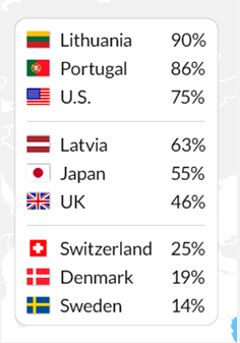
believe their government
is corrupt
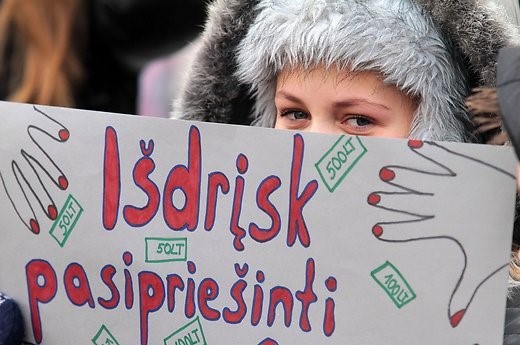
students say no to
bribes for doctors
During Soviet times, government was administered for the people in control, not for the local population, court decisions were decreed, they were not the administration of justice, and academia was the domain of ideologues. 25 years of freedom and openness should have put those bad experiences behind Lithuania, but that is not so.
Today, it is a matter of expectation that court pronouncements will be governed by ideological dictates. Few, if any Lithuanians expect real justice to be effected. For foreign companies, doing business in Lithuania is almost impossible in a situation where business people do not expect rule of law, so, surely Government would be a refuge of competence?
Lithuanian Government has not emerged from Soviet styles. In an attempt to devolve power, Lithuania has created a myriad of fiefdoms of power, each speaking in the name of the Government, each its own centralized power base of ideology.
Chepstow, Wales
Doesn't that sound suspiciously like Lithuania? Ah, but I didn't mention the mountains of Snowdonia, which would give the game away.
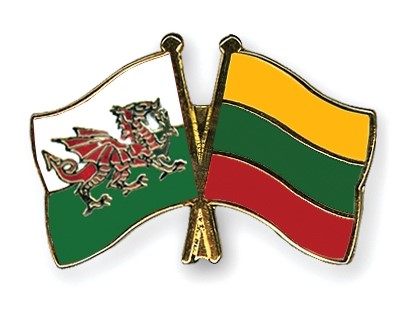
I'm talking about Wales, that part of the UK which Lithuanians used to call "Valija", but later named "Velsas" (why?). Wales, the nation which has welcomed two Lithuanian heads of state to its shores - firstly Professor Vytautas Landsbergis, who has paid several visits and, more recently, President Dalia Grybauskaitė who attended the 2014 NATO summit which was held in Newport, South Wales.
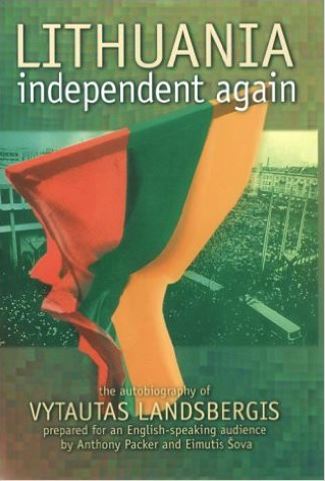
ENGLISH VERSION OF THE
AUTOBIOGRAPHY OF VYTAUTAS LANDSBERGIS.
Although Lithuanian activities have thinned over the decades as that postwar generation died out, the Lithuanian Martyrs' parish hall is crowded with many, many hundreds of visitors who come to the Lithuanian cemetery for All Souls' Day. Similarly, the Franciscan parish has standing room only for Christmas Eve mass.
Although I am firmly embedded in the literary culture of Canada, my themes are usually Lithuanian, and I'll be in Kaunas and Vilnius in mid-November 2015 to give talks about the Lithuanian translations of my novels and short stories, which I write in English.
If you have the Lithuanian language, come by to one of the talks listed in the links below. And if you don't, you can read more about my work at
www.anatanassileika.com
http://www.vdu.lt/lt/rasytojas-antanas-sileika-pristatys-savo-kuryba/ https://leu.lt/lt/lf/lf_naujienos/kvieciame-i-rasytojo-59hc.html
"My love and best wishes to all. As long as VilNews exists, there is hope for the future,"" she writes.
Irena Veisaite means very much for our publication, and we do hereby thank her for the support and wise commitment she always shows.
You can read our interview with her
Facing a new reality
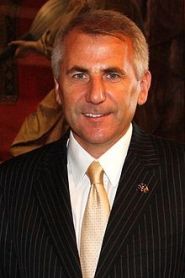
Dear readers of VilNews,
For a number of years, the EU and Russia had assumed the existence of a strategic partnership, based on the convergence of values, economic integration and increasingly open markets and a modernisation agenda for society.
Our agenda was positive and ambitious. We looked at Russia as a country ready to converge with "European values", a country likely to embrace both the basic principles of democratic government and a liberal concept of the world order. It was believed this would bring our relations to a new level, covering the whole spectrum of the EU's strategic relationship with Russia.
The likelihood of Putin
invading Lithuania
.jpg "lithuania today")
Founding Director at Summer Literary Seminars
Are all Lithuanian energy
problems now resolved?
Lithuania as a country does not have significant energy resources. Energy consuming infrastructure after WWII was small and totally supported by energy imports from Russia.
First nuclear reactor begins power generation at Ignalina in 1983, the second reactor in 1987. Iganlina generates enough electricity to cover Lithuania's needs and about 50%.for export. As, prerequisite for membership in EU, Ignalina ceases all nuclear power generation in 2009
The Klaipėda Sea terminal begins Russia's oil export operations in 1959 and imports in 1994.
Mazeikiu Nafta (current ORLEAN Lietuva) begins operation of oil refinery in 1980.
Have Lithuanian ties across
the Baltic Sea become
stronger in recent years?
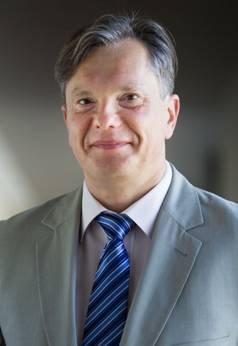
The two decades that have passed since regaining Lithuania's independence can be described as a "building boom". From the wreckage of a captive Soviet republic, a generation of Lithuanians have built a modern European state, and are now helping construct a Nordic-Baltic community replete with institutions intended to promote political coordination and foster a trans-Baltic regional identity. Indeed, a "Nordic-Baltic community" - I will explain later in my text the meaning of this catch-phrase.
Since the restoration of Lithuania's independence 25 years ago, we have continuously felt a strong support from Nordic countries. Nordics in particular were among the countries supporting Lithuania's and Baltic States' striving towards independence. Take example of Iceland, country which recognized Lithuania in February of 1991, well in advance of other countries. Yet another example - Swedish Ambassador was the first ambassador accredited to Lithuania in 1991. The other countries followed suit. When we restored our statehood, Nordic Countries became champions in promoting Baltic integration into Euro-Atlantic institutions. To large degree thanks Nordic Countries, massive transformations occurred in Lithuania since then, Lithuania became fully-fledged member of the EU and NATO, and we joined the Eurozone on 1 January 2015.
Have you heard about the
South African "Pencil Test"?
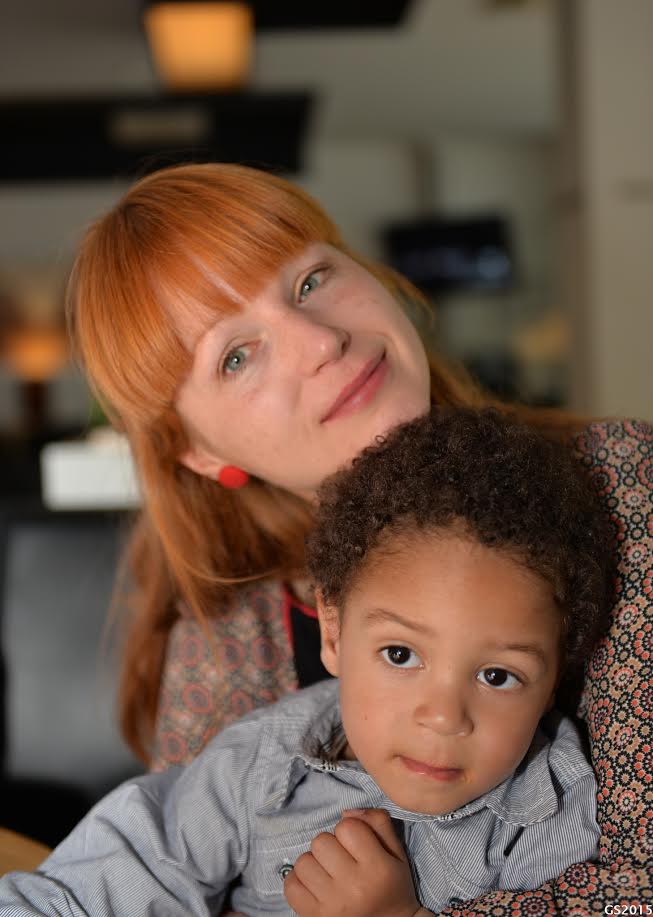
But that is exactly what happened to me when I came back from South Africa. I will tell you how.
VilNews e-magazine is published in Vilnius, Lithuania. Editor-in-Chief: Mr. Aage Myhre. Inquires to the editors: editor@VilNews.com.
Code of Ethics: See Section 2 – about VilNews. VilNews is not responsible for content on external links/web pages.
HOW TO ADVERTISE IN VILNEWS.
All content is copyrighted © 2011. UAB ‘VilNews’.