
THE VOICE OF INTERNATIONAL LITHUANIA

|
VilNews has its own Google archive! Type a word in the above search box to find any article.
You can also follow us on Facebook. We have two different pages. Click to open and join.
 Click on the buttons to open and read each of VilNews' 18 sub-sections Click on the buttons to open and read each of VilNews' 18 sub-sections  |

|


Archive for January, 2011
The 2nd FBI Director (1912-1919)
- Posted by - (0) Comment
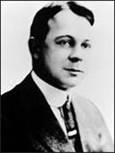 Lithuanian-American Alexander Bruce Bielaski was born in Montgomery County, Maryland. He received a law degree from George Washington University in 1904 and joined the Department of Justice that same year. Like his predecessor Mr. Finch, Mr. Bielaski worked his way up through the department. He served as a special examiner in Oklahoma where he “straightened out the court records” and aided in the reorganization of Oklahoma’s court system when the Oklahoma territory became a state. Returning to Washington, Mr. Bielaski entered the Bureau of Investigation and rose to become Mr. Finch’s assistant. In this position he was in charge of administrative matters for the Bureau. At the end of April 1912, Attorney General Wickersham appointed Mr. Bielaski to replace Mr. Finch. As chief, Mr. Bielaski oversaw a steady increase in the resources and responsibilities assigned to the Bureau. Read more…
- Bookmark :
- Digg
- del.icio.us
- Stumbleupon
- Redit it

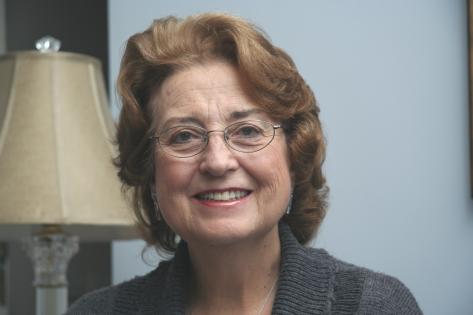
Regina Narusiene, Chairwoman of the World Lithuanian Community.
Regina Narusiene lives a busy double life. Through part of the year, she stays with husband and family in a small village 100 km. northwest of Chicago, but it’s not usual to see her for long periods at her home in Vilnius and work on behalf of ‘the international Lithuania’ – this nation outside the nation that includes about almost as many Lithuanians as the country’s resident population. Regina has been President of the World Lithuanian Community (WLC) since 2006. Before that she led the Lithuanian American Community Inc. (LAC) for six years and then was the president of the Board of Directors of that Community for another 6 years.
She is in Vilnius today, and invited me to her apartment, for an informal coffee chat about her life and observations about Lithuania and Lithuanians.
Dual citizenship. These two words have come to represent Regina's premier of the heart since she took over the leadership of WLC in 2006, the same year that Lithuania's Constitutional Court ruled that the country's Constitution had to be interpreted in such a way that individuals with citizenship of another country should not be allowed to have and keep Lithuania’s citizenship as well.
“The first few months after the court had made its terrible decision, at first I received almost 100 angry letters every day from Lithuanians and their descendants from around the world. They felt that the mother country had disowned them, cutting ties with them and that their efforts and desires to be citizens of Lithuania were not welcomed or respected. They felt that the mother country wanted to punish those who had emigrated, whether this occurred against the background of war, persecution or for economic reasons.”
Regina is herself a lawyer, with over 50 years legal practise in Illinois with her husband Bernard, litigating all types of court cases. Still, the ruling of the Lithuanian Constitutional Court has surprised her. She strongly argues that Lithuanian citizenship for those of Lithuanian descent is an inalienable constitutional birth right and that the government may not arbitrarily take it away.
"I maintain that people of Lithuanian heritage, who were born in Lithuania and have Lithuanian citizenship, have an inviolate birth right to citizenship. Lithuania cannot deprive them of this birth right. That right is guaranteed by the Constitution, but somehow that Constitutional right has been ignored. In my opinion, depriving Lithuanian citizenship to Lithuanians living abroad is against the best interests of Lithuania," she says, convinced that Lithuanians living abroad worldwide should be welcomed to participate in their motherland’s future through Lithuanian citizenship. The most valuable asset of a nation has is its people. When a substantial part of its people are rejected the nation dwindles. It self destructs.
She proceeds to tell me that the WLC laboured to supersede the decision statutorily, but that Presidents Adamkus and Grybauskaite declined to approve Parliament’s pro dual citizenship statutory enactments. Finally Lithuania did on 2 December 2010 enact a new citizenship law, which allows Lithuanians citizens and their descendants to preserve their Lithuanian citizenship if they emigrated before 11 March 1990. This new legislation prohibits dual citizenship for all those who emigrated after the reestablishment of Lithuania’s independence on 11 March1990, with the exception for those who received another country’s citizenship between January l, 2003 and November 16, 2006, the date the Constitutional Court decision became effective. The ruling is not applied retroactively, only prospectively. The new citizenship law becomes effective on 1 April 2011. The World Lithuanian Community takes the position that it is incorrect to take away the Lithuanian citizenship from Lithuanian descent people and their descendants that was acquired by birth. The Community does not support an unrestricted dual citizenship Constitutional amendment.
Behind a blue curtain
Our little coffee chat in Regina's apartment has an important and serious beginning, but I also wanted to know more about the personal life of Lithuania's international 'mom', so I ask if there is something she remembers from her childhood in Lithuania, during the early years of World War II.
On my request she tells me a dramatic childhood story, in deep emotion, but lightens up when she describes her years in America, where she was educated as a lawyer and became a successful attorney in partnership with her husband Bernard. She became active in her support for a free Lithuania early, and has been in the very forefront for political, economical, cultural, educational and social support to her home country during the last several decades.
But first her childhood story from wartime Lithuania:
“I was almost five years old, but I still clearly remember the day when a truck with Soviet soldiers drove up to the home we were hiding in Kaunas. My father ordered me to hide behind the blue curtains in the home’s living room and not make even the smallest move or sound. Our family was to be deported to Siberia and the soldiers had come to take us. It felt as though it took an eternity before my father returned and told me I could come out from my hiding place. A truck with German soldiers had come up behind the Soviet truck, forcing the Soviets to leave. That probably saved our lives. As the Soviets were returning to Lithuania in 1944 we escaped to Germany, and after living in Displaced Persons camp for 5 years, in 1949 we emigrated to the United States.”
KGB infiltrators in our US-LT societies
As the Soviets once more reoccupied Lithuania in 1944, Regina and her parents managed to get out of Lithuania. They knew that the fate awaiting them under a Soviet-controlled Lithuania would be deportation to northern Siberia's frozen tundra.
Like so many other Baltic refugees they came to eastern Germany, where they lived for a while in Dresden and were witnesses to the bombing and terrible destruction that took place during the war's final months. Regina's parents followed the war developments closely, and realized that they had to get farther west into Germany, or otherwise they risked to come under Soviet control in the part of the country that later became the DDR (East Germany). The day after the German surrender the family heading south-west. They had to walk 200 km on foot, while a smaller part of the trip took place on cattle trains. Finally they came to the city of Augsburg, north-west of Munich in the southern German region Bavaria where they stayed in a Displaced Persons camp until 1949, when a cousin in Chicago helped them to come over to the U.S.
Regina tells me that her father had a small notebook where he wrote down all the events, including the many concerns, which met the family during the escape from Lithuania until they finally were able to settle in Chicago.
"But he never told me much," she says. "Only when I got older I realized that my father was afraid of informers who could make life difficult for us, for our relatives who remained in Lithuania, and for the Lithuanian partisans who kept on fighting against the Soviet occupants well into the 1950s. The KGB had their own spies within the Lithuanian communities in the U.S., so we were extremely careful with what we said outside the home. I had, anyway, not so much to tell as my parents were very reluctant to share information with me. "
Until the 1960s, we thought we would someday return to Lithuania
Regina's new life in Chicago was similar to that of American children in general. She immediately attended high school, which was extremely difficult because she did not then posses basic English language skills. Seven years later, after acquiring a bachelor’s degree in Political Science at the University of Illinois she began to study law at the University of Illinois where she met her future husband, Bernard, and the two married in 1959. Bernard was also Lithuanian, but born in the United States. After graduation and having received their Juris doctors degrees, the two new lawyers opened their own law office. They raised three children and now have seven grandchildren.
"Through all these years, there was not a single day without us thinking of our beloved homeland - Lithuania. The very limited information coming out from the almost totally sealed Soviet Union, told us about terrible atrocities against our people. We heard vague stories about the incredibly tragic deportations of hundreds of thousands from the Baltics to Siberia, and we were told that thousands and thousands became victims of the terrorist regime that ruled our home country. It was very hard to realize that there was so little we could do, but we held together and kept the memory of Lithuania before the American people as best we could. In 1952, LAC (Lithuanian American Community Inc.) was founded, and quickly became the organization that united Lithuanians all over the United States together with a common bond. "
What a contrast it must have been between the post-war lives of the Lithuanians who managed to flee, before the borders were completely closed in 1944-45 and those who were trapped in a country that increasingly appeared as a prison it was virtually impossible to escape from alive. The only thing the Lithuanians in the U.S. could do with the tragedies that took place in their homeland was to transmit radio programmes in their native language through the station Voice of America to tell their country people that they were not forgotten and that they had to try to keep their spirits up even in those difficult times.
They did manage to convince the American government not to recognize the unlawful annexation of Lithuania into the Soviet Union. The Lithuanian Americans managed to maintain the pre-war Lithuanian Embassy in Washington and consistently advocate the Lithuanian cause.
LAC also did their utmost to lobby the U.S. authorities to pressure the Soviet Union out of Lithuania. Regina maintains that throughout the post-war period the Lithuanian-Americans kept alive the hope of a free Lithuania.
"Until the end of the 1960s we believed that Lithuania would again be a free and independent country and that we could return to. But then came the 1970s, as time went on our hopes began to fade," she admits with sorrow in her voice. She now looks out through the windows facing a Vilnius that today is free, peaceful and stunningly beautiful, but that not many years ago was eyewitness to incomprehensibly gruesome atrocities against its citizens.
The most thrilling moment of my life
The little eight year old girl who left home in a chaotic and dangerous escape from a cruel enemy in 1944, was to become a mature woman of 53 before she again could set foot on the home country's beloved soil.
In August 1989 Regina came back home, and on 23rd of August was standing in Vilnius along with tens of thousands of other Lithuanians and held hands in a 600 km long human chain that stretched from Vilnius to Tallinn. Fifty years had passed since Molotov and Ribbentrop had signed the infamous pact that was to be the beginning of a bloody and deadly hell, unprecedented in Europe's history, for a population that did not want anything but to live in peace and harmony.
"I felt the rebirth of my homeland, and when I stood there in the line with my dear countrymen to mourn all those who had been killed and tortured by a regime of madness, and heard our Lithuanian national anthem resound from the speakers around Vilnius, with hope for a new time to come. I was moved to tears more than any time earlier in my life. That moment was the most thrilling I've ever experienced. And I decided then and there to do my very best to help Lithuania to again be resurrected, and grow as a proud and strong nation." The lawyer, politician and activist who has experienced so much, and through her profession and life learned how to act professionally and balanced in all circumstances, had become clearly emotional.
President Bush Sr. at first chose a head-in-the-sand attitude
"Understandably, I was full of enthusiasm and optimism when I returned to the United States in 1989. The Lithuanian Americans quivered with excitement and jubilation, and we were soon organized to exert supportive pressure through all political, media and other channels we had access to. I think my uncle in Lithuania, having been deported to Siberia, expressed how we all felt, in one single sentence, when he said that he had been in Siberia and that he was not under any circumstances letting this chance for freedom slip by."
But the battle for secession from the Soviet Union was still not won. Gorbachev's sweet words about freedom for all the Soviet states were not truthful so all means had now to be used to ensure Lithuania's independence. The Lithuanian parliament's declaration of freedom 11 March 1990 was the first and most important step in that direction, but it was also more and more obvious that the Soviets would resist. Regina tells me that when Professor Landsbergis came to Washington 9 December 1990, he was convinced that the Soviet military would take action against Lithuania. Landsbergis met with U.S. President Bush Sr. to tell him this, but President Bush was unwilling to do anything at all at that time and went instead for a head-in-the-sand approach, telling us that the U.S. could not let the USSR fall apart, due to nuclear concerns etc.
“Fortunately however, the Baltic desk at the State Department in Washington was unwilling to accept such attitudes. We spent efforts to effectively exert pressure on all sides. Among the first things we were very pleased with was the cooperation with Iceland, which was the world’s first nation to recognize Lithuania's new independence. Tacitly the U.S. authorities supported Iceland's recognition, but they felt they couldn’t take a similar step so soon," explains Regina.
When the Soviet troops attempted to re-impose complete control of Lithuania on 13 January 1991, Regina and the Baltic organizations in the United States were quick to condemn the attack. "I hold you personally responsible, Mr. Gorbachev," she said in an interview with CNN that was carried nationwide in the United States.”
A change of mindset is necessary in today’s Lithuania
In 1994 Regina Narusiene was elected President of LAC (Lithuanian American Community Inc.). She held this position through two terms, until 2000, then she served as chairman of the LAC Board of directors for two terms until 2006, when she was elected President of the WLC (World Lithuanian Community) and now is in her second 3-year term as leader of the this 'nation outside the nation'. During the 20years that have passed since Lithuania regained its freedom, she has made tireless efforts for her homeland. She spearheaded the drive in the United States for the admission of Lithuania into NATO from January 6, 1994 until its official admission into NATO on 29 March 2004. She has served as an advisor on various matters to most of the Prime Ministers of Lithuania and extensively contributed her legal talents with respect to the printing and issuance of the Lithuanian currency - Litai. She is a founding member and continues to serve as a member of the Lithuanian Royal Palace Foundation. She feels that she has always been personally well received in Lithuania.
“Recently however, I've heard some in Lithuania say that Lithuania does not need or want our help. Still I see significant reluctance to improve the country's legal systems. It seems that some of the country's leaders simply are not ready to or interested in implementing urgently needed reforms. I am saddened to see the public’s perception that rule of law is still not working effectively in Lithuania." Regina sighs a little deflated when she shares those thoughts with me.
Towards the end of the conversation I ask her to express some thoughts on what it takes to get Lithuania to grow stronger and better over the years to come. I'll let her words finish my little report from our coffee talk:
"Let me first say that it is deeply tragic to see so many young, talented and beautiful people leave this country. Some say that it is now no longer talk of emigration, but evacuation. It is therefore obvious that much more must be done to pave the way for good jobs and opportunities for the country's younger population. But it is also my opinion that we need a shift in mindset among some of the country's leaders.”
“Last but not least, I yearn to see far more of the population, young and old, engaged in voluntary public oriented organizations and activities. That is exactly what democracy for a large part is about, and it does not take much. Lithuania's people should begin to take such initiatives themselves. A good, democratic society consists of people who give of themselves to help each other. Lithuania has unfortunately still a long way to go in this respect.”
“I will conclude by saying that it is important for the nation to maintain good relations with all Lithuanians, and their descendants, now living in other countries.”
“Lithuania needs a new global strategy, and we in the ‘Lithuanian World Community’ will do our utmost to contribute to such a strategy. Lithuania has an enormously large group of smart Lithuanians and good hearts outside the country, and it is important that Lithuania invite to dialogue with them and seek their support and input to promote a better future for Lithuania, the country we all love. "
- Bookmark :
- Digg
- del.icio.us
- Stumbleupon
- Redit it

Citizenship and loss thereof
- Posted by - (2) Comment
Text: Regina F. Narusis, J.D.
Why is Lithuanian citizenship so important to Lithuanian emigrees ? The reasons why so many emigres posses a desire to regain and to maintain citizenship status with their country of origin are many. First and foremost, citizenship is the most important real tie to their homeland , for which they continue to posses an abiding love and affection. It is a symbol, if not tangible, and marker of one‘s identity throughout the world.
Read more...- Bookmark :
- Digg
- del.icio.us
- Stumbleupon
- Redit it

The Lithuanian World Community
- Posted by - (1) Comment

The Lithuanian World Community (Lithuanian: Pasaulio lietuvių bendruomenė or PLB) is a non-governmental and non-profit organization established in 1949 that unifies Lithuanian communities abroad. The Constitution of the Lithuanian World Community declares that it consists of all Lithuanians living abroad. The Community is active in 36 countries, including representation in Lithuania. Read more...
- Bookmark :
- Digg
- del.icio.us
- Stumbleupon
- Redit it

Lithuanian footsteps in South Africa
- Posted by - (0) Comment
Text and photos: Aage Myhre
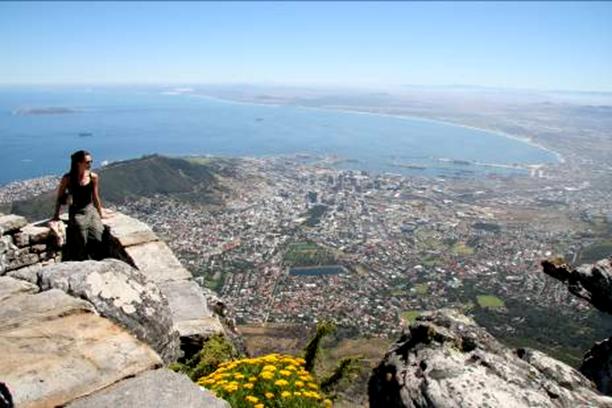
For the tens of thousands Litvaks who came to South Africa during the years 1860 – 1940, the Cape Town harbour was the first glimpse they had of their new homeland.
It is considered that around 90% of the approximately 80,000 Jews living in South Africa are of Lithuanian descent (the so-called Litvaks), which thus constitutes the largest pocket of Litvaks in the world! You are hereby invited to learn more about this unique Jewish community that still holds Lithuania alive in their hearts, museums and synagogues.
Read more...- Bookmark :
- Digg
- del.icio.us
- Stumbleupon
- Redit it

- Posted by - (0) Comment
Greetings to VilNews from the Holy Land!
Postcard from Darius Degutis, Lithuania’s Ambassador to Israel and South Africa

Lithuania and Israel are 4000 kilometers apart but this does not prevent us from enjoying and developing a strong partnership. Together, our two countries are embarking on an agenda which is directed at our future, at the opportunities that the 21st century provide to us – we are expanding our economic ties, developing cooperation in the fields of high-tech and innovations, boosting the spirit of entrepreneurship, promoting tourism.
2010 was a remarkable year for our partnership: Israeli Foreign Minister paid a first ever official visit to Lithuania, we witnessed an exchange of seven high level Governmental and Parliamentary visits, three Lithuanian business forums were held in Israel, and a number of cultural events took place. A very positive year of 2010 was crowned by the visit of the Prime Minister of Lithuania, Andrius Kubilius, the first in 16 years.
We have promising plans for 2011 as well: the visit of President Peres to Lithuania is expected, Israel’s Minister of Trade and Industry will bring to Lithuania an Israeli business mission, Lithuania will participate in an International Tourism Exhibition in Tel Aviv and in Jerusalem Book Fair, an Lithuanian IT companies are planning further expansion of their activities in Israel.
A very special place is devoted to the history of the Lithuanian Jewish community – the Litvaks. Their story covers the period of more than 600 years. Jews came to Lithuania in the 14th century and they were granted full privileges and rights by Lithuanian Grand Dukes Gediminas and Vytautas Magnus. Later in 1623 the Lithuanian state acknowledged self governed Jewish council which enabled Jewish community to carry its autonomous and fully fledged life.
President of Israel Shimon Peres once said, “you can not be Jewish unless you are Lithuanian or a Litvak as it is known in Yiddish language and Litvak is not just the name of the place, it is a unique character and a major culture”.
Vilnius was not just the main city for the Litvaks, it also served as a cultural and spiritual center for Jewish communities of the whole region. Even today we hear the echo of the wisdom of Elijah ben Shlomo or as he is widely known Gaon of Vilna (1720-1797).
Litvaks have left an important and deep footprint in the history of Lithuania. They contributed significantly to the development of culture, science, business not only in Lithuania and Israel, but in many other countries as well.
President Shimon Peres, Prime Minister Benjamin Netanyahu, Knesset Speaker Reuven Rivlin, Samuel Bak, Menachem Begin, Eliezer Ben Yehuda, Romain Gary, David Gering, Laurence Harvey, Jascha Heifetz, Grigorij Kanovich, Jacque Lipschitz, Icchokas Meras and many, many other most prominent people and outstanding personalities who are recognized and respected all over the world belong to the same family – the family of Litvaks.
But nothing brings Lithuania and Israel closer than our common passion for basketball. Sarunas Jasikevcius or Sharas as he widely is known in Israel is a true hero of our two nations. Equally loved and praised by every Lithuanian and Israeli, Sharas, by helping Maccabi team to win two European trophies, became a living legend for basketball fans all over Israel.
The European Basketball Championship of 2011 will be held in Lithuania. Shall we say that Lithuania becomes a champion by winning over Israel in the final...?
Ambassador Darius Degutis
Graduated from Vilnius University in 1986. Began his work career in the International Chamber of Commerce, Lithuania Branch. Later export Manager for the company Audėjas. Joined the Lithuanian Ministry of Foreign Affairs in 1991, Nordic countries department. Was appointed Counselor and Deputy Head of Mission to the Lithuanian Embassy in Denmark, 1992. 1998-2001: Deputy chief of mission at the Lithuanian Embassy in USA. 2001-2004: Ambassador in Poland. 2009: Appointed Ambassador of Lithuania to the states of Israel and South Africa.
D. Degutis was awarded the Order for Merits to Lithuania the Commander’s Cross.
- Bookmark :
- Digg
- del.icio.us
- Stumbleupon
- Redit it
Jewish culture returns to Vilnius
- Posted by - (1) Comment
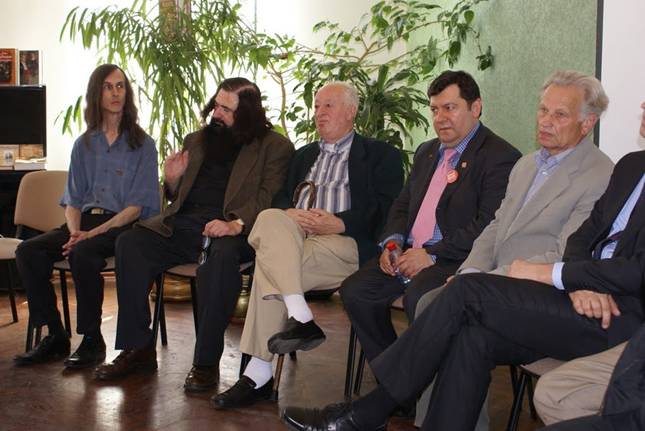
(Left-right): Wyman Brent, book collector,
Professor Dovid Katz, director of the Litvak Studies Institute,
Dr. Simonas Alperavičius, head of the Jewish Community of Lithuania,
Emmanuel Zingeris, Member of Seimas (Parliament),
Žibartas Jackūnas, Vilnius City Councillor
Photo: Žilvinas Beliauskas
10 June 2010 was an important day for bridge building and reconciliation in Lithuania, as representatives of the local Jewish community, the diplomatic corps and others met to participate in the first display of books compiled by American Wyman Brent.
Many of us had a certain feeling of participating in writing a new chapter of history when we met this early June day. Vilnius, which for hundreds of years had been one of the world's most important centres of Jewish culture and learning, was, as we know virtually wiped out from the Jewish world map during the Holocaust, but as we meet here - individuals from many countries, nationalities and cultures - this early summer day to celebrate that an American Baptist has collected more than 5,000 books for what eventually will become a Jewish library of 200,000 titles, the feeling of a new dawn is clearly present.
Wyman Brent's planned new library is not the only signal. Two other men, professor Dovid Katz and professor Mikhail Iossel, have also been very active recently. As a result, last year, the new Litvak Studies Institute was established in the premises of the Jewish community in Vilnius city centre.
These two events have not healed the wounds after the Holocaust in this country, and it will take a long time and many more efforts before this will happen. But it is important to maintain and preferably breathe new life into what was once a thriving Jewish culture here. The efforts that are now being made by these three gentlemen is nothing less than admirable, and one could therefore hope that 10 June 2010 represented a turning point in the positive direction.
- Bookmark :
- Digg
- del.icio.us
- Stumbleupon
- Redit it
World famous Litvaks
- Posted by - (5) Comment

Many famous Jewish people lived and created in Lithuania. It was not for nothing that Vilnius was called "Jerusalem of the North" - as the wealth of its sages and of its religious scholarship competed with that of Jerusalem. The Jews made a large cultural and economic contribution, to both the Jewish people and to Lithuanians.
During the 19th and 20th century, tens of thousands of Lithuanian Jews emigrated to the United States of America. Many Lithuanian Jews also emigrated to South Africa which became famous as a haven for its 120.000 Jews who were spared the Holocaust. A small number also emigrated to the British Mandate of Palestine. The rise of the Nazis in Germany and the ensuing Holocaust destroyed the vast majority of Jews who had not managed to leave Lithuania and its environs.
Jews of Lithuanian origin are today in leading roles and positions around all the world – some of our nowadays most famous politicians, scientists, businessmen, economists, actors, writers and singers have Litvak background.
The Gaon of Vilnius

Elijah Ben Solomon (1720 - 1797).
The word "gaon" means genius and on no person could this title be more appropriately bestowed than on Rabbi Eliyahu of Vilna. Rabbi Eliyahu was probably the most influential Jewish leader in modern history.
Rabbi Eliyahu's great abilities began to show at a very early age. At the age of seven he gave his first public discourse and displayed a fully developed intellect. By the time he was ten he had advanced to the point where he no longer needed a teacher. When he was still a young man, Rabbi Eliyahu accepted upon himself "galus", self-imposed exile (a not unheard of practice at that time), in which he wandered from community to community as a beggar. This lasted for a period of some years whereupon he returned to Vilnius.
His diligence in learning was unsurpassable. The Gaon's son testified that for fifty years his father did not sleep for more than two hours in a twenty-four hour period. His breadth of knowledge was amazing, and he was knowledgeable in almost all secular fields and authored books on grammar and mathematics. His righteousness and kindness were also legendary. Despite his personal poverty he always gave 20% of his income to charity.
Possibly the Gaon's single biggest contribution to the Jewish people was his corrective notes on most of our ancient texts, particularly the Talmud.
The Gaon passed away in 1797 leaving behind a tremendous legacy, both from his vast and varied writings on all Torah subjects and from his outstanding students who went on to spread Torah throughout the people of Israel. After Solomon’s death, about 50 (out of surviving 70) of his works, mostly commentaries on the Bible and Talmud, were published, as well as The Principles of the Hebrew Grammar (1833), and the Fundamentals of Algebra, Geometry and Astronomy (1834).
Litvaks lead Israel
|
|
Prime Minister of Israel. Born 1949 in Tel Aviv, Israel. Grandson of Nathan MILEIKOWSKY from Lithuania, who changed his name to Netanyahu when he arrived in Tel Aviv from Lithuania in 1930. Mr. Netanyahhu‘s parents immigrated to United States, where he attended high school in Philadelphia, PA and later MIT and Harvard. A member of the conservative Likud party, he was Prime Minister from June 1996 to July 1999 and became the first (and to date only) Prime Minister of Israel to be born after the creation of the state. He was Finance Minister of Israel until August 9, 2005, when he resigned in protest of the Gaza Disengagement Plan advocated by Prime Minister Ariel Sharon. Mr. Nethanyahu is today the ninth and current Prime Minister of Israel, serving since March 2009. Netanyahu also serves as the current Chairman of the Likud Party, as a Knesset member, as the Health Minister of Israel, as the Pensioner Affairs Minister of Israel and as the Economic Strategy Minister of Israel. |

|
|
Ehud Barak Leader of Israel’s Labour Party and Minister of Defence and Deputy Prime Minister in Binyamin Netanyahu's government. Born 1942 in Kibbutz Mishmar Hasharon, Palestine), former Prime Minister of Israel (1999-2001). Ehud Brog (he changed his name to Ehud 'Barak' -lightening- when he entered the army) was born in a kibbutz which his father, who emigrated from Lithuania, founded in 1932. Barak is the oldest of four brothers and remained on the Kibbutz until he joined the Army at age 17. He Received a B.Sc. degree in physics and mathematics from Hebrew University in Jerusalem and a M.Sc. degree in 1978 in economic engineering systems from Stanford University in California. |

Famous Jews with Lithuanian origin or parentage
· Roman Abramovich, Oligarch and owner of Chelsea F.C.
· Moshe Arens, former Israeli defence minister and foreign minister
· Naum Aronson, sculptor. Born in Kreslavka, worked in Paris. Moved to USA.
· Aharon Barak, President of the Supreme Court of Israel from 1995–2006
· Ehud Barak, Israeli Chief of Staff, foreign minister, prime minister, defence minister and Labour leader
· Erran Baron Cohen, English-born trumpeter and composer
· Sacha Baron Cohen, English-born entertainer
· Jillian Becker, South African writer
· Menachem Begin, Israeli Prime Minister from Brest-Litovsk
· Dan Bern, American folk singer, poet, painter
· Ben Bernanke, Chairman of the United States Federal Reserve
· Michael Bloomberg, New York Mayor
· Sydney Brenner, biochemist, Nobel laureate 2002
· Eli Broad, American philanthropist and investor; founder of KB Home
· Charles Bronson, American actor
· Marc Chagall, Russian-born French painter
· Leonard Cohen, Canadian singer-songwriter, poet and novelist
· Aaron Copland, U.S. composer, original family name was Kaplan
· Irwin Cotler, Canadian Minister of Justice and Attorney General from 2003–2006, and international human rights lawyer
· Melvyn Douglas (Melvyn Hesselberg), American actor
· Bob Dylan, U.S. singer-songwriter, author, musician and poet (original name was Robert Allen Zimmerman)
· Yaffa Eliach, Author (wrote Hasidic Tales of the Holocaust)
· Bernard Friedman, South African politician
· Brian Epstein, The Beatles Manager
· Harrison Ford, American film actor and producer
· Massimiliano Fuksas, Italian architect
· Romain Gary, French writer
· Philip Glass, U.S. minimalist composer
· Leopold Godowsky, composer and pianist
· Emma Goldman, anarchist
· Itamar Golan, pianist
· Nadine Gordimer, 1991 Nobel Prize for literature
· Bernard Gordon, South African businessman and philanthropist, Rand pioneer, founder of Kibbutz Mayan Baruch in Israel
· Lauren Grant, modern dancer, Mark Morris Dance Group. Maternal grandfather from Lithuania, circa 1900.
· Aron Gurwitsch, philosopher in the field of phenomenology
· Laurence Harvey, British actor
· Esther Hautzig, award-winning writer
· Jascha Heifetz, acclaimed 20th century violinist born in Vilnius
· Seymour Hersh, American journalist
· Moe Howard (born Harry Moses Horwitz), Shemp Howard (born Samuel Horwitz) and Curly Howard (born Jerome Lester Horwitz) of the Three Stooges, a U.S. comedy trio
· Jay M. Ipson, founder and president of the Virginia Holocaust Museum in Richmond
· Al Jolson, singer-songwriter, dancer, entertainer
· Mendel Kaplan, was a South African Jewish industrialist, philanthropist and community activist
· Ronnie Kasrils, South African communist leader, minister of Intelligence Services
· Sol Kerzner, South African casino magnate (Sun City)
· Joseph Klausner, scholar of modern Hebrew literature and former Israeli presidential candidate
· Aaron Klug, biophysicist, Nobel laureate 1982.
· Hillel Kook, Revisionist Zionist activist, politician, and prominent member of the Irgun
· Tony Leon, South African former opposition leader
· Emmanuel Levinas, philosopher
· Peggy Lipton, U.S. actress
· Jacques Lipchitz, sculptor
· Emmanuel Lubezki, 3 time Academy Award nominee, cinematographer
· Sergio Lubezky, Latin American photographer
· Alexander Ziskind Maimon, author and scholar
· Benoit Mandelbrot, mathematician, regarded as the founded of fractal geometry
· George Marcus, anthropologist
· Michael Marks, founder of retail network Marks and Spencer
· Sammy Marks, ‘father’ of Litvak South Africa, businessman, politician, entrepreneur
· Walter Matthau, U.S. actor
· Gideon Mer, Israeli scientist who worked on malaria research
· Hermann Minkowski, mathematician (born in Kaunas)
· Clara Nathanson, sculptor. Lithuanian (Vilnius, b.1887)
· Benjamin Netanyahu, Israeli Prime Minister, original family name was Milikowsky
· Amos Oz, Israeli writer, novelist and journalist
· Fanny Mikey, Colombian theatre impresario, daughter of a Lithuanian immigrant to Argentina
· Pink (Alecia Moore), U.S. musician, mother is of Lithuanian Jewish ancestry
· Maury Povich, U.S. talk-show host
· Shloyme Zanvl Rappoport, author and Jewish folklorist who under the pseudonym, S. Ansky wrote the play, The Dybbuk
· Winthrop Paul Rockefeller, Rockefeller family, U.S., Republican politician (his mother was a Litvak)
· Willy Ronis, photographer
· Jerome David Salinger, writer
· Milton Shapp (b. Milton Jerrold Shapiro), cable TV pioneer and governor of Pennsylvania; parents were Lithuanian Jews
· Ariel Sharon, former Israeli Prime Minister, from a family of Georgian Jews of Lithuanian descent
· Joe Slovo, South African Communist and MK leader, minister of construction in Nelson Mandela's government
· Chaïm Soutine, painter
· John Stewart, U.S. TV comedian
· David Suchet, famous English actor
· Helen Suzman, South-African anti-apartheid activist
· Moshe/Michael Tchaban, Lithuanian born singer-songwriter
· Vilna Gaon, preeminent religious leader and Talmudist
· Meir Vilner, Israeli communist leader, the last of the signatories of Israel's declaration of independence to pass away
· Mary Louise Weller, U.S. actress and model
· Harry Dexter White, economist
· Lewis Wolpert, South African born geneticist
· L.L. Zamenhof, founder of the Esperanto language
· Paul Zukofsky, violinist and conductor from New York.
|
Lenoard Cohen |
Bob Dylan |
Harrison Ford |
Charles Bronson |


- Bookmark :
- Digg
- del.icio.us
- Stumbleupon
- Redit it
Israel’s flag
- Posted by - (1) Comment
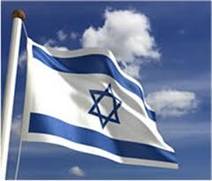
Israel’s flag was designed by a Lithuanian Jew.
The flag was initially made for the Zionist movement by David Wolffsohn (1856-1914), a Zionist leader from Lithuania’s Baltic Sea coast. The flag was first flown at the First Zionist Congress in Basel, Switzerland, in 1897, and became the official Israeli flag when the State of Israel was proclaimed in Tel Aviv on 14 May 14 1948.
David Wolffsohn was born in Darbenai, a village north of Palanga, in 1856 where he received a traditional Jewish education. He moved in 1872 to Memel (Klaipeda) and then again to East Prussia, finally making his home in Cologne in 1888. Here he became a successful businessman.
Wolffsohn had been active in Jewish affairs throughout his travels but it was in Cologne that he first became involved in Zionist activities. In 1893, together with Max Bodenheimer , he established the Cologne Association for the Development of Agriculture in the Land of Israel, which was one of the Hovevei Zion groups of the time. In 1896, immediately after he heard of Herzl's impending publication of Der Judenstaat, Wolffsohn travelled to Vienna, to meet with the future leader of the Zionist movement.
Wolffsohn soon became Herzl's associate and was a member of the Inner Actions Committee until 1904. He went with Herzl on his tour to Constantinople and Eretz¬Israel where they met with Kaiser Wilhelm II. Wolffsohn became one of the central figures in the establishment of the Jewish Colonial Trust and later became its first president. But in this capacity he experienced a number of differences with Herzl who despite his lack of financial experience interfered in the running of the bank.
Despite these difficulties, Wolffsohn remained loyal to Herzl even during the Uganda plan controversy and rather than to oppose the leader of the Zionist Organization, Wolffsohn maintained his silence.
After Herzl's death, Wolffsohn assumed the position of President of the World Zionist Organization continuing the political and diplomatic priorities of his predecessor. The practical Zionists and the Democratic faction opposed his re-election in 1911 although he continued his work with the Jewish Colonial Trust. He died on 15 September 1914, in Hamburg, Germany.
- Bookmark :
- Digg
- del.icio.us
- Stumbleupon
- Redit it
Napoleon named Vilnius ‘Jerusalem of the North’
- Posted by - (0) Comment
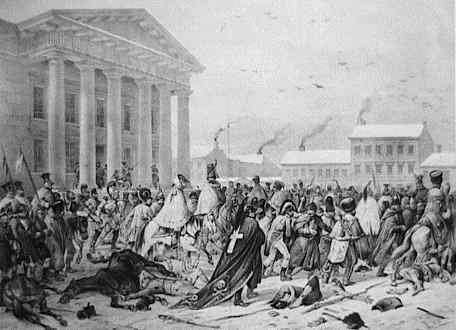
Napoleon’s soldiers at the Vilnius’ Old Town Hall, 1812.
It was a midsummer Wednesday year 1812. On this day, the 24th of June, Napoleon Bonaparte crossed the Nemunas River with his huge army, heading for Vilnius. Napoleon stayed in Vilnius for 18 days, until the 10th of July, awaiting the Russian Tsar's reply to his new peace offer. It is said that Napoleon himself became very surprised on what met him in Vilnius, a city so far away from the European mainstreams and still with a lively Mediterranean mood and life.
Napoleon was the one who started calling Vilnius ‘Jerusalem of the North’, and it was the first and only "Jewish city" Napoleon would ever see. He was no doubt aware of the Crusades, Inquisitions, pogroms and laws designed to discourage Judaic life. But there it was, right before his eyes, an exception to the rule.
And true enough, the history of the Litvaks, as the Lithuanian Jews were called, is unusual and surprising. It was a history of mostly peaceful coexistence with other peoples and cultures that lasted for more than six centuries. It was a history that spawned an incredible number of eminent Jews, not the least of whom was Elijah ben Solomon Zalman (1720-1797), also known as “The Gaon of Vilnius”.
The "Golden Age of Jewry" in Lithuania started with Grand Duke Gediminas (1275-1341), the empire builder who took a liking to foreigners and Jews whose skills and education were badly needed in medieval Lithuania. In the early 1300's he attracted them to his realm with numerous perks, including guarantees of religious freedom and tax exemptions. The Jews of Europe responded in droves, and Vilnius became the heralded centre of Jewish culture and learning. There would be synagogues, schools, theatres, publishing houses and the Yiddish Institute of Higher Learning. At a time when others in Europe were effectively illiterate, all the Jews in Vilnius could read and write. This was so unusual that it provoked the invention of a brand-new word, "Vilner," meaning "an educated man with knowledge." For almost 700 years, the Litvaks became an inseparable part of Lithuanian society, having enriched the country’s economy, culture, science, and education.
During the Second World War, about 200,000 (95%), Lithuanian Jews were murdered. This was the greatest loss in all of Eastern and Central Europe. The Nazi Holocaust led to an almost complete extermination of Lithuania’s Jews, and also destruction of their history and cultural monuments - a most tragic page of Lithuanian history.
- Bookmark :
- Digg
- del.icio.us
- Stumbleupon
- Redit it
The memory of my Kupiškes grandfather
- Posted by - (3) Comment
|
|
|
|
“This postcard was the last sign of life my father had from his father. It was sent from my grandfather’s home here in Kupiskes (North Lithuania) in March 1941 to my father’s new home in Pretoria (South Africa), but my grandfather was most probably already dead when the postcard reached Pretoria late summer 1941. He was killed by the Nazis”. Attorney Ivor Feinberg, Lithuania’s consul in Pretoria, is obviously very touched when he visits his grandfather’s house in Kupiskes, telling us about the last memory of his grandfather – a memory not unlike many other stories related to the about 70,000 Jews of Lithuanian descent living in South Africa. Pictures: Aage Myhre |
|


Lithuanians dominate the Jewish community in South Africa to an extent seen in no other country, even their former home. "We have around 80,000 to 90,000 Jews in South Africa, and about 80 percent of them are of Baltic descent, most of them from Lithuania," said David Saks, an historian and researcher at the Jewish Board of Deputies in Johannesburg. "We probably have the most 'Lithuanian' Jewish community in the world," said Saks, whose own grandparents came from Lithuania. This ratio even exceeds that of Lithuania itself as most of the Baltic state's small Jewish community, now numbering a mere 5,000, is comprised mostly of immigrants who arrived from different parts of the Soviet Union after World War Two.The war devastated Lithuanian Jewry, once a leading centre of Jewish thought and culture. Historians estimate that 94 percent of the country's pre-war Jewish population of 220,000 perished in the Holocaust. The capital Vilnius, once known as the Jerusalem of the North, was home to a thriving community of 60,000 Jews, with more than 90 synagogues and the biggest Yiddish library in the world. Aside from one functioning synagogue, few traces of its rich Jewish past remain. "South Africa is more Litvak than Lithuania itself...we see our culture and society have been preserved there," said playwright and novelist Mark Zingeris, one of the few Litvaks remaining in Lithuania.
- Bookmark :
- Digg
- del.icio.us
- Stumbleupon
- Redit it
The Great Synagogue of Vilna
- Posted by - (3) Comment

The great synagogue in Vilnius

The Great Synagogue of Vilna which once stood at the end of Jewish Street in the centre of Vilnius (where today’s courtyard between Vokieciu Street and Stikliu Street i located), was built between 1630-1633 after permission was granted to construct a synagogue from stone. Standing on the spot of an existing synagogue built in 1572, the site had first been used to house a Jewish house of prayer in 1440.
According to legend it was so magnificent and impressive, Napoleon who stood on the threshold of this synagogue in 1812 and gazed at the interior was speechless with admiration. The synagogue had a number of entrances. One, at street level, consisted of a pair of iron gates which, had been donated by a tailors’ society in 1640. The other entrance on the western side, added in 1800, was a bit more imposing. An elevated two-tiered wooden gable with a portal and wrought iron posts. There was a heavy iron door with an original Hebrew inscription indicating it was a gift of a "society of Psalm reciters" in 1642.
At the time of its building,ecclesiastical regulations all through Europe specified that a synagogue could not be built higher than a church. To obey the law, and yet create the necessary interior height, it was customary to dig a foundation deep enough for the synagogue’s floor level to be well below that of the street. Outside, the synagogue looked to be about three stories tall, but inside it soared to over five stories. Another entrance with a vestibule and the “pillory” was located on the northern side of the building.
The interior of the synagogue was redesigned in the mid-18th century by Vilnian German Johann Christoph Glaubitz. It had the overwhelming grandeur of an edifice in the style of the Italian Renaissance and an awe-inspiring atmosphere. Four massive, equidistant columns supported the vast stone-floored pile, and within them was the three-tiered ornate, rococo almemar, with a beautiful cupola, supported by eight small columns. It was built in the second half of the eighteenth century by Rabbi Judah ben Eliezer (commonly known as the YeSoD - an acronym of the three words Yehudah Sofer ve-Dayyan), the famous scribe and judge.


Interiors
The two-tiered Holy Ark on the eastern wall was a splendid structure, intricately carved with gilded woodcarvings, representing plants, animals and Jewish symbols, with a double-headed eagle on top. It was approached by a twofold flight of steps, with iron balustrades, ascending from the right and the left. Hanging from the walls and ceilings there were numerous bronze and silver chandeliers. The synagogue contained a valuable collection of ritual objects. The building was repaired in the 19th century.
Formerly there was an imposing seven-branched brass candelabrum in front of the Ark, but on the eve of the German invasion of the city during theWorld War I, it was sent off to Moscow. There also once was a “Chair of Elijah” in the northwest corner on which the rite of Brit milah was performed.
On both sides of the Holy Ark there were two-story structures, serving as the women’s sections, connected to the prayer hall by little windows. Another gallery for women was situated along the north side, also consisting of two floors built by Noah Feibusch Bloch, a community elder who advanced the money and when the community was unable to return the 14,000 gulden due, he made a present of the structure.
The main prayer hall was square and could hold 300 people. The synagogue was designed on a substantial and massive scale, for it was also intended to serve as a stronghold within which the Jews could take refuge in times of danger. On the High Holy Days before World War II the synagogue held 5,000 worshippers.
In 1846, when Sir Moses Montefiore visited the synagogue, the treasurers distributed entrance tickets to the masses of people.
The synagogue was partly destroyed by the Germans during World War II. The ruined synagogue and the whole “schulhof” complex which had grown around it were demolished by the Soviet authorities from 1955 to 1957 and were intentionally replaced by a basketball court and a school to effectively prevent any future initiatives to rebuilt a cultural monument.
Three original pieces from the Great Synagogue of Vilna survived the destruction quite miraculously and are now on display at the Vilna Gaon Jewish Museum: a door of the Holy Ark, a reader’s desk, and a bas-relief with the Ten Commandments.
Source: Wikipedia
|
|
- Bookmark :
- Digg
- del.icio.us
- Stumbleupon
- Redit it

|
EUROPE’S LONGEST AND
BLOODIEST GUERILLA WAR LITHUANIA, LATVIA & ESTONIA 1944 - 1953
Lithuanian ‘forest brothers’ from the so-called "Vytis" military district. |

EUROPE’S LONGEST AND BLOODIEST
GUERILLA WAR IN MODERN TIMES
THE BALTIC STATES 1944 – 1953
Text: Aage Myhre
Pictures: Mostly from the KGB Museum in Vilnius
Tell a Lithuanian that it was today, the 9th of May 1945, that his country was liberated and peace after WWII restored. Tell him that this 2010 May it is 65 years since the Soviet Union and the Western world defeated Hitler's Nazi regime, and that Lithuania since then has been a free, happy country in line with what other European countries experienced after they were occupied in 1939 –1940 and liberated in 1945. Do not be surprised if you get an angry and annoyed look back. For while we in the Western world, in Russia and in other parts of the world joyfully could celebrate the liberation and the recovered freedom after the World War, Lithuania, the other two Baltic states, and Ukraine were forced to realize that one war had been replaced by a new, much bloodier and more protracted war, lasting from 1944 to at least 1953. What we in the west celebrated in May 1945 was by Lithuanians and the other occupied countries experienced only in 1990 –1991.

The end of World War II saw Germany dramatically reduced in size. Before long
it was also divided into East and West. Germany's defeat meant that Poland
and Czechoslovakia returned to the map of Europe after a six-year absence.
But not so for Estonia, Latvia, Lithuania, Ukraine and northern East Prussia
(Kaliningrad) that all remained occupied by the USSR.
Western radio stations told us, who were lucky enough to grow up on the western side of the iron curtain, thoroughly about the Hungarian uprising against the Soviet intervention in 1956, an uprising that resulted in 2,500 Hungarians and 700 Soviet soldiers losing their lives.
Western television stations showed us in detail what happened when Czechoslovakia was invaded in 1968 by more than 200,000 troops from the Warsaw Pact countries Soviet Union, Poland, East Germany, Hungary and Bulgaria - with the outcome that 72 Czechs and Slovaks were killed when they tried to resist.
However, we got almost nothing to know about the many, many times bloodier uprising against the Soviet that was happening right outside our own front door, in the Baltic States, through nine long years from 1944 to 1953.
It is estimated that approximately 30,000 Balts and 100,000 Soviet soldiers died in this bloody guerrilla war when Estonians, Latvians and Lithuanians withdrew into the woods to organize its powerful armed partisan resistance after the Soviet Union at the end of the second World War, in 1944, pushed the German forces out, and Stalin decided to incorporate the Baltic States into his powerful autocracy instead of giving these countries their freedom and independence back. Today we know that this tragic, involuntary occupation and oppression was to last the whole 47 years, from 1944 to 1991.

Entering a Siberian Gulag (leaf from Eufrosinia Kersnovskaya's notebook). During the period 1940 – 1953
Stalin’s Soviet deported approximately 600,000 individuals from the Baltic States to Siberia.
Around 100,000 of them never returned to their homelands.
In addition to the 30,000 Balts who died in direct combats with the Red Army during this nine-year guerrilla war, comes all those who died in or on their way to Siberia, all because of their resistance to the Soviet raids home in the Baltics. It is considered that Josef Stalin was responsible for the deportation of not less than 600,000 Baltic people to the permafrost concentration camps and the gulag prisons during these years, and that probably as many as 100,000 of them died during the stay or during the three-month journey where they were stuffed into icy cold, miserable cattle wagons with thin straw mats as mattresses, and very limited food rations to survive on during the long way to the cold hell, thousands of kilometres north and east.
We speak, in other words, about an almost unimaginable and too little known purges of totally 130,000 people from the Baltic States during the very first years after the Second World War. But let us not forget that also the approximately 100,000 Soviet soldiers who died were victims of the same madness that almost a quarter million people were exposed to by an inhuman despot, still by many is regarded as a hero in Russia, Georgia and other former Soviet republics. The despot Adolf Hitler almost pales in comparison.
In comparison, 58,000 Americans died during the Vietnam War in the years 1960-75, and we were all fed with regular updates on how the war evolved, almost minute by minute.
The distance between the free, western country of Sweden and Lithuania is less than 300 kilometres, shorter than the distance between Vilnius and Klaipeda. But despite the short distance, there was remarkable little information that reached the West about the tragic carnage that took place so close to our own front doors after the war.
We probably had enough to lick our wounds after five years of occupation and the World War II. Even today there are very few people who know much about the bloody Baltic guerrilla war. This is, for example all my Norwegian Encyclopaedia gives of information: "The armed resistance against the Soviet regime took the form of guerrilla groups in the forests (forest brothers) and had a large scope. Only in 1953 the armed resistance ebbed out."

Lithuania’s WWII: Torn apart by two super powers.

Many of the partisans were young men returning to Lithuania from the West after WWII to fight for their beloved home country. Here are three of them, with their official and nick names: K. Sirvys - "Sakalas", J. Luksa - "Skirmantas", B. Trumpys - "Rytis". Very few ‘Western partisans’ returned to the West. Almost all of them were killed by the Soviets.
Partisans, or "forest brothers" as they called themselves, were found in all three Baltic countries, but it was in Lithuania that the major groupings were found. It was also here that the really huge death tolls came. It is considered that 22,000 partisans and 70,000 soldiers from the Red Army and NKVD were killed in Lithuania alone, this in addition to the approximately 60,000 Lithuanians who died in Siberia during the early post war years.
The Lithuanian partisans usually appeared in uniforms, with national insignias and identification of rank as like other nations' armies. It is said that the Lithuanian soldiers always saved the last bullet for themselves; they knew all too well that torture, a symbolic trial and execution by hanging, head shot or group execution awaited them if they were captured.
The post war Guerrilla War in Lithuania is normally divided into three different phases:
- The first phase lasted from July 1944 to May 1946, with violent skirmishes and casualties on both sides. More than 10,000 forest brothers lost their lives in battles and skirmishes during these two years. Partisans captured during this period small towns from the Soviet forces, local quisling units were disarmed and the occupants’ offices were destroyed. But the big losses meant that tactics had to be changed.
- The second phase lasted from May 1946 until November 1948. The Lithuanian units were then divided into smaller groups that hid in well-camouflaged bunkers. During this period a joint command was established for all Lithuanian forces fighting against the occupying army. Contacts were also made contacts with the West in this period, but no help arrived.
- The final phase lasted until May 1953. And despite the brutal oppression and forced collectivization, around 2,000 partisans were still active with their armed resistance against the occupation. During this period, they also worked extensively with informing the Lithuanian people by publishing newspapers, books and leaflets. Circulation varied from a few hundred to 5,000. Such publications lasted until 1959.
There were also parallel battles against Soviet forces in Estonia and in Latvia, but in much smaller scale. Only in Western Ukraine, there was fighting in the same scale as in Lithuania.

The Forest Brothers often used cellars, tunnels or more complex
underground bunkers as their hideouts, such as the one depicted here.
The Baltic Partisan War came mostly to an end by May 1953, two months after Joseph Stalin died. But the last active resistance man in Lithuania shot himself, rather than surrender, as late as 1965, and the last partisan did not come out from his hiding place before 1986, 42 years after the guerrilla war in the Baltics started.
In 1955, the Soviet-controlled 'Radio Vilnius’ offered amnesty to all the partisans who were still hiding in Lithuania's deep forests, and in 1956 the KGB repeated a similar provision. Such amnesty-deals were of course meant only to lure the last forest brothers, so when the famous partisan leader 'Hawk' was taken that the same year, he was immediately given a symbolic trial and executed. Hawk was an American-born Lithuanian who had returned to his home country to fight the Soviet occupation.
Instead of giving themselves over to the Soviet occupiers, many chose to commit suicide, often by exploding a grenade right in their own faces in order to destroy them so much that they would not be identifiable and thereby create a risk to their relatives' lives. Such suicides occurred until around 1960. Many also managed to obtain false identity and get back into society without being detected.
Many of the Soviet Union's atrocities against the Baltic States have only come to light in earnest after 1991 when these countries regained their freedom and independence. A large part of the archives that mentioned the said matters were, however, brought to Moscow to prevent the World from having access to these highly revealing documents.
But, strangely, in 1994 a former KGB officer decided to go to the Lithuanian authorities with detailed information about how torture and executions had taken place at the KGB headquarters in the Vilnius city centre. He told that there had been secret burials for the victims, just on the outskirts of Vilnius. When the huge mass grave he had told about was found and opened, several hundred corpses of partisans were discovered, all in Lithuanian uniforms, and all obviously tortured to death.
One can ask whether it was a fatal mistake for a small country like Lithuania to so aggressively a predominance they had to understand they would not be able to defeat. Admittedly, there is a general perception that Lithuania thereby was avoiding most of the ‘russification’ that Stalin and later leaders implemented in all other Soviet republics. The Russians were simply too afraid of the Lithuanians as a result of the strong opposition during the post-war years, hence the proportion of Russians in Lithuania today represents only 6% of the population, compared to more than 30% in Latvia and around 25% in Estonia.
But the bloodshed in the Baltics, and the incredibly extensive deportations to Siberia, as a result of the partisan opposition, made that these three countries lost too many of their best men and women. The hero status they may have achieved around the world never became significantly large. We in the West did not know what really happened, and when we finally learned, far too many decades have passed to achieve a proper attention for the heroes, the very guerrilla war, the deportations and the unbelievable sufferings the Baltic people underwent on the Siberian permafrost during the 1940s and 1950s.
Lithuania, Latvia and Estonia have paid an extremely high price for their rebellion behaviours, and are unlikely ever to receive the honour and the redress they deserve for their courage to fight the injustice they were subjected to during the ruthless Soviet period.
When World War II ended, the West chose to forget Lithuania

The historic meeting near the end of World War II, the Yalta Conference, became fatal for Lithuania.
It involved three key allied leaders. Left to right: Winston Churchill, Prime Minister of the United Kingdom;
Franklin D. Roosevelt, President of the United States; and Joseph Stalin, Premier of the Soviet Union.
For several years after World War the Balts believed that the U.S. and other Allied powers would come to their rescue and help to free them from the Soviet occupation. This was fatal.
The partisan leaders were familiar with the Atlantic Charter, which was signed by Churchill and Roosevelt 12 August 1941 aboard the U.S. cruiser Augusta in Newfoundland, a charter later acceded to on 1 January 1942 by all countries involved in the war against Germany and Japan - including the Soviet Union. This declaration stated that all territorial changes resulting from the war would only take place after the population's own desires, and that any people should have the right freely to choose their form of government.
What the Baltic people did not know, was that their case head was not at all discussed when the British Prime Minister, Winston Churchill, the U.S. President Franklin D. Roosevelt and the Soviet leader Josef Stalin in February 1945 met in the city of Yalta on the Black Sea to lay the conditions for peace and the post-war period. The Baltic States were totally forgotten; but they did not know about it, and therefore continued the impossible fight against the evil superior force until 1953.
It has been speculated that Roosevelt's failing health may have been the reason why Stalin so easily got the upper hand at the Yalta Conference. The outcome was, in any case, very tragic for the Baltic States, and only in 2005 the American president, George W. Bush came here to apologise on behalf of the United States. Russia’s President, Vladimir Putin, was also asked to apologise for the atrocities against the Baltic States in the years after Yalta. But Russia still considers that they 'liberated' the Baltics and sees no reason to excuse themselves. It went even so far that Putin declared Lithuania's President Valdas Adamkus 'persona non grata' after the latter refused to come to Moscow to participate in Russia’s anniversary celebration of the Soviet victory over Nazi Germany on 9 May 2005.
In the years after WWII a number of Lithuanian agents were amazingly capable of getting in and out of the country several times, and in December 1947 a full delegation travelled to Western Europe to present their case to the Pope and to Western governments. But no countries or leaders dared go into conflict with Stalin's Soviet Union, and Lithuanians call for help was largely met with deaf ears.
Though not quite. Both U.S. and UK intelligence agencies gave their orders to see what might be done to create secret anti-communist organizations and operations behind the Iron Curtain. They also helped to organise the radio stations 'Radio Liberty' and 'Radio Free Europe', which for many years thereafter conveyed useful information to the Baltics. In 1951 came the 'Voice of America' on air, and thus gave hundreds of thousands of Baltic war refugees in the United States a voice back to their home countries at the Baltic Sea.
Unfortunately, the success of the Western intelligence services and their 'relief efforts' very much failed, which in retrospect largely is attributed to the British intelligence officer Kim Philby, the man who in reality was a Soviet spy who unfortunately contributed so actively to the killing of tens of thousands of Baltic people.
The intelligence organizations' attempts to help the Baltic States irritated Stalin violently, and he therefore imposed increasingly tough measures against the uprisings. His NKVD (later renamed the KGB) had more or less free hands to exercise extensive torture against individuals and groups believed being in league with the partisans. Vague suspicions were enough to allow use of cruel torture methods. Many were hanged or shot without any real form of litigation. A huge number of relatives and family members of the partisans were sent to slave labour camps in Siberia. All private farms were incorporated into collective farms to prevent them from continuing to provide food to the partisans, and many farmers were deported to Siberia. The West's attempts to help got quite the reverse effect. Tyranny had triumphed, and our close neighbours on the Baltic Sea's south coast were once again suffering in a most cruel way.

One of the many killed Lithuanian partisans, Juozas Luksa –
"Skirmantas", "Daumantas", after his death on the 4th of September 1951.
Photo: KGB
Few in the West know that Lithuania 500 years ago was considered Europe's largest country, stretching from the Baltic to the Black Sea. Few in our today's West know the proud and honourable cultural history of the Baltic countries, or that these countries were economically fully on par with Scandinavia until World War II, and few know about the heroic guerrilla war these three nations fought against the mighty Soviet Union after WWII.
During five world war years, the Baltic area became the incredibly bloody and sad battlefield where Stalin and Hitler pushed each other back and forth, with fatal and almost incomprehensible destruction and murders of hundreds of thousands innocent people as result. It was here that the Holocaust saw its very worst outcome on Earth, when 95% of the large Jewish population of Lithuania was exterminated. It was here that Europe's longest and bloodiest guerrilla war and the ensuing mass deportations to Siberia took place through more than a decade during and after WWII.
Hundreds of thousands of our closest neighbours died just outside our own front door (or were deported to the gulag camps in the permafrost of Siberia). These terrible things happened only 300 kilometres away from Lithuania’s closest Western coast, at the same time as we westerners celebrated our new freedom and the beginning of the new era we today know as the proud Western World.
Didn’t we know, or did we prefer not to know?
- Bookmark :
- Digg
- del.icio.us
- Stumbleupon
- Redit it
Text: Jeff Lewis & Arturas Bakanauskas
|
|
|


LEFT: Jeff Lewis and Rasa Mekuskaite studying one of Arturas’ African snails at a Vilnius cafe table.
RIGHT: Arturas Bakanauskas, the American-Lithuanian who breeds African snails in his bathroom.
Your dream has come true; after years of hard work and struggle, you have become one of the leading members of your profession, earning big fees. And then you receive an offer you cannot refuse: to work as an independent consultant abroad. The deadlines are loose, there is plenty of free time; travel is part of the package, and you are your own boss. You will be working in the rarefied air of executives, CEOs, managers, etc., who all speak English, so learning a foreign language is not a requirement. What's not to like?
Well, the image of the ugly American is of an outsider who comes into a situation ignorant of the local methods and customs, but who goes around telling everyone what they are doing wrong and gets angry when they fail to do so. But as an independent consultant, that is precisely your job description: telling people how to do their job. Furthermore, a low fee will mean your clients may well fail to respect you, but a high fee means they definitely expect results.
At home, you knew all the variables inside out. Here, things are done differently, and while the current system mostly seems to work for them, they would not have hired you if they did not perceive a need to change. Furthermore, they speak a distantly related language which seems to have little in common with English, no matter what expert linguists appear to say. Thus there is no way to get to the bottom of the situation so you can provide truly effective recommendations.
This is exactly the situation Jeff Lewis, a Welshman, found himself two and a half years ago when he moved to Lithuania. Jeff, a well-qualified business development consultant who had successfully resolved the unemployment problem in several UK communities, was invited to repeat his successes in the Baltics, Poland, and Slovakia.
While driving through Poland to Lithuania during heavy rains in April 2008, a lorry slammed into Jeff’s car, sending it into the central barrier. The car was totalled, most of his personal and business possessions lost, and his collarbone fractured. When he called his colleague in Klaipeda, Antanas Bucys, to report that he was seriously considering cancelling his plans, Antanas's answer changed everything: ‘Jeff, my sodyba (home) is your sodyba, my jeep your jeep’. This hospitality not only convinced him to continue his journey, but to take up permanent residence in Lithuania.
|
|
“Antanas's answer changed everything: ‘Jeff, my sodyba (home) is your sodyba, my jeep your jeep’. This hospitality not only convinced him to continue his journey, but to take up permanent residence in Lithuania.”
|

The fruit of this collaboration in Klaipeda was the award-winning ethnographic farmstead, Sena Troba (www.senatroba.lt). Jeff helped the village of Lapiai to implement rural development projects, contributed six basketballs to the school’s special needs programme, and helped to develop a ‘Families at Risk’ strategy. He also donated a copy of the 2008 Encyclopaedia Britannica on DVD to his project’s Klaipeda education representatives. Whilst living and working in Klaipeda Jeff accepted the opportunity in September 2008 to take a trade mission to Amsterdam and Copenhagen to promote the Regions design, fashion and manufacturing facilities.
This success drew Jeff to Kaunas, where he helped to develop a business education partnership between the UK textile manufacturing company, Camira Fabrics Ltd, which has a manufacturing facility, Camira Fabrics, UAB in Ariogala (Lithuania), and the Kauno taikomosios dailės mokykla (Kaunas Applied Art School, http://www.tdm.kaunas.lm.lt/) and the Kaunas Division of Valakupiai Rehabilitation Centre (VRC, www.reabilitacija.lt). The hope is that Camira Fabrics, UAB will provide work experience and possibly employment opportunities for hearing impaired students and disabled VRC candidates. Camira UAB already donates surplus materials to the school while Jeff, in line with his commitment to social corporate responsibility, donated a 16-volume Encyclopaedia Britannica Science Library, now supplemented by a copy of the complete 2011 Encyclopaedia Britannica on DVD, to it.
This success led to his moving to Vilnius and its myriad opportunities. And so he ended up at a Friday evening meeting between a young man representing Lithuanians all across Canada and a local organisation trying to promote Lithuania and Lithuanians in the world. Opposite him at the table sat an unusual individual, Arturas Bakanauskas. Arturas was neither a well-dressed successful businessman nor a member of the media, but a experienced researcher and translator invited to attend in order to offer whatever insights he could. Although born in the US, he identifies with Lithuania and conversed with the waitress freely in Lithuanian. Arturas made several suggestions in the course of the evening, but there was little chance to talk until the walk home when they realised they both lived in the same direction, and had a lot more in common.
A couple of weeks later they were invited to join the same desk at VilNews and so started weekly planning meetings where they got to know each other much better. For example, it turned out that they both have exactly the same first and middle names: Jeffrey Arthur, the first time either had encountered such a person. Although they are worlds apart in respect to experience, it is very complimentary, just like their names.
|
|
“Opposite him at the table sat an unusual individual, Arturas Bakanauskas. Arturas was neither a well-dressed successful businessman nor a member of the media, but an experienced researcher and translator invited to attend in order to offer whatever insights he could. Although born in the US, he identifies with Lithuania and conversed with the waitress freely in Lithuanian.”
|

Jeff has the business experience and the ear of people able to act on his recommendations, Arturas’s knowledge of the local situation that allows Jeff to make more relevant proposals and recommendations in such areas as rural development, vocational education, forestry, ecological foods, ethnographic arts, and international competition, e.g. the mixed choir 'Gabija’ of Vilnius Gediminas Technical University in 2008 took fourth place, the highest result among the European choirs, in the 62nd International Music competition ‘EISTEDDFOD 2008‘ in Llangollen (North Wales). Jeff remembers this well as whilst attending the Eisteddfod he met Terry Waite CBE and discussed ethnic community developments. This was with the help of Lithuania’s Honorary Consul to Wales, Anthony Packer. This collaboration is contributing to the formulation of travel and tourism strategies such as for hosting of Klaipeda cruise ship passengers, promoting Lithuanian music festivals, etc.
A discussion at a recent Novotel Lithuanian brunch between the French Ambassador and Jeff on the subject of the success of the French rugby team and sports in general led to the idea of founding a sports division of the Vilnius International Club that would arrange the public showing of such international sports events as the Euroleague and European Cup basketball games, Lithuania’s national pastime, (in association with Darius Laskys, the well known national basketball supporter, coach, and senior player), football matches, which are gaining in popularity in Lithuania, the Six Nations Rugby Tournament, the World Rugby Cup later this year, and the 2012 London Olympics. The Shakespeare Hotel currently hopes to host it. These events will not only contribute the excitement of a crowd, but also be a great opportunity to network with other fans, to see games not widely available in Lithuanian homes, to learn about other sports, and raise money for charity.
- Bookmark :
- Digg
- del.icio.us
- Stumbleupon
- Redit it
- Posted by - (4) Comment
2004 - 2010 in Lithuania
What Has Changed?
Text: KR Slade
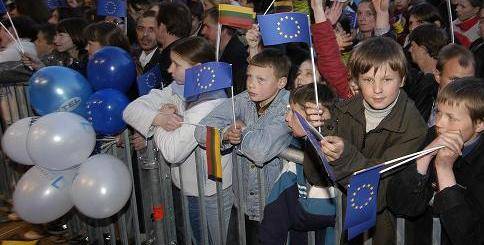
Lithuania joined NATO in March of 2004, and the European Union in May of 2004. In May of 2006, Lithuania was not successful in joining the Euro Zone (i.e., the euro currency group); inflation was too high. The Lithuanian currency, the litas, remains pegged to the euro; the fixed-rated is unlikely to change because Lithuanian debts are tied to the euro (i.e., if the litas were devaluated, the debts would be greater).
In 2009, after much denial at all levels of government and politics for more than a year, a parliamentary investigatory committee confirmed that Lithuania had two secret prisons (during the period from September 2004 to November 2005) for the ‘extraordinary rendition’ of the USA ‘war on terror’. However, there was no proof that the prisons had actually ever been used. The president of Lithuania at the time of the existence of the prisons said that he had no knowledge of the prisons and that their existence had not been proven to him.
In the last six years, there have been 3 ½ Presidents of Lithuania. In the Spring of 2004, the President was impeached (on some vague grounds tantamount to ‘treason’); he insists that it was a coup organized by the USA from when he refused to allow any USA secret prison in Lithuania; he is now a member of the EU parliament; there was no sufficient evidence to convict him for his alleged crime of treason; in late 2010, the EU courts decreed that the Lithuanian parliament’s law banning him from elective office was illegal and void. There was a ‘temporary’ president, who was currently the speaker of the parliament (since Lithuania does not have a vice-president), for three months until there was a new election. The new president, a Lithuanian-born American (apparently not ethnic-Lithuanian) was re-elected (serving from February 1998 to February 2003 and July 2004 to July 2009). In the summer of 2009, there was a decisive mandate for Lithuania’s first women president, who has no party affiliation, and who remains the most popular politician in recent memory. The previous twenty years of relations with Russia are moving from being antagonistic, and beginning to become normalized.
As a condition of admission to the EU, December 2009 saw the closure of the last (of two) of Lithuania’s Soviet-era nuclear reactors for the production of electricity. The construction of a replacement reactor has still not yet been begun, albeit now 6 years of inaction. If ever commenced, the project will take at least a decade to complete.
Recent indications are that soon mandatory military service for males will be eliminated in favour of an all-volunteer military. There is not much discussion of the last decade regarding how easy and widespread was the avoidance of the military-service obligation.
The last population census in Lithuania took place in 2001: 3,484,000 persons were recorded. About a year ago, the population figure was suddenly acknowledged by ‘official’ estimates to be 3,200,000 persons. However, there remains a problem with ‘the math’. At the end of the Soviet era, the population was stated as 3.5 million. By 1994, when the last Russian troops left, there was an acknowledged population-drop of 10% (troops, their families, their support structure, and other ethnic/linguistic Russians). The birth rate has declined by 25% since Soviet times. Mortality rates continue to be high. There currently are 200,000+ known Lithuanians in London. There are large numbers of recently migrated Lithuanians in other parts of the UK, in Ireland, Spain, and other EU countries, as well as in South Africa, Israel, USA, Canada, South America, and Australia. Three years ago, the Supreme Court of Lithuania declared unconstitutional dual-citizenship; some people then left Lithuania and repatriations are fewer. About a year ago, immigration laws were changed to make more difficult the bringing of a spouse and children to Lithuania for individuals (usually men) who had work visa’s (usually for professional work); the number of temporary workers dropped (as did foreign investments). There is no fact that would indicate any contribution to any possible increase in the population since 2001. In summary: the total of the minuses are more than 300,000 acknowledged reduction; far more; probably at least twice more. In conclusion, the true population is likely to be less than 3 million, perhaps about 2.6 to 2.85 million. [Note: there is a new population census scheduled to be completed on 1 May 2011.]
During the last two years, the Lithuanian economy shrunk at the huge amount of 15 percent; the consolation is that this is not as bad as next-door-neighbour Latvia, which had the world’s greatest decrease at 18 percent. The analyses by government and the banking sector foresee ‘improvement’, because the rate of decrease is slowing. Of course the rate of decrease is slowing; if the rate were not slowing, then in a half-dozen years there would be Zero economy !! The ‘good news’ is that maybe there will be ‘some’ (true) growth, maybe a-fraction-of-one-percent, this year. QUESTION: how many years will it take, at the rate of a-fraction-of-one-percent per year, to return the lost original amount ? Statistically, that time period is beyond the life expectancy of most of the people now living.
From my observations
(some topics not so often discussed; this is how life really is) . . .
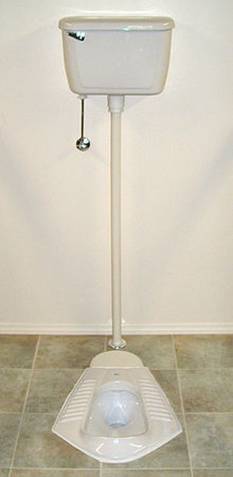
There is the anecdote of the politician visiting the countryside to promote acceptance of Lithuania becoming a member of the European Union. After his speech, he accepted questions. As is typical in Lithuania, there were no questions. Finally, from the back of the room, some farmer asked, “If everyone is going to make more money, then won’t prices for everything go up?” Everyone laughed; everyone knew that the old farmer had never gone to school, was poor, and was very-very stupid.
Bus/trolley intra-city transportation fares have increased by a factor of 4x; service has been reduced by about one-quarter. There has been an increase of 3x for the price of a cup of coffee or tea, as well as anything else available in a restaurant; and most offerings are new (not ‘traditional’) items, and cost 5x the amount of what was formerly a meal. In stores, prices have increased 3x for food, beer, and alcohol. Cigarettes are increased by 4x; in February 2011 there was a further increase of about 9 percent. Electricity and heating and gas costs have tripled. There is less restaurant and bar business because smoking is no longer allowed per EU requirements.
Many churches that were once open all day are now open only a couple of hours per day. Libraries are no longer open on Saturdays (or Sundays); weekday hours begin later and end earlier. Most of the national library is closed for more than two years, due to structural damage from nearby construction.
The costs have doubled for attendance at post-secondary schools (colleges, universities, and ‘higher schools’). In universities, there are now varying costs -- depending on the course selection.
Perhaps one-half of the above price increases occurred prior to the 2008 world economic crisis. In 2009, the VAT (‘value-added tax’; similar to a sales tax; on both goods and services) was increased from 18 percent to 21 percent.
Banks have initiated ‘service charges’ for their customers to get access to the customers own funds. People cannot pay their bills directly and/or in cash for their rent, insurance, electricity, heat, home gas, school fees, etc. All of these expenses may be paid via Internet, but with a service charge to the bank; otherwise, it is necessary to go to a bank or post office or some retail store to pay the bill, and to pay a ‘service charge’ to the point of payment.
Buildings are still being built with toilets that are ‘holes in the floor’; adding audacious to infamous, there may be a charge of one (1) litas to use it ! The term: ‘squat toilet’ may be unfamiliar to most Westerners, except for possible memories of ‘latrines’ (e.g., Boy Scouting days, or military service). Unfortunately, the squat-toilet is still very much in use in Lithuania. These devices are found in many public buildings (transportation terminals, shopping centres, schools, restaurants, bars, etc.), as well as in renovations and new construction. The proponents advance their arguments of ‘optimum human anatomical function’ and lowered disease contagion due to absence of bodily contact. This ignores the fact that the installation is impossible to maintain sanitation, handicapped persons use, and Western values/opinion. Moreover, there are related ‘toilet issues’ regarding the use of toilet-seats as an ‘optional luxury’, as well as the common fact of toilets that do not function to accept any paper -- leaving the spent paper to accumulate in open receptacles. Lastly, the general rule is “bring your own paper” (i.e., none supplied).
There is an anecdote at a local university: “I think that we are having very important guest today.” “Maybe a politician, or even a minister?” “No; more important; maybe a foreign prime minister, or head of state. The lavatory has soap to wash your hands, paper to wipe your hands, and even toilet paper.”
Abandoned construction projects are not uncommon. The landscape contains carcasses of abandoned projects -- typically hotels, large homes, or apartment buildings. Construction began on the ‘national soccer stadium’ in the Soviet era; in the last six years construction has re-commenced and stopped the same number of times. “It is not a big problem; the national sport of Lithuania is basketball, not soccer.” The monumental ‘Palace of the Rulers’ re-construction of the complex destroyed in Czarist times is now suspended for lack of 100 million litas needed for completion; after an original estimate a couple of years ago of a total cost of 100 million litas, later doubled, and still-later adding another 100 million litas for interior furnishings. “It is not a big problem; there was only one ruler who ever actually lived in the original palace anyway; Lithuania doesn’t need a Renaissance Disneyland.”
During the last few years, it has become very rare to hear about robberies of banks, jewellery stores, warehouses, etc.
Six years ago every newspaper carried stories of a half-dozen financial scandals on their front page. In the last year or so, a reader might see only one or two such stories a month.
In the last three years, there seem to be much less bribery of police. A new law provided that money would go to an arresting officer, from fines from convictions of attempted bribery; thus, the police officer gets more money by not taking the bribe and arresting the briber.
In the last six years almost every building has a publicly wall-posted diagram for exit / evacuations in the event of an emergency. However, most of those exits are locked. I have never seen a ‘crash-bar’ (‘panic-bar’) on any door anywhere in Lithuania.
Most, but not all, public buildings now have signs indicating exits. However, the signs are rarely illuminated. Most buildings do not have emergency lighting. On Wednesday, 7 February 2007, at about 6 p.m., I was in the ‘Europa’ shopping centre -- a high-end, multi-level, Vilnius mall that had been constructed three years previously; all of the lights (and escalators and elevators) went off; there were no emergency lights; there were no exit lights; there was no public-address announcement.
In the Old Town, there are many restaurants, bars, and clubs that serve clients in brick-vaulted windowless cellars. There is rarely a secondary exit; the only way out is the one way that everybody came in.
The fire-truck fleet seems to have been modernized and expanded. However, the fire trucks are designed to carry their own water supply; fire hydrants are rare. ‘Standpipes’ (high-capacity water sources inside of buildings, in the hallways) may exist, but there are never any fire hoses. Portable fire-extinguishers are usually not accessable, except by a key to their lock.
In the early post-Soviet times, there were no ‘supermarkets’ to buy food; although there were, and still are, large ‘markets’ (meaning ‘marketplaces’) of many individual vendors selling various kinds of food, etc. Six years ago, there were some individually-owned small food stores; these have all since disappeared, except in the villages. Interestingly, those little village stores, where the customer must ask the clerk for any product, because fear of theft did not permit ‘self-service’, do still exist; and, even in the cities, some pharmacies are still of that model. Today, there are three or four chains of food stores that operate various-size stores: from what might be considered a ‘corner store’, to medium, to large, and a few very-large stores -- usually located in shopping malls. However, even the largest store/mall in Lithuania would be only ‘large’ (not ‘very large’ or ‘huge’) by US/Canadian standards. Most food items found in an ‘average size’ food store in Canada/US can also be found in Lithuanian food stores. What is missing in the Lithuanian stores is the selection of sizes; it is not possible to buy a bar of body-soap larger than 100 grams.
I still get confused at the supermarket. Toilet paper must always be located immediately adjacent to paper towels; the wrapping always blocks the middle of the package, and the labelling is usually in Polish; this can be confusing when selecting, and disappointing after purchasing. (It took me six years to learn to squeeze the package in the centre vertically.) Facial tissue is at the other side of the store -- next to body soap, toothpaste, and feminine hygiene products. The price (in Lithuanian ‘litas’) of facial tissue is between .29 and .59 for a packet of ten, or 3.99 and 5.99 for a box of 100. Coffee might be 4.99 for 250 grams, and 11.99 for 500 grams. Laundry detergent must be for only white, or colour, or black; no laundry detergent will wash all colours. I cannot find toothpaste with fluoride. There is no salted butter, no dehydrated onion, no frozen TV dinners, no sauce Béarnaise, no brown gravy, and (most sadly to me) no Kraft macaroni-and-cheese. To find Coca-Cola in cans, rather than plastic bottles, is rare; I like two cans a month; I do not like the taste from bottles. There is no canned soup; “no one buys soup, everyone makes soup”. There is no sliced roast-beef; ‘shaved’ sliced-meat is unknown in markets and restaurants (although there may be some smoked game-meat, and imported prosciutto ham). Hellman’s” mayonnaise is always in the refrigerated section; the Hellman’s high price promotes the cheap local versions that must always be refrigerated. There is a wide selection of smoked (i.e., not stove/oven cooked) dried sausage; at great variety of prices and appearances; I buy whatever the person next to me buys. There is something not available in Canada/US: ‘surelis’, which is ‘curd’ (like cottage cheese, but solid) of some dozen flavourings, covered with chocolate; about the size of a small “Milky-Way” candy bar; it must be kept refrigerated, or it could melt to goo.
On restaurant tables, now there are usually salt and pepper shakers; good-luck getting the salt out of the shaker: the salt is not iodized, the grains are larger, and the wet Lithuanian climate makes nigh-impossible using the shaker. On a restaurant table, to find ketchup would be rare. Occasionally there are napkins, always of the texture of tissue paper, which are absolutely useless.
About two years ago, the law changed governing the sales of alcohol in stores. Now, there are no more late-night, or 24-hour (‘always open’), stores selling booze. There are no retail-store sales of any alcohol after 10pm. The same law also prohibits store sales of any alcohol on the first weekday of September, because that is the day that all children (from kindergarten through university) return to school. I do not really understand the reasoning, given the result that this day has now become ‘Go to Bar Day’. Alcoholics often drink ‘surrogate alcohol’: cheap cleaning-solvents and perfumes. The capitol city has a high number of alcoholics, drug addicts (usually heroin), homeless, and psychiatric cases populating the streets and parks; this situation did not exist in Soviet times, and appears to be worsening recently. Suicide rates remain amongst the highest in the world. Abusive family instances are beginning to get some attention by the society-at-large.
One of the most visible improvements in day-to-day life is the reduction of randomly discarded refuse. Six years ago, there was trash thrown everywhere; the improvement was rather strange. Most of the refuse was empty beer containers: 1/4 litre glass bottles, 2 litre plastic bottles, and beer cans. First, a 25-cent refundable deposit was placed on the small glass re-useable bottles; returnable to most places of sales. More recently, a premium of 2 or 3 cents was given for the recyclable 2-litre bottles and aluminium cans; however, the locations for such returns are few-and-far-between. Making the beverage containers returnable did not, of itself, solve the refuse problem, because most people would not be bothered to carry the bottles/cans back to a store or to a refuse collection centre; and, perhaps some attached a social stigma to seeking a refund. Therefore, everyone continued to throw-away the bottles/cans. However, in the last couple of years, the large (and apparently increasing) number of destitute people has taken up the ‘job’ of collecting discarded glass/plastic bottles and aluminium cans; such beverage containers now have been eliminated from all public places.
Water often flows directly off buildings’ roofs (and balconies); usually, there are gutters to channel the roof water to downspouts. However, in either case, the vast majority of buildings (including the renovated and the newest) deposit the roof water to alongside the exterior of the building ! The result is: water in the basement, destruction of foundation walls, and water onto sidewalks and streets; and, ice-accumulation is increased, causing further problems. Sidewalks are usually paved with square concrete tile-blocks (about 14 inches / 32 cm), which due to the significant amount of water results in disturbing their supporting soil, causing further uneven (or collapsed) sidewalk pavement providing for increased collection water on sidewalks. Moreover, the streets are not arced, to direct any water to roadway-gutters, nor are the streets sloped to channel water to storm drains; moreover, there are always an insufficient number of storm drains. The lack of good design and infrastructure to control run-off water turns land into veritable swamps. And: it rains alot in LT !! Perhaps, engineering schools in Lithuania might benefit from a study of how the Romans (i.e., 2,000 years ago) controlled water runoffs.
Snow removal is most-often left to the one responsible for creating the snow: God. Very recently, there are now some snowploughing trucks that are beyond the old Soviet army-trucks fitted with ploughs. Still, there is no equipment or ‘systems’ of the sort found in Canada, or even in the USA; there is no sidewalk ploughing, no snow blowers; the method is still to use shovels (often home-made from a broom handle attached to a squared piece of metal or plywood) and brooms (made from the gathering of tree branches).
Similarly, grass-cutting is not ‘developed’. It is rare to see any tractors, or even riding lawnmowers. There is some use of gasoline-powered lawnmowers, but without collecting the cuttings, so hand raking is required thereafter. It is not unusual to see ‘weed-wackers’ being used to cut hectares / acres of grass.
Tap water has very-high levels of minerals, which cause problems with pipes, washing machines, hot-water heaters, water boilers, showerheads, faucets, valves, etc. There are the common announcements: ‘no water today’, or ‘no water this week’; the pipes and machinery periodically have to be cleaned of clogs.
In all cities, heat to all buildings is provided ‘centrally’, meaning from one or more huge thermal plants (gas or oil fired), with the hot water piped (underground) to each building throughout the municipality. Apparently, a ‘monopoly’ is allowed for this industry; moreover, residents or buildings are ‘restricted’ (or not allowed) to have their own individual heating system installed.
Colleges / universities are governed by their own faculty, in ‘senates’ -- which appoint ‘rectors’ (i.e., chief-operating officers) from their own faculty membership. There is no concept of governance by ‘trustees’ for not-for-profit organizations (which are called NGO’s -- ‘non-governmental organizations’). In the non-educational sectors of public institutions, the entire leadership of the institution is vested exclusively in a managing ‘director’ (head administrator), responsible only to the government (as in Soviet times). Thus, there is no private fund-raising; the institution is entirely governmentally supported; the institution is responsible to its workers (as in Soviet times; the ‘workers, collectively, effectively own the institution’) and/or the government, and not to its clients or to the taxpayers.
The intra-city public transportation system consists of trolley and bus vehicles. [There is also some quasi-legal mini-vans ‘companies’ operating ‘route taxi services’; both intra-city and inter-cities.] Perhaps some four years ago, the public transport system had route maps, inside of each vehicle and at each ‘stop’; these route maps lasted for about six months. Then, the maps were removed. However, no one could read the microscopic printing of the name of the streets on the maps, especially the maps printed as handouts. In 2010, a new system was instigated regarding how passengers enter the vehicle. Previously, everyone entered and exited from any of the three doors. Now, passengers must enter through only the front door, where their tickets can be checked (as well as their behaviour). This change to public transportation took more than fifty years. Two years ago, each bus/trolley was equipped with an electronic device to accept passenger tickets; these devices have never worked.
The economic situation of the last couple of years has had some very visible effects. Some street lighting has been turned-off. Crime is increasing, especially in rural areas. Office buildings have very-high vacancies. Many storefronts are empty. Bankruptcies have dramatically increased. Many houses, which began construction in last couple of years, are not completed, or are often vacant, or never have been occupied; there are areas of newer neighbourhoods that are ‘ghost streets’.
The concept of a public ‘classical debate’ is making appearance in Lithuania. On 30 November 2010, the ‘Vilnius International Club’ and ‘Mykolas Romeris University’ of Vilnius presented a debate, with distinguished speakers on both sides of the ‘motion’:
American Style Capitalism is at its collapse
in tandem with the collapse of Soviet style communism;
therefore the European Union must find other ways
to protect and promote enlightenment values
* * * * *
Conclusion
Regardless of any true/actual cause-effect relationship, people in Lithuania will tend to associate their present and coming lifestyle status with ‘democracy’ and the ‘free-market’ (a/k/a ‘capitalist’) system . . .
Since former-president, now Prime Minister Putin rose to power ten years ago, Russian officials have insisted that their country will develop its own political system: sometimes called "sovereign democracy", as opposed to “parliamentary democracy” -- which many Russians associate with ‘poverty’. Russia may have abandoned communism, but Russia wants its own form of ‘free market’ system, and its own form of ‘democracy’; not such American-style, or Western-European style, systems.
Lithuania, and its neighbours, will be influenced by the developing systems in Russia.
Note: a version of this article appeared in the October-November 2010 and January-February 2011 issues of the Canadian subscribers’ journal, ‘Dialogue’ magazine
*********************
During the last two years,
the economy shrunk the huge amount of 15%;
the consolation is that this is not as bad
as next-door Latvia
that had the world’s greatest decrease at 18%.
*********************
The analyses of government and the banking sector
see ‘improvement’ because the rate of decrease is slowing.
Of course the rate of decrease is slowing;
if the rate were not slowing,
then in a half-dozen years there would be Zero economy !!
*********************
The ‘good news’ is that maybe there will be some growth,
maybe a-fraction-of-one-percent, this year.
Now, how many years will it take,
at the rate of a-fraction-of-one-percent per year,
to return the lost original amount ?
Statistically, that time period is well-beyond my life expectancy.
**************************
There is the anecdote of the politician visiting the countryside
to promote acceptance of Lithuania becoming
a member of the European Union.
After his speech, he accepted questions.
As is typical in Lithuania, there were no questions.
Finally, from the back of the room, some old farmer asked,
“If everyone is going to make more money,
then won’t prices for everything go up?”
Everyone laughed; everyone knew that the old farmer
had never gone to school, was poor, and very very stupid.
**************************
There is an anecdote at a local university:
“I think that we are having very important visitor today.”
“Maybe a politician, or even a minister?”
“No; more important; maybe a foreign prime minister, or head of state.
The lavatory has soap to wash your hands, paper to wipe your hands,
and even toilet paper.”
*********************
... it is not possible to buy a bar of body-soap larger than 100 grams ...
*********************
The price (in Lithuanian ‘litas’) of facial tissue is between .29 and .49 for a packet of ten, or 3.99 and 4.99 for a box of 100. Coffee might be 4.99 for 250 grams, and 11.99 for 500 grams.
*********************
There is no canned soup; “no one buys soup, everyone makes soup”.
*********************
Snow removal is most-often left to the one responsible for creating the snow: God.
*********************
Russian officials have insisted that their country will develop its own political system: sometimes called "sovereign democracy", as opposed to “parliamentary democracy” -- which many Russians associate with ‘poverty’.
*********************
- Bookmark :
- Digg
- del.icio.us
- Stumbleupon
- Redit it
A Lithuanian Presidential Palace…
- Posted by - (0) Comment
A LITHUANIAN PRESIDENTIAL PALACE
|
||||||||||||||||||||||||||||||||||||||||||

|
It must have been quite a shock to Stulginskis to return to Lithuania in 1956. The country he loved and had given everything for, was now ruled by Moscow-believing Communists. Hundreds of thousands of the country's leading women and men had fled to America and other nations in the west. Still others had been deported to Siberia, with tens of thousands dyeing en route to or on the permafrost. 1956 was the year that Lithuania's long-term guerrilla war against the Soviet superior force had finally come to an end, with the result that 20,000 Lithuanian forest brothers and about 70,000 Soviet soldiers had lost their lives. Lithuania in the period 1956-1969 was characterized by extensive KGB activity, denunciation, imprisonment and executions without trial, widespread corruption and mismanagement in which most of the good, democratic principles Stulginskis had fought so hard for were totally forgotten and disregarded. |
LITHUANIAN SSR
|

Stulginskis passed away in Kaunas in 1969, after having experienced nearly 30 years of humiliating and unjust assaults in Siberia and in his once proud homeland Lithuania.
It is today 92 years since Stulginskis, together with the other brave leaders of those days, became one of the signatories of Lithuania's declaration of independence. And in only 10 days it is exactly 125 years since this political lion was born (26 February 1885).
President Aleksandras Stulginskis should not be forgotten.
Aage Myhre,
Editor
|
WORLD LEADERS REIGNING AT THE TIME WHEN STULGINSKIS WAS THE PRESIDENT OF LITHUANIA
|
|||||||
|
|
|
|
|
|
|
|
|
|
WILSON |
BALDWIN |
DOUMERGUE |
STULGINSKIS |
PILSUDSKI |
HINDENBURG |
LENIN |
|
|
§ - President Woodrow Wilson (United States) § - Vladimir Lenin (Russia, later Soviet Union) § - President Paul von Hindenburg (Germany) § - Prime Minister Stanley Baldwin (United Kingdom) § - President Gaston Doumergue (France) § - Prime Minister Benito Mussolini (Italy)
§ - Prime Minister Józef Piłsudski (Poland)
|
- President Tomáš Garrigue Masaryk (Czechoslovakia) - Prime Minister Charles Ruijs de Beerenbrouck (The Netherlands) - President Kaarlo Juho Ståhlberg (Finland) - Prime Minister Hjalmar Branting (Sweden) - Prime Minister Johan Ludwig Mowinckel (Norway) - Prime Minister Thorvald Stauning (Denmark) |
||||||
|
|
|
|
|
|
|
|
|


president
ALEKSANDRAS STULGINSKIS
(1885-1969)

In May of 1920 Stulginskis was elected Chairman of the Constituent Seimas and
President of the State, reelected President at the First and the Second Seimas,
holding post of the President uninterruptedly until 7 June 1926.
Aleksandras Stulginskis was born in the village of Kutaliai of the Kaltinenai Rural District of the then Taurage District on 26 February 1885 into the family of a land tenant. He studied at the elementary school in Kaltinenai, the Liepaja gymnasium, and the Samogitian Theological Seminary in Kaunas. After graduating from the latter, he continued his studies in philosophy and theology at the University of Innsbruck (Austria). But upon making a decision not to be ordained as a priest, he entered the agronomy institute in Halle (Germany), and after graduating from it in 1913 started to work in Lithuania as an agronomist. He wrote many articles for the then Lithuanian press, mostly on the problems of the development of agriculture; from 1914 he edited the Viensedis (The Isolated Farm) periodical publication. When the Germans occupied Lithuania, he left for Vilnius and here joined the activity of Lithuanian organizations, and was elected to the Lithuanian Relief Committee, where he organized education courses for elementary school teachers. For quite a lengthy period headed the Rytas (Morning) Education Society, managed gardens in a Vilnius suburb that supplied orphanages with vegetables and potatoes. In 1918 he started publishing the newspaper Ukininkas (The Farmer), Ukininko kalendorius (The Farmer's Calendar).

In memory of the 40 years since Stulginskis’ passing away, 2009.
Stulginskis was one of the founders of the Christian Democratic Party. In 1917 he was elected Chairman of the Central Committee of the Party. In 1917 together with other Lithuanian patriots he appealed with a memorandum to the President of the United States W. Wilson for the recognition of Lithuania's independence. He was one of the organizers of the Lithuanian conference of Vilnius, a participant In it, and was elected to the Council of Lithuania(later the State Council). On 16 February 1918 he signed the Independence Act. With the war nearing the end and with Lithuanian refugees returning from Russia, Stulginskis headed the state commission for their affairs. Stulginskis spoke for an independent, democratic Lithuania and criticized severely those who agreed for Lithuania to become a monarchic state.
Stulginskis organized the defence of Lithuania against the Bolshevists and Poles, and founded a Lithuanian army. In M. Slezevicius' government he served as a minister without a portfolio. In P. Dovydaitis' cabinet of ministers A. Stulginskis served as a Deputy Prime Minister and Minister for Internal Affairs, afterwards Minister of Agriculture and State Wealth, and was one of the incorporators of the Ukio (Economic) Bank.
In May of 1920 he was elected Chairman of the Constituent Seimas and President of the State, reelected President at the First (21 December 1922) and the Second (19 June 1923) Seimas, holding post of the President uninterruptedly until 7 June 1926, when Dr. Kazys Grinius was elected President. In 1925-1930 Stulginskis was in charge of the Lithuanian Scout Brotherhood.

When the Bolsheviks occupied Vilnius in January 1919, the Government and ministries were moved to Kaunas. It was in the provisional capital that the State Council established the President's institution on 4 April 1919, and elected Antanas Smetona the first President of Lithuania. On 1 September 1919, President Smetona and his office moved to a building specially designated as the Presidential Palace, currently the Historical Presidential Palace in Kaunas.
It was here President Stulginskis held office from 1922 till 1926.
After the coup d'etat of 17 December 1926, Stulginskis was elected Chairman of the Fourth Seimas and held this post until 12 April 1927 when A. Smetona dissolved the Seimas. Then Stulginskis bought an estate in Jokubavas, in the Kretinga Rural District, and started to run it. At his leisure he wrote articles to the XX amzius (The 20th Century), Ukininkas and other periodical publications.
In 1938 he took part in the first World Lithuanian Congress in Kaunas, where he delivered a speech demanding the observance of the democratic principles in Lithuania.
The first year of the Soviet occupation he spent at his estate in Jokubavas. In June, 1941 he and his wife were arrested (their daughter Aldona evaded the arrest). The former President was deported to the camps in the Krasnoyarsk Territory, and his wife was exiled to the Komi Republic. Only in 1952, in the camp, Stulginskis' case was completed – and he was sentenced to the 25 years in Soviet camps. But after Stalin's death, due to Stulginskis' daring attempts he and his wife were allowed to return to Lithuania at the end of 1956. They resided in Kaunas.
Lithuania’s highly respected pre-war president and democracy builder, Aleksandras Stulginskis passed away on 22 September 1969. He was buried in the Aukstoji Panemune cemetery In Kaunas.

Grave of President Aleksandras Stulginskis and his wife Ona (Kaunas).

16 February – Lithuania’s Independence Day
16 February 1918 was the date Lithuania declared its independence from
Imperial Russia and established its statehood

Members of the Council of Lithuania in 1917
From left to right
Sitting: J. Vileišis, dr. J. Šaulys, kun. J. Staugaitis, St. Narutavičius, dr. J. Basanavičius,
A. Smetona, kan. K. Šaulys, Stp. Kairys, J. Smilgevičius.
Standing: K. Bizauskas, J. Vailokaitis, Donatas Malinauskas, kun. Vl. Mironas, M. Biržiška,
kun. A. Petrulis, S. Banaitis, P. Klimas, A. Stulginskis, J. Šernas, Pr. Dovydaitis.
The Act of Independence of Lithuania (Lithuanian: Lietuvos Nepriklausomybės Aktas) or Act of February 16 was signed by theCouncil of Lithuania on February 16, 1918, proclaiming the restoration of an independent State of Lithuania, governed by democraticprinciples, with Vilnius as its capital. The Act was signed by all twenty representatives, chaired by Jonas Basanavičius. The Act of February 16 was the end result of a series of resolutions on the issue, including one issued by the Vilnius Conference and the Act of January 8. The path to the Act was long and complex because the German Empire exerted pressure on the Council to form an alliance. The Council had to carefully maneuver between the Germans, whose troops were present in Lithuania, and the demands of the Lithuanian people.
The immediate effects of the announcement of Lithuania's re-establishment of independence were limited. Publication of the Act was prohibited by the German authorities, and the text was distributed and printed illegally. The work of the Council was hindered, and Germans remained in control over Lithuania. The situation changed only when Germany lost World War I in the fall of 1918. In November 1918 the first Cabinet of Lithuania was formed, and the Council of Lithuania gained control over the territory of Lithuania. Independent Lithuania, although it would soon be battling the Wars of Independence, became a reality.
While the Act's original document has been lost, its legacy continues. The laconic Act is the legal basis for the existence of modern Lithuania, both during the interwar period and since 1990. The Act formulated the basic constitutional principles that were and still are followed by all Constitutions of Lithuania. The Act itself was a key element in the foundation of Lithuania's re-establishment of independence in 1990. Lithuania, breaking away from the Soviet Union, stressed that it was simply re-establishing the independent state that existed between the world wars and that the Act never lost its legal power.
(Wikipedia)

|
English Translation
RESOLUTION
The Council of Lithuania in its session of February 16, 1918 decided unanimously to address the governments of Russia, Germany, and other states with the following declaration:
The Council of Lithuania, as the sole representative of the Lithuanian nation, based on the recognized right to national self-determination, and on the Vilnius Conference's resolution of September 18–23, 1917, proclaims the restoration of the independent state of Lithuania, founded on democratic principles, with Vilnius as its capital, and declares the termination of all state ties which formerly bound this State to other nations. The Council of Lithuania also declares that the foundation of the Lithuanian State and its relations with other countries will be finally determined by the Constituent Assembly, to be convoked as soon as possible, elected democratically by all its inhabitants. The Council of Lithuania by informing the Government of ..................... to this effect requests the recognition of the Independent State of Lithuania.
|
- Bookmark :
- Digg
- del.icio.us
- Stumbleupon
- Redit it

OPINIONS
Have your say. Send to:
editor@VilNews.com
Ph. D., Chicago
A wave of unity sweeps the international Lithuanian community on March 11th every year as Lithuanians celebrated the anniversary of the Lithuanian Parliament's declaration of independence from the Soviet Union in 1990. However, the sense of national unity engendered by the celebration could be short-lived.
Human beings have a strong tendency to overgeneralize and succumb to stereotypical us-them distinctions that can shatter even the strongest bonds. We need only search the internet to find examples of divisive thinking at work:
- "Those who fled Lithuania during World II were cowards -- and now they come back, flaunt their wealth, and tell us 'true Lithuanians' how to live."
- "Lithuanians who work abroad have abandoned their homeland and should be deprived of their Lithuanian citizenship."

In Lithuania Christmas Eve is a family event and the New Year's Eve a great party with friends!
Lithuanian say "Kaip sutiksi naujus metus, taip juos ir praleisi" (the way you'll meet the new year is the way you will spend it). So everyone is trying to spend New Year's Eve with friend and have as much fun as possible.
Lithuanian New Year's traditions are very similar to those in other countries, and actually were similar since many years ago. Also, the traditional Lithuanian New Years Eve party was very similar to other big celebrations throughout the year.
The New Year's Eve table is quite similar to the Christmas Eve table, but without straws under the tablecloth, and now including meat dishes. A tradition that definitely hasn't changes is that everybody is trying not to fell asleep before midnight. It was said that if you oversleep the midnight point you will be lazy all the upcoming year. People were also trying to get up early on the first day of the new year, because waking up late also meant a very lazy and unfortunate year.
During the New Year celebration people were dancing, singing, playing games and doing magic to guess the future. People didn't drink much of alcohol, especially was that the case for women.
Here are some advices from elders:
- During the New Year, be very nice and listen to relatives - what you are during New Year Eve, you will be throughout the year.
- During to the New Year Eve, try not to fall, because if this happens, next year you will be unhappy.
- If in the start of the New Year, the first news are good - then the year will be successful. If not - the year will be problematic.
* If New Year's night is cold and starry - look forward to a good summer!
* If the during New Year Eve trees are covered with frost - then it will be a good year. If it is wet weather on New Year's Eve, one can expect a year where many will die and dangerous epidemics occur.
* If the first day of the new year is snowy - the upcoming year will see many young people die. If the night is snowy - mostly old people will die.
* If the New Year time is cold - then Easter will be warm.
* If during New Year there are a lot of birds in your homestead - then all year around there will be many guests and the year will be fun.
Christmas greetings
from Vilnius
and epic battle for the
future
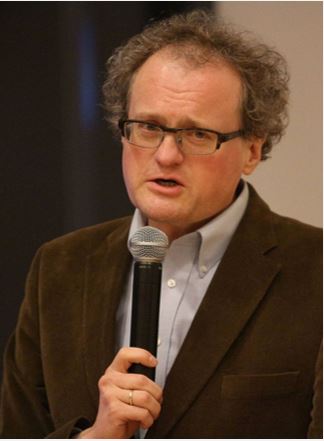
Philosopher, political theorist, historian of
ideas, social analyst, and political
commentator
Ukraine was and continues to be perceived by the EU political class as a sort of grey zone with its immense potential and possibilities for the future, yet deeply embedded and trapped in No Man's Land with all of its troubled past, post-Soviet traumas, ambiguities, insecurities, corruption, social divisions, and despair. Why worry for what has yet to emerge as a new actor of world history in terms of nation-building, European identity, and deeper commitments to transparency and free market economy?
Right? Wrong. No matter how troubled Ukraine's economic and political reality could be, the country has already passed the point of no return. Even if Vladimir Putin retains his leverage of power to blackmail Ukraine and the West in terms of Ukraine's zero chances to accede to NATO due to the problems of territorial integrity, occupation and annexation of Crimea, and mayhem or a frozen conflict in the Donbas region, Ukraine will never return to Russia's zone of influence. It could be deprived of the chances to join NATO or the EU in the coming years or decades, yet there are no forces on earth to make present Ukraine part of the Eurasia project fostered by Putin.
want to learn about the
new, scary propaganda
war between Russia,
The West and the
Baltic States!
believe their government
is corrupt
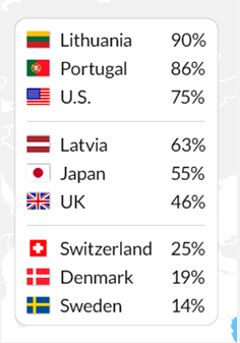
students say no to
bribes for doctors
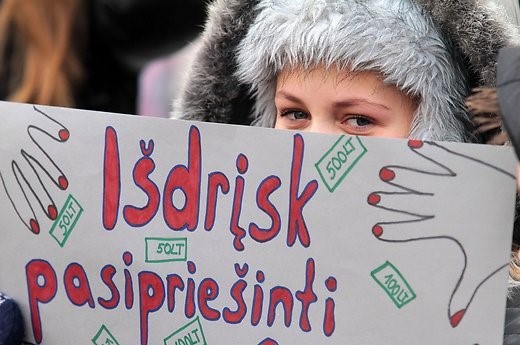
During Soviet times, government was administered for the people in control, not for the local population, court decisions were decreed, they were not the administration of justice, and academia was the domain of ideologues. 25 years of freedom and openness should have put those bad experiences behind Lithuania, but that is not so.
Today, it is a matter of expectation that court pronouncements will be governed by ideological dictates. Few, if any Lithuanians expect real justice to be effected. For foreign companies, doing business in Lithuania is almost impossible in a situation where business people do not expect rule of law, so, surely Government would be a refuge of competence?
Lithuanian Government has not emerged from Soviet styles. In an attempt to devolve power, Lithuania has created a myriad of fiefdoms of power, each speaking in the name of the Government, each its own centralized power base of ideology.
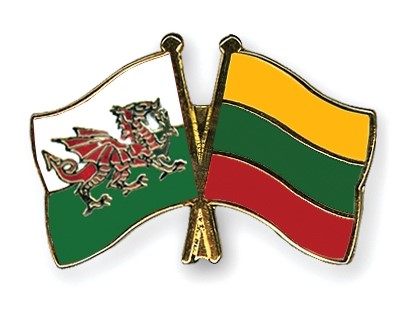
Chepstow, Wales
Doesn't that sound suspiciously like Lithuania? Ah, but I didn't mention the mountains of Snowdonia, which would give the game away.
I'm talking about Wales, that part of the UK which Lithuanians used to call "Valija", but later named "Velsas" (why?). Wales, the nation which has welcomed two Lithuanian heads of state to its shores - firstly Professor Vytautas Landsbergis, who has paid several visits and, more recently, President Dalia Grybauskaitė who attended the 2014 NATO summit which was held in Newport, South Wales.
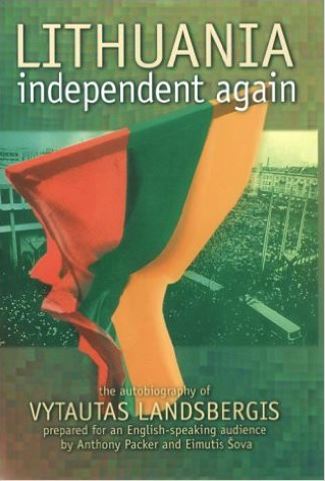
ENGLISH VERSION OF THE
AUTOBIOGRAPHY OF VYTAUTAS LANDSBERGIS.
Although Lithuanian activities have thinned over the decades as that postwar generation died out, the Lithuanian Martyrs' parish hall is crowded with many, many hundreds of visitors who come to the Lithuanian cemetery for All Souls' Day. Similarly, the Franciscan parish has standing room only for Christmas Eve mass.
Although I am firmly embedded in the literary culture of Canada, my themes are usually Lithuanian, and I'll be in Kaunas and Vilnius in mid-November 2015 to give talks about the Lithuanian translations of my novels and short stories, which I write in English.
If you have the Lithuanian language, come by to one of the talks listed in the links below. And if you don't, you can read more about my work at
www.anatanassileika.com
http://www.vdu.lt/lt/rasytojas-antanas-sileika-pristatys-savo-kuryba/ https://leu.lt/lt/lf/lf_naujienos/kvieciame-i-rasytojo-59hc.html
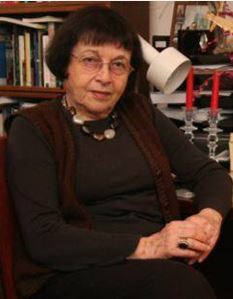
"My love and best wishes to all. As long as VilNews exists, there is hope for the future,"" she writes.
Irena Veisaite means very much for our publication, and we do hereby thank her for the support and wise commitment she always shows.
You can read our interview with her
Facing a new reality
Dear readers of VilNews,
For a number of years, the EU and Russia had assumed the existence of a strategic partnership, based on the convergence of values, economic integration and increasingly open markets and a modernisation agenda for society.
Our agenda was positive and ambitious. We looked at Russia as a country ready to converge with "European values", a country likely to embrace both the basic principles of democratic government and a liberal concept of the world order. It was believed this would bring our relations to a new level, covering the whole spectrum of the EU's strategic relationship with Russia.
The likelihood of Putin
invading Lithuania
.jpg "lithuania today")
Founding Director at Summer Literary Seminars
Are all Lithuanian energy
problems now resolved?
Lithuania as a country does not have significant energy resources. Energy consuming infrastructure after WWII was small and totally supported by energy imports from Russia.
First nuclear reactor begins power generation at Ignalina in 1983, the second reactor in 1987. Iganlina generates enough electricity to cover Lithuania's needs and about 50%.for export. As, prerequisite for membership in EU, Ignalina ceases all nuclear power generation in 2009
The Klaipėda Sea terminal begins Russia's oil export operations in 1959 and imports in 1994.
Mazeikiu Nafta (current ORLEAN Lietuva) begins operation of oil refinery in 1980.
Have Lithuanian ties across
the Baltic Sea become
stronger in recent years?
The two decades that have passed since regaining Lithuania's independence can be described as a "building boom". From the wreckage of a captive Soviet republic, a generation of Lithuanians have built a modern European state, and are now helping construct a Nordic-Baltic community replete with institutions intended to promote political coordination and foster a trans-Baltic regional identity. Indeed, a "Nordic-Baltic community" - I will explain later in my text the meaning of this catch-phrase.
Since the restoration of Lithuania's independence 25 years ago, we have continuously felt a strong support from Nordic countries. Nordics in particular were among the countries supporting Lithuania's and Baltic States' striving towards independence. Take example of Iceland, country which recognized Lithuania in February of 1991, well in advance of other countries. Yet another example - Swedish Ambassador was the first ambassador accredited to Lithuania in 1991. The other countries followed suit. When we restored our statehood, Nordic Countries became champions in promoting Baltic integration into Euro-Atlantic institutions. To large degree thanks Nordic Countries, massive transformations occurred in Lithuania since then, Lithuania became fully-fledged member of the EU and NATO, and we joined the Eurozone on 1 January 2015.
Have you heard about the
South African "Pencil Test"?
But that is exactly what happened to me when I came back from South Africa. I will tell you how.
VilNews e-magazine is published in Vilnius, Lithuania. Editor-in-Chief: Mr. Aage Myhre. Inquires to the editors: editor@VilNews.com.
Code of Ethics: See Section 2 – about VilNews. VilNews is not responsible for content on external links/web pages.
HOW TO ADVERTISE IN VILNEWS.
All content is copyrighted © 2011. UAB ‘VilNews’.