
THE VOICE OF INTERNATIONAL LITHUANIA

|
VilNews has its own Google archive! Type a word in the above search box to find any article.
You can also follow us on Facebook. We have two different pages. Click to open and join.
 Click on the buttons to open and read each of VilNews' 18 sub-sections Click on the buttons to open and read each of VilNews' 18 sub-sections  |

|


Archive for January, 2011
Health tourism in Lithuania
- Posted by - (34) Comment
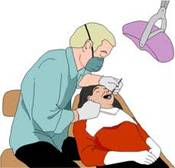
Many people come to Lithuania for quality health care at a reasonable cost. Medical quality is very high. As an example, I recently destroyed a molar tooth. About 1/3 of the tooth broke off.
The next day I had a dental appointment at one of the best dental centers in Vilnius located centrally in the old town. It is a modern facility, very comfortable which looks exactly like any other quality dental center in any other country of the world. Several dentists and dental assistants work at the dental center. My dentist is very professional, speaks very good English. She is also the first dentist I have ever visited who has given me a hand mirror so that I could watch her work. Very entertaining to watch!
In about 1.5 hours she completely rebuilt my tooth and it was completely painless. Aside from the the discomfort of having my mouth held open for 1 1/2 hours, there very little discomfort.
The new tooth feels great. It feel completely natural and looks like the rest of my teeth. Only a trained dentist would be able to tell that it was not my real tooth. I am 100% satisfied with it.
How much did I pay for the work? 300 litas or approximately 85 euros all inclusive. I expect I would have paid 10 times that amount in many countries. Perhaps that explains the health tourism in Lithunia.
Text: Gene Emmer
(from his travel blog www.lithuania-travel.net)
- Bookmark :
- Digg
- del.icio.us
- Stumbleupon
- Redit it

God bless the Baltic American clinic!
- Posted by - (15) Comment

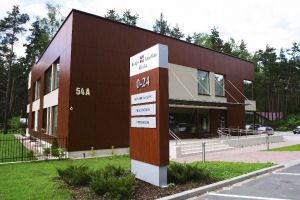
Our baby was born at the Baltic American Clinic and our experience at the BAC could not have been better. Much of our positive experience at the Baltic American Clinic was due to two people: Our amazing OB/GYN Jurate and the excellent mid-wife Rasa. Rasa is something like the "mother superior" of the Baltic American Neonatology Center. Rasa runs everything with her experience and her charm. Rasa gave us our first lessons in parenthood. While Jurata took care of all things medical, Rasa was responsible for nearly everything else (food, comfort, diaper changes, even the bill at the end of the stay). Rasa seemed to be always watching over us with her careful eye. We loved it!
The BAC is something like a cross between a 5 star hotel and a hospital. To be sure the BAC is not set up for difficult births and if they believe that your birth might be complicated, you will be referred to the University Hospital. But if you will have a normal birth, the BAC will be for you.
You will receive round the clock care in a private room, room service, highly trained staff who will cater to your every need. You will be comfortable and well cared for and receive some basic training if parenthood if you need it. Both parents and baby are welcome to stay 24 hours per day in the guest rooms. There are no visiting hours (at least for parents). Fathers are always welcome.
While our pregnancy and delivery at the BAC were only positive, we have not always been happy with other medical care at the BAC. Like everywhere else, whether you are happy or not will depend on the health care provider. But if you are having a baby in Lithuania, we would highly recommend delivering at the Baltic American Clinic.
Text: Galina Emmer
(from her travel blog www.lithuania-travel.net)
- Bookmark :
- Digg
- del.icio.us
- Stumbleupon
- Redit it

Mastering the vacation battle
- Posted by - (13) Comment
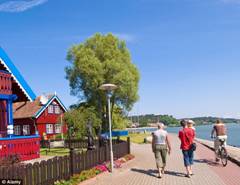
The Nida resort at the Curonian Spit is the place
to go to recharge you batteries.
Finding the balance between relaxation and a cultural experience on holiday can be a challenge, but the friendly Lithuanians of the Curonian Spit have mastered the vacation battle, according to Daniel Andrews of Travelbite.co.uk.
White sand beaches, wind swept dunes and the dancing forests of pine, this UNESCO World Heritage Site offers Europe's most preserved touch of natural paradise. Known for the highest drifting sand dunes in Europe, the 5,000-year-old, 97km peninsula, split between Kaliningrad (Russia) and Lithuania, provides a sense of tranquillity and an assortment of natural wonders.
Being so protected from development, it isn't the easiest place to get to. But once you are there, you'll be glad you made the trip. airBaltic provide flights from London Gatwick South to Riga, Latvia, where you can catch a connecting flight to Palanga, a 45 minute journey via taxi or public transport to Klaipeda, the start of any journey to the Curonian Spit.
According to the National Tourism Office, Klaipeda offers a true reflection of Lithuanian life. A stay at The Old Mill Hotel, situated in the up and coming historical port area of the city, provides luxurious comfort at an affordable price. Minutes from the hotel you'll find the Castle Museum, built in the remains of Memelburg Castle, dating back to 1252. The restored underground tunnels hold the entire history of the oldest city in Lithuania.
Take a walk along Aukstoji Street, beautiful 18th century warehouses line the old cobbled lane and is a great place to start exploring the old town and its unique architecture, which houses some of the cities many museums and galleries. One museum definitely worth a visit is the Blacksmith's Museum. Established in 1993, the working blacksmith's holds an impressive selection of craftsmanship.
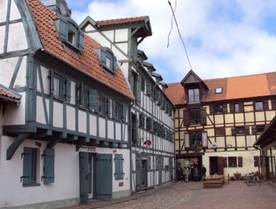
Klaipėda
Rescued iron grave markings from the city's old cemetery, after it was levelled by Soviets, make for interesting viewing. After a walk around the museum, take a seat in the workshop and try your hand at crafting their own piece of jewellery, but be patient, it's harder than it looks.
If you are in the city on a Sunday, make sure that by midday you are in the old Post Office courtyard. For 30 minutes a carillon of 48 chromatically tuned bells provides the city with an inspiring concert of sound ranging from the old classics to this years chart toppers. Before leaving, make sure you take a peak inside the red-brick neogothic Palace, built in 1893. It is one of the most impressive buildings in Klaipeda.
For something to eat, head to Friedrich Passageway, the western European styled street has something for every taste. For the adventurous types try Friedrich Pub which serves traditional food dishes like eel in white wine, Cepelinai (potato dumplings filled with meat - despite looking like an alien egg, it is actually quite enjoyable). If the traditional cuisine isn't to your fancy, the nearby pizzeria or Mediterranean Friedrich provide a fine selection of western dishes.
After a good night's rest, hire a bicycle and take the five minute ferry ride over to the Curonian Spit. Described as a Mecca for artists and the recreational oasis for the tired, the tourism brochures are not far off the mark.
A dedicated cycle path weaves its way through the pine forests between the small settlements and is a great way to explore the natural sites. If you are extremely quiet, amongst the small deer that inhabit the island you might spot the pair of Elk which are said to have crossed the frozen Baltic sea.
Your first port of call should be the small town of Juodkrante. Lithuania is famous for its amber and on the bay of amber, after stormy weather, small pieces can be found washed up on shore. Further into the town, have a unique refreshment stop on board Kogas, a pseudo pirate ship moored in the harbour. Here you can enjoy a cold glass of Svyturys beer and some light lunch while looking out to the Baltic Sea.
Continue by bike through the pine forests that line the Baltic Sea side of the peninsula before crossing the Nida-Klaipeda road. A short distance from the crossing you will find one of the most fascinating sites of your stay, the Dead Dunes. Over hundreds of years the rolling dunes have engulfed villages which remained buried below the white sands. Make sure you stick to the specially laid boardwalk, which takes you up to the vantage point, or face a hefty fine. From the top you can view the Baltic Sea on one side and the Curonian Lagoon on the other.
For a relaxed night's stay, call in at Villa Queen Luise, named after the Prussian Queen who stayed at the site's original inn in 1807 before it had to be rebuilt after a fire in 1829. The views from your private balcony out across the Curonian Lagoon are stunning. The hotel also offers row boats for an evening on the lagoon or a Swedish sauna in the open air.
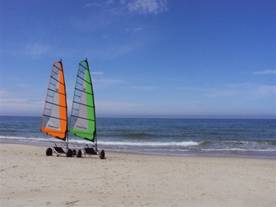
Next morning, head out for the final cycling stretch to Nida, the region's largest settlement. The path takes you through the forest before winding around the lagoon bay.
The best way to see Nida is by foot. Stop in at the local supermarket for refreshments and then head up to the lighthouse. During the summer months a number of festivals and open air film nights take place here, but head up early to beat the crowds. Continue through the forests towards the Parnidzio dune. At the top from storm damaged sundial calendar, the true beauty of the Curonian Spit can be admired.
Head back into the town, winding your way down the sand dunes and visit one of the many amber museums before taking a sunset cruise along the shoreline. Local boats take you right along the coast, up to the Kaliningrad border, and from here you really appreciate the size of the sand dunes as they tower above you.
Make sure you get up early the next morning and join the locals for a free early morning yoga session starting at 8am. An hour of gentle exercise on the soft white sand, with the wind massaging your skin, prepares you for the more invigorating blokart. Irklakojis offer the land sailing tours, wind levels provided, along with kayaking, sailing and hiking.
No visit to the area is complete without a taste of amber vodka or tea, enjoy your final Lithuanian sunset from one of the bars or cafes lining Nida bay. A perfect end to a culturally relaxing holiday.
Daniel Andrews
http://www.travelbite.co.uk/holiday-ideas/europe/lithuania/lithuania-s-natural-paradise-$1377673.htm
- Bookmark :
- Digg
- del.icio.us
- Stumbleupon
- Redit it

Text: Audrius Simaitis
My efforts to change the outlook of the Lithuanian health system started in January 2009 when I created the very first plan for how to bring about the change, long before the Ministry of Health started the current reform for this sector. Mr. Žilvinas Beliauskas was a wonderful partner in this enormous effort at that time but government institutions paid little attention, if any.
When in autumn of 2009 the Ministry of Health started the current reform it was obvious that the suggested changes, although important, will not bring a long term ongoing success as much deeper changes tackling the main underlying issues were required.
I have created a concept that is called "Health Care Reform Based on Values". The main idea of this concept is to create 3 medical regions in Lithuania with university centres as the main coordinating institutions in each of the region. Vilnius and Kaunas already have such an institution and Klaipeda does not.
One of the obvious problems that are the main source of underlying current problems, such as corruption, is the fact that the directors of the hospitals have too much power. Indeed their powers could be compared to the Kings of the middle ages. There is no control and accountability for their actions, as many Boards in the hospitals do not have any decision making powers. To compound the issue, six years ago Parliament issued a law that the there is no retirement age limit for the heads of the hospitals. They are the only category in the country to have such indulgence.
These are just a few examples to illustrate the fact that there is too much power concentration in one hand. This led to the situation where doctors and nurses are very passive and over the years they never learned to express their concerns or opinions publicly purely due to the fear. The fact that doctors accept unofficial payments also contributes significantly to the stagnation in the system.
Therefore we need to create an institution that will tackle these issues and will release the potential currently suppressed by existing structures and fears.
This leads to the next idea described in the "Health Care Reform based on Values". Each of the 3 regions should be governed by the elected/appointed Boards that would consist of the doctors, nurses, directors of the hospitals, representatives of the public and representatives of the patients' organizations. In this way the balance of the power between the directors of the hospitals and doctors will be achieved. The Regional Board will be responsible for the strategic decisions and the hospitals will be responsible for the implementation of these decisions.
And the integral part of this concept is the New Physician's contract that would encompass all the modern aspect of the physicians’ role in today's society. The concept also foresees significant change in the role of nurses as the current role of the nurses in Lithuania is well beyond the times.
Since autumn 2009 I have made multiple presentations of "Health Care Reform based on Values" to hospitals, various organizations, including presentations to the Speaker of the Parliament Mrs. Irena Degutiene, to the Health Care Minister Mr. Algis Caplikas, to the health care team of the President Dalia Grybauskaite. Various national mass media outlets published a lot of my articles reflecting these ideas.
In the continuation of these efforts to bring about the change, I organized a Western Lithuanian group of doctors and patients. This group in collaboration with Klaipeda University organized a Conference on the 15th of January 2010. About one hundred representatives of the doctors, patients' organizations and nurses in Western Lithuania took part in this Conference. The Resolution of this Conference fully supported the idea of establishing Klaipeda’s University Hospital with the idea to create the Association of all three Hospitals in Klaipeda as an initial step. The Resolution also supported the idea of establishing a Board of the Association with the thought to bring about balance between the administrators of the Hospitals. This also would enable the implementation of modern methods of health care management.
Basically there was no reaction from the government institutions to this Conference, and there two main reasons for that. Firstly, Vilnius and Kaunas University Hospitals do not want to loose their dominating status, as this obviously is associated with the finances. They have a lot of power and influence on the Ministry of Health to a degree that some of the prominent figures state that health care in Lithuania is governed by them and not by the Minister. Secondly, is the very important reason that most of the directors of the hospitals in Klaipeda do not want to have the University Centre as their own role could be different after the Klaipeda’s University Hospital is established.
This was very well demonstrated during the latest debate /forum which was initiated by the Mayor of Klaipeda and myself on the 26th November 2010. Only one Director of Klaipeda's three major Hospitals was present during this debate. This debate was about the future of the Klaipeda’s Hospitals and the unanimous decision of the forum was that there is the obvious need to establish Klaipeda’s' University Hospital. A representative of the Ministry of Health, Mr. Martynas Marcinkevicius who gave a presentation during this event supported this idea. There have been no developments since then.
The “fight” continues.
- Bookmark :
- Digg
- del.icio.us
- Stumbleupon
- Redit it

Text: Gene Emmer
(from his travel blog www.lithuania-travel.net)
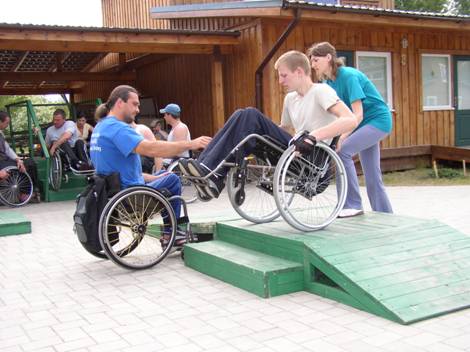
Unfortunately, Vilnius Lithuania does not rank high on any list of wheelchair accessible cities. We rarely see any wheelchair users in the city. When we do, they are invariably manual wheelchairs. We have yet to see a power wheelchair or a mobility scooter in Vilnius.
Several problems plague Vilnius in terms of accessibility. While it is not difficult to find accessible accommodation in Vilnius, it is difficult to get around. Like many European old towns, the streets are cobblestone. Old town shops usually have steps, and rarely have ramps or lifts. Restaurant toilets will sometimes be a flight up or down, with no alternative access. There is little in the way of disabled parking. The good news is that the Vilnius old town is pedestrian friendly. So, with some patience and a bit of assistance, a manual wheelchair user will manage in most places.
In the newer part of the city, such as shops and restaurants located on Gedimino Prospektas, things are a bit better. For example, the shopping mall located on Gedimino 9 is wheelchair accessible. Some of the newer mega shopping centres, such as Akropolis, Ozas, Panorama will offer few problems for wheelchair users. However, the vast majority of the buildings in Vilnius were built without elevators or ramps and there has been little in the way of retrofitting to accommodate people with disabilities.
Services for wheelchair users are also limited. It will be difficult to locate wheelchair accessible vehicle rental or wheelchair rental in Vilnius. While the Vilnius Airport will present few problems to a wheelchair user, access to the train station will be quite difficult. There is ramp access at the train station to one of the doors at the train station. However, getting onto the trains is challenging as there are no ramps to the train platforms and getting onto the train usually requires a very steep climb up steps built into the train cars.
While Vilnius is a beautiful city and certainly one to be enjoyed by everyone, a trip to Vilnius, Lithuania will present challenges to many wheelchair users. With adequate planning, many of the challenges can be overcome. But wheelchair accessibility of Vilnius, Lithuania leaves much to be desired.
- Bookmark :
- Digg
- del.icio.us
- Stumbleupon
- Redit it

The best doctor in Vilnius?
- Posted by - (2) Comment

Having worked in the Pharmaceutical industry for over 15 years, I have seen and gotten to know more doctors than most. I know that there are many doctors who are good at treating the disease but not so good at treating the patient. There are other doctors who are very good with patients, but are sometimes lacking in their medical skills. To find a doctor who is good at both is unfortuately rare.
I have a found a doctor who is not only good at both, he is perhaps the best doctor I have ever met. His name is Dr Cervin.
It is not just me. I have mentioned Dr Cervin to my friends and I know that some are seeing him. Most express their gratitude for the referal. This guy is that good.
Dr. Cervin studied medicine is Australia. His passport maybe Lithuanian, but his medical approach is very much western. He is that GP who you just feel confident in and comfortable with. He offers old-fashioned patient care with modern medical treatment. The ideal mix that you rarely find anymore. Needless to say his English is perfect Australian English.
Dr. Cervin's assistant is pure Lithuanian. She is very kind but her English is limited. So, if you call and speak English, she will probably connect you through to Dr. Cervin directly.
The other nice thing about Dr. Cervin is his location near the Cathedral Square. For many expats and visitors to Vilnius, this is very convenient.
All this comes at a reasonable price. At the moment the cost of a consulation is about 150 lta (approx. euro 50) plus the cost of any exams or proceedures. However, Dr. Cervin always consults with his patient before ordering any of these. So, you will not be suprised by the bill.
So if you are looking for the best GP in Vilnius, call up Dr Cervin and say G'day.
Text: Gene Emmer
(from his travel blog www.lithuania-travel.net)
- Bookmark :
- Digg
- del.icio.us
- Stumbleupon
- Redit it
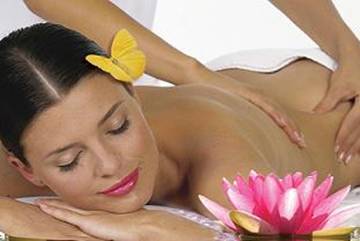
The most famous Lithuanian SPA town – Druskininkai in Southern Lithuania, famous for its mineral water and remarkably nice environs, is only one of several SPA spots in this country! We invite you to indulge yourself in an outstanding exotic SPA treatments and dive into the sea of SPA pleasures. Massage masters will reveal you the ancient secrets of relaxation, while aromatic bathtubs and various baths will help you to regain your strengths after a hard working day. SPA treatments revive your skin, pamper your body and calm your spirit.
Druskininkai
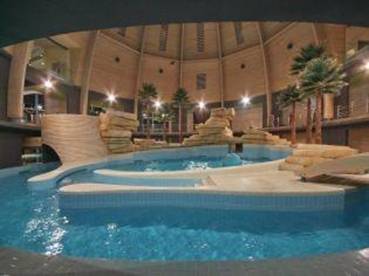
Druskininkai SPA
Druskininkai is a year-round international resort offering mineral bath, mud and climate therapies.
Mineral waters of different mineralization, similar to the well-known European mineral waters, and cure mud are found in the resort. Nature also endowed Druskininkai with mild climate, many lakes and beautiful parks and groves, where the guests can find their peace. Since 1794 the small town that has rapidly grown into an attractive tourist center offering all the benefits of a carefree and safe vacation.
Druskininkai offers a wide variety of health treatment services: herbal, bubble, honey and other baths, massages, krio- and magnet therapy, various health care, beauty and weight loss packages, etc.
Here are several worth-seeing sights: soviet sculptures museum “Gruto parkas”, woodcarvers’ parks, etc. Visit one of the largest Aqua-parks in Europe and 70-level adventure park ONE.
Birštonas
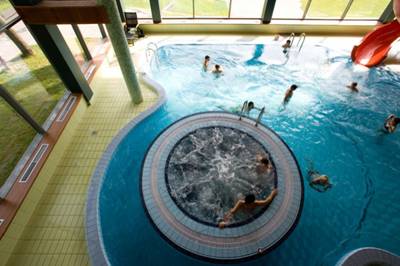
Tulpė Medical SPA in Birstonas
The resort of Birstonas was founded in 1846. At the turn of the 19th-20th centuries, the first patients not only from Lithuania but also from the major cities of Russia and Poland used to come to the sanatoriums that applied the mineral water and curative mud procedures. Birstonas has two perfect specialized rehabilitation sanatoriums for treatment and recreation that provide treatment for various illnesses by applying the latest methods as well mineral water and curative mud, where one can recover from the mental or physical fatigue as well. Another factor, which significantly attributes to the treatment quality and health recovery in Birstonas, is the air of this resort, surrounded by forests and the loops of the Nemunas river, which is especially mild and saturated with phytoncides and light negative ions having the effect of a huge inhalator on a human body.
The resort boasts beautiful environment: houses scattered among trees, elegant villas constructed in late 19th-20th centuries, the neo-Gothic church with its tower rising towards the sky, the buvette of mineral water, the monument to Vytautas the Great, the Hill of Songs, and artificial lakes. The resort town is surrounded by the scenery environs approached by a great many special roads and paths for pedestrians and cyclists, riders and horse-drawn carriages. The lovers of water entertainments are offered to rent a canoe at the Sport Centre and try the bends of the Nemunas. Impressive panoramas of nature open from the high banks of the Nemunas and hill-forts. The Bird Watching Site is established in the area of the Nemunas islands. But you can enjoy the most beautiful loops of the Nemunas only from an air balloon or a plane taking off from Pociūnai Airport. Birstonas is developing into a winter resort as well. The downhill skiing track is equipped here. One can also go skiing as well as ride on horse-driven sleigh through snow-covered forests.
The resort often hosts concerts, poetry evenings and sport events. Birstonas is a perfect place for conferences and seminars where the fatigue of intensive activities will be quickly removed with the help of relaxing procedures or spending free time in harmonious and pure nature. The biggest Lithuanian river, the Nemunas, which wings spectacularly in the middle of the country as it flows towards the sea, has formed three loops. The structure of the landscape of this region is one of the most peculiar in Lithuania. Birstonas, one of the most beautiful resorts of Lithuania, is situated in the south of the country.It has been famous for its curative waters, sanatoria and beautiful nature since the olden times. The Nemunas River surrounds the resort on all sides and forms a unique loop there.
- Bookmark :
- Digg
- del.icio.us
- Stumbleupon
- Redit it
Text: Algis Ratnikas
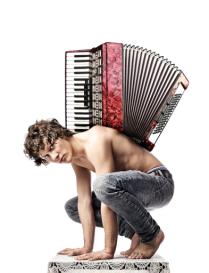
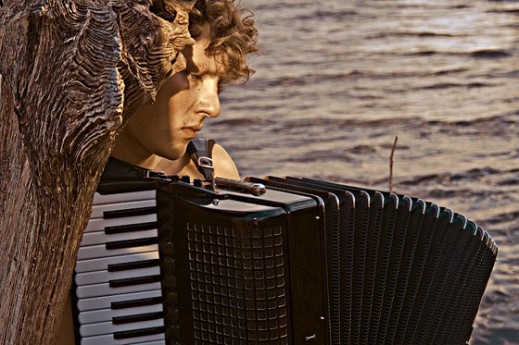
Martynas Levickis (20), Lithuanian born classical accordionist, arrived in the US in the summer of 2010 to compete at the International Accordion competition, July 21-25 in Santa Clara, Ca., an event sponsored by the Accordionists and Teachers Guild (ATG). This was the focus of his US tour that included performances in St. Louis, Chicago, Wisconsin, Pennsylvania and Santa Clara. There was already quite of a bit of a buzz regarding his talent and videos of his recent performances were already available on the Internet. A number of people later commented on the Santa Clara competition saying they were at wits end to figure out how the judges would be able to choose a winner from the extraordinary talent that was present. The local Bay Area Lithuanian community with the assistance of Esti Fernandez, ML’s US-based assistant for his 2010 tour, organized a local concert. It was held one day after Martynas won 2nd place and $3000 in the 3rd edition of the Anthony Galla-Rini International Competition for Classical Accordion. First prize and $5000 went to Gao Yi Cheng, a performer from China.
The Bay Area Sunday concert was held just hours before ML was scheduled to leave the area. Martynas displayed a level of talent and virtuosity on the accordion well beyond what anybody in the audience had ever witnessed. He presented the Partita from "Also sprach Zarathustra" by Sergei Berinski; Prelude and Fugue in G sharp minor by J.S. Bach; “Fantasy’84” by Jurgen Ganzer; Sonata in D major by D.Scarlatti; “Flashing” by Arne Nordheim, a cadenza from the concerto for accordion ‘Spur’ and “Soliloque from Concert Suite” by Franck Angelis. Our local audience was enthralled. We had never seen or heard classical music played on the accordion with such brilliance and verve. One and all jumped to their feet in ovation. To top off the afternoon Martynas added three Lithuanian folk songs and his voice, which again brought the audience to its feet.
Martynas Levickis has been playing accordion since the age of 3 and started serious study at the age of 8. He studied at the Saulius Sondeckis Conservatoire in Siauliai (Lithuania), under the direction of Mrs. Maryte Markeviciene. At the age of 12, Martynas began participating in national and international accordion festivals and competitions. He has entered accordion festivals in Lithuania, Italy, France, Netherlands, the USA, Poland, Estonia and Belarus, winning awards in all of the competitions. In 2004, he was the first accordionist to be awarded Lithuanian Queen Morta prize. He was given an honorable mention and prizes by Lithuanian President and the head of Parliament. In 2005, he won the young artist scholarship presented by Siauliai city municipality. In 2006, the Siauliai authorities awarded him a new accordion for his achievements.
In 2008 Martynas entered the Royal Academy of Music. He has since performed in master classes with prof. Friedrich Lips, Prof. Matti Rantanen, Claudio Jacomucci, Nikolaj Sevriukov, Dr. Raimondas Sviackevičius and others. Martynas is currently studying his third year at the Royal Academy of Music in London under the direction of Prof. Owen Murray. In the summer 2009 he toured Chicago, St. Louis and Memphis where he won multiple first prizes at the 71st Annual American Accordionist Association festival. His composition “The Quiver” won 1st prize and established him as a composer. In June 2010, at the Kings Place in London he presented a piece “Double” (by composer E.Medeksaite) for accordion and electronics. Most recently, Martynas won the first prize in the well regarded world accordion competition “Coupe Mondiale 2010”, Piano-Accordion category in Croatia.
While in London Martynas continues to teach on Saturdays at a Music Academy for young pupils and to actively perform for the Lithuanian Community in London and for Music Halls, such us the Queen Elizabeth Music Hall.
On Jan 16, 2011, Martynas appeared on TV in the Lithuanian "Lietuvos Talentas" TV show (TV3) and won the grand finals with a cash prize of 10K Euros.
http://www.youtube.com/watch?v=U6vf6KeMFMA
Martynas is an active member of the Lithuanian Accordionists’ Association by establishing new ideas and creating better opportunities for young accordionists in the country.
The following links provide access to some videos of Martynas in performance:
http://www.youtube.com/watch?v=Hj8ofoV65qI
http://www.youtube.com/watch?v=CNGLGUfwNQE
http://www.youtube.com/watch?v=w8XbDpbPk5A
For more information and to download Martynas on iTunes, please visit www.levickis.com
- Bookmark :
- Digg
- del.icio.us
- Stumbleupon
- Redit it
100 years since M.K. Čiurlionis died
- Posted by - (4) Comment
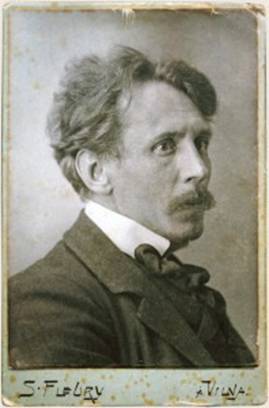
On the 10th of April it is 100 years since Lithuania’s national composer and painter, Mikalojus Konstantinas Čiurlionis (1875-1911), died. VilNews will on this occasion respect presents a series of articles about his life and works. We will also have a very personal talk with his great grandson, Rokas Zubovas, who has been following in his great-grandfather’s musical footsteps.
On the 10th of April it is 100 years since Lithuania's national composer and painter, Mikalojus Konstantinas Čiurlionis (1875-1911), died. VilNews will on this occasion respect presents a series of articles about his life and works. We will also have a very personal talk with his great grandson, Rokas Zubovas, who has been following in his great-grandfather's musical footsteps...
Lithuanian artist and composer Mikalojus Konstantinas Čiurlionis (1875-1911), a unique figure in the history of European arts, has left a profound imprint on Lithuanian culture.
Judging by the breath of his artistic activities and diverse interests, Čiurlionis can be seen as a truly Renaissance individual. Over a short, mere decade-long career, he composed nearly four hundredmusical compositions, including two large-scale symphonic poems, an overture, two piano sonatas, a string quartet, and a cantata for chorus and orchestra. During those same brief years he also created approximately four hundred paintings and etchings, as well as several literary works and poems, while still finding time to experiment with art photography. Notes from his study years at the Warsaw Institute of Music show his interest in geology and history, chemistry and geometry, physics and astronomy, astrology and ancient mythology, dead and modern languages, philosophical ideas of antiquity and modernity, eastern and western religions.
On the other hand, his active involvement in the Lithuanian national movement and his idealist self-sacrifice for the sake of artistic ideals show him as a typical artist of the Romantic mold. During his short life, Čiurlionis managed to be at the heart of the creation of the Lithuanian Artists Union and actively organized and participated in the first three exhibitions of Lithuanian artists, organized and directed Lithuanian Choruses in Warsaw, Vilnius, and St. Petersburg, and was the first Lithuanian professional composer not only to take interest in Lithuanian folk songs, but to collect and publish them. His passionate approach to life is perhaps best summarized by his refusal to accept an offered safe teaching position at the Warsaw Institute of Music, and his declaration in a letter to his brother that he intends “to dedicate to Lithuania” all of his “past and future works.”
In addition, in following the German Symbolists in his paintings, exploring synaesthetic ideas, fashionable at the time, and exploring chromatic and harmonic possibilities of the tonal major-minor system in his music compositions, Čiurlionis stands as typical artist of the late Nineteenth-early Twentieth century Europe.
Finally, his latest mature paintings, based on intricate musical compositional techniques, and piano compositions in which tonal writing is blended with proto-serial techniques and constructive use of short rhythmic, melodic and harmonic complexes, stand as examples of totally unprecedented plastic-aural experiences unique in the history of European art.
- Bookmark :
- Digg
- del.icio.us
- Stumbleupon
- Redit it
- Posted by - (1) Comment
M. K. Čiurlionis great grandson, Rokas Zubovas:
Music of Čiurlionis makes you grow
Text: Indre Lauciute

Rokas Zubovas. A world famous pianist.
2011 is a special year with regards to the famous Lithuanian national composer, artist and cultural activist Mikalojus Konstantinas Čiurlionis. He died exactly 100 years ago. In April.
Naturally, this year is extraordinary special to his great-grandson, the world famous Lithuanian piano player, Rokas Zubovas.
We met Rokas, and simply asked him: Why? What is so catchy and special about the music of your great grandfather that you can’t tear yourself off from spending almost every day with him and his art, as well as the memory of him, continuously studying and playing his music?
Rokas Zubovas;
“Last year I spent much more time with M.K. Ciurlionis’ music than ever before. All these tasks regarding Ciurlionis music I used to do before fade compared to the tasks I accomplished in 2010. In order to record seven hours of live music, one has to spend 8-9 hours every day continuously playing his notes. Of course, going so deep into his music I’ve discovered new experiences and grasped fresh ideas. Just imagine you’re holding the notes and feeling them not just intellectually, theoretically, but also physically at the same time. Such immersion into his music gave me something that I can’t even describe and express in words yet, but the thing I’m sure about is that I’ve changed and I am different now.”
“Last year was extraordinary because of trying to concentrate on one subject. The last time I had such an experience was 20 years ago, when I was studying in the United States; then I had to choose and determine my priorities. At that time I experienced that when you concentrate on the most important things in your life, you realize you’ve been surrounded by so many worthless things, although they seemed to be so important and amusing. And then you get surprised - you just don’t miss them at all.”
“I could describe the year 2010 using one phrase I heard from a priest in a church a few years ago: “Christmas comes to everyone in a very different time and separate.” This means, that the miracle of Christmas is very autonomic and personal. The last year I could call as my time for Christmas. I understood and discovered many things that I couldn’t before. By living with Ciurlionis music and playing his notes I achieved a better understanding of why did he write the music the way he did. When I hold the notes of such a composer, the feeling of the music is somehow more sensitive.”
I think one could be jealous of such a Christmas. I didn’t find my Christmas yet. It seems that last year was really remarkable for you. What other discoveries did you make in 2010?
“One of the precious and important things that I found for myself is the polyphonic music of Ciurlionis. It explains his late music really well or reveals why and what he was seeking in his studies.”
Another area that I didn’t pay enough of attention to - all his study is about the grey hour. I think it’s a subject that most of us never think about or at least didn’t ever before. One hundred years ago when there was no electricity yet, people used to outlive the dusk hour specifically. I mean the time when there’s no daylight anymore, but it’s still not dark enough to light oil lamps. That hour was perceived as the time for concentration, visions, recollections, dreams and stories. This period of the time is special, because you can’t trust your eyes - you can’t see the real objects anymore, just the shapes and shadows. Maybe that’s the source and the reason, why the reincarnation theme is so strong in the music and paintings of Ciurlionis. Those shapes just disappear in his music.”
“In addition, one of the most important goals that I achieved last year is that I’ve already launched a website about Ciurlionis. I already received some letters from the Netherlands, England and Japan, concerning the same question: where to get the notes of Ciurlionis? I’m delighted that there are more and more people who are searching for Ciurlionis and now they have this point where they can get it - the website”.

Čiurlionis and Sofija Kymantaitė-Čiurlionienė in 1908
Preparing for our interview I found out that Ciurlionis is popular even on social networking pages, such as facebook. In specialized pages for classical music and forums, people are discussing about his music and asking each other “who is he?”
“One year ago I had a dream. I want, that one day a man would wake up in Kenya and find out that 2011 is 100th anniversary of the death of M.K.Ciurlionis; one could google about it easily and find representative information concerning all one’s questions on the website I’ve launched. I’ve experienced that it is possible to find some letters or information about paintings of Ciurlionis in libraries and museums, but sadly not the music. It seems that music is such a peculiar area which exists only when it is being played.”
“Besides, I was shocked. Ciurlionis is such a big figure for all our history of music and has been dead for one hundred year already, but we still haven’t recorded all his music. That was also one of the reasons why I decided to take this big mission - to record all his notes. Everything is already done, and my goal is to send two DVD copies to city libraries, gymnasiums, music schools and schools of higher education.”
I’ve heard that the state of Lithuania doesn’t support your project the way it should. Does it mean that your work is considered to be as an underground activity?
“Recording Ciurlionis’ music is a must do thing. I remember the famous phrase of John F. Kennedy: “Don’t ask what your country can do for you. Ask instead what you can do for your country.” I like this phrase, but I still see one objection in it. It’s implying that a man has to do something for his state. I think that a state, Lithuania, is what we are. I am of the same importance as a prime minister of Lithuania, or some other famous and important politician. Why should I let, that the face of Lithuania would be built just by them? I am equal with the minister or any other Lithuanian you could meet on the street. Lithuania is not just somebody alone, it’s all the people. That’s why I don’t consider that the things I do are just for Lithuania. I think that Lithuania is doing this.”
“Despite daily topics about the lack of money, I think that every project could be started with saying: “There’s no money”. If we always give everything to the hands of money, then we just kill a human in ourselves. We give up ourselves to money because we think it is ruling everything. It doesn’t. It’s just us. There are so many people that live without being controlled by money. Let’s follow them.”

This year is special. What are the special events that will make people be interested in Ciurlionis?
“There are many events planned. It is really sad that the national program of Ciurlionis is structured not in the way I would be satisfied – money is given to the more bureaucratic things, but anyway, that’s the way it is.”
“Art is alive just when it is relevant. It has to influence people - otherwise it doesn’t exist. I’m very happy, that in Lombardia, in Italy there is an exhibition of Ciurlionis displayed at the moment. And approximately 10,000 children will have the possibility to participate in the project called “Ciurlioniada”. That’s a big investment in the future because a lot of children will know about Ciurlionis. That is informal learning and it doesn’t matter if a kid won’t remember the name of Lithuanian artists anymore but still, he would already have been trying to copy an angel from his paintings or a zodiac sign. They will have some understanding. That’s impressive. I would be very happy if Lithuanian children would have such a possibility - to touch the sense of Ciurlionis art.”
“Nevertheless, I’m very happy, because this year there will be two different exhibitions of Ciurlionis displayed in Vilnius - one in spring, and the other one in autumn. The first one will be devoted for sensational experiencing of Ciurlionis music and the second one - for musicology subjects. These conferences are going to last four days and attract many guests from all over the world.”
“One of the biggest accents I’m excited about is the conference in Finland in winter. This conference is organized by the Finnish Musician’s Union and is the biggest annual event for all the Finnish musicologists attending the symposium. One evening is devoted to Ciurlionis, and I think that’s the best way to spread the information that we could dream about. Imagine that suddenly the whole Finnish musicology community will be touched with a tiny colour of Ciurlionis and people will become aware that he exists at all. They are precisely the people who can carry the message about his music. But why don’t we do this? Why don’t we look for the ways the message about Ciurlionis could spread as a water-colour painting.”
Are you the only pioneer, initiator doing something about the works of Ciurlionis?
“There are more people doing something about it. Lately I’ve been talking to the students of the music academy, who want to make a music festival in Druskininkai this summer. There would be three colossal scenes with different kinds of music, such as jazz, classics and alternative music. There would also be an area for tents and paintings of Ciurlionis would be exhibited under the night sky by using lasers and there would be a direct broadcast on facebook and youtube. These are a few of the many amazing youthful ideas that could attract other young people to the knowledge of Ciurlionis. I hope it will work. It would be a great accent on Ciurlionis for this year.”
“There will be more and more people doing something related to Ciurlionis. I have no doubt because there are people who love Ciurlionis music. We just need ideas (not money) to start doing something. Nowadays we understand art differently. When we adapt Ciurlionis music to the changing world, a man can hear that the melodies are acceptable and touching. That’s why they adapt so easily. As I’ve mentioned already, the art of Ciurlionis is catchy. Usually, if someone hears and experiences the art of Ciurlionis, he stays connected with it. For this reason the sound of Ciurlionis spreads in the world. It seems, that there’s love shining from the inside of his art, and it spreads.”
How long have you lived with the music of Ciurlionis?
“It all started in my childhood, of course. When I was accepted to the music school of “Naujalis” in Kaunas, it was somehow always natural to think, that if there’s a need to play Ciurlionis, me as a great-grandson, would the best fit. So I got used to being related with the name of Ciurlionis since my primary classes. I don’t even remember what I used to play but obviously, it was already Ciurlionis. As I remember, even the first big concerts of mine were also shaped by Ciurlionis music. To sum up, it would be almost 35 years.”
“Almost all the time I used to have an internal prejudice that to some extent, I am as an advocate of him. I used to feel that everyone expects me to be the one who has to carry the message about Ciurlionis. That is my mission. I used to ignore it.”
“But once, when I was playing in United States, a perception came. I understood, that being a part of Ciurlionis, I should accept it as a blessing and it’s a gift to have the possibility to touch his notes and share them with others. I realized that his music is so great that I could exist or not but still his music would exist hundreds of years after my death. And if I touch it and spread it, it’s just a blessing for me and I should just embrace and appreciate it. I take it as a present to myself and every time I’m affected by his music I find something special for myself to grow.”
“True art can be the one that doesn’t have neither the bottom nor the top. If the painting is good, then every time you look at it you can find something different. It’s the same with a good movie or a book. But nowadays we have this fast food industry. If you ate a hamburger, you know that you can get the same later. There’s just massive production which is the same. Ciurlionis was living in that time and culture that is inexhaustible.”

M.K. Ciurlionis - Lightning Flashes
Could you be called as a missioner who’s like Prometheus carrying the torch?
“I don’t consider myself to be like this. Some people say that if I’ve recorded Ciurlionis music, then there’s no use to do that anymore for at least a few decades. No. The more interpretations of Ciurlionis, the better to the music. The music of Beethoven exists not because everyone plays it in the same manner but because of different variations and interpretations. When everyone plays it in different ways, then appears a line that combines everything into one. Tradition doesn’t occur out of one thing, tradition is born out of what is different. Among these different options you can find one common denominator that unites them all. There always has to be a dominator. To copy and to be the same is just boring and I don’t see any sense in it. That’s why I encourage to play Ciurlionis music and to interpret it in freestyle. I’m not perfect. No one is. I just do it the way I can.”
“Let’s allow Ciurlionis to be played in the manner of jazz, pop way of music or to be transformed into something different. Why not? When people will see him in this manner then they will try to find who he really is and will come to his music. And these people will be the ones who makes him famous.”
“Everyone has this basic thought that Ciurlionis is something “good”. Heritage, in other words. It’s kind of a basic thinking that you’ve learned at school and don’t analyze anymore. When we place something into a box then it’s already conserved and no one is touching that unless to clean the dust. The thing is that music is alive just when you hear it, not when it’s placed on some shelf. No one is interested in old authentic music from old, let’s say 1936, because for us it’s too boring. We have to transcribe it and adapt it the way we could understand it and to make it relevant. The same with Ciurlionis. We have to clean the dust and take care about his music but at the same time adapt it to our ears.”

How big is the difference between understanding the music of Ciurlionis and the nowadays lives we’re living?
“Ciurlionis was living in at time when art had the function that’s already forgotten. The art was as a medium among the human and all these mysterious unintelligible phenomenons - the nature and the human. I’m absolutely convinced that art appeared as an explanation of the things that we can’t understand by mind. When we don’t find the way how to make an explanation for anything, then we create our own explanation system through the paintings, music or mythology. It explains to us how we should live and why the things are the way they are. We don’t understand but we don’t need to, we feel. It’s the same about the music. The role of it is to explain our feelings. When you dive in and loose yourself in music then you feel how the world of your emotions becomes pure. But why? Because of the harmony you get. We don’t think about our world of emotions too much but with music we’re able to harmonize it end then continue living. When Ciurlionis was still alive, this role of the music was still important and the artists used to create trying to create a model to explain the world.”
What has changed nowadays?
“Well, partially I think it’s our fault. We don’t believe in such anymore.”
Why so?
“I think today’s artists do not believe they are creating some kind of explanation of the world or creating some model for it. Still there’re many artists who believe in it but most of the artists don’t even come to such idea.”
So why do they create then?
“The phenomenon of 20th century is originality. Ancient art existed through copying. The position of the artist in the 19th century was like this: if you want to become a painter, first year don’t use paper, viper or anything because anyway, you won’t create anything valuable. It would be just a waist of expensive material. Just refine your arm. You do this, then find out the artist you admire the most and start copying him. Do this till you’re able to copy him perfectly. When you already reach this level, when you’ll be able to make the ideal copy, then you’ll understand what is wrong in his painting. You’ll experience who you are. When you’ll see this disagreement among you and your beloved artist, you’ll find out that this disagreement is you.”
„Nowadays this way of thinking has lost its sense. Quite often I see so many artists that try to make an impression by any means, anyhow. The goal is to make an impression to as many people as possible and after on everyone forgets it. No one cares about it anymore but does this impression explain anything and is there any deeper meaning? There’s nothing. Just a façade”.
“Let’s remember such a phenomenon as cinema. Almost 30 years ago such directors as I.Bergman, R.Fellini or W.Allen used to figure on the covers of magazines and newspapers. They were representing the time, it was pulsing. Nowadays the cinema revolves around the question of how much money did this or that movie earn and for sure you always have suggestions, which is the most expensive and that’s why it’s worth seeing. What does it have to deal with the harmony or the art I’m talking about? Nothing. Everything is just a façade.”
“When we pass from sensuous things to sensual things, then the art stops it’s function. We want to sell ourselves for a high price but you can just see that people come to the concerts with empty eyes and leave like this. Just made one more tic in their “to do list”. “
“We could say that’s because of the market. That’s the reason why we act like this. But no, still every person wares its soul and cares around his sacred mark and where to fulfill it. And finds it. Art is used to be considered as a source of satiation. But art is not like this anymore. People discover other sources for that: a small kitty, taking care of the children, flowers, practicing yoga. There happens that somehow these small things appear that satiates a man and there’s always be the desire of fullness. As long as we are humans, the desire will last.”

- Bookmark :
- Digg
- del.icio.us
- Stumbleupon
- Redit it
Meet the wall at Literatų gatvė
- Posted by - (0) Comment
Text: Giedrė Avard

You leave Vilnius Old Town’s main street – Pilies g. – and after only 50 m you meet this wall at Literatu street,
full of artworks dedicated to some of the greatest writers of Lithuanian past and present.
Once upon a time in the old town of Vilnius, in the winding street that has got its name to honour masters of letters, a beautiful idea was realized. „Literatai“ (eng- litterateur) street has a rich and long history which begins at the times no-one can remember and is being continued by art projects on the street walls. You can find more than hundred peaces of art works created to remember poets, essayists and different types of writers related to Lithuanian cultural heritage of literature. Various weatherproof techniques have been used to make the artworks; some pieces are made of ceramics, others are sculptures made of glass and other materials, whereas some pieces are painted straight on the wall.Already from some distance you start seeing differently sized and colored shape artworks, and when you get closer you will see that each appear to be a characterful peace of ar. It may bring you into the wonderful stories behind if you care to take your time and observe at least some, which you find most interesting. On the other hand, being on a distance gives you a moment to notice a composition, which may be an interesting experience as a new creation – the whole wall it self.

Wall fragment.

Dedication to Arvydas Ambrasas, by Greta Medelytė.

Dedication to CASTOR & POLLUX by "SINTEZIJA"

Dedications to Rimas Burokas (11) and Tomas Čepaitis (12) made by Birutė Zokaitytė.
The project is successfully growing and spreading on the wall. More and more art peaces are being installed into the walls at the street every year since 2008. As the manager Eglė Vertelkaitė says, „there is a vision to create a „Literatų“ street embassy, where you can develop Lithuanian culture, share experiencea and be an integreted part of it.“
More pictures and more to read about the project at www.literatugatve.lt
- Bookmark :
- Digg
- del.icio.us
- Stumbleupon
- Redit it
The unorthodox music professor
- Posted by - (0) Comment

Text: Aage Myhre
Here he is, the professor who is conducting music and music festivals more energetically than anybody else, and who treats the very term music in an anything but traditional manner, for example when he conducts an acrobatic plane, doing its loops according to Bach’s “Ave Maria”, or when he conducts a complete “orchestra” of bulldozers and excavators.
- Bulldozer conduction is very sexual, says the professor, gesticulating and emphasizing the importance of his words, in his so typical manner - full of humor, intensity and warm enthusiasm.

Donatas Katkus was born in Kaunas 68 years ago, where his mother, an amateur actress, raised him alone. The professor was the outcome of a hectic love affair, and he never met his own father.
-But, says the professor, I do not complain, because I am a very young and very nice man, and I am just happy my mother did not take the veil in a Belgian nunnery, as she planned to do before the war started.
|
“The cultural life in Vilnius is in fact so attractive and extensive that there is no need to go anywhere else. You are never alone in Vilnius!” |
Life is easy
Professor Katkus is widely known for his excellent mood. The laughter and the good story is never far away, always told with great immersion and sometimes also with aloud gesticulation in order to make himself fully understood, like when he told me about the concert, where he conducted a small plane to make its loops to the music of “Ave Maria”.
Everybody in the restaurant stopped talking when the professor started his demonstration of how this event had been performed, using his arms to follow the loops, and his voice to indicate how the plane engine had been increasing its number of revolutions on its way up to highest octaves, into a decrescendo of sound and movement when the plane turned its nose down again.
- I am an actor by nature, and I do not take life too seriously, says the professor.
Forest brothers
But life was not always easy for Donatas Katkus. He can still well remember the summer day in his mother’s native village in the year 1949, when KGB suddenly appeared with a young, white-shirted man they had arrested. After one hour they re-appeared, and then the young forest brother’s shirt was totally soaked with blood. They would put the dead body of forest brothers at show for two weeks in the center of the village square in order to observe the reactions of the people watching the gruesome show so they could find out the relatives of the diseased and to demonstrate how dangerous it was to fight for the freedom of our country, says the professor with a sad glance.
Family in Siberia
- Many from the family of my wife were deported to Vorkuta and the Siberian tundra, and I know stories of how they had to build their houses from frozen human bodies because no other building materials were available.
- But I know that they had their music, and I tend to think that the Lithuanian folk songs very much contributed to their survival, he tells, and the eyes of the professor start shining again.
Fear is terrible
- How was it to work during the Soviet period?
- Well, for people like me, working with culture, it was not too bad. But it was terrible always to feel fear, always having to look back over the shoulder in case somebody should be listening. Vilnius was a true province during those years, as everything international was supposed to take place in Moscow, and only at the end of the period it was possible to get impulses through Warsaw and later also directly from the West. My personal “breakthrough” came when I, as a young man, was chosen to participate in a competition in the Belgian city of Liege, where our Vilnius String Quartette won the first price.
One of the greatest achievements of Professor Katkus was to start and develop the Vilnius String Quartet, where he played his main instrument, the viola. – I have been playing in the quartet for 29 years, and it is still doing well today, so I am rather proud of that, he says.
St. Christopher
The St. Christopher has come to play the main role in the life of Professor Katkus, first when in 1994 he founded the St. Christopher Chamber Orchestra, and in 1995 when he started the now so famous St. Christopher Summer Festival, which also this year was very successfully concluded, with its 36 concerts in different Vilnius venues during the months of July and August.
The saint’s name derives from a 3rd century legend, and the name means “Christ-bearer”. St. Christopher is the patron Saint of Vilnius and is featured on the coat of arms of the city. Due to the old legend, St. Christopher has become the saint of people who carry certain loads on their shoulders. The name seems to fit for the professor…
Money is crazy
Professor Katkus admits that it has been a very hard job to collect all the money needed for his summer festival. – This year, for example, he says, when it was only one week till the opening, I was still lacking 70,000 litas.
- But you did not get a heart attach?
- Look, I get several heart attacks in every festival, but do the festivals become inferior because of this? It’s so crazy always to have to think about money, which in fact is SOOO small a part of reality, so I prefer to remain happy whatever happens!
Advice to foreigners
- What is your advice to foreigners living in or visiting Vilnius?
- My advice is to take advantage of the fantastic musical life we have here in this rather small city, including two symphony orchestras, two chamber orchestras, two string quartets and a Music Academy with concerts almost every day! Both our Opera and our National Philharmonic are of fantastic level, and there are also a number of good pop and jazz concerts around in town. The cultural life in Vilnius is in fact so attractive and extensive that there is no need to go anywhere else. You are never alone in Vilnius!
Especially when the St. Christopher Summer Festival is in full swing in July and August.

- Bookmark :
- Digg
- del.icio.us
- Stumbleupon
- Redit it
|
|
|
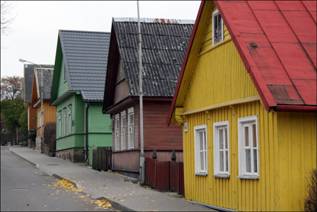
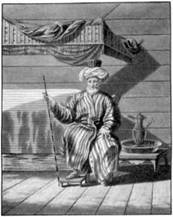
Since the 14th Century two Turkish nationalities – Tatars and Karaims – have been living in Lithuania. From linguistic and ethno genetic points of view they belong to the oldest Turkish tribes - Kipchaks. This ethnonym (Kipchak) for the first time was mentioned in historical chronicles of Central Asia in the 1st millennium BC. Anthropologically ancient Kipchaks were very close to Siberia inhabitants Dinlins, who lived on both sides of the Sajan Mountains in Tuva and the northern part of Gob. In 5th century BC Kipchaks lived in the West of Mongolia, in 3rd century BC they were conquered by Huns. Since the 6 - 8 centuries, when the first nomadic Turkish empires were founded, the Kipchak’s fate is closely connected with the history and migration of the Middle Asia tribes. In Turkish literature they are known as Kipchaks. The history of Karaims is connected with Lithuania since 1397-1398. According to the tradition, The Great Duke of Lithuania Vytautas, after one of the marches to the Golden Horde steppes, had to bring from the Crimea several hundred Karaims and settle them in the Great Duchy of Lithuania. Transference of several hundred Karaim families and several thousand Tatars was not done once. It was in connection with the state policy of The Great Duchy to inhabit the empty areas, build towns and castles and to develop trade and economic life. Initially, Karaims were settled in Trakai between the two castles of The Great Duke, present Karaim Street. Later they were found living in Biržai, Naujamiestis, Pasvalys and Panevėžys. However, Trakai has always been the community's administrative and spiritual centre for Karaims in Lithuania, nowadays more and more also for Karaims throughout the world.
- Bookmark :
- Digg
- del.icio.us
- Stumbleupon
- Redit it
The exceptional relationship between Italy and Lithuania, which was especially evident for the period of 1300 – 1800, will never come back, but will always remain as a remarkable memory, and leave its unique hallmarks in and on Lithuania forever.


It is a myth that Rome and Vilnius both were established by wolves. But it is no myth that the Italians have put an
indelible mark on Lithuania, and when Gediminas, the Grand Duke of Lithuania, in 1323 decided to put down
roots in what is now Vilnius city, a Franciscan monastery was already in place – at the foot of Castle Hill where the Cathedral today is located. Since then, for hundreds of years, the spirit of Rome and Italy played a main role in the development of Vilnius and to a certain degree also of Lithuania.
No wonder that Vilnius sometimes is referred to as “the world’s most Italian city outside Italy”.
1300 – 1400:
The Grand Duke writes to the Pope
* Italy was involved in and with Vilnius already from its very first days as a capital city. Even the name Vilnius was used for the first time when Grand Duke Gediminas in 1323 – the same year he founded the city - wrote to Pope John XXII asking for support in Christianizing the Grand Duchy of Lithuania, by then one of Europe’s leading nations.


Grand Duke Gediminas and Pope John XXII
* Gediminas invited merchants, craftsmen, bankers, farmers, and soldiers to come to the new capital, guaranteeing all freedom of beliefs and good working conditions. Vilnius became thereafter truly international, though not with much of German or Scandinavian influence, as one could expect, rather influenced by Rome – greatly different from the other two Baltic capitals.
* Early examples of Italian influence within architecture, where at least some fragments of heavy, massive walls and other elements, typical for the early Gothic period, still do exist in some Vilnius churches, among them the Cathedral, the Church of Assumption (Traku 9) and the Church of Resurrection (Didzioji 17).
* And, there is one church you really should visit if you would like to smell the 700 years of Italian influence on Lithuanian history. That is the St. Nicholas Church (Sv. Mikalojaus 4). This tiny little church was originally erected around 1320, and remains the oldest Gothic building in town, though with several changes over the centuries. But a true beauty!

St. Nicholas Church, Vilnius
1400 – 1500:
Prince Casimir, Patron Saint of Lithuania, educated by Italians
* Young Prince Casimir (1458 – 1484) was supposed to be a Grand Duke, and also to ascend the throne of Hungary, but chose a spiritual life instead. He died of tuberculosis at an age of 25, and his remains (today resting in the Vilnius Cathedral) quickly won fame for miracles, so already in 1521, Casimir was elevated to sainthood, and canonized by Pope Leo X. He is considered the patron saint of Lithuania and Poland. The cult of St. Casimir has left a deep mark in the history and art of Lithuania. And, of course, one of Casimir’s main teachers was Italian, the humanist Callimachus Buonacorsi, who described Casimir as a “holy youth”, and also wrote; “He should either never have been born or should have abided with us forever”.
* This was also the century when, according to the Polish historian Jan Dlugos, the legends about Lithuanian’s similarities with the ancient Romans arose – also stating that the name Lithuania derived from “l’Italia.”
* By the end of the 14th Century, the fusion of Italian and Northern European art had lead to the development of an International Gothic Style (the first Gothic style originated already around 1150, at the fall of the Roman Empire). Leading architects and artists travelled all over Europe, and also Lithuania got its part of this new Gothic wave by the end of the 15th Century, today first of all symbolized by the probably most famous structure in Vilnius, the Church of St. Anne (below) – a masterpiece nearly unsurpassed in the world - and the connected Church of St. Francis and St. Bernadine – built by Bernadine monks who arrived in Vilnius by the middle of the century.

St. Anne Church, Vilnius
1500 – 1600:
Vilnius becomes a Renaissance capital, competing with Florence
* Throughout the Renaissance, when Italy was a trading centre and a melting pot for the world’s greatest civilisations, Vilnius also became a Renaissance centre, competing with Florence and Milan. The two great nations merged when Grand Duke Sigismund the Old (1467-1548) married the Princess of the Italian cities Bari and Milan, Bona Sforza, and returned to reign in and from Vilnius as the capital of the Grand Duchy of Lithuania. They created an Italian community within the court and, under the influence of the new Grand Duchess, Italian culture became the preoccupation of the city’s elite; macheroni, skryliai, and even the confection marcipanus became staples among the cogniscenti; and life at court became a series of cultural events, with rich noblemen competing for extravagance.
* During the rule of Sigismund the Old The Royal Palace in Vilnius was greatly expanded, to meet the new needs of the Grand Duke – a new wing was added, as well as a third floor; the gardens were also extended. The palace reconstruction plan was probably prepared by Italian architect Bartolomeo Berrecci d Pontassieve, who also designed several projects in the Kingdom of Poland.
It was in his Vilnius palace that Sigismund the Old welcomed an emissary from the Holy Roman Empire, who came to introduce Sigismund to Bona Sforza, his second wife, in 1517.
* The education of the royal couple’s son, the later Grand Duke Sigismund August (1520-1572), was the responsibility of a Sicilian, Jonas Silvijus Amatas, between 1529 and 1537. Sigismund Augustus further developed Lithuania’s first library that his mother brought from Italy, and sent scholars and traders across Europe to assemble volumes of practical and historical value. Sigismund Augustus later took an Italian lover, Diana di Kordona. Dates are not available, but it is recorded that even at the age of 40, she had maintained her beauty and charm.
* In 1532, the Vilnius Cathedral Orchestra was performing with the Grand Duchess, Bona Sforza, singing alto!
* Sigismund II Augustus was crowned Grand Duke of Lithuania in the Royal Palace. He carried on with palace development and lived there with his first wife Elisabeth of Austria, daughter of the Emperor of the Holy Roman Empire. She was buried in Vilnius Cathedral. Sigismund II's second wife, Barbara Radvilaite, also lived in the palace. According to contemporary accounts of the Holy See emissary, the Royal Palace at that time contained more treasures than the Vatican. Sigismund II also assembled one of the largest collection of books in Europe. This collection became an important part of the library that opened in Vilnius in 1570, since 1579 known as Vilnius University Library.

The Royal Palace, Vilnius
* Sigismund Augustus rebuilt the Lower Castle and furnished it in a very luxurious, Renaissance style. It was turned into a centre of Renaissance culture, boasting an excellent library, a theatre, a choir, a picture gallery, and a collection of tapestries. The castle, as well as other venues of the city, was open for masquerades and competitions, scholarly disputes and feasts. In Vilnius, the ruler kept horse-stables with two thousand horses and even something like a zoo – five bears, a lion and ten camels. The plan was prepared by several Italian architects, including Giovanni Cini da Siena, Bernardino de Gianotis Zanobi, and others. The palace was visited by Ippolito Aldobrandini, who later became Pope Clement VIII.
* In 1562, Georges Blandrata, a physician from the University of Bologna, was installed as antitrinitoriu teoretiku (roughly, master of theoretical information) at the royal court in Vilnius.
* In 1562, Lithuania got an extremely important, firm transport link to Western Europe and Italy, when the post-route Vilnius-Krakow-Vienna-Venice opened.
* In 1569, the bishop established Vilnius College and School Theatre. A year later, its first performance was a comedy, “Hercule”, by Italian S. Tucci.
* Also in 1569, the first four Jesuits arrived, and in 1570 they founded the Jesuit College of Vilnius. It became Vilnius University in 1579, by decrees of Pope Gregory XIII and Grand Duke Stephen Bathory.
* In 1571, an Italian goldsmith, Petra Petina, was accepted as a designer of coins and medals by the Lithuanian Royal Mint, and his coins and medals produced during the reign of Stephen Bathory are considered the most significant of ancient Lithuanian coins.
* In 1584, Simonas Simonijus, a physician from Padua, conducted the first autopsy and two years later, in 1586, he published the first medical text in Lithuania.
* On the 29th of October 1579, Pope Gregory XII issued a bull acknowledging the Vilnius University, which soon became the major intellectual center of Lithuania and North-East Europe. It is regarded as one of the oldest and most respectable universities in Eastern and Central Europe, including its extensive collection of Latin literature. The University includes twelve courtyards, whereof the Great Courtyard is the most valuable in the historical and artistic respect. It reminds an Italian Renaissance square, though it combines elements of three styles – Renaissance Mannerism, Baroque and Classicism.

Vilnius University and the Church of Sts. Johns’
(the church’s freestanding bell tower to the right)
1600 – 1700:
The Vilnius Silhouette turns Baroque
* During the 17th Century, Vilnius turned more and more Baroque, in fact becoming the largest Baroque city north of the Alps, as well as the one farthest to the east.
* During this period, excellent monuments of Baroque were built, such as the Church of St. Casimir (1604-1618) – designed along the line of the famous Il Gesu Church in Rome, and St. Theresa Church (1633-50) – where the façade was designed by the Italian architect Constantino Tencalla in accordance with the models of Roman architecture. Other outstanding monuments of the Baroque period are the churches of St. Ignatius and All Saints.

The Church of St. Casimir in the centre of Vilnius.
* And do not forget to visit the Chapel of St. Casimir in the Cathedral - one of the most artistic Baroque Mausoleums in all of Europe!
* The most exquisite Baroque monument in Vilnius, however, is the unique Church of St. Peter and St. Paul (1668-1704). Its interior décor, consisting of 2000 stucco statues, is unique in Europe. The Italian sculptors Pietro Perti, Giovanni Maria Gallia and others did the decoration works during a period of 33 years. The church was renovated in 1801-04 by Giovanni Beretti and Nicolas Piano, both from Milan.
* Around 1600, Giovanni Battista became conductor of a castle orchestra and author of many masses and motets still played.
* Along the way, scholars were going south for education, and fashions, fabrics, and music from Italy were shaping the culture of Lithuania.
* It is also really worthwhile going to Kaunas to see one of the most prominent examples of Baroque architecture in Lithuania. Go to the peninsula of the Kauno Marios Water Reservoir. The Pazaislis Church and Monastery (picture below) was started built in 1667, by Italian Camalduli monks, who were invited to Kaunas by the Chancellor of the Grand Duchy of Lithuania, Kristupas Pacas. The most striking part of the ensemble is a hexagonal dome, and two protruding towers, looking like helmets. Several generations of Lithuanian and Italian masters worked at this impressive complex until it was completed by the middle of the 18th century, but the first, and main master, was the Italian architect Lodovico Fredo.

1700 – 1800:
The Italian sculptures on the Vilnius Cathedral
* Classicism was introduced to Lithuania from Rome, where some of the most famous Lithuanian artists, architects and other performers of the fine arts were studying during this century. The famous painter Pranciskus Smuglevicius studied for example at the St. Lucas Academy for a number of years, and the architect Laurynas Gucevicius was in Rome for studies during the period of 1776-1777.
* The first appearance of Neo-Classicism came also from Rome, when the architect Carlo Spampani in 1773 came here to design the portal in the White Hall of the Vilnius University’s Observatory of Astronomy.
* In 1784, the bishop of Vilnius, I. Masalski, invited the famous Italian sculptor, Tommaso Righi, to come here for the creation of sculptures on the Vilnius Cathedral. His creations can today be seen on the western façade, in six niches where he gave life to the four evangelists, with Moses and Abraham on each of the sides.

Vilnius Cathedral
* The Vilnius Cathedral Treasury does also contain several objects with Italian origin, worth a separate study. The treasures were so carefully hidden behind brickwork in one of the Cathedral’s niches just before the World War II, that they were discovered again only in 1985.
* Attention should also be paid to the gorgeously carved High Altar of the St. Francis and Error! Hyperlink reference not valid., created by the Italian Master Danielo Giotto by the end of the 18th century.
* Also gardens and parks were made according to Italian style. The most famous was probably the Gostauto Garden, which today mostly is covered by the Presidency Park. The original garden was made following the example of Northern Italian parks, and was said to have been one of the most beautiful, being laid out geometrically with straight radial paths, round square and regularly shaped lawns characteristic of the baroque age.
* Try also to find time for a weekend trip to southern Latvia to visit the Rundale Palace (1735-1768) near the town Bauska, 200 km north of Vilnius, supposed to be the most beautiful Baroque palace in the Baltic States, created by the author of the St. Petersburg’s Winter Palace, the Italian architect Bartolomeo Rastrelli.

The Rundale Palace
* In 1795, Lithuania lost its sovereignty, and became a province of the Russian Empire. With this, also the extraordinary and long-lasting contact with Italy vanished. The 500 year golden period had come to an end.
1800 – 1900:
St. Peter and St. Paul Church gets its final Italian touch
* The direct Italian influence on and in Lithuania disappeared more or less in the 19th Century. But also the Russian Empire had its influence from neo-styles inherited from Italy, and some examples of these styles can be found in Lithuania.
* One example of direct influence from Italian masters, also in this century, is the renovation works on the St. Peter and St. Paul Church during the years 1801 - 1804 (ref. above description from the period 1600 - 1700).

St. Peter and St. Paul Church interior
* And, do by no means miss the chance to visit Traku Voké to see the magnificent Estate of Count Tiskevicius, built in 1876 - 80 by the Italian architect L. Marconi.

The Traku Voké estate of Count Tiskevicius
1900 – 2011:
Italian pizza, technology and fashion invades Lithuania
* More than 200 years have passed since the golden period of the Italian-Lithuanian relationship ended. Today, the relationship is being re-built, and Italy is once again well represented in Vilnius, with Embassy, Cultural Centre, a Chamber of Commerce and many different companies.
* And, as in the rest of the modern world, the streets of the Lithuanian cities and villages have in the latest years been “invaded” by Italian pizzerias, fashion boutiques and furniture stores.
* The latest 20 years has also brought a good number of Alfa Romeos, Fiats, Lancias, and even a few Ferraris, Maseratis and Lamborghinis to Lithuania.
* The Italian influence on the Lithuanian architecture is no longer very important. But there has been one exception from that; the new Italian embassy building in the district of Zverynas in Vilnius. The former Italian Ambassador to Lithuania, Giulio Prigioni, did a fantastic job during the years 2004 – 2006 in leading the renovation of a 100 year old Palladian villa into a modern building that today is Italy’s very representative headquarter in Lithuania. The renovation project was done by the Italian architect Nunzio Rimmaudo.


Former Italian Ambassador Giulio Prigioni did a tremendous job to remake
this 100-year old Paladian villa into what today is the representative
Italian Embassy complex in Lithuania.
* Lithuania’s Armed Forces spent in 2006 - 2008 €75 million to buy three units of the Italian transport aircraft C-27J. The selection was made within a bid for the renewal of the old fleet of Soviet-made twin-engine An-26s in service with the Lithuanian Air Force. The Italian-Lithuanian relationship is again flying high…

The Italian transport aircraft C-27J is now used by the Lithuanian Armed Forces.
- Bookmark :
- Digg
- del.icio.us
- Stumbleupon
- Redit it
Text: Virginijus Kundrotas
Dean of Adizes Graduate School (USA),
Vice president of Adizes Institute (USA), Europe
President of BMDA – Baltic Management Development Association, Lithuania,
CEEMAN Vice President
What should a well established educational institution look like or how should it be managed?
There are opinions that educational institutions are so different to compared to business or non-governmental organisations that they should also need to be managed differently. Even if the difference specifically exists, the basic principles of management remain the same. Let’s look at it through the consulting methodology of Dr. Ichak Adizes (USA), an internationally known management thinker and implementer.
The methodology of Dr. Adizes is based on the functional approach to management. Following that approach, any well-managed organisation or educational institution should perform four basic roles.
Functional – systematic – proactive - organic
First, it should be functional, meaning that it should provide what the client needs. In this case, the Institution will be effective in the short run.
Second, it needs to be systematic, which requires to administrating, systematizing, and executing tasks in systemic way. I noticed that in Lithuania (but also in a whole Central and East Europe) often we are lacking a systemic approach towards the issues to be solved and that requires us to reinvent the wheel each time we need one, wasting the time and energy. If we perform this role, this will provide the efficiency in the short run.
Then, the organisation must be proactive, adapting to the new trends, grabbing the available opportunities in the market and forecasting where the market is going. This gives a chance to be effective in a long-term perspective.
And finally, it needs to be organic, integrating and creating a climate of cooperation. You need to ensure that all parts of your organization fit together and are interchangeable, which calls for long-term efficiency.
Let’s look at how these four aspects of successful organizations apply to the everyday activity of a Higher education institution. Such as program design, teaching, research activities, teaching materials preparation and relationship with the community.
I have noticed that there are a various traditions in Lithuania and the whole of Central and Eastern Europe when it comes to program design. Some of the programs are created based on heritage. This is especially true of large and bureaucratic institutions. They design their programs on the basis of what they have, not on the basis of what the clients need. Their goal is to satisfy the professors, who are working in their institutions, by allowing them to teach their courses not paying attention to are those courses needed in the program. Fortunately, institutions of this kind are becoming increasingly rarer and rarer.
Another trend that I have noticed is some of our institutions simply copy programs from more their experienced Western counterparts. There is nothing wrong in learning from more experienced colleagues or those who have achieved something already, but a copy-and-paste approach is never appropriate, especially if there is no deep understanding of the imported program. Like in the previous example, fortunately, there are less and less such institutions.
If you want to find out whether a higher education institution is well positioned to respond to customer needs, find out if it has executive development programs. These programs create a good opportunity to be close to the customers and study their needs and to offer what they desire.
One more suggestion is to look at the governance structure of the institution. Do they have Boards and external members in those Boards, letting have a closer connection with the business community and society at large? Do they have an advisory board from the local and international community? This helps enormously in the design of the relevant programs.
It is also a good indicator if faculty members participate in consulting activities because that work gives them an opportunity to understand real life issues and find out what corporate clients need.
Speaking about teaching, I often see the contradiction between traditional teaching and interactive teaching. In Central and Eastern Europe we still have a lot of cases when traditional teaching methods are used. There is nothing wrong with that, especially if the professor is good and manages to approach the audience in 3 different information perception ways, relying on visual, audio and imaginative stimuli. However, this type of teaching is not enough. Students should be involved in group-work and different types of interaction because this is much more efficient learning. The professor should not just preach but give the students an opportunity for discussion and participation in the learning process. This is where the most effective learning comes from.
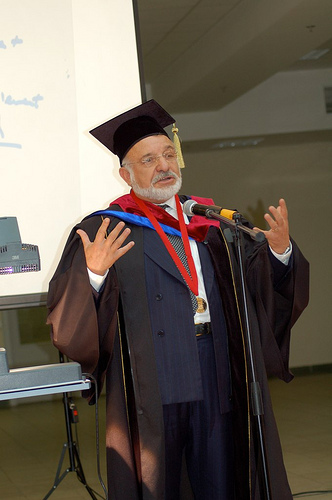
Dr. Ichak Adizes
Higher Education institutions often are forced to conduct research, which gives them recognition among their academic peers. Such research is often seen as the main driver for innovation. Even if it is partially a true, still I saw a too many examples when HEI starts focusing on the research which is too advanced and has only long term perspective (we will come back to this important factor later on) forgetting about the applied research, which is the need of the local or international community now. They do not perform the research, which could be useful today for a practical world. As one of the well known management thinkers and implementers prof. Peter Lorange (former President of IMD Lousagne and current President of Lorange Institute in Switzerland) pointed out in January 2011 at an international conference in Lyon, “the innovation is real innovation only if it is understood by others, by your clients”. If it is too advanced and not understandable – it does not satisfy current client needs and therefore can not be effective in short term perspective.
In order to be so, the goal of HEI is to “speak understandable research language”.
As for the teaching material, it should support the learning process. Participating in various international accreditation site visits I have seen a lot of examples when students are overloaded with teaching materials. Huge reading lists are drawn up but in reality the students do not read all that material at all. It is better to focus on a few good textbooks andt give the students a real opportunity to read them and learn something from them in depth. Additional optional readings are welcomed to be included as well.
And the last point in order to keep effectiveness in short term perspective is to share your benefits with the community. It is extremely important to let society know what are you doing, what kind of programs you are offering and to communicate those programs by providing some elements of them to the community for free in order to create awareness, etc.
These remarks have been done towards the need to be functional. Now let’s look to the need be systematic.
Concerning program design, I have seen many ad hoc programs in their program portfolio at various institutions in Central and Eastern Europe. This means that those schools do not develop their programs on the basis of their strategic strengths. Every school has some strengths and weaknesses as well as its own unique strategic development strategy. But instead of setting up programs that reflects their strengths, they often use an ad hoc approach trying to have what their neighbours have or what they feel it is fashionable to have. The existing laws sometimes also encourage such mediocre behaviour. They call that “innovations”, but in reality it is only a fake try to do something really unique. Of course, that does not work well.
In order to be efficient with respect to teaching, I would say that you have to be sustainable in your approach, rather than fall prey to some temporary fashion. Use new methods but do not overuse them. One of the examples could be given in relation with using too many slides in professor’s presentations. I have heard of a professor who used 200 slides in an hour presentation. The participants could not follow the speech and thoughts of that professor. Other wrong examples are to use case studies for people who do not have practical experience and using e-learning for people who do not have the challenge of participation and distance, etc.
In relationship with teaching materials the important issue is to provide those materials at the time when they are needed by the students. In our part of the world, resources can be a big challenge. I am talking about books and the Internet. Price is still an issue. However, I think that if you know what you need, there is always a possibility to obtain it. We have perfect examples in CEE business schools of how to prepare and present those materials extremely efficiently.
How creativeness and innovation could apply for program design, teaching and materials preparation? Being proactive (and due to that effective in long run) involves an ability to adapt to shifting trends and opportunities. It is not enough to discover what the client needs today. We should be able to predict what the client will need tomorrow. The financial crisis demonstrated this in a very vivid way. Enrolment numbers have fallen at many institutions. Part of the problem is that companies have cut their budgets dedicated for learning. However, there is another reason: most institutions of Higher Education were unable to adapt to the rapidly changing situation. They were not fast enough. They did not manage to offer a portfolio for the particular moment. Yet, after the initial shock, many HEI started getting out of their stupor and came up with innovative programs. It is possible to do that if you are proactive.
Talking about the teaching, I have also noticed another shortcoming of management education in Central and Eastern Europe: a lack of a high number of good professors. The same people teach on undergraduate, graduate and executive programs. They use the same methods across the board. That does not work. When you have experienced executives, you can immediately start a discussion. But when your audience consists of undergrads, you need to provide a stronger foundation first. Of course, interactive learning methods should be present.
Concerning the teaching materials, it is not a good strategy to develop some excellent stuff and use it for ever. You need to be constantly involved in case writing and development of new material. Proactiveness means adapting to new trends and opportunities and being permanently curious instead of finally satisfied.
Finally, in order to be organic (and due to that efficient in long term perspective), you need to use a team approach instead of a single-innovator approach. What I mean by that is that even if you have a fantastic professor who is very innovative and capable of developing a good program single-handedly, it is preferable to involve others in that process in order to achieve sustainability and interchange ability. Also, it is great to use prominent scholars but you also must involve other faculty and guest speakers in the same program. That will give everybody an opportunity to understand what is going on and create a good team spirit.
Also, this should apply in setting up research activities in HEI. The teams of researchers, working together in the particular expertise area are much more efficient than even very advanced individuals in long term perspective. They also create long lasting bases for the research traditions in the HE institutions.
The same thing is related towards creating teaching materials together enabling the creation the culture of mutual trust and respect within an organisation.
Involvement of local community (business, but also community at large) in study program development, teaching (as guest lecturers), research development (case studies creation), study materials development (providing practical examples, annual reports, etc.), advising the management of institution, etc. is assuring efficiency of operations in long term perspective.
I believe that Higher Education Institutions that use this approach from the four perspectives that I mentioned will be successful in designing the demanded programs, will be teaching them properly, will do the research, which benefit not only the authors of their creation, will be able to create the relevant and useful teaching materials and have great connections with society.
They are then going to be effective and efficient in short and long term perspective!
And I sincerely wish this to them!
- Bookmark :
- Digg
- del.icio.us
- Stumbleupon
- Redit it

OPINIONS
Have your say. Send to:
editor@VilNews.com
Ph. D., Chicago
A wave of unity sweeps the international Lithuanian community on March 11th every year as Lithuanians celebrated the anniversary of the Lithuanian Parliament's declaration of independence from the Soviet Union in 1990. However, the sense of national unity engendered by the celebration could be short-lived.
Human beings have a strong tendency to overgeneralize and succumb to stereotypical us-them distinctions that can shatter even the strongest bonds. We need only search the internet to find examples of divisive thinking at work:
- "Those who fled Lithuania during World II were cowards -- and now they come back, flaunt their wealth, and tell us 'true Lithuanians' how to live."
- "Lithuanians who work abroad have abandoned their homeland and should be deprived of their Lithuanian citizenship."

In Lithuania Christmas Eve is a family event and the New Year's Eve a great party with friends!
Lithuanian say "Kaip sutiksi naujus metus, taip juos ir praleisi" (the way you'll meet the new year is the way you will spend it). So everyone is trying to spend New Year's Eve with friend and have as much fun as possible.
Lithuanian New Year's traditions are very similar to those in other countries, and actually were similar since many years ago. Also, the traditional Lithuanian New Years Eve party was very similar to other big celebrations throughout the year.
The New Year's Eve table is quite similar to the Christmas Eve table, but without straws under the tablecloth, and now including meat dishes. A tradition that definitely hasn't changes is that everybody is trying not to fell asleep before midnight. It was said that if you oversleep the midnight point you will be lazy all the upcoming year. People were also trying to get up early on the first day of the new year, because waking up late also meant a very lazy and unfortunate year.
During the New Year celebration people were dancing, singing, playing games and doing magic to guess the future. People didn't drink much of alcohol, especially was that the case for women.
Here are some advices from elders:
- During the New Year, be very nice and listen to relatives - what you are during New Year Eve, you will be throughout the year.
- During to the New Year Eve, try not to fall, because if this happens, next year you will be unhappy.
- If in the start of the New Year, the first news are good - then the year will be successful. If not - the year will be problematic.
* If New Year's night is cold and starry - look forward to a good summer!
* If the during New Year Eve trees are covered with frost - then it will be a good year. If it is wet weather on New Year's Eve, one can expect a year where many will die and dangerous epidemics occur.
* If the first day of the new year is snowy - the upcoming year will see many young people die. If the night is snowy - mostly old people will die.
* If the New Year time is cold - then Easter will be warm.
* If during New Year there are a lot of birds in your homestead - then all year around there will be many guests and the year will be fun.
Christmas greetings
from Vilnius
and epic battle for the
future
Philosopher, political theorist, historian of
ideas, social analyst, and political
commentator
Ukraine was and continues to be perceived by the EU political class as a sort of grey zone with its immense potential and possibilities for the future, yet deeply embedded and trapped in No Man's Land with all of its troubled past, post-Soviet traumas, ambiguities, insecurities, corruption, social divisions, and despair. Why worry for what has yet to emerge as a new actor of world history in terms of nation-building, European identity, and deeper commitments to transparency and free market economy?
Right? Wrong. No matter how troubled Ukraine's economic and political reality could be, the country has already passed the point of no return. Even if Vladimir Putin retains his leverage of power to blackmail Ukraine and the West in terms of Ukraine's zero chances to accede to NATO due to the problems of territorial integrity, occupation and annexation of Crimea, and mayhem or a frozen conflict in the Donbas region, Ukraine will never return to Russia's zone of influence. It could be deprived of the chances to join NATO or the EU in the coming years or decades, yet there are no forces on earth to make present Ukraine part of the Eurasia project fostered by Putin.
want to learn about the
new, scary propaganda
war between Russia,
The West and the
Baltic States!
believe their government
is corrupt
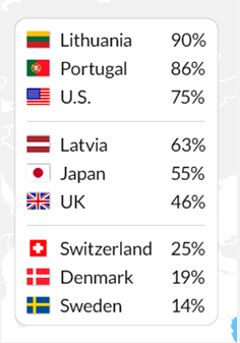
students say no to
bribes for doctors
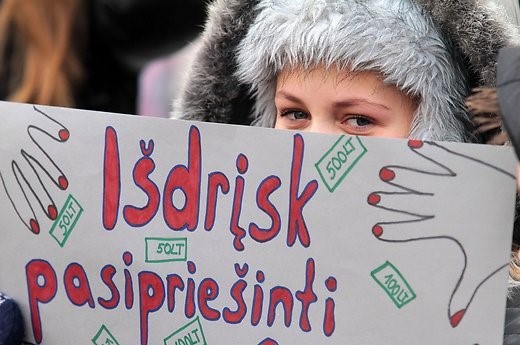
During Soviet times, government was administered for the people in control, not for the local population, court decisions were decreed, they were not the administration of justice, and academia was the domain of ideologues. 25 years of freedom and openness should have put those bad experiences behind Lithuania, but that is not so.
Today, it is a matter of expectation that court pronouncements will be governed by ideological dictates. Few, if any Lithuanians expect real justice to be effected. For foreign companies, doing business in Lithuania is almost impossible in a situation where business people do not expect rule of law, so, surely Government would be a refuge of competence?
Lithuanian Government has not emerged from Soviet styles. In an attempt to devolve power, Lithuania has created a myriad of fiefdoms of power, each speaking in the name of the Government, each its own centralized power base of ideology.

Chepstow, Wales
Doesn't that sound suspiciously like Lithuania? Ah, but I didn't mention the mountains of Snowdonia, which would give the game away.
I'm talking about Wales, that part of the UK which Lithuanians used to call "Valija", but later named "Velsas" (why?). Wales, the nation which has welcomed two Lithuanian heads of state to its shores - firstly Professor Vytautas Landsbergis, who has paid several visits and, more recently, President Dalia Grybauskaitė who attended the 2014 NATO summit which was held in Newport, South Wales.
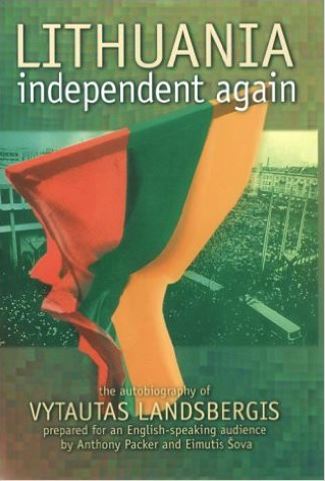
ENGLISH VERSION OF THE
AUTOBIOGRAPHY OF VYTAUTAS LANDSBERGIS.
Although Lithuanian activities have thinned over the decades as that postwar generation died out, the Lithuanian Martyrs' parish hall is crowded with many, many hundreds of visitors who come to the Lithuanian cemetery for All Souls' Day. Similarly, the Franciscan parish has standing room only for Christmas Eve mass.
Although I am firmly embedded in the literary culture of Canada, my themes are usually Lithuanian, and I'll be in Kaunas and Vilnius in mid-November 2015 to give talks about the Lithuanian translations of my novels and short stories, which I write in English.
If you have the Lithuanian language, come by to one of the talks listed in the links below. And if you don't, you can read more about my work at
www.anatanassileika.com
http://www.vdu.lt/lt/rasytojas-antanas-sileika-pristatys-savo-kuryba/ https://leu.lt/lt/lf/lf_naujienos/kvieciame-i-rasytojo-59hc.html
"My love and best wishes to all. As long as VilNews exists, there is hope for the future,"" she writes.
Irena Veisaite means very much for our publication, and we do hereby thank her for the support and wise commitment she always shows.
You can read our interview with her
Facing a new reality
Dear readers of VilNews,
For a number of years, the EU and Russia had assumed the existence of a strategic partnership, based on the convergence of values, economic integration and increasingly open markets and a modernisation agenda for society.
Our agenda was positive and ambitious. We looked at Russia as a country ready to converge with "European values", a country likely to embrace both the basic principles of democratic government and a liberal concept of the world order. It was believed this would bring our relations to a new level, covering the whole spectrum of the EU's strategic relationship with Russia.
The likelihood of Putin
invading Lithuania
.jpg "lithuania today")
Founding Director at Summer Literary Seminars
Are all Lithuanian energy
problems now resolved?
Lithuania as a country does not have significant energy resources. Energy consuming infrastructure after WWII was small and totally supported by energy imports from Russia.
First nuclear reactor begins power generation at Ignalina in 1983, the second reactor in 1987. Iganlina generates enough electricity to cover Lithuania's needs and about 50%.for export. As, prerequisite for membership in EU, Ignalina ceases all nuclear power generation in 2009
The Klaipėda Sea terminal begins Russia's oil export operations in 1959 and imports in 1994.
Mazeikiu Nafta (current ORLEAN Lietuva) begins operation of oil refinery in 1980.
Have Lithuanian ties across
the Baltic Sea become
stronger in recent years?
The two decades that have passed since regaining Lithuania's independence can be described as a "building boom". From the wreckage of a captive Soviet republic, a generation of Lithuanians have built a modern European state, and are now helping construct a Nordic-Baltic community replete with institutions intended to promote political coordination and foster a trans-Baltic regional identity. Indeed, a "Nordic-Baltic community" - I will explain later in my text the meaning of this catch-phrase.
Since the restoration of Lithuania's independence 25 years ago, we have continuously felt a strong support from Nordic countries. Nordics in particular were among the countries supporting Lithuania's and Baltic States' striving towards independence. Take example of Iceland, country which recognized Lithuania in February of 1991, well in advance of other countries. Yet another example - Swedish Ambassador was the first ambassador accredited to Lithuania in 1991. The other countries followed suit. When we restored our statehood, Nordic Countries became champions in promoting Baltic integration into Euro-Atlantic institutions. To large degree thanks Nordic Countries, massive transformations occurred in Lithuania since then, Lithuania became fully-fledged member of the EU and NATO, and we joined the Eurozone on 1 January 2015.
Have you heard about the
South African "Pencil Test"?
But that is exactly what happened to me when I came back from South Africa. I will tell you how.
VilNews e-magazine is published in Vilnius, Lithuania. Editor-in-Chief: Mr. Aage Myhre. Inquires to the editors: editor@VilNews.com.
Code of Ethics: See Section 2 – about VilNews. VilNews is not responsible for content on external links/web pages.
HOW TO ADVERTISE IN VILNEWS.
All content is copyrighted © 2011. UAB ‘VilNews’.