
THE VOICE OF INTERNATIONAL LITHUANIA

|
VilNews has its own Google archive! Type a word in the above search box to find any article.
You can also follow us on Facebook. We have two different pages. Click to open and join.
 Click on the buttons to open and read each of VilNews' 18 sub-sections Click on the buttons to open and read each of VilNews' 18 sub-sections  |

|


Archive for April, 2012
- Posted by - (0) Comment
Lithuania’s ambassador to the U.S.:
We will never forget or underestimate the role of Lithuanian Americans in our struggle for independence

Lithuania’s ambassador to the United States, Žygimantas Pavilionis
Ambassador ŽygimantasPavilionis interviewed by Aage Myhre
Ambassador, you represent Lithuania in the United States, a country where around one million Lithuanians and people of Lithuanian descent live, as citizens of the United States. Are you to a certain degree also their ambassador?
As an ambassador of the Republic of Lithuania, I represent, first of all, interests of my country and my fellow citizens. Not all Lithuanian Americans are citizens of Lithuania, but they, nevertheless, kept close ties to their Homeland and helped greatly to keep memories of independent and free Lithuania alive. All the Lithuanians no matter where their live are equally important share of our nation. This is not only the official position of our Government, but also my personal idea I always had and believed in. Therefore, yes, I am to certain degree their ambassador as well.
Lithuanian-Americans played a significant role in the post-war years, until Lithuania's recovered independence in 1990-1991, by constantly exerting pressure on the U.S. President and leaders in other Western countries so that they would
pressure the Soviet Union to allow the Baltic countries freedom after the Soviet occupation taking place during World War II. Now, as more than 20 years have passed since the freedom bells rang, the question is whether the Lithuanian-Americans have a role to play also today? See our article https://vilnews.com/?p=8899
We in Lithuania will never forget and never underestimate the role of Lithuanian Americans in our struggle for independence. It will remain an indispensable part of our history. However, it sounds sometimes a bit strange when I hear that the mission of our countrymen abroad might be over. Not at all! Free, democratic and Western minded Lithuania we fought for and we have now is not the fact that will last forever by itself. On the contrary, we must remember that state-building is a continuous process, which requires our personal everyday efforts. So there are a lot of challenges both in our foreign and domestic policy we are facing now where the help and support from the Lithuanian diaspora is of vital importance. Economy, energy, security issues, education, social affairs– those and many other areas where we need our common work on it. To be more concrete and to illustrate what has been said I would like to name at least two significant projects which our Embassy is going to undertake together with the Lithuanian community in US this year - NATO Summit in May and World Lithuanian Economic Forum in September. Both evens will take place in Chicago, but we do expect an active engagement of Lithuanians from all over United States in them.
“The majority, I believe, are disappointed and discouraged with the present president’s seemingly unfriendly view toward Lithuanian-Americans and others abroad.” This said Regina Narusiene, President of the World Lithuanian Community, in a recent interview (see https://vilnews.com/?p=6704), based on a comment referred to in The Baltic Times, where President Grybauskaite should have said that most prominent U.S. Lithuanian émigrés, instead of focusing on developing U.S. - Lithuanian business ties, prefer providing political advice to the Lithuanian authorities, which may not be that necessary nowadays. She was supposedly “disappointed by Lithuanian émigrés’ inability to attract U.S.-based investments to Lithuania.” Here in VilNews we often hear Lithuanian-Americans say they do not feel welcome to their
home country, and that Lithuania's current president seems to antagonize them. What are the ambassador's comments to this?
I would not like to comment the words of President which I haven’t heard myself, but as far as I’m familiar with the position of President Grybauskaite towards Lithuanian diaspora I could only presume that these words were taken out of the context and that the President didn’t mean at all anything that could be interpreted as an “unfriendly view toward Lithuanian-Americans and others abroad”…
Having said that I might add that Lithuanians are well known in the U.S. for their persistence, hard and committed work and interesting achievements. We know Lithuanians from every generation who became successful politicians, businessmen, artists, social workers, etc. Just look at our honorary consuls – people like Krista Bard or Daiva Navarette are known in their areas of expertise. We also know a lot of Lithuanians from a younger generation who are well established in universities, research labs, have created their businesses. And some of them very successfully extended their business in Lithuania. Do you know that the company “VPA Logistics”, which operate the block train corridor project from Klaipeda to China, called “Sun”, was created by American-Lithuanians from New Jersey? And this project was developed with a great support of the government and the President itself. And there are much more concrete examples were Lithuanian Americans has invested, developed business in Lithuania or with Lithuania, but they have not yet very much advertised that.
| VPA Logistics – excellent example of business venture established by a Lithuanian American Mr. Vytautas ‘Victor’ Paulius is the Lithuanian American who founded the New Jersey company VPA (Vytatuas Paulius Associates) in 1967. UAB VPA was established in Lithuania’s port city Klaipeda in 1996, currently owning & operating over 30,000 sq.m. (320,000 sq.ft.) of state of the art cold storage space located within the Port of Klaipeda and Laistu International Trade Center (LITC), adjacent to Klaipeda State Seaport. VPA Logistics is the company behind the new SUN TRAIN that operates between China and Klaipeda. |
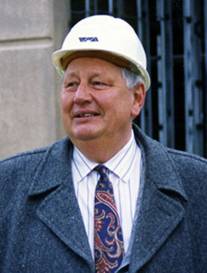 VYTAUTAS "VICTOR" PAULIUS |
In a meeting at your embassy in Washington last year, representatives of LAC (Lithuanian American Council) expressed their concern on a wide range of topics including Lithuania's developing energy policy, the country’s image in the international community, emigration issues and their demographic impact, the prospect of maintaining citizenship rights of recent immigrants, ongoing cooperation between organizations of the Diaspora and Lithuania, and minority issues in Lithuania. LAC representatives suggested that Lithuania would benefit significantly by availing itself of the expertise and knowledge found in the Diaspora communities in developing energy and security policies and a host of other areas such as environmental issues, ecology, medicine, economic development, and the promotion of improved interactions between the government and the people through non-governmental organizations (ref. https://vilnews.com/?p=5031). Has there been any official Lithuanian response to this?
The Embassy deals with various Lithuanian American organizations on a daily basis, including on issues that you just have mentioned. The meeting that you are referring to was held as a coordination meeting to compare our notes and to brief each other on the most important issues on which we should unite our efforts. As I already said, we greatly value the experience and experience that Lithuanians American can bring to their Homeland, and if there are concrete proposals or advices, we listen to them and use accordingly.
In November 2011, the Jewish Lithuanian Heritage Project hosted a roundtable “Think Tank” at your embassy. The theme of the discussion was, "A comprehensive Five Year plan to improve Lithuanian-Jewish relations: Cultivating Sunflowers." (ref. https://vilnews.com/?p=9949). In a response, one of our readers wrote: “Is this about the establishment of a new Judenrat to apologize for Lithuanian anti-Semitism? “If truth be told” having a holiday party at Lithuania’s D.C. Embassy is not revolutionary. What would be revolutionary would have been, and would be, is the prosecution of Lithuanian collaborators and SS members, the prosecution of today’s neo-Nazi youth groups, reinstatement of the ban against the display of the swastika and ending the noxious practice of the Uzgavenes holiday when people dress as Jews and beg on the street.” Harsh words?
Yes, words are harsh and a bit unfair as they fail to describe the whole picture of what’s happening in an attempt to confront the past. I recognize that the awakening process among Lithuanians has been a long one and is still ongoing, but no one can deny the progress that has been made. The Lithuanian government is committed to rehabilitating the heritage of Lithuanian Jewry, preserving the memory of those who perished in the Holocaust, and developing an educational program on the subject of the Holocaust so these atrocities would never happen again.
Let me be clear that Lithuania has never denied that there were those among us who collaborated with the occupying power of Nazi Germany and committed crimes against Lithuanian Jews. We know that we owe an immeasurable debt to our Jewish compatriots. The war crimes are never to be forgotten and never to be forgiven. Lithuania seeks to follow this path - all cases of genocide are meticulously investigated.
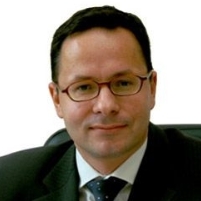 |
ZYGIMANTAS PAVILIONIS (Phonetic: pa-vill-i-OH-nis) Ambassador of the Republic of Lithuania Ambassador Pavilionis joined the Ministry of Foreign Affairs in 1993, where he was instrumental in achieving Lithuanian accession into NATO and the European Union. Between 1993 and 2009, he has held various high-level positions in the Lithuanian MFA, most focused on Lithuania’s relationship with the European Union. Most recently Ambassador Pavilionis acted as Ambassador –at-Large and Chief Coordinator for Lithuania’s Presidency of the Community of Democracies and Chief Coordinator for Transatlantic relations. He has a Master’s Degree in Philosophy and Postgraduate Diploma in International Relations and Doctoral Studies. He pursued both degrees in Vilnius University, Lithuania. Pavilionis is married to Lina Pavilioniene and has four sons. |
- Bookmark :
- Digg
- del.icio.us
- Stumbleupon
- Redit it

The Lithuanian FBI boss and his famous sister
- Posted by - (0) Comment
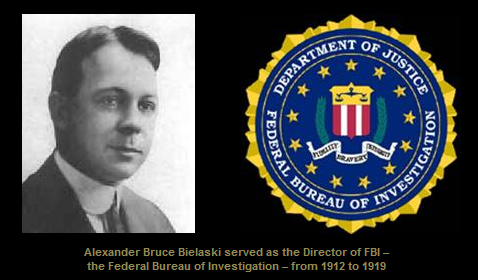
Many have heard of the legendary Director J. Edgar Hoover who led the FBI from1924 to 1972, but few have heard of the name Alexander Bruce Bielaski who served as the Director of the Federal Bureau of Investigation from 1912 to 1919. FBI was established in 1908, and Bielaski was its second Director.
Even fewer know that Bielaski was of Lithuanian origin. Although his family name was Polonized over time, his family roots can be traced directly back to Lithuania. His grandfather, Captain Alexander Bielaski (Beleskis) had been born on August 1, 1811, in Lithuania.
The FBI Director’s sister, Ruth Bielaski Shipley
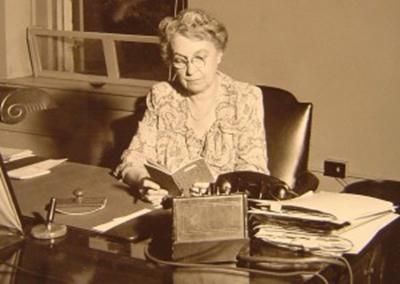
Ruth Bielaski Shipley
Another rather unknown story among Lithuanian Americans, is that Ruth Bielaski Shipley (April 20, 1885 – November 3, 1966) was head of the Passport Division of the United States Department of State for 27 years from 1928 to 1955. In 1951 TIME called her "The most invulnerable, most unfirable, most feared and most admired career woman in the U.S. Government."
- Bookmark :
- Digg
- del.icio.us
- Stumbleupon
- Redit it

The Lithuanian FBI boss and his famous sister
- Posted by - (3) Comment
Many have heard of the legendary Director J. Edgar Hoover who led the FBI from1924 to 1972, but few have heard of the name Alexander Bruce Bielaski who served as the Director of the Federal Bureau of Investigation from 1912 to 1919. FBI was established in 1908, and Bielaski was its second Director.
Even fewer know that Bielaski was of Lithuanian origin. Although his family name was Polonized over time, his family roots can be traced directly back to Lithuania. His grandfather, Captain Alexander Bielaski (Beleskis) had been born on August 1, 1811, in Lithuania. Being raised under Czarist Russian occupation, Bielaski as a young man was educated in a Czarist Russian military school. After graduation, he had been commissioned as a Topographical Engineer Lieutenant and assigned to duty in the Russian Army.
Captain Alexander Bielaski (Beleskis) from Lithuania
With the start of the 1830-1831 Polish-Lithuanian Insurrection, Captain Bielaski resigned from the Russian Army and became severed on the Staff of General Dembinski. Dembinski’s Corps consisting of 3,500 Polish regulars and severalhundred Lithuanian guerrillasfought heroically to defendLithuania from the advancing Czarist Russian forces. Still thegallantry they displayed couldnot stop the superior numbers of the Russians and they wereforced to withdraw. In an epicmarch, General Dembinski led his small force back to Warsaw. During the retreat, Bielaski took command of a small 300 man rear guard whose mission was to hold the vital river crossing at all cost while the others fled tosafety. Fighting heroically, Bielaski forces successfully held the forge until the other rebels had reached safety. They did not withdraw until their numbers had been reduced to about 30 men which Bielaski then led into nearby woods. Through his skill the survivors successfully withdrew to Warsaw while constantly skirmishing with the pursuing Russians. By the time Bielaski reached Warsaw he only had one man still under his command. Bielaski then fought with distinction at the Battle of Grochowo until he was seriously wounded. A bullet ripped open one side of his face and pulled out his teeth before it came out of his neck. Although knocked to the ground, Bielaski continued to fight until he was stabbed in his shoulder by an advancing Russian. Being left on the battle field as dead, Bielaski recovered from his wounds only to learn that the insurrection which he had fought so valiantly for had been crushed.
Refusing to continue living under Russian occupation, Bielaski left Poland for France and eventually arrived in the United States. In 1835 he served as a civilian surveyor with the U.S. Army in Florida during the Seminole War and later settled in Illinois. He eventually obtained employment and gained fame as an engineer for the Illinois Central Railroad. Bielaski became an American citizen in 1841. After having lived in various parts of the country, Bielaski married Mary Ann Carey, an Illinois resident, in July 1842 and would eventually father three boys and four girls. While residing in Illinois, Bielski became an intimate friend of Abraham Lincoln who would later become the President of the United States. In 1844, Bielaski was appointed Chief Draftsman for the U.S. Bureau of Patents and moved with his family to Washington, D.C.
With the start of the Civil War, Bielski offered his services to the Union and returned to Illinois to serve as a Lieutenant with Company F of the 30th Illinois Volunteer Infantry Regiment. On September 1, 1861, Bielaski accompanied his regiment to Cairo, Illinois, where it was assigned to General John A. McClernand’s 1stBrigade of the District of Cairo under the command of General Ulysses S. Grant. Due to his prior military service, Bielaski was subsequently appointed an aide-de-camp to General McClernaud with the appointment being recommended by President Abraham Lincoln. In this position, Captain Bielaski took part in the Battle of Belmonton November 7, 1861, where the Union forces commanded by General Grant engaged the Confederate forces under the command of General Leonidas Polk. As the federal forces were moving against a Confederate entrenched artillery supported position, Captain Bielaski rode forward encouraging the advancing troops.
When his horse was shot out from under him, Captain Bielaski chose to continue the attack on foot. Seeing the national colors falling, Captain Bielaski quickly grabbed the fallen flag and continued its advance through withering enemy shot and shell. While carrying the Stars and Stripes of his new homeland, Captain Bielaski was killed by a cannon explosion and his body never recovered. Although the advancing column succeeded in driving the Confederates from their position, they were later forced to withdraw. General McClernaud is quoted as having stated that “A braver man never fell on the field of battle. His bravery was only equaled by his fidelity as a soldier and patriot. He died making the Stars and Stripes his winding sheet.” Although many men had fought with great distinction, like some battles in the Civil War, the Battle of Belmont held no strategic importance. Its only importance to the war was it showcased the talents of previously unknown General Ulysses S. Grant who eventually led the Union forces to total victory.
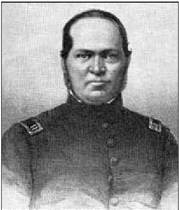
Captain Alexander Bielaski (Beleskis), Grandfather of FBI
Director Bielaski, was born on August 1, 1811, in Lithuania
With Captain Bielaski’s death, his older children immediately sought employment to support the family. His son, Oscar Bielaski, born on March 21,1847, in Washington, D.C. decided to follow in his father’s footsteps and joined the Union Army as a drummer-boy with a Union Cavalry Regiment. During lulls between battles, Oscar learned how to play baseball. After the war, he returned to Washington, where he secured a position as a government clerk and continued to play baseball. Oscar Bielaski went on to become one of the first professional baseball players. His professional career lasted five years during which time he played with the Washington Nationals, Baltimore Canaries, and Chicago White Stockings.
Another son, Alexander Bielaski, graduated from St. John’s College in Annapolis, Maryland and the Boston Theological Seminary and became a distinguished Methodist Episcopal Minister. The Reverend Doctor Bielaski and his wife, Roselle Bielaski, had three daughters and three sons.
Alexander Bruce Bielaski was born in Maryland in 1883
His son, Alexander Bruce Bielaski, who became the FBI Director, was born on April 2, 1883 in Montgomery County, Maryland. He attended George Washington University and after obtaining his law degree in 1904 received an appointment with the U.S. Department of Justice. His initial assignments included an appointment as a special examiner and reorganization of the Oklahoma court system following its admission as a state. Upon returning to Washington, Bielaski was assigned to the Bureau of Investigation and eventually became the Administrative Assistant to Director Stanley W. Finch who had been appointed as the first Director of the new organization. Upon Finch’s departure from the Bureau of Investigation, Bielaski was appointed to replace him. Bielaski remained as the Director of the Bureau of Investigation from April 30, 1912 to February10, 1919. During that time, Bielaski oversaw a steady increase in bureau resources and responsibilities.
After leaving the Bureau of Investigation, Bielaski entered into private law practice. While on a trip to Mexico in 1921, Bielaski was kidnapped by Mexican bandits and a ten thousand dollar ransom paid for his release. After being held for three days, Bielaski managed to escape and took the paid ransom money with him. During prohibition, Bielaski worke das an undercover decoy in a speak easy in New York which resulted in many arrests and convictions. He later went onto head the National Board of Fire Underwriters arson investigator team and serving as the President of the Society of Former Special Agents. Alexander Bruce Bielaski died on February 19, 1964.
Like his Lithuanian immigrant grandfather, Alexander Bielaski made an outstanding contribution to his nation and deserves an honoured place in Lithuanian-American history.
Source: Henry Gaidis, a contributor to the magazine Bridges. He is a member of the Board of Directors of JBANC and among his many interests is military history.
The FBI Director’s sister, Ruth Bielaski Shipley
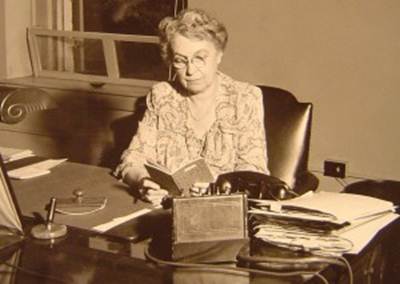
Ruth Bielaski Shipley
Another rather unknown story among Lithuanian Americans, is that Ruth Bielaski Shipley (April 20, 1885 – November 3, 1966) was head of the Passport Division of the United States Department of State for 27 years from 1928 to 1955. In 1951 TIME MAGAZINE called her "The most invulnerable, most unfirable, most feared and most admired career woman in the U.S. Government."
Shipley was born Ruth Bielaski on April 20, 1885 in Montgomery County, Maryland. She attended high school in Washington, D.C., took the civil service examination and first worked for the Patent Office beginning in 1908. She was married to Frederick W. van Dorn Shipley in 1909. She left government service for several years while the couple lived in the Panama Canal Zone, where he worked in government administration until his poor health forced their return to the United States. They had a son born about 1911 who was given his father's name. She joined the State Department on August 25, 1914. Her husband died in 1919. In 1924 she became assistant chief of the Office of Coordination and Review.
She became head of the Passport Division in 1928, the first woman to hold the position, after twice declining the appointment. She succeeded foreign service officer Parker Wilson Buhrman and initially headed a staff of more than 70.
In 1930, she was a member of the United States delegation to the Hague conference on the codification of international law. In 1933, she led a successful campaign over the objections of some at the State Department, to prevent a magazine's advertising campaign from using the word "passport" to identify its promotional literature. She believed it "cheapened...the high plane to which a passport had been raised."
In 1937, she altered the Passport Division's policies and began issuing passports in a married woman's maiden name alone if she requested it, no longer followed by the phrase "wife of". She noted that the passports of married men never carried "husband of" as further identification.
Government policy with respect to passport issuance changed radically with the course of international relations during her tenure. The Neutrality Act of 1939 restricted travel by American citizens to certain areas and forbade transport on the ships of nations involved in hostilities. Shipley reviewed every application personally and the number of passports issued fell from 75,000 monthly in 1930 to 2,000. She also oversaw the issuance of new passports to all citizens abroad and the incorporation of new anti-counterfeiting measures into their design.
TIME 1951: "The most invulnerable, most unfirable, most feared and most admired career woman in Government."
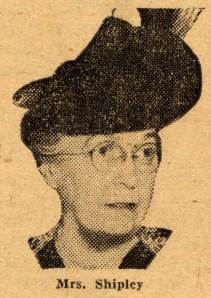
According to a 1939 newspaper profile of Shipley, she had the authority "to comply with or to deny applicants, and in the main tends to grant as many as possible under the legal restrictions. When a complex case arises, however, she admits it to a board of advisers who constitute a supreme court of arbitration on the matter." In 1945 Fortune called her "redoubtable" and in 1951 Time described her as "the most invulnerable, most unfirable, most feared and most admired career woman in Government." That same year Reader's Digest wrote that: "No American can go abroad without her authorization. She decides whether the applicant is entitled to a passport and also whether he would be a hazard to Uncle Sam's security or create prejudice against the United States by unbecoming conduct."
Her authority was widely acknowledged and rarely challenged with success. Decisions of the Passport Division were not subject to judicial review during her years of service and her authority was described as "limitless discretion." Bill Donovan of the Office of Strategic Services (OSS) first tried to win favor with Shipley by hiring her brother. When she nevertheless insisted on identifying OSS agents by noting "on Official Business" on their passports, Donovan had to get President Roosevelt to reverse her. Her efforts to deny travel privileges to the children of U.S. diplomats were similarly overridden in the years following World War II.
In 1942, she was criticized for issuing a passport to a Polish-American Catholic priest who visited Joseph Stalin to plead for a democratic post-war Poland. President Roosevelt defended her. By the end of World War II her staff numbered more than 200.
Because of her personal role in issuing passports, many important figures corresponded with and met with her to document their reasons for travel abroad, including W. E. B. Du Bois, playwright Lillian Hellman,[20] and Manhattan project physicist Martin David Kamen.
In the 1950s she became the object of controversy when critics accused her of denying passports without due process on the basis of politics, while critics defended her actions as attempts to support the fight against Communism. Senator Wayne Morse called her decisions "tyrannical and capricious" for failure to disclose the reasons for the denial of passport applications. Her supporters included Secretary of State Dean Acheson and Senator Pat McCarran.
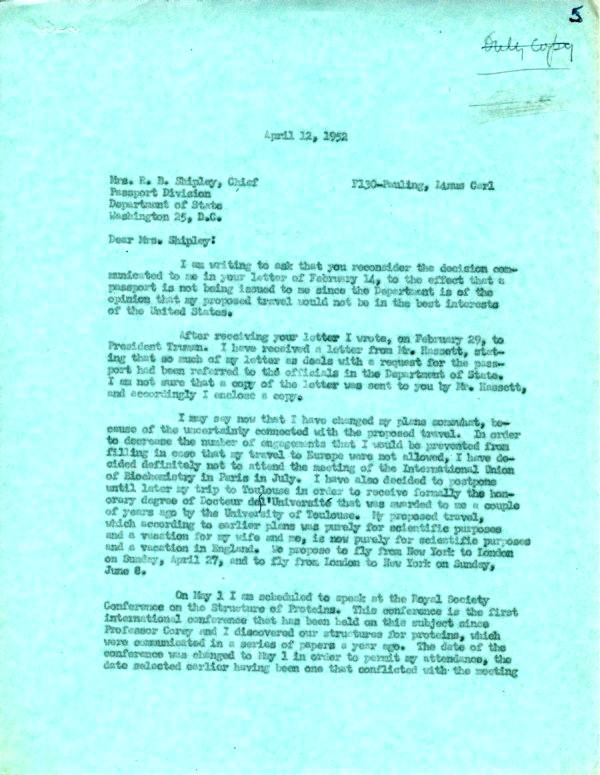
In September 1952, Secretary of State Dean Acheson called his relations with Shipley's "Queendom of Passports" "a hard struggle" and said that passport, travel and visa issues were "the most distasteful part of this job." In 1953, she refused Linus Pauling a passport for travel to travel to accept the Nobel Prize in Chemistry because, using the standard language of her office, it "would not be in the best interests of the United States," but was overruled.
Upon her retirement, an editorial in the New York Times attributed her reputation for "arbitrary" decision to the fact that she had to enforced newly restrictive government policies. Despite the conflict between individual freedom and government policies, it said, "there was never any doubt that Mrs. Shipley did her duty as she saw it."
She retired on April 30, 1955, when she reached the mandatory retirement age of 70. She said that she chose her successor, Frances G. Knight, herself. The State Department awarded her its Distinguished Service Medal upon retirement.
The American Jewish League Against Communism, one of whose officers was Roy Cohn, gave her an award for "a lifetime of service to the American people."
She died in Washington, D.C., on November 3, 1966. She is buried in the Congressional Cemetery in Washington, D.C.
Letter from Linus Pauling to Ruth B. Shipley. April 12, 1952
Pauling writes to request that Mrs. Shipley reconsider her decision not to issue him a passport. He sends a copy of his letter from Mr. Hassett, Secretary to the President, requesting a passport for Pauling. He describes, in detail, his revised itinerary so that it might help him obtain permission to travel overseas. Pauling recounts the pleasant meeting that he had with Mrs. Shipley last time they met over his passport, and requests to have another meeting with her. View Transcript
- Bookmark :
- Digg
- del.icio.us
- Stumbleupon
- Redit it


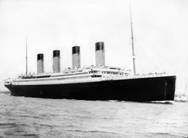
The RMS Titanic sank one-hundred years ago, and has remained a fixture of curiosity and study ever since. Over the last century oceanography has advanced a great deal, and several research expeditions have gone down to the wreck to study it, sometimes managing to bring items back up from the depths. Last week, one such story broke about a rare Lithuanian book being salvaged from the shipwreck. Lithuanians on the Titanic? Indeed.
Juozas Montvila was born in Gudinė in 1885 and ordained in 1908, became a vicar in Lipskas, but was caught ministering to the Uniates, a religious group “proscribed” by Czarist Russia. His sentence removed his vicarage and forbade him from becoming a pastor. He wrote and illustrated for several newspapers in Vilnius. An appeal to the sentence was not forthcoming, so he prepared to emigrate to the United States, where he had family, so that he could resume his pastoral calling. He traveled to England and from there boarded the Titanic and stayed with the Second Class passengers. After the ship struck the iceberg, Montvila, along with two other Catholic priests, stayed on board to console doomed passengers who couldn't make it to the life boats. Montvila was 27 in 1912.
- Bookmark :
- Digg
- del.icio.us
- Stumbleupon
- Redit it

- Posted by - (0) Comment
____________________________
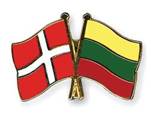
COWI to open IT service centre in Vilnius

____________________________
Denmark's Nielsen & Nielsen to hire 40 finance professionals in Kaunas

- Bookmark :
- Digg
- del.icio.us
- Stumbleupon
- Redit it

- Posted by - (0) Comment
 |
Go to our VilNews Forum to discuss this topic |
Contact us at:
editor@VilNews.com
____________________________
Many of us here in America are looking for relatives in Lithuania
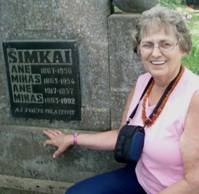
I am the granddaughter of two Lithuanians that immigrated to the United States in 1911. They were Simas Dikmonas b.Mar 19, 1890 Girininkai d. 1924 Sheboygan Wisconsin and Marija Šimkute b. May 3, 1892 Girininkai died Nov 5, 1968 Sheboygan Wisconsin.
Diane LeRoy
San Antonio Texas, USA
____________________________
Please, Please, Please!
Help us who seek our Lithuanian ancestors
Dear Editor,
Yes, absolutely it would be a fantastic idea. I've been trying to understand how and where to locate information on my Lithuanian ancestors for years. I thought I was Russian until some facts from my great grandfather's Naturalization Papers had me focusing on Vilnius, but without understanding the language or how records were kept, I was lost. Please, Please, Please! Help us who seek our Lithuanian ancestors learn how and where to get the information. Teach us the history of Lithuania from when it was Russia to what it is now. Help us find how village names have changed and where those villages are or were. Where are the records kept from those villages? How do I get access to them? What were the customs and traditions of our ancestors? And who might we be related to from those places today?
I can find records for most Western European countries quite easily and most of them for free. But anything East of Berlin seems unobtainable. If you can help unravel the difficulties of Lithuania genealogy research I would be overwhelmingly happy.
Christopher
____________________________
It is very hard to find information in Lithuania
--
JULIE GALLAHUE | talent director
nxt|MODEL : Colorado's elite boutique modeling agency
303.900.5955 x2 | www.nxtmodel.com | twitter @nxtmodel
____________________________
Maybe there still is hope
I just heard about you site today. But after 3 years of trying to find a way to trace my family roots in Lithuania I have pretty much given up. Maybe there is still hope.... I really would love to see any Lithuanian genealogy information online.
Ellie Dowling
____________________________
Please do add a Genealogy Section!
I just learned of your publication and the article about finding relatives and ancestors. What a great bunch of resources! Please do add a Genealogy Section!
Ileen Peterson
- Bookmark :
- Digg
- del.icio.us
- Stumbleupon
- Redit it
Russia deploys S-400 missiles in Kaliningrad
- Posted by - (0) Comment
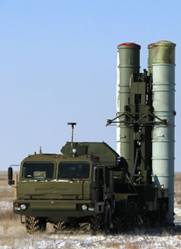
A Russian newspaper has reported that the military has begun deploying S-400 mobile surface-to-air missiles in Kaliningrad, the Baltic exclave bordered by Poland and Lithuania.
Izvestia cited unnamed military officials as saying the missiles arrived Friday, but did not say how many. The Defense Ministry declined comment on the report.
S-400s, Russia’s most advanced surface-to-air missiles, have a range of 120-400 kilometers (75-250 miles).
The report comes amid rising tension between the U.S. and Russia over Washington’s plans for a missile-shield system in Europe, which Russia contends threatens its own defenses.
- Bookmark :
- Digg
- del.icio.us
- Stumbleupon
- Redit it
- Posted by - (0) Comment
Comments to our article:
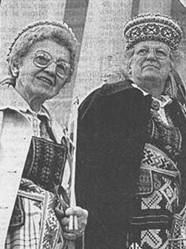
The Knights of Lithuania
keep on fighting
Click HERE to read the article
- Bookmark :
- Digg
- del.icio.us
- Stumbleupon
- Redit it
I wrote many letters to our govt in protest about our govt turning Simas Kudirka back to the Russians when he jumped ship
- Posted by - (0) Comment
There is a Lithuanian consulate in Wash DC. The US had no right to turn him over. IT was good to see him at last in the USA. My family belonged to the Knights of Lithuania in Scranton Pa. Thank you for all you do.
Charlotte Surenko
Note: You can read about the defection of Simas Kudirka HERE
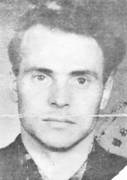
SIMAS KUDIRKA
This photograph was taken
from his Soviet Identification card.
- Bookmark :
- Digg
- del.icio.us
- Stumbleupon
- Redit it
I participated in the late 1940s
- Posted by - (0) Comment
Neat article. I remember the Lithuanian summer festival that I attended w/my mother's mom/stepfather in Luzerne Co in the late 1940's
Albert P Mikutis Jr·
- Bookmark :
- Digg
- del.icio.us
- Stumbleupon
- Redit it
- Posted by - (6) Comment
As long as VilNews exists, there is hope for the future
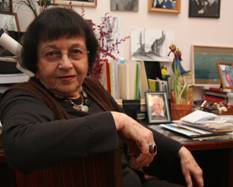 Dr. Irena Veisaite, Chairwoman of the VilNews Honorary Council |
Professor Irena Veisaite, Chairwoman of our Honorary Council, has asked us to convey her heartfelt greetings to the other Council Members and to all readers of VilNews.
“My love and best wishes to all. As long as VilNews exists, there is hope for the future,” she writes. Irena Veisaite means very much for our publication, and we do hereby thank her for the support and wise commitment she always shows. You can read our interview with her HERE. |
- Bookmark :
- Digg
- del.icio.us
- Stumbleupon
- Redit it
- Posted by - (1) Comment
Open letter to Mayor Zuokas from Gene Emmer:
We need playgrounds
in Vilnius Old Town!
Dear Mayor Zuokas,
I live in the Vilnius old town with my wife and young child. We have a small family business and are very happy here. Yet, one thing that concerns us very much is the lack of quality, safe play areas for young children in Vilnius old town. Within the old town there are basically three playgrounds:
Sereikiškės Park: There used to be two play areas. But one was in very bad condition and was removed. The play area which remains is currently the best in the area. But in nice weather it is generally completely full of children.
Vilniaus Gatve: Last year a small wooden park was built near the Šv. Kotrynos Church. It is very simple wooden play area and already needs repairs.
Vokieciu Gatve (behind the Post Office): This is a rundown, playground in very bad condition. It is a night time hangout for drunks and is always full of trash, broken bottles and animal droppings.
As you know, the children of the old town have very few options to walk to recreation, get exercise and breathe fresh air. I was excited to learn recently that you have decided to improve and build several new parks in Vilnius!
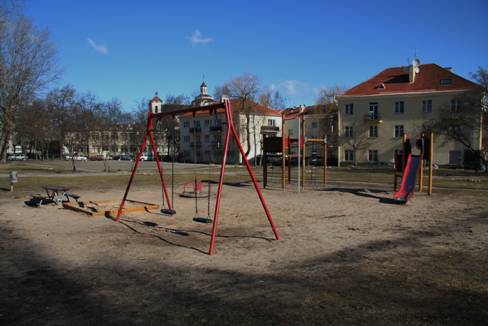
Vokieciu Gatve (behind the Post Office): This is a rundown, playground in very bad condition. It is a night time hangout for drunks and is always full of trash, broken
bottles and animal droppings.
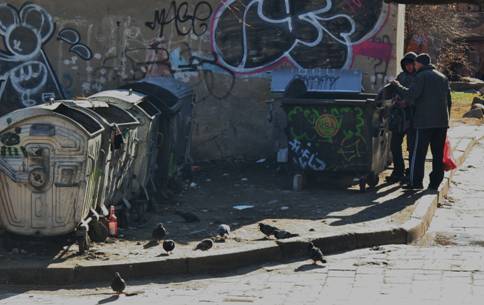
These waste containers are located just 50 meters from the playground at Vokieciu g.. They are a favorite haunt for the homeless and others in search of food residues.
- Bookmark :
- Digg
- del.icio.us
- Stumbleupon
- Redit it
- Posted by - (0) Comment

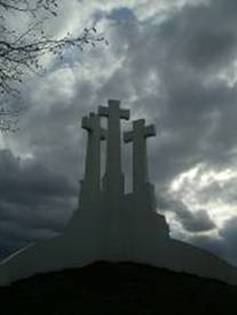
HILL OF THREE CROSSES, VILNIUS
By Aage Myhre
aage.myhre@VilNews.com
Easter Sunday 1991 represents one of the most magical moments I've ever experienced in my life. The date was the 31st of March, and I wandered through the Old Town of Vilnius together with the one who would later become my wife. A couple of months earlier I had been standing with Professor Vytautas Landsbergis in the Lithuanian Parliament looking out at the Soviet military forces and the tens of thousands of Lithuanians who were there with their bonfires and primitive tools to protect the Parliament. I had seen the coffins of the thirteen brave individuals standing outside the Cathedral in Vilnius, and I had seen how a whole people gathered in grief and despair over the USSR's new assault on this small nation and the innocent civilians who so bravely sacrificed their lives for their home country.
- Bookmark :
- Digg
- del.icio.us
- Stumbleupon
- Redit it
- Posted by - (3) Comment
Saulene’s
|
|

Text: Saulene Valskyte
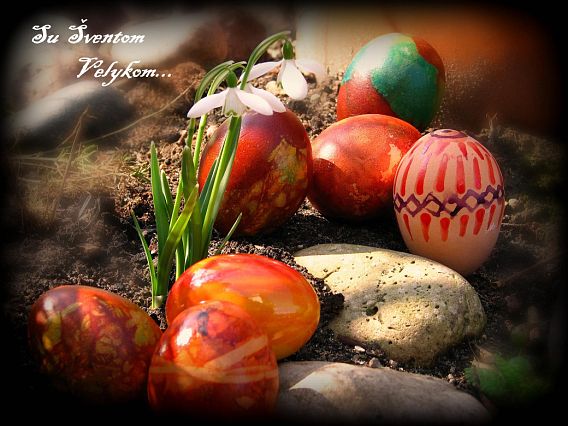
Spring has come, the sun is shining, birds are singing, at least that's what it should be like. In Lithuania Easter weather swings from blizzard to burning sun, but regardless to that is this the most colorful celebration of the year. As all Christian celebrations Easter traditions here are intertwined with paganism, Easter in particulary were a pagan celebration of awakening nature.
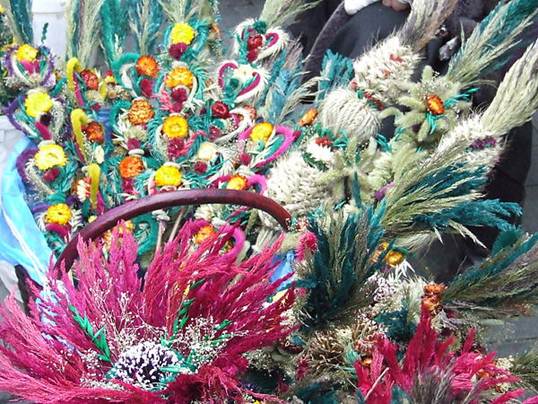
The Easter celebration starts a week before Easter Day, on Palm Sunday, when people are gathering in churches with beautiful, colorful, original “palms”. In Lithuania every region have there own palm making traditions, usually palm base are the juniper twig. During the church service the palms are being blessed. Afterwards people participate in a traditional Palm Sunday ritual, beating each other with the blessed palms, wishing each other health and strength. Today this is mostly a children game, but in old days everyone were doing it, singing "It's not me, it's palm what beats you, there's Easter in a week, and you will get an Easter egg".
Just as with Christmas, the week before Easter is supposed to be meatless. Although this tradition is not very popular these days, at least the last few days people should try to eat less meat or not at all. This means that herring and other fish courses should be the most common ingredients on the table.
Very important is to clean everything well before Easter Day. Traditionally Holy Thursday was the "cleaning day", but as people get more and more busy, Easter Saturday has become a more convenient day for all cleaning jobs.
The day before Easter is for decorating eggs. These are the two most popular ways to do that:
With wax
Melt some wax in a dish and make some ornaments on the egg with the tip of the needle or crochet and wait until the wax gets cold and hard. Decorate the egg with paint and when it gets dry scrub the wax off.
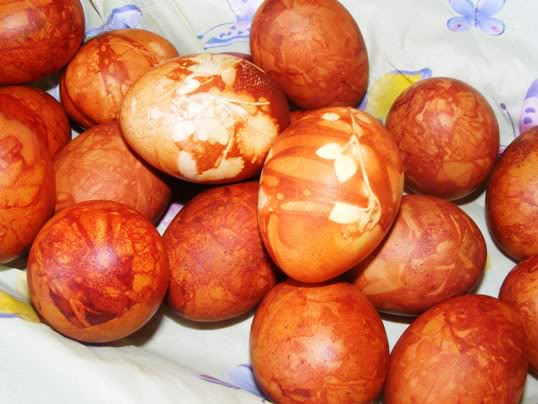
With onion shells
Boil eggs in water with lots of onion shells. You can also decorate it with some plants print. To do that put a leaf or a blossom on the egg and lace it up with a thread, then put it in something tight (most widely used are stockings) and then boil in with the shells.
When I was a child, we were decorating eggs with color pencils, because Easter eggs are always more for children.

The most important meal on Easter Day is a late breakfast after a mass at church. Family members who don't go to church, stay home to prepare the festive table, covered with a white tablecloth and the table decorated with a white lamb figurine.
On a traditional Easter table you will find traditional Lithuanian dark bread, big pork roast, special Easter pie and Easter eggs.
The meal starts with a short prayer, and the elder of the family blesses the table with blessed water from church, then hands out one Easter egg to everyone. The egg fight begins! The egg fight starts when the people around the table are hitting the ends of each other’s eggs until they crack. Then the winners play with the other winners until only one egg is left un-smashed. The winner egg owner should be healthy all year long.


After the egg fight is over, the meal continues with a big pork roast. In some regions the pork head was the main course of the meal. Also very popular is meat jelly with some vegetables. To make it more festive, some people set it in egg shell to make it look as an Easter egg.
After the meal mother the Easter eggs are equally divided for all the children and they go to roll eggs. Eggs are rolled from a gutter or a plank, with the point to hit each other’s eggs that already have rolled down the slide.
Grownups, who went to the church in the morning, usually go to sleep after this, as they had a very early morning. People don't visit each others on the first Day of Easter, except if they have a neighbor unable to walk. Then every neighbor should visit the valetudinarian with some presents from their Easter tables.
Second Day of Easter is for visiting friends and neighbors and exchanging Easter eggs.
Have a nice, sunny and very colorful Easter with your families, let your Easter eggs be the strongest and most beautifull of all.
Happy Easter from Saulene!
- Bookmark :
- Digg
- del.icio.us
- Stumbleupon
- Redit it
- Posted by - (0) Comment
Saulene’s
|
|
Text: Saulene Valskyte
Spring has come, the sun is shining, birds are singing, at least that's what it should be like. In Lithuania Easter weather swings from blizzard to burning sun, but regardless to that is this the most colorful celebration of the year. As all Christian celebrations Easter traditions here are intertwined with paganism, Easter in particulary were a pagan celebration of awakening nature.
The Easter celebration starts a week before Easter Day, on Palm Sunday, when people are gathering in churches with beautiful, colorful, original “palms”. In Lithuania every region have there own palm making traditions, usually palm base are the juniper twig. During the church service the palms are being blessed. Afterwards people participate in a traditional Palm Sunday ritual, beating each other with the blessed palms, wishing each other health and strength. Today this is mostly a children game, but in old days everyone were doing it, singing "It's not me, it's palm what beats you, there's Easter in a week, and you will get an Easter egg".
- Bookmark :
- Digg
- del.icio.us
- Stumbleupon
- Redit it
- Posted by - (0) Comment

- Bookmark :
- Digg
- del.icio.us
- Stumbleupon
- Redit it

OPINIONS
Have your say. Send to:
editor@VilNews.com

Ph. D., Chicago
A wave of unity sweeps the international Lithuanian community on March 11th every year as Lithuanians celebrated the anniversary of the Lithuanian Parliament's declaration of independence from the Soviet Union in 1990. However, the sense of national unity engendered by the celebration could be short-lived.
Human beings have a strong tendency to overgeneralize and succumb to stereotypical us-them distinctions that can shatter even the strongest bonds. We need only search the internet to find examples of divisive thinking at work:
- "Those who fled Lithuania during World II were cowards -- and now they come back, flaunt their wealth, and tell us 'true Lithuanians' how to live."
- "Lithuanians who work abroad have abandoned their homeland and should be deprived of their Lithuanian citizenship."


In Lithuania Christmas Eve is a family event and the New Year's Eve a great party with friends!
Lithuanian say "Kaip sutiksi naujus metus, taip juos ir praleisi" (the way you'll meet the new year is the way you will spend it). So everyone is trying to spend New Year's Eve with friend and have as much fun as possible.
Lithuanian New Year's traditions are very similar to those in other countries, and actually were similar since many years ago. Also, the traditional Lithuanian New Years Eve party was very similar to other big celebrations throughout the year.
The New Year's Eve table is quite similar to the Christmas Eve table, but without straws under the tablecloth, and now including meat dishes. A tradition that definitely hasn't changes is that everybody is trying not to fell asleep before midnight. It was said that if you oversleep the midnight point you will be lazy all the upcoming year. People were also trying to get up early on the first day of the new year, because waking up late also meant a very lazy and unfortunate year.
During the New Year celebration people were dancing, singing, playing games and doing magic to guess the future. People didn't drink much of alcohol, especially was that the case for women.
Here are some advices from elders:
- During the New Year, be very nice and listen to relatives - what you are during New Year Eve, you will be throughout the year.
- During to the New Year Eve, try not to fall, because if this happens, next year you will be unhappy.
- If in the start of the New Year, the first news are good - then the year will be successful. If not - the year will be problematic.
* If New Year's night is cold and starry - look forward to a good summer!
* If the during New Year Eve trees are covered with frost - then it will be a good year. If it is wet weather on New Year's Eve, one can expect a year where many will die and dangerous epidemics occur.
* If the first day of the new year is snowy - the upcoming year will see many young people die. If the night is snowy - mostly old people will die.
* If the New Year time is cold - then Easter will be warm.
* If during New Year there are a lot of birds in your homestead - then all year around there will be many guests and the year will be fun.
Christmas greetings
from Vilnius
and epic battle for the
future
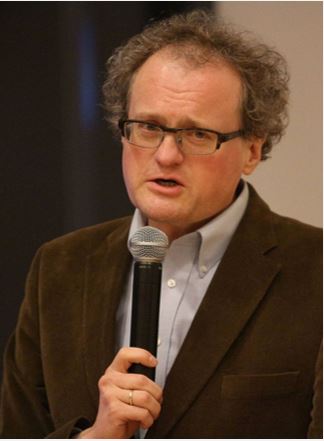
Philosopher, political theorist, historian of
ideas, social analyst, and political
commentator
Ukraine was and continues to be perceived by the EU political class as a sort of grey zone with its immense potential and possibilities for the future, yet deeply embedded and trapped in No Man's Land with all of its troubled past, post-Soviet traumas, ambiguities, insecurities, corruption, social divisions, and despair. Why worry for what has yet to emerge as a new actor of world history in terms of nation-building, European identity, and deeper commitments to transparency and free market economy?
Right? Wrong. No matter how troubled Ukraine's economic and political reality could be, the country has already passed the point of no return. Even if Vladimir Putin retains his leverage of power to blackmail Ukraine and the West in terms of Ukraine's zero chances to accede to NATO due to the problems of territorial integrity, occupation and annexation of Crimea, and mayhem or a frozen conflict in the Donbas region, Ukraine will never return to Russia's zone of influence. It could be deprived of the chances to join NATO or the EU in the coming years or decades, yet there are no forces on earth to make present Ukraine part of the Eurasia project fostered by Putin.
want to learn about the
new, scary propaganda
war between Russia,
The West and the
Baltic States!
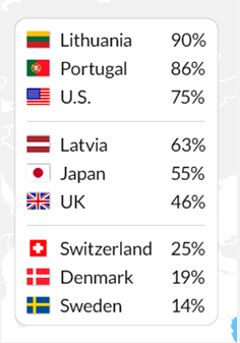
believe their government
is corrupt
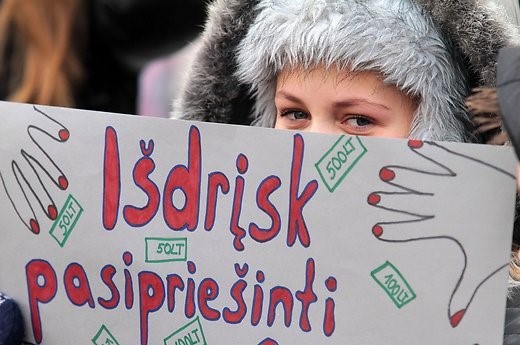
students say no to
bribes for doctors
During Soviet times, government was administered for the people in control, not for the local population, court decisions were decreed, they were not the administration of justice, and academia was the domain of ideologues. 25 years of freedom and openness should have put those bad experiences behind Lithuania, but that is not so.
Today, it is a matter of expectation that court pronouncements will be governed by ideological dictates. Few, if any Lithuanians expect real justice to be effected. For foreign companies, doing business in Lithuania is almost impossible in a situation where business people do not expect rule of law, so, surely Government would be a refuge of competence?
Lithuanian Government has not emerged from Soviet styles. In an attempt to devolve power, Lithuania has created a myriad of fiefdoms of power, each speaking in the name of the Government, each its own centralized power base of ideology.

Chepstow, Wales
Doesn't that sound suspiciously like Lithuania? Ah, but I didn't mention the mountains of Snowdonia, which would give the game away.
I'm talking about Wales, that part of the UK which Lithuanians used to call "Valija", but later named "Velsas" (why?). Wales, the nation which has welcomed two Lithuanian heads of state to its shores - firstly Professor Vytautas Landsbergis, who has paid several visits and, more recently, President Dalia Grybauskaitė who attended the 2014 NATO summit which was held in Newport, South Wales.
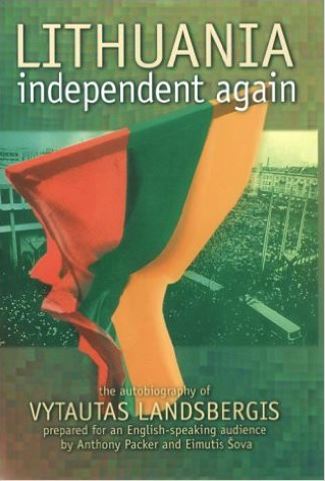
ENGLISH VERSION OF THE
AUTOBIOGRAPHY OF VYTAUTAS LANDSBERGIS.
Although Lithuanian activities have thinned over the decades as that postwar generation died out, the Lithuanian Martyrs' parish hall is crowded with many, many hundreds of visitors who come to the Lithuanian cemetery for All Souls' Day. Similarly, the Franciscan parish has standing room only for Christmas Eve mass.
Although I am firmly embedded in the literary culture of Canada, my themes are usually Lithuanian, and I'll be in Kaunas and Vilnius in mid-November 2015 to give talks about the Lithuanian translations of my novels and short stories, which I write in English.
If you have the Lithuanian language, come by to one of the talks listed in the links below. And if you don't, you can read more about my work at
www.anatanassileika.com
http://www.vdu.lt/lt/rasytojas-antanas-sileika-pristatys-savo-kuryba/ https://leu.lt/lt/lf/lf_naujienos/kvieciame-i-rasytojo-59hc.html
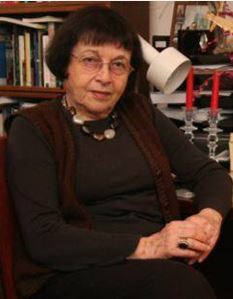
"My love and best wishes to all. As long as VilNews exists, there is hope for the future,"" she writes.
Irena Veisaite means very much for our publication, and we do hereby thank her for the support and wise commitment she always shows.
You can read our interview with her
Facing a new reality
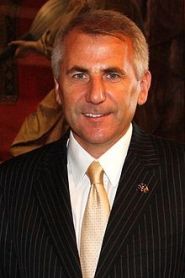
Dear readers of VilNews,
For a number of years, the EU and Russia had assumed the existence of a strategic partnership, based on the convergence of values, economic integration and increasingly open markets and a modernisation agenda for society.
Our agenda was positive and ambitious. We looked at Russia as a country ready to converge with "European values", a country likely to embrace both the basic principles of democratic government and a liberal concept of the world order. It was believed this would bring our relations to a new level, covering the whole spectrum of the EU's strategic relationship with Russia.
The likelihood of Putin
invading Lithuania
.jpg "lithuania today")
Founding Director at Summer Literary Seminars
Are all Lithuanian energy
problems now resolved?
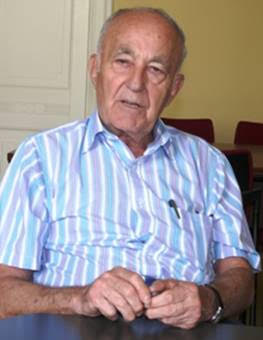
Lithuania as a country does not have significant energy resources. Energy consuming infrastructure after WWII was small and totally supported by energy imports from Russia.
First nuclear reactor begins power generation at Ignalina in 1983, the second reactor in 1987. Iganlina generates enough electricity to cover Lithuania's needs and about 50%.for export. As, prerequisite for membership in EU, Ignalina ceases all nuclear power generation in 2009
The Klaipėda Sea terminal begins Russia's oil export operations in 1959 and imports in 1994.
Mazeikiu Nafta (current ORLEAN Lietuva) begins operation of oil refinery in 1980.
Have Lithuanian ties across
the Baltic Sea become
stronger in recent years?
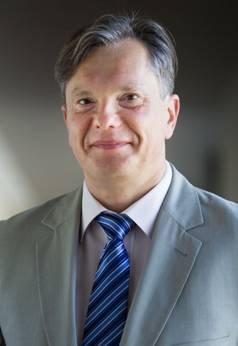
The two decades that have passed since regaining Lithuania's independence can be described as a "building boom". From the wreckage of a captive Soviet republic, a generation of Lithuanians have built a modern European state, and are now helping construct a Nordic-Baltic community replete with institutions intended to promote political coordination and foster a trans-Baltic regional identity. Indeed, a "Nordic-Baltic community" - I will explain later in my text the meaning of this catch-phrase.
Since the restoration of Lithuania's independence 25 years ago, we have continuously felt a strong support from Nordic countries. Nordics in particular were among the countries supporting Lithuania's and Baltic States' striving towards independence. Take example of Iceland, country which recognized Lithuania in February of 1991, well in advance of other countries. Yet another example - Swedish Ambassador was the first ambassador accredited to Lithuania in 1991. The other countries followed suit. When we restored our statehood, Nordic Countries became champions in promoting Baltic integration into Euro-Atlantic institutions. To large degree thanks Nordic Countries, massive transformations occurred in Lithuania since then, Lithuania became fully-fledged member of the EU and NATO, and we joined the Eurozone on 1 January 2015.
Have you heard about the
South African "Pencil Test"?
But that is exactly what happened to me when I came back from South Africa. I will tell you how.
VilNews e-magazine is published in Vilnius, Lithuania. Editor-in-Chief: Mr. Aage Myhre. Inquires to the editors: editor@VilNews.com.
Code of Ethics: See Section 2 – about VilNews. VilNews is not responsible for content on external links/web pages.
HOW TO ADVERTISE IN VILNEWS.
All content is copyrighted © 2011. UAB ‘VilNews’.