
THE VOICE OF INTERNATIONAL LITHUANIA

|
VilNews has its own Google archive! Type a word in the above search box to find any article.
You can also follow us on Facebook. We have two different pages. Click to open and join.
 Click on the buttons to open and read each of VilNews' 18 sub-sections Click on the buttons to open and read each of VilNews' 18 sub-sections  |

|


Author Archive
Thank You-Aciu!!!!!
- Posted by - (0) Comment

Meiloute Marquez
- Bookmark :
- Digg
- del.icio.us
- Stumbleupon
- Redit it

I love reading your posts and articles, but most of all I love looking at your photographs! You should publish a catalogue of the photographs…I think that I may even void any royalties concerning the ones that I am in ;-)
- Posted by - (0) Comment
- Bookmark :
- Digg
- del.icio.us
- Stumbleupon
- Redit it


Karenkay Ketcheson
Olson-Sharp
- Bookmark :
- Digg
- del.icio.us
- Stumbleupon
- Redit it

- Posted by - (0) Comment
Audronius Azubalis:
Sooner or later the history knocks at the door of the present
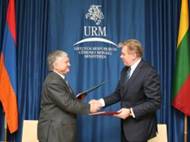
Foreign Minister Edward Nalbandian of Armenia and Lithuanian Foreign Minister Audronius Azubalis. Vilnius, 26 January2012.
Photo: urm.lt
Armenian Foreign Minister Edward Nalbandian paid a working visit to Lithuania on January 26. Within the framework of eth visit Minister Nalbandian had meetings with Lithuania’a Prime Minister Andrius Kubilis, Foreign Minister Audronius Azubalis and Vice-Speaker of Sejm Cheslovas Yurshenas.
At a joint press conference with his Lithuanian counterpart Edward Nalbandian expressed gratitude to Lithuania for adoption of the Armenian Genocide act back in 2005.
“The arguments of Turkey do not stand any criticism. They say the bill passed by the French Senate will hinder the process of normalization of the Armenian-Turkish relations. However, it’s clear to everyone that it’s only Turkey that prevents that normalization. Turkey says the French law edits history. Unfortunately, the black pages of the tragic history of our nation have already been written, and the only way to turn these pages is the recognition and condemnation of this crime against humanity.
The bill passed by the French Senate is not targeted against any concrete country, the Armenian Foreign Minister said, adding that Turkey’s reaction is an evidence of that country’s state policy of denial.
Referring to the same issue, the Lithuanian Foreign Minister said: “Sooner or later the history knocks at the door of the present, and we have to open it. We have to look the history in the face and assess the reality in an open, transparent and fair way. Without that we’ll never have peace in stable inter-state relations. That is why I think that right are the politicians who say that history must be discussed, while those who say history should be left to historians are wrong. Mistrust in bilateral relations will exist until we square accounts with the past.”
- Bookmark :
- Digg
- del.icio.us
- Stumbleupon
- Redit it

- Posted by - (0) Comment
EUROPE – MY HOME & MY CASTLE (10 of 10)
 |
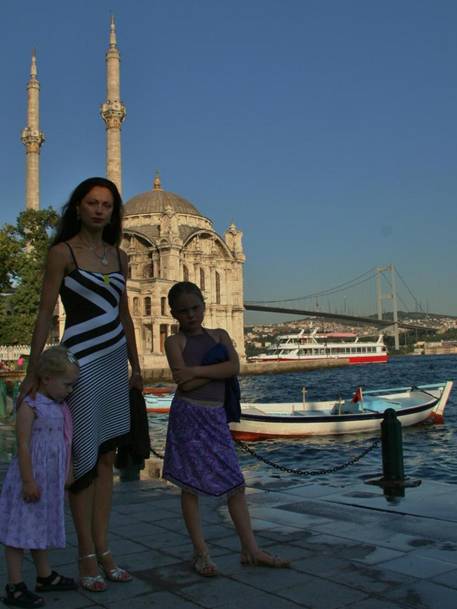
Turkey, where Europe meets Asia |
|
Today we publish the last travel report
Tour guide, writer and photographer: Aage Myhre To read today’s travel report, click HERE To read the previous articles, go to our SECTION 11 |
- Bookmark :
- Digg
- del.icio.us
- Stumbleupon
- Redit it

- Posted by - (2) Comment
EUROPE – MY HOME & MY CASTLE (10 of 10)

|
Turkey, where Europe meets Asia |
|
Today we publish the last travel report Tour guide, writer and photographer: Aage Myhre
|
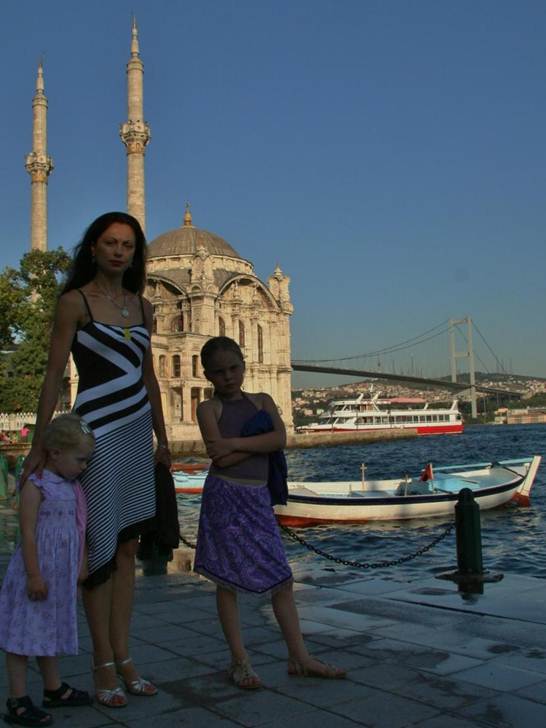
|
|
|

|
|
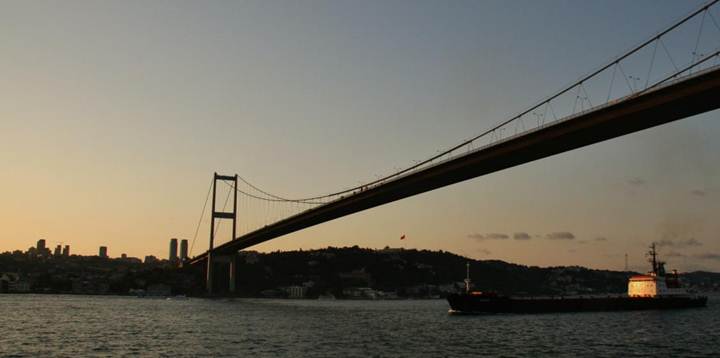
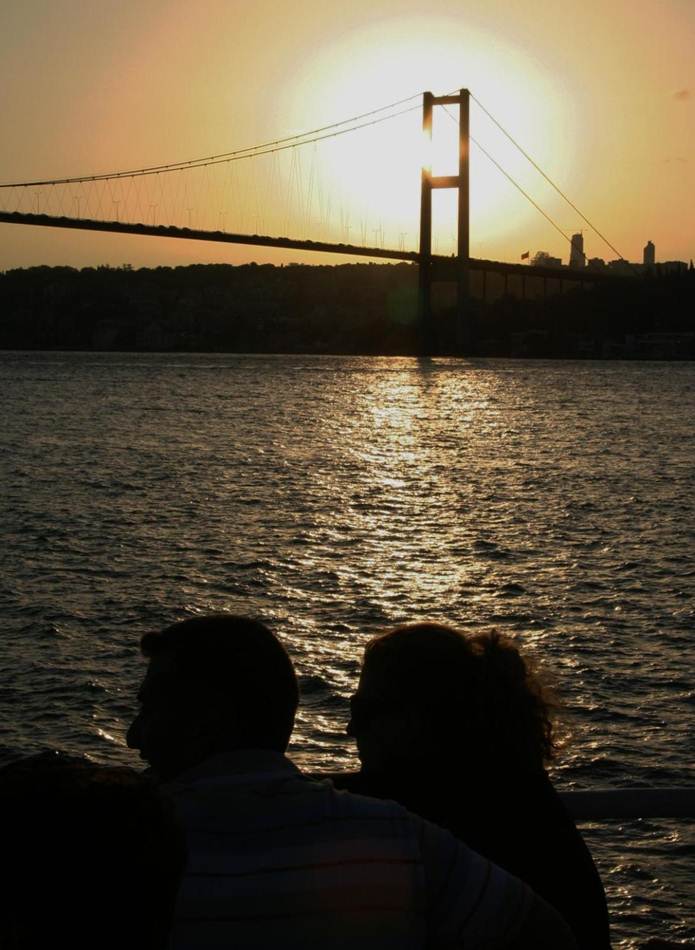
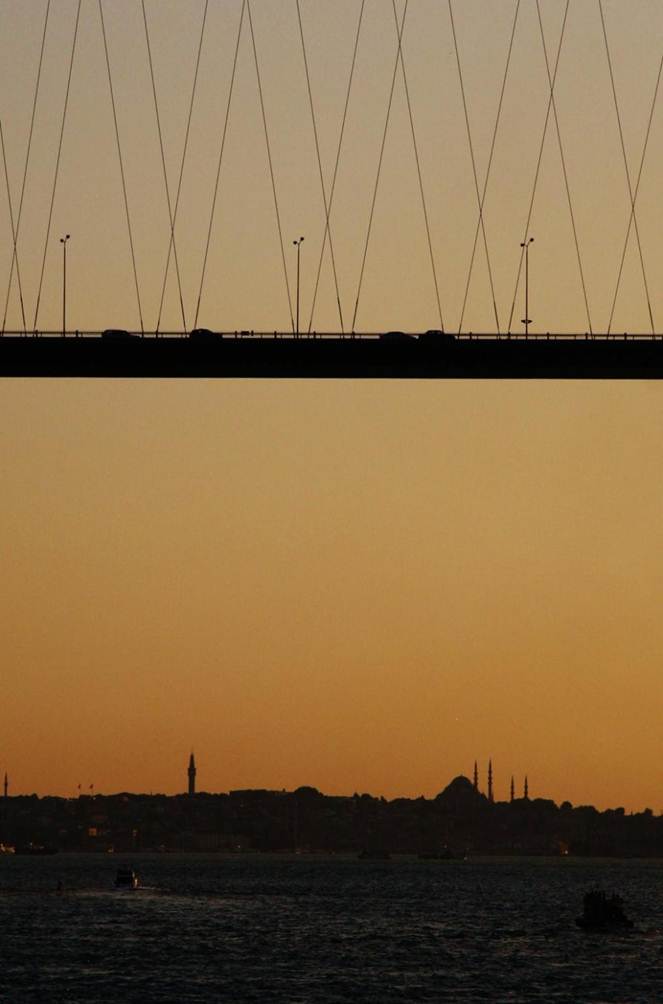
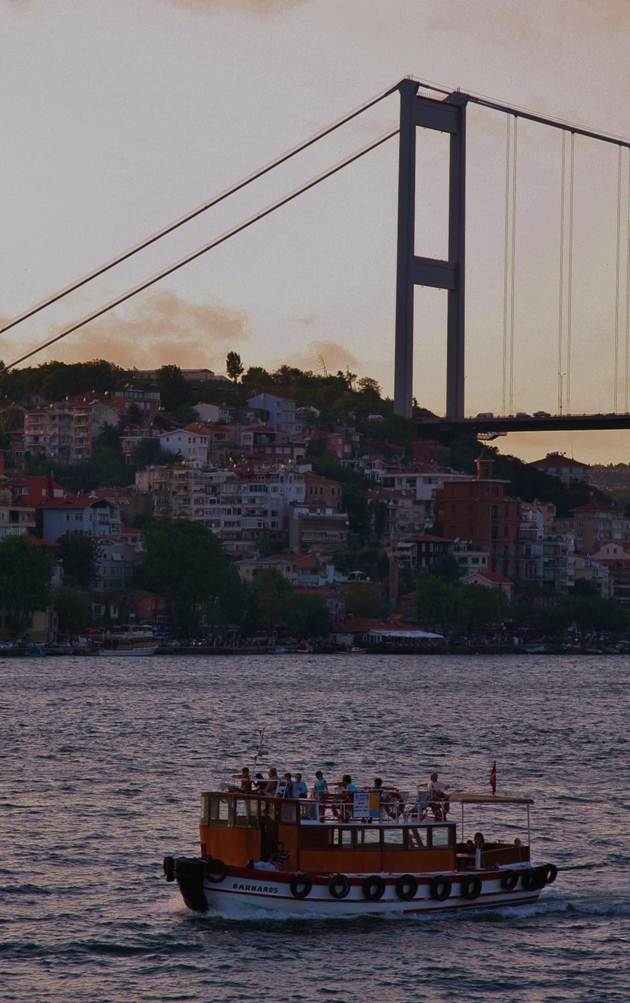
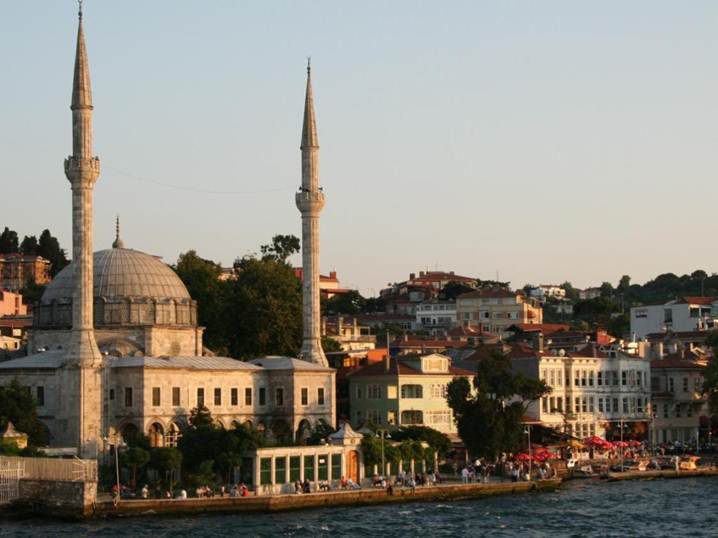
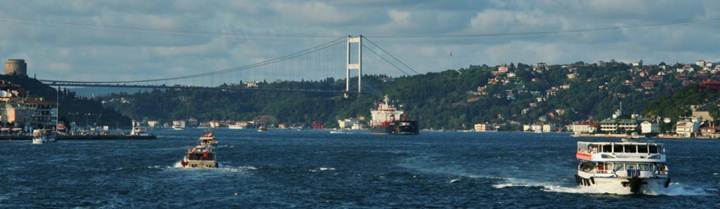
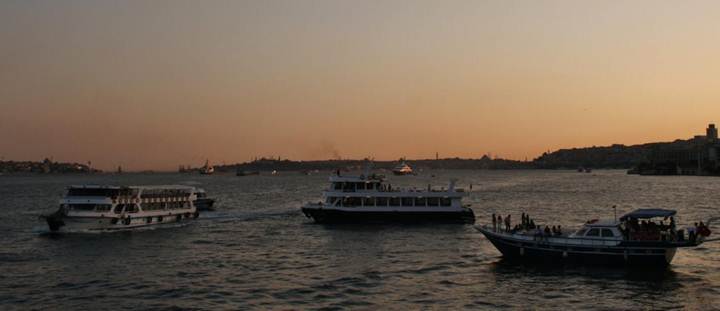
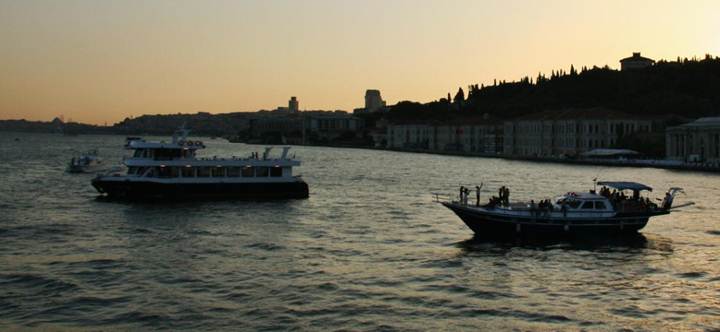
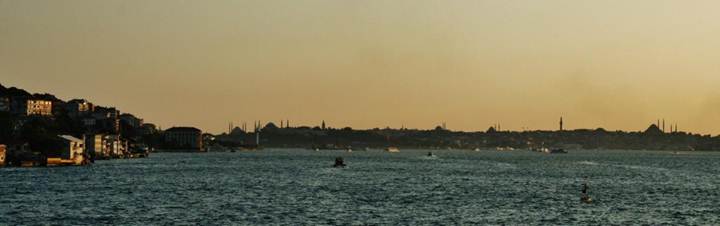
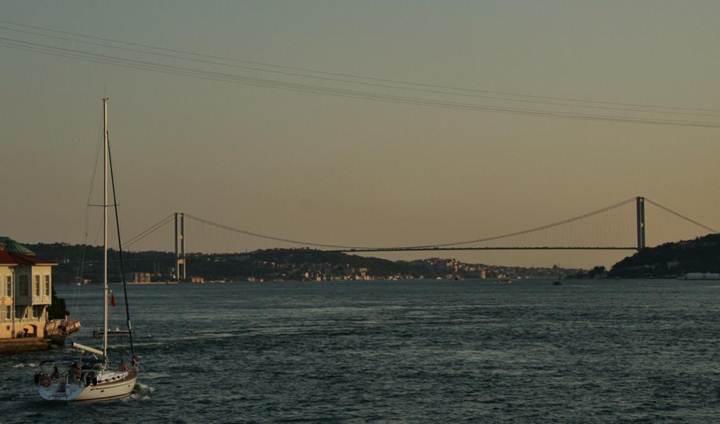
I am in Hotel Conrad in Istanbul. The view from the terrace outside my hotel room is amazing. I look down at the beautiful city I've learned to like so well. The boats on the Bosporus Strait bustle frantically back and forth between the Asian and the European side. Large ships are headingtowards the Black Sea. Others to the Mediterranean Sea. It must have been quite a sight to see the armada of Viking ships sailing in here in the year 860. The Vikings came to plunder. They had travelled far; starting from the Baltic Sea, following the rivers through Russia, by then ruled by a Viking, Rurik. They came to the Caspian Sea and the Black Sea. From there it was only a short distance through the Bosporus Strait until Istanbul, or Miklagard (‘The Great City’) as they named the city – at that time the capital of the Eastern Roman Empire, with hundreds of thousands of residents and colossal treasures the Vikings had never seen before. |
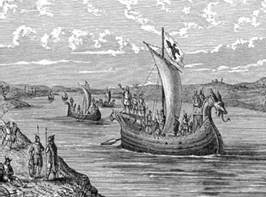
Huge walls met them when they sailed in here from the Black Sea and docked in the harbour of the Golden Horn. The huge wealth made contemporary Istanbul a tempting prey for the Vikings, but the size made them chose to go into service of the emperor instead of trying to conquer the city. He appointed them to a guard of mercenaries, known as 'The Varings.' Their most famous chief was Harald Hardrada (1015 - 1066), half brother to the Norwegian king Olav who was killed in the famous Battle of Stiklestad outside Trondheim in the year 1030. Harald became king of Norway in the year 1046. During the seven years he was here in Miklagard, he had a comet career and was named the top-commander of the The Varings. From Constantinople he led a total of 18 major battles around the Mediterranean Sea, such as against Sicily and North Africa. He conquered no less than 80 cities. The Vikings’ era in Istanbul came to an end after 344 years(!) here on the banks of the Bosporus, in 1204, when the Crusaders conquered the city.
From my terrace I look over to the mosque that was once the world’s largest church building, Hagia Sophia (Holy Wisdom Church). It was completed in the year 537. On one of the pillars is written, clearly visible to this day, 'Halvdan was here'. Carved into the pillar-marble in the contemporary Norse language, the Runes, some time at the end of the 800's. Think about it. A Norwegian Viking was behind the world's first graffiti ...
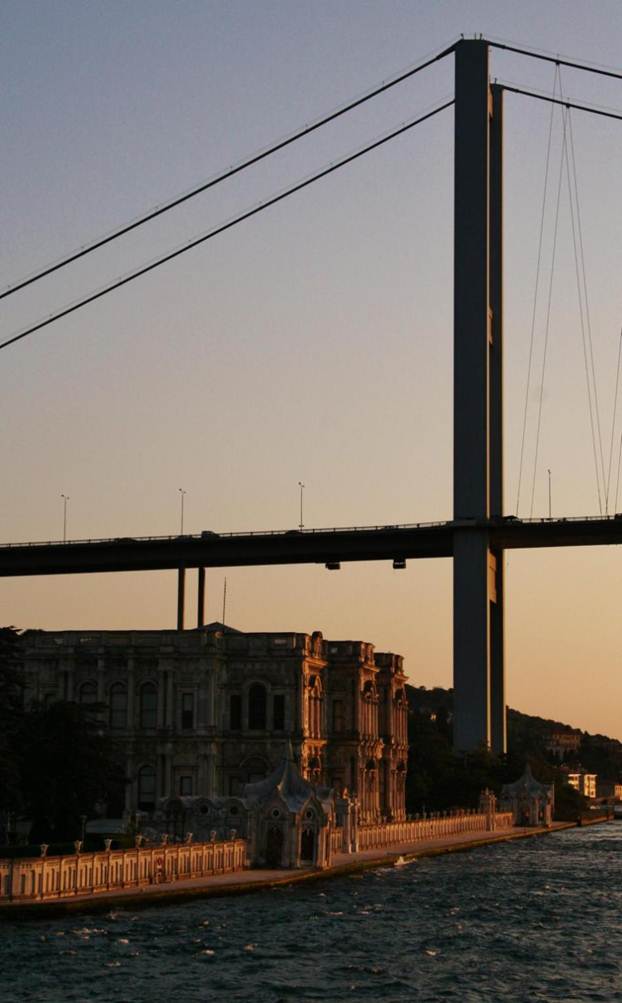
Down at the Bosporus shore I see the lavishly beautiful Dolmabahce Palace. It was there in the palace he died in 1938, Turkey's first president, Mustafa Kemal Ataturk (1881-1938). Founder of the country as a republic and a modern, democratic society, a revolutionary and wise statesman, who more than any other has made Turkey a tolerant nation where the country's many nationalities and religions generally live in peaceful coexistence. Probably also the best guarantor for conflict management in the Middle East. It is said that Turkey is the very barometer of how the state of peace and harmony in the world. Atatürk's famous epigram, "Peace in the home country, peace in the world" still applies.
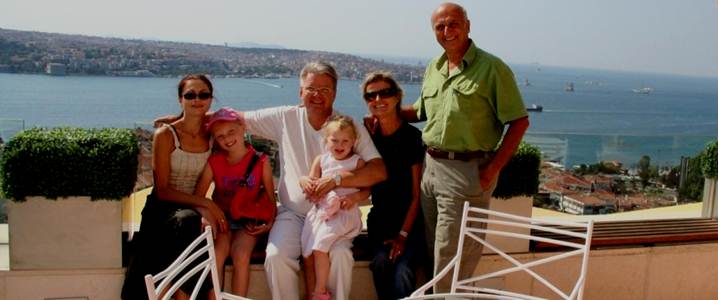
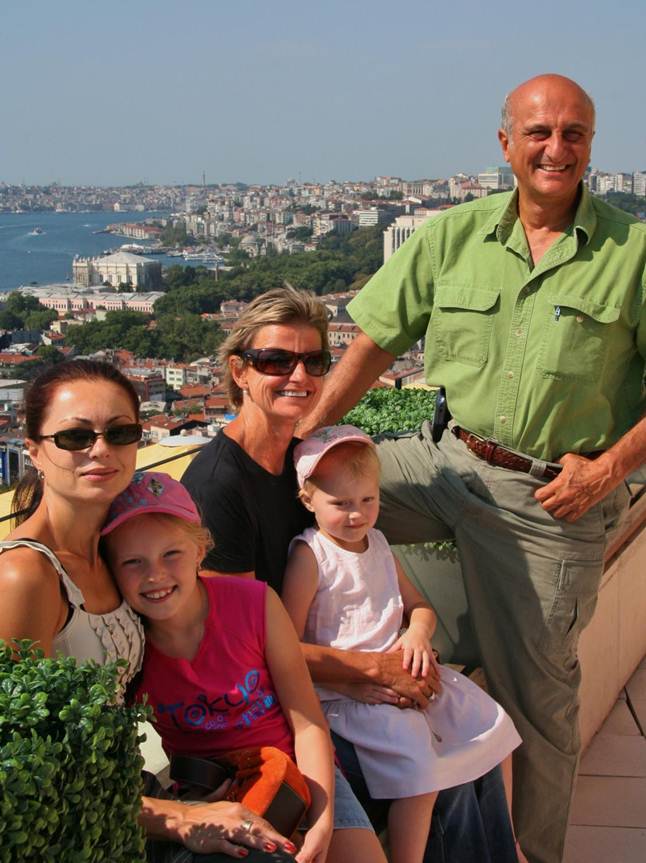
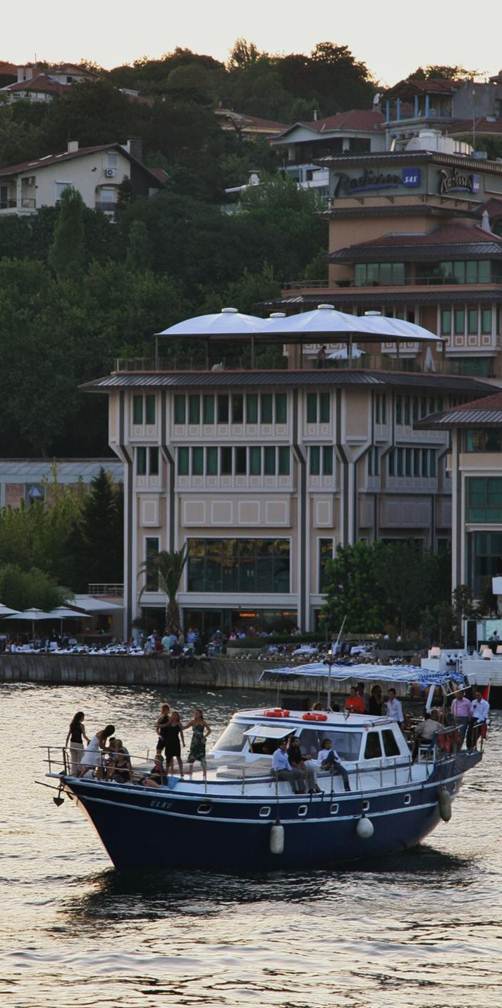
My international family gathered at Hotel Conrad's rooftop in Istanbul. Phenomenal views of the Bosporus and the
Asian part of the city. Lithuanian, Iranian, American and Norwegian in perfect harmony!
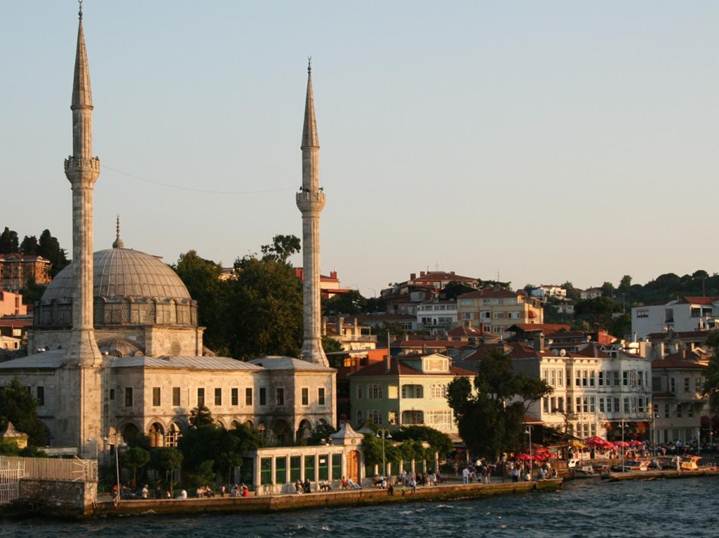
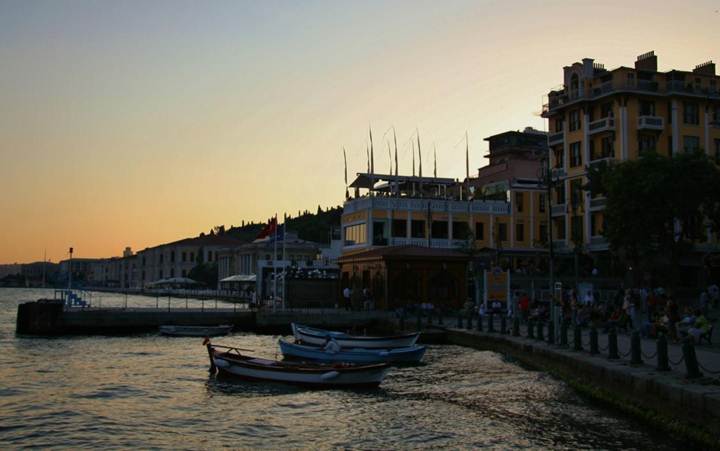
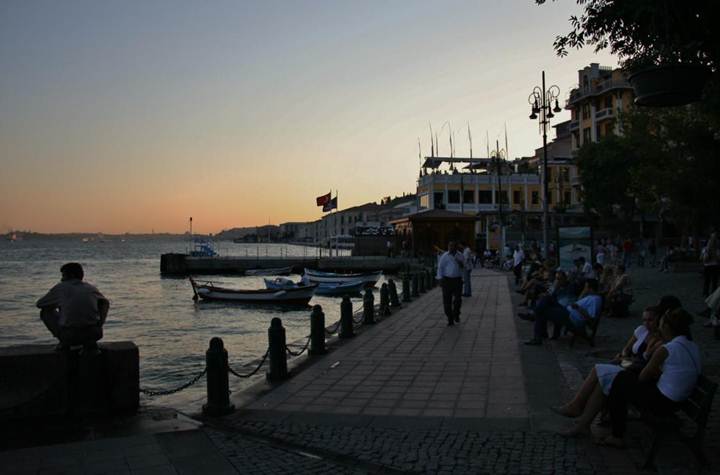
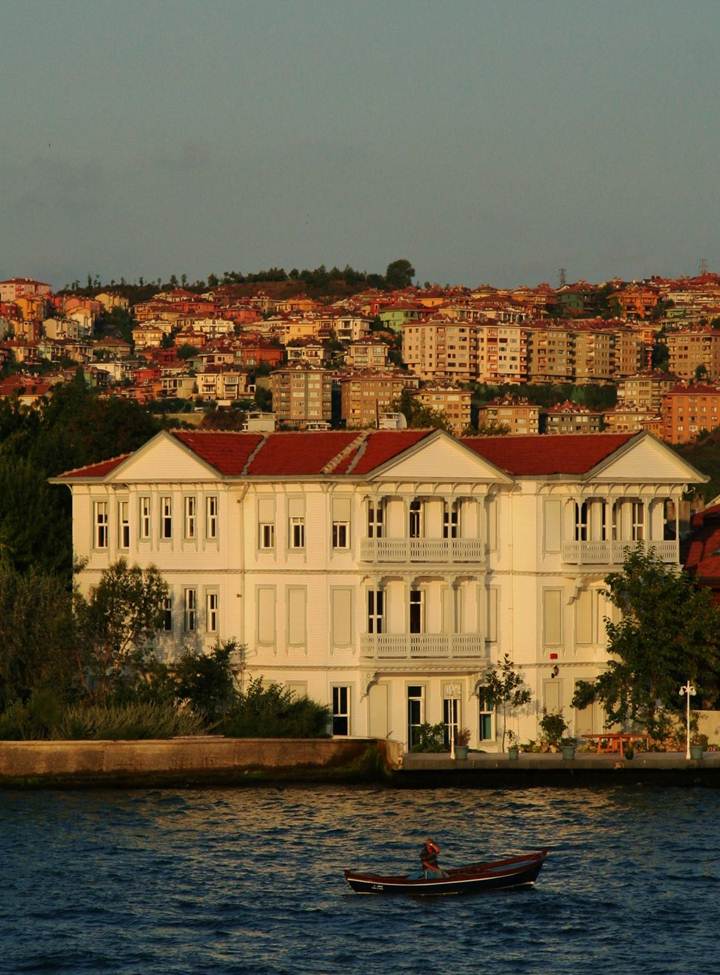
Water and land are living together in great harmony here in Istanbul. A captivating beautiful, ancient, modern city.
Photo: Aage Myhre
|
It is late afternoon when my plane takes off from Istanbul Ataturk Airport. The flight is set to Antalya in southern Turkey. Soon I gaze down at the impressive mountain massifs that so beautifully characterize this country. I've got a window seat on the left side and look down towards the area where today's capital, Ankara, is located. Through centuries the Galatians lived there, the people Apostle Paul wrote two letters to. They were Celts who had come all the way from Ireland and Britain to settle right here. The many people movements through the history of mankind never cease to surprise me. It might well have been that it was through the Galatians that Christianity came to northEurope. The apostle went this route on foot from Istanbul home to his birthplace Tarsus in southern Turkey, now called Yalvac (Psidian Antioch). It's strange to think that it was here that Paul and Barnabus lived and from here introduced Christianity to our pagan world. Yalvacs history dates back to 280 BC. In Paul's time the area had a mixture of Jews, Romans and Greeks. |
|
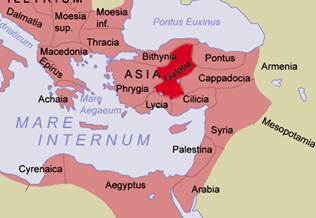
The sun has already disappeared into the evening azure Mediterranean Sea as we slowly descend towards Antalya. I can still easily study the pine-clad Taurus Mountains, sloping down towards the sparkling clear sea outside the irregular coastline of rocky headlands and secluded coves. It is said that Antalya is bathed in sunshine 300 days a year. It is therefore not surprising that this is a tourist paradise with a focus on sunbathing, swimming and water sports. But Antalya also has a large number of historical sites, beautiful mosques and much more scattered in the surrounding landscape characterized by pine forests, olive and citrus trees, palms, avocado and banana plantations.
This is the fascinating backdrop to my visit. I have come to Antalya to participate in the inauguration of a so-called "Religious Garden" which will include a mosque, a church and a synagogue, designed to beautifully symbolize the glorious history of many nationalities and religions living side by side here in Turkey since historic times.
Turkish Prime Minister Recep Tayyip Erdogan, has arrived from Ankara to perform the official opening, and as he opens this complex of Muslim, Christian and Jewish places of worship, he emphasizes that his government will eliminate all remaining obstacles to religious freedom in Turkey.
During the subsequent dinner, the Prime Minister tells us that religious tolerance in Turkey is a legacy from the Ottoman Empire. He cites the regulations that once upon a time were introduced by Mehmet the Conqueror, the sultan who captured Istanbul in 1453, that the Ottoman Empire would always show respect for non-Muslims."Because of this significant historical experience, Turkey is currently a guarantor of peace and brotherhood inthis region," concludes Prime Minister Erdogan.
Netherlands’ 'European Affairs Ministers', Atzo Nikolai, and members of the diplomatic community in Ankara and religious leaders representing Turkish, Greek, Armenian and Jewish minorities participate in the ceremony. Applaud the Prime Minister's speech.
"People will be able to freely practice their religion in this Garden of Tolerance. This is a very important message," says AtzoNikolai, and adds: "The EU will continue to encourage reforms in Turkey. It will probably still be frictions sometimes but the reforms Turkey has undertaken are encouraging. "
Leaders of Turkey's non-Muslim minorities support the opening of the new "Garden of Religions", but not without acerbic remarks about legal matters that increasingly restrict their activities. "Catholics are able to practice their religion in Turkey, but has no property rights over their own churches. I hope we will get this right one day," said Father Alphonse Sammut, a representative of the Catholic church in the country.
The Armenian Orthodox Patriarch Mesrob II, emphasizes that non-Muslim places of worship as soon as possible should be opened in all major Turkish cities. "This should be done either by renovating historical sites or to build new ones such as the one here," he says.
That evening I walk along one of the endless, soft Antalya beaches, listening to the lazy waves that slowly wash in from the Mediterranean Sea. A clear, dark sky with billions of twinkling stars arches over me. Almost reflecting the dramatic historical events that have taken place in this area through more than 2000 years. I wonder about tolerance, religious freedom, brotherhood and peace can really begin to grow out from here to neighbouring countries in the Middle East, where war and hatred still dominate...
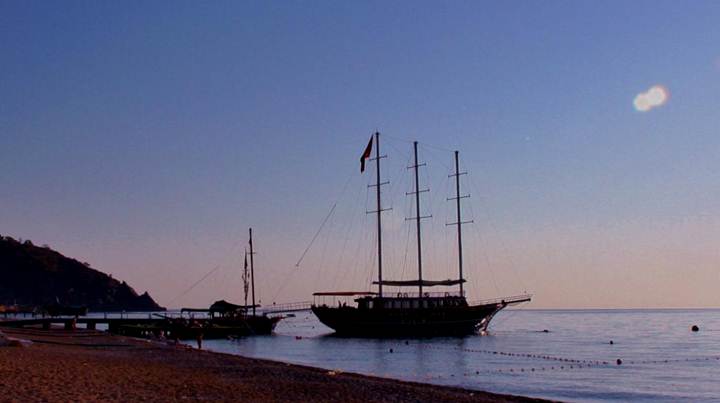
Photo: Aage Myhre.
The Ottoman Empire
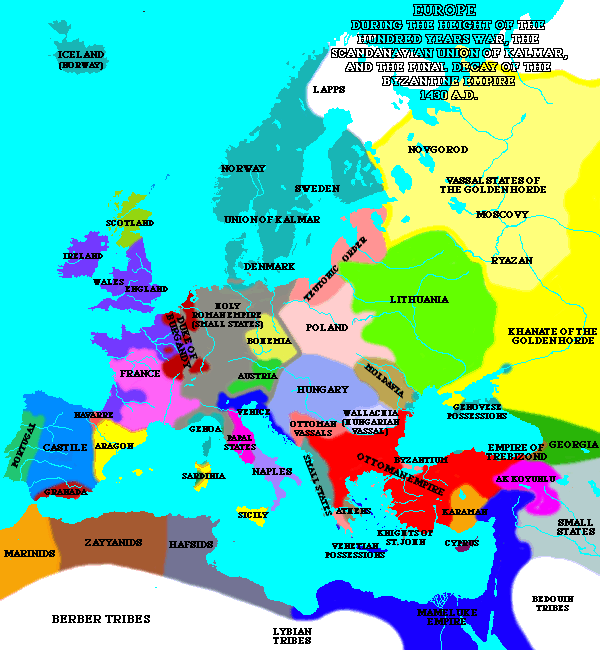
Europe in 1430, when The Grand Duchy of Lithuania and the Ottoman Empire both were leading forces.
The Ottoman Empire was a Turkish empire which lasted from 27 July 1299 to 29 October 1923.
The Ottoman Empire was one of the largest and longest lasting empires in history; such that the Ottoman State, its politics, conflicts, and cultural heritage in a vast geography provide one of the longest continuous narratives. During the 16th and 17th centuries, in particular at the height of its power under the reign of Suleiman the Magnificent, the empire became the most powerful state in the world – a multinational, multilingual empire that stretched from the southern borders of the Holy Roman Empire (until the outskirts of Vienna), Royal Hungary (modern Slovakia) and the Polish–Lithuanian Commonwealth in the north to Yemen and Eritrea in the south; from Algeria in the west to Azerbaijan in the east; controlling much of southeast Europe, western Asia, and North Africa. The empire contained 29 provinces and numerous vassal states, some of which were later absorbed into the empire, while others were granted various types of autonomy during the course of centuries.
With Constantinople (present-day Istanbul), and vast control of lands around the Mediterranean basin, the empire was at the center of interactions between the Eastern and Western worlds for six centuries.
After the international recognition of the Grand National Assembly of Turkey (GNA) headquartered in Ankara, by means of the Treaty of Lausanne signed on 24 July 1923, the GNA proclaimed on 29 October 1923 the establishment of the Republic of Turkey as the new Turkish State that succeeded and formally ended the defunct Ottoman Empire, in line with the treaty. The Ottoman Caliphate was abolished on 3 March 1924.
Today’s journey:
|
|
Turkey |
Turkey is a Eurasian country located in Western Asia (mostly in the Anatolian peninsula) and in East Thrace in South-eastern Europe. Turkey is bordered by eight countries: Bulgaria to the northwest; Greece to the west; Georgia to the northeast; Armenia, Azerbaijan (the exclave of Nakhchivan) and Iran to the east; and Iraq and Syria to the southeast. The Mediterranean Sea and Cyprus are to the south; the Aegean Sea is to the west; and the Black Sea is to the north. The Sea of Marmara, the Bosporus and the Dardanelles (which together form the Turkish Straits) demarcate the boundary between East Thrace and Anatolia; they also separate Europe and Asia.
Turkey is one of the six independent Turkic states. The vast majority of the population are Muslims. The country's official language is Turkish, whereas Kurdish and Zazaki languages are spoken by Kurds and Zazas, who constitute 18% of the population.
|
|
Oghuz Turks began migrating into the area now called Turkey (derived from the Medieval Latin Turchia, i.e. "Land of the Turks") in the 11th century. The process was greatly accelerated by the Seljuk victory over the Byzantines at the Battle of Manzikert. Several small beyliks and the Seljuk Sultanate of Rûm ruled Anatolia until the Mongol invasion. Starting from the 13th century, the Ottoman beylik united Anatolia and created an empire encompassing much of South-eastern Europe, Western Asia and North Africa. After the Ottoman Empire collapsed following its defeat in World War I, parts of it were occupied by the victorious Allies. A cadre of young military officers, led by Mustafa Kemal Atatürk and his colleagues, organized a successful resistance to the Allies; in 1923, they would establish the modern Republic of Turkey with Atatürk as its first president. Turkey is a democratic, secular, unitary, constitutional republic with an ancient cultural heritage. Turkey has become increasingly integrated with the West through membership in organisations such as the Council of Europe, NATO, OECD, OSCE and the G-20 major economies. Turkey began full membership negotiations with the European Union in 2005, having been an associate member of the European Economic Community since 1963 and having reached a customs union agreement in 1995. Turkey has also fostered close cultural, political, economic and industrial relations with the Middle East, the Turkic states of Central Asia and the African countries through membership in organisations such as the Turkic Council, Joint Administration of Turkic Arts and Culture, Organisation of Islamic Cooperation and the Economic Cooperation Organisation.
|
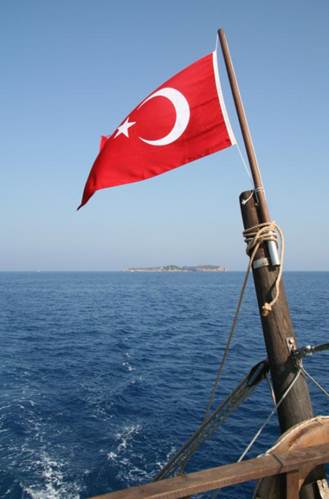
Istanbul
Istanbul is the largest city of Turkey. Istanbul metropolitan province (municipality) had 13.26 million people living in it as of December, 2010, which is 18% of Turkey's population and the 3rd largest metropolitan area in Europe (including the Asian side of the city) after London and Moscow. Istanbul is a megacity, as well as the cultural, economic, and financial centre of Turkey. It is located on the Bosporus Strait and encompasses the natural harbour known as the Golden Horn, in the northwest of the country. It extends both on the European (Thrace) and on the Asian (Anatolia) sides of the Bosporus, and is thereby the only metropolis in the world that is situated on two continents. Istanbul is a designated alpha world city.
During its long history, Istanbul has served as the capital of the Roman Empire (330–395), the Eastern Roman (Byzantine) Empire (395–1204 and 1261–1453), the Latin Empire (1204–1261), and the Ottoman Empire (1453–1922). When the Republic of Turkey was proclaimed on 29 October 1923, Ankara, which had previously served as the headquarters of the Turkish national movement during the Turkish War of Independence, was chosen as the new Turkish State's capital. Istanbul was chosen as a joint European Capital of Culture for 2010 and the European Capital of Sports for 2012. Istanbul is currently bidding to host the 2020 Summer Olympics. The historic areas of the city were added to the UNESCO World Heritage List in 1985. The city covers 39 districts of the Istanbul province.
Myra, Turkey – where Santa was born
(sorry Finland...)
St. Nicholas, who later became known as Santa Claus, was a popular bishop at Myra in the 4th century AD, born in Patara between 260 AD and 280, famous for his miracles and known for his kindness. His parents died of the plague and he was left a wealthy young man.
It is said that he was thrown into prison by Emperor Diocletian, perhaps participated in the Council of Nicaea, implored Emperor Constantine for a large tax reduction for Myra which was granted and destroyed Myra's renowned temple of Artemis (among many others). After the death of St. Nicholas, Myra became a rich pilgrimage centre with many new churches built.
|
|
Bari, Italy, where Santa is buried... In 1087 Italian merchants, during the confusion of the Seljuk invasion, stole his body at Myra and transported it to Bari in Italy, which became a pilgrimage centre and where his relics are still preserved today. An oily substance called Manna di S. Nicola, which is highly valued for its medicinal powers, is said to flow from them. St. Nicolas who later became better known as Santa Claus, and And ironically enough, the relics of the woman who was such a leading symbol of Lithuania's greatness are to be found, not in Lithuania, but in southern Italy along with the remains of the symbol of today's Christmas traditions, a bishop from Myra in today’s southern Turkey... |
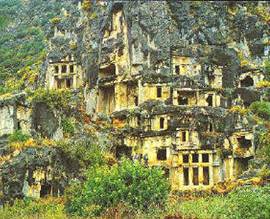
St. Nicholas' cult spread beyond the Byzantine Empire in the 6th -11th centuries, celebrated especially in Holland and the East Church under Russian imperial patronage. He later became the patron saint of Greece and Russia as well as of children, sailors, merchants, scholars, those unjustly imprisoned and travellers.
St. Nicholas was known for his charitable nature and humility. Several legends about him have been based on his kind and giving nature and have led to the development of Santa Claus.
For more information about St. Nicholas, see the website St. Nicholas: Discovering the Truth About Santa Claus.
Myra was a leading city of the Lycian Union and surpassed Xanthos in early Byzantine times to become the capital city of Lycia. Its remains are situated about 1.5 km north of today's Demre, on the Kaş-Finike road. Most of the ancient city is now covered by Demre and alluvial silts, for it is located on the river Demre Cay in a fertile alluvial plain. Today this large plain is almost covered with greenhouses stuffed full of tomatoes. In ancient times this area was probably farmed extensively, for export and trade with the interior of Lycia.
The date of Myra's foundation is unknown. There is no literary mention of it before the 1st century BC, when it is said to be one of the six leading cities of the Lycian Union (the other five were Xanthos, Tlos, Pinara, Patara and Olympos). It is believed to date back much further however, as an outer defensive wall has been dated to the 5th century BC.
The city is well known for its amphitheatre (the largest in Lycia) and the plethora of rock-cut tombs carved in the cliff above the theatre.
Myra once had a great temple of the goddess Artemis Eleuthera (a distinctive form of Cybele, the ancient mother goddess of Anatolia), said to be Lycia's largest and most splendid building. It was built on large grounds with beautiful gardens and had an inner court defined by columns, an altar and a statue of the goddess. Not a trace of it remains today, however, since St. Nicholas (the bishop of Myra in the 4th century AD) in his zeal to stamp out paganism in the region, had the temple of Artemis, along with many other temples, completely destroyed. See more about St. Nicholas below.
In Roman times the emperor Germanicus and his wife Agrippina paid Myra a visit in 18 AD and were honoured with statues of themselves erected in Myra's harbour (Andriace, located 5 km southwest of Myra).
St. Paul changed ships at Myra's port on his way to his trial in Rome, in about 60 AD, after he had been arrested in Jerusalem after being charged with inciting to riot. Andriace was a chief port for Egyptian vessels passing through the area; Egypt was the breadbasket of the Roman Empire and the imperial government had a fleet of grain ships that carried grain to Rome and other parts of the Empire. Andriace was a major trans-shipment point for grain from Alexandria - grain came from the plain near Myra, and was also possibly brought in by boats, to be shipped onwards from Lycia. It is likely that Paul made the trip to Rome on a grain ship as these were often used to transport passengers as well.
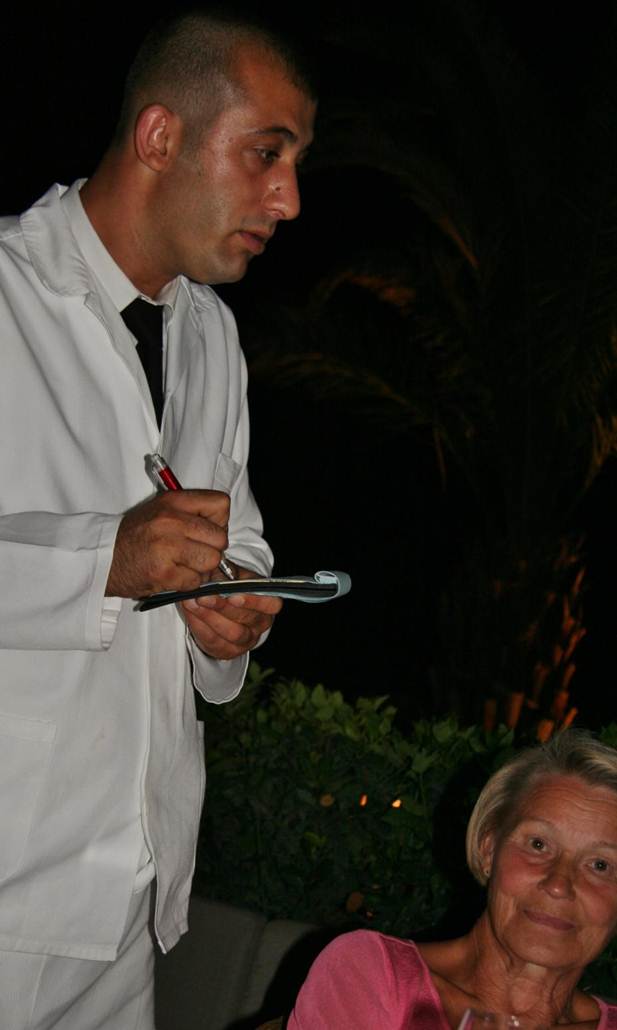
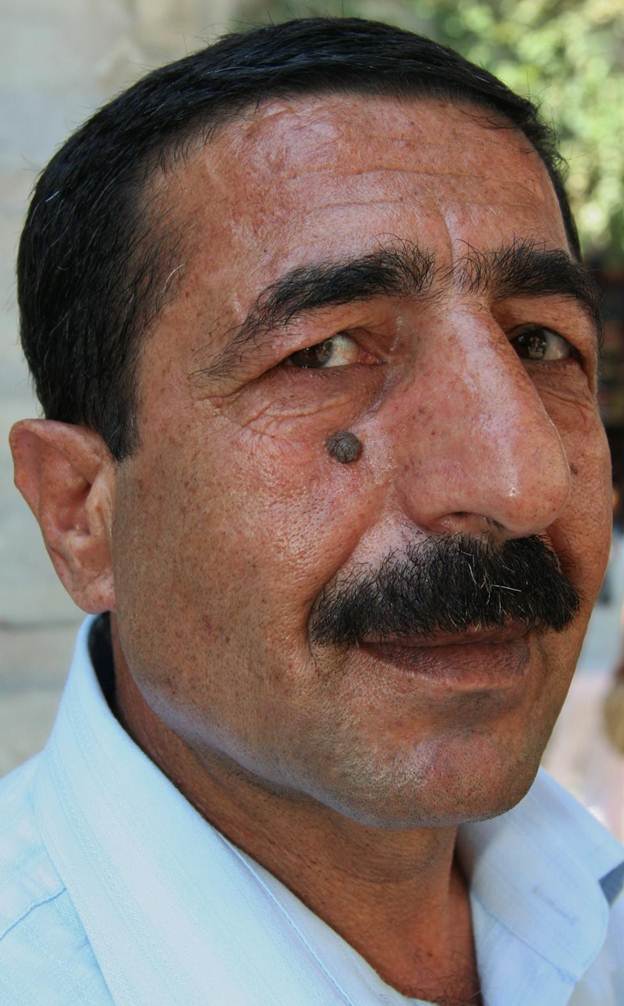
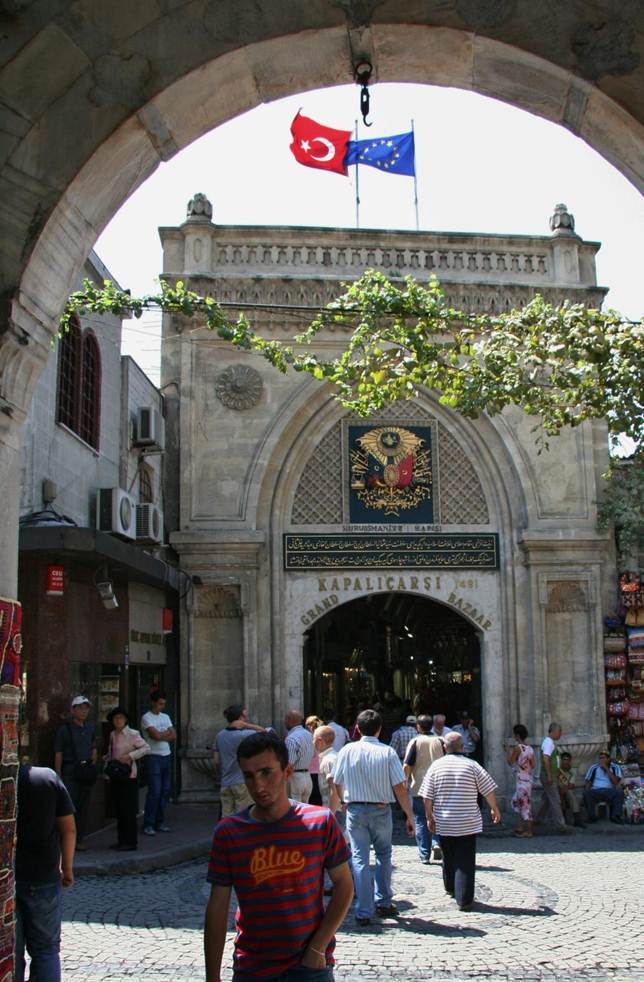
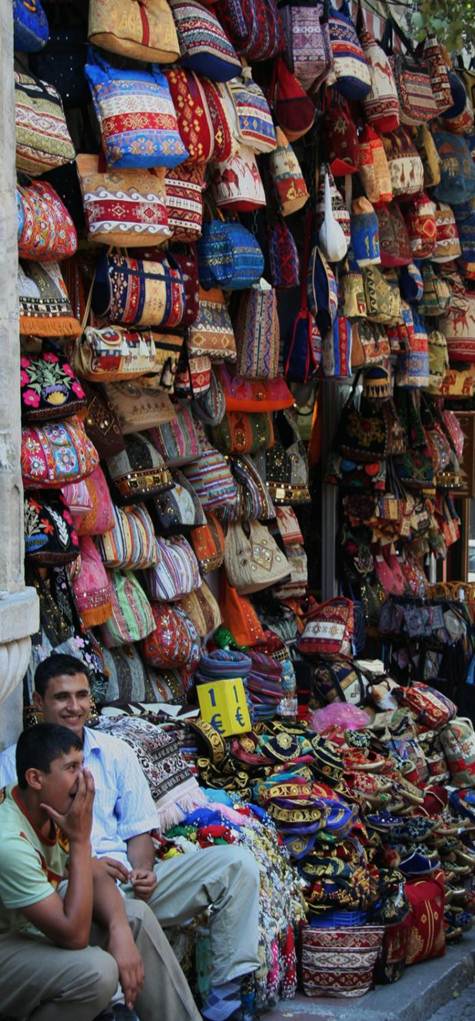
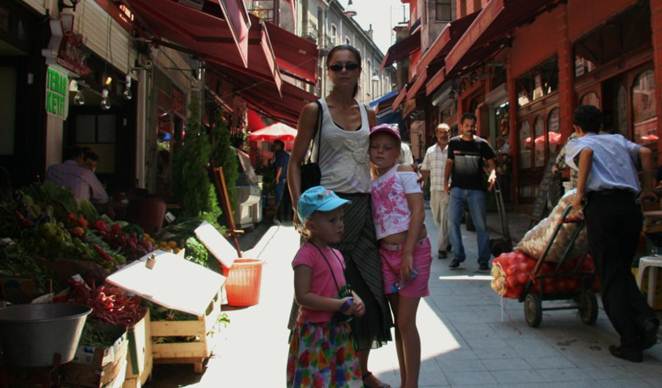
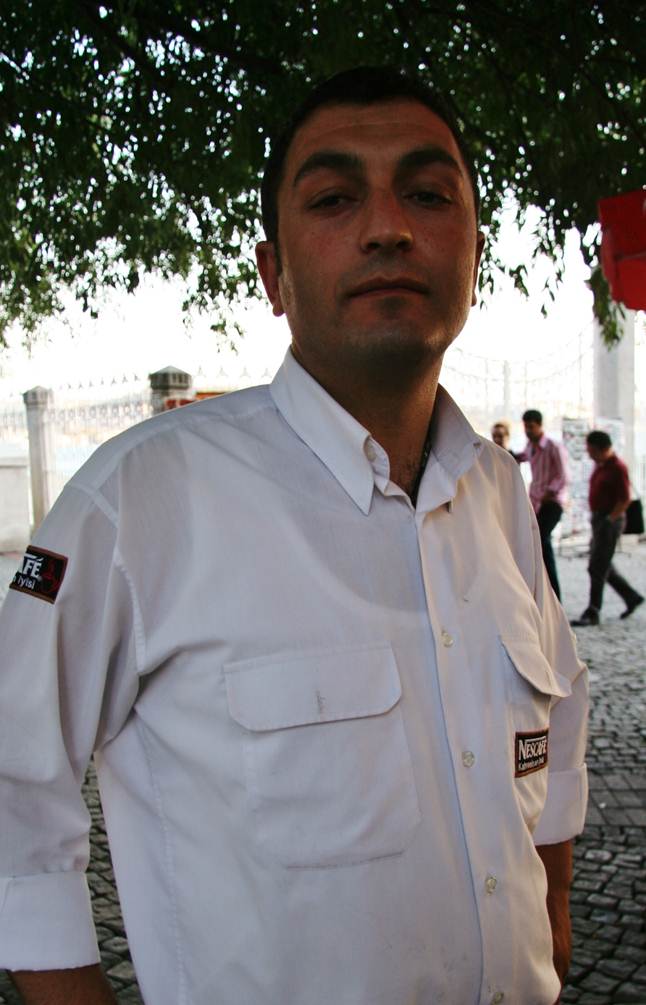
People I’ve met in Turkey
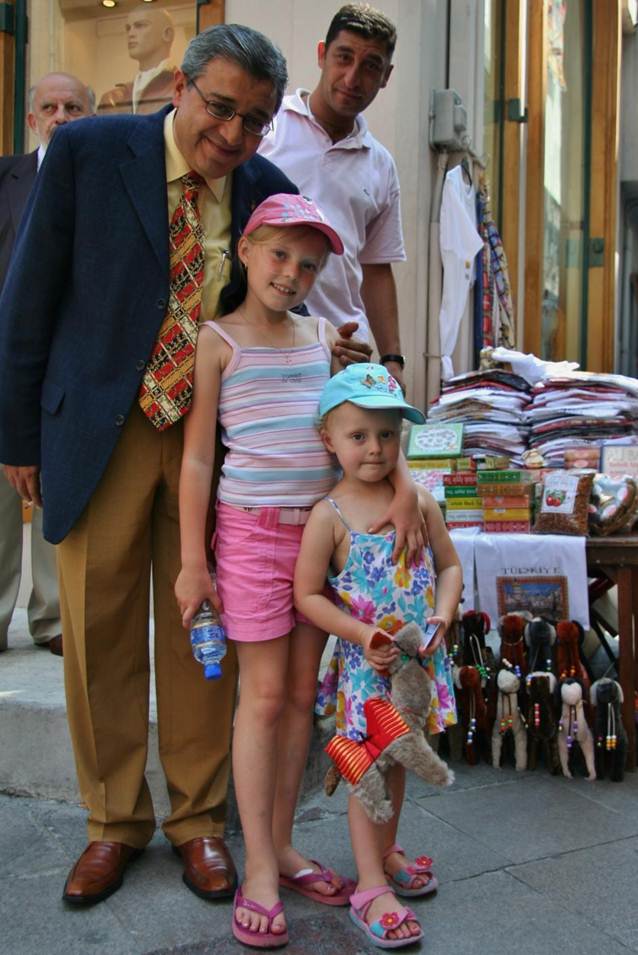
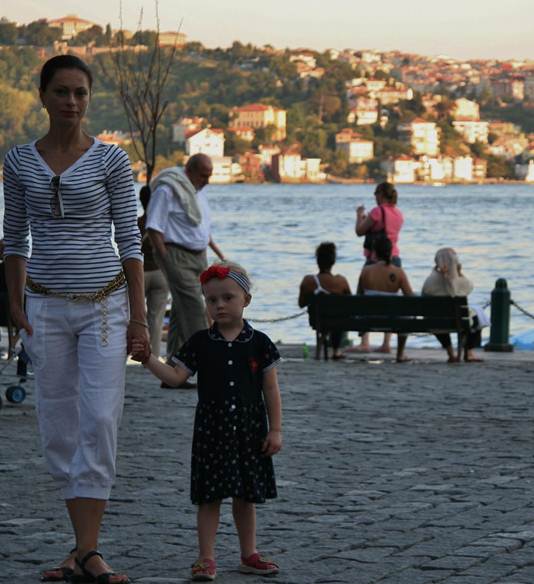
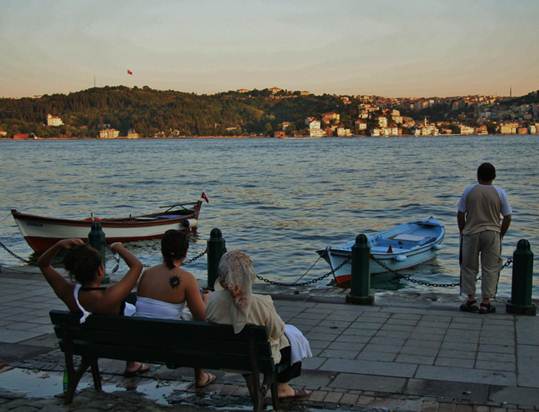
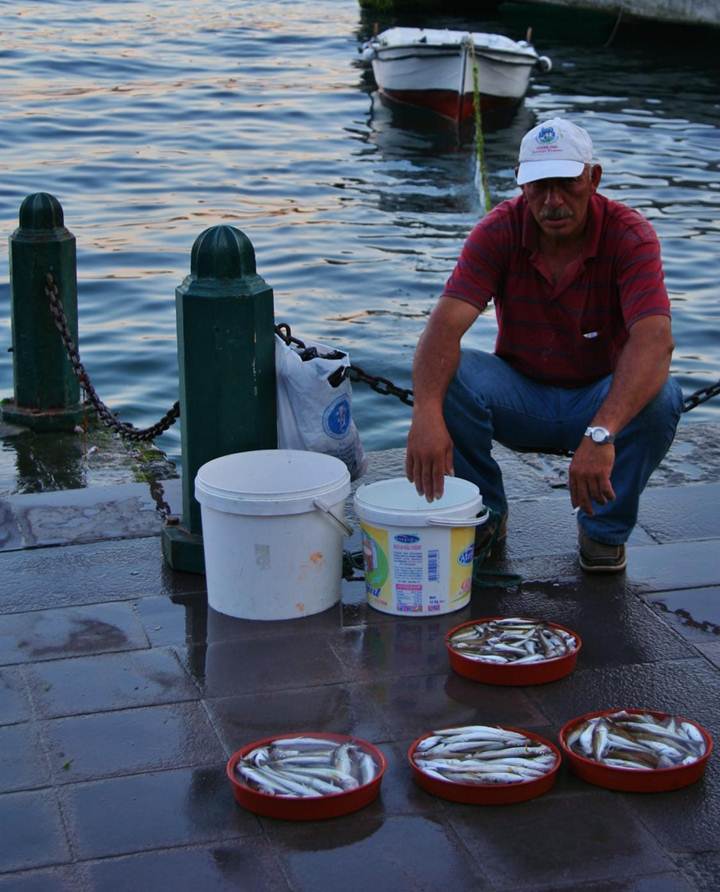
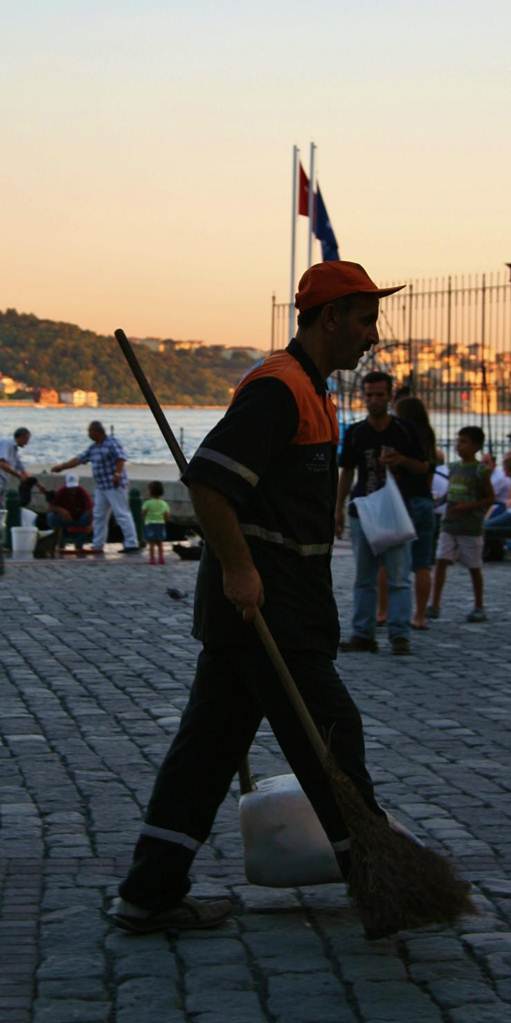
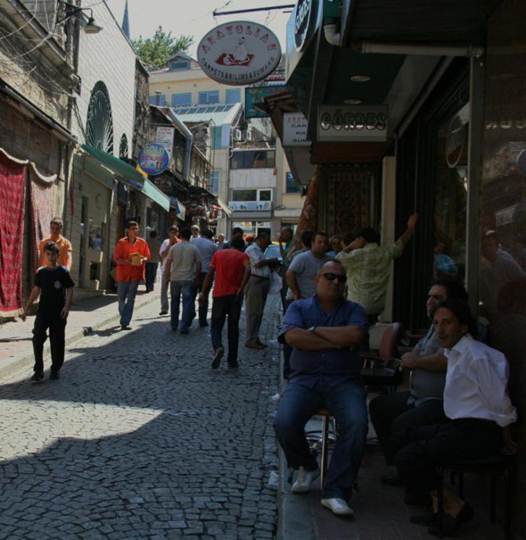
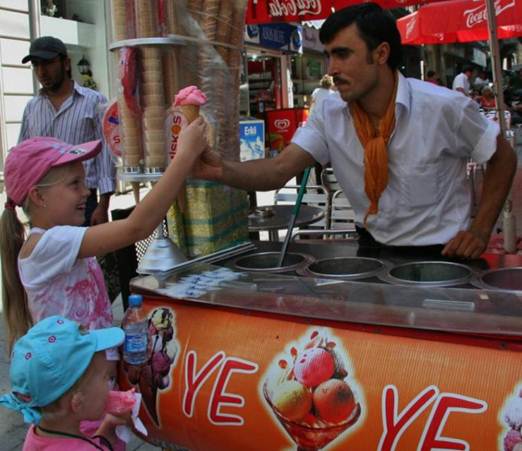
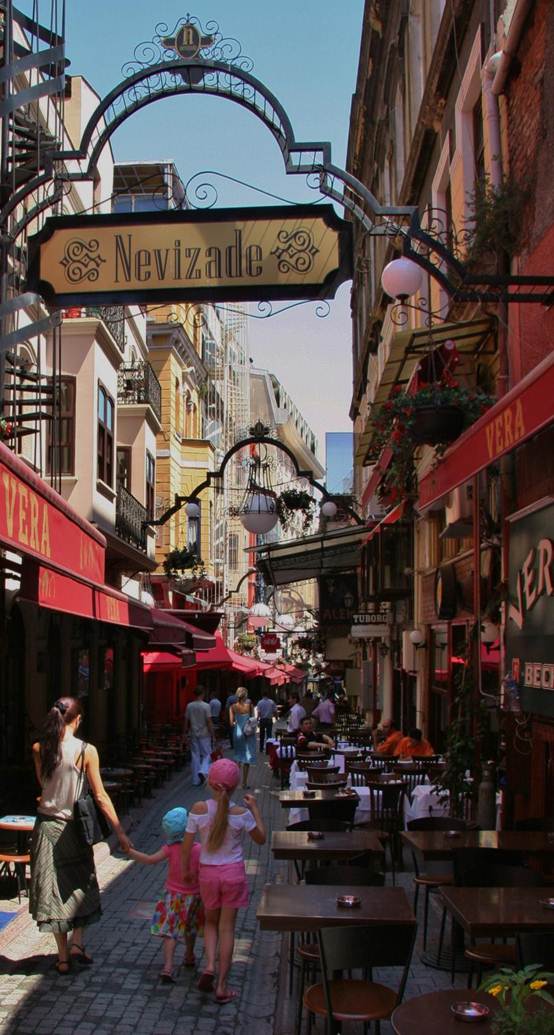
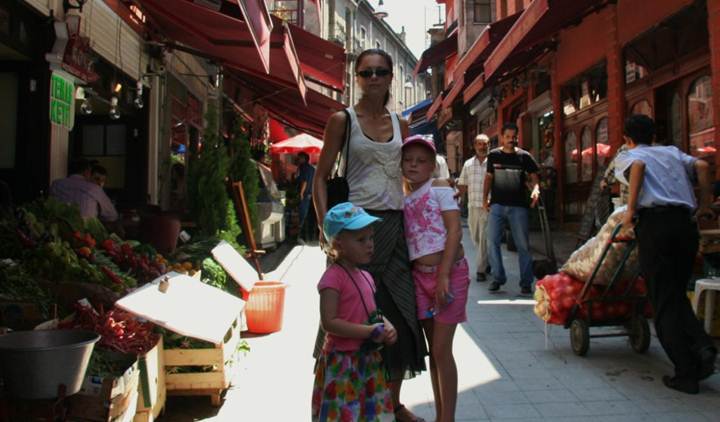
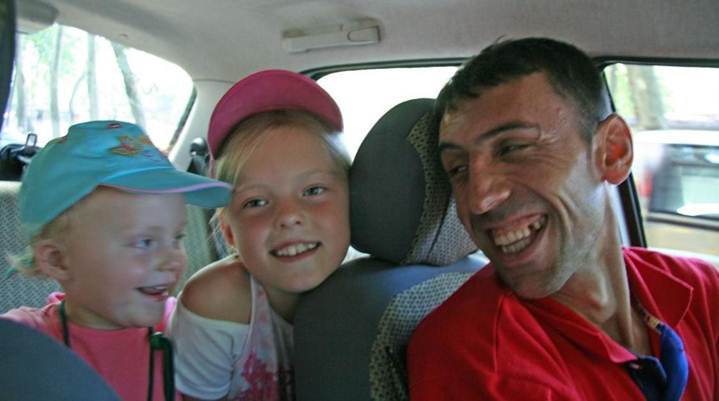
. 
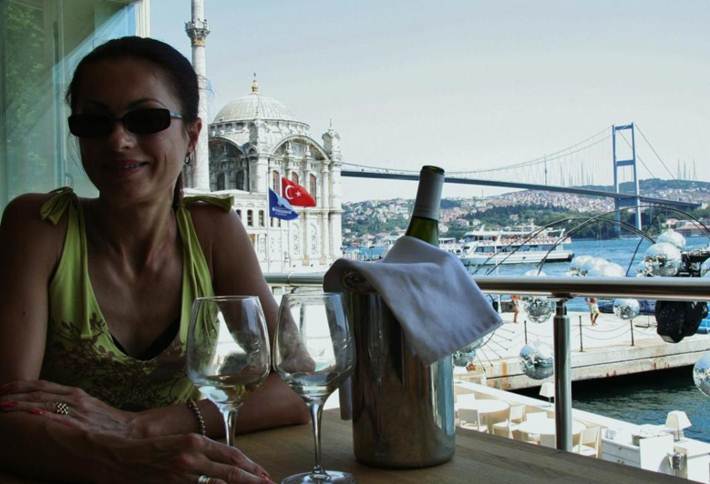
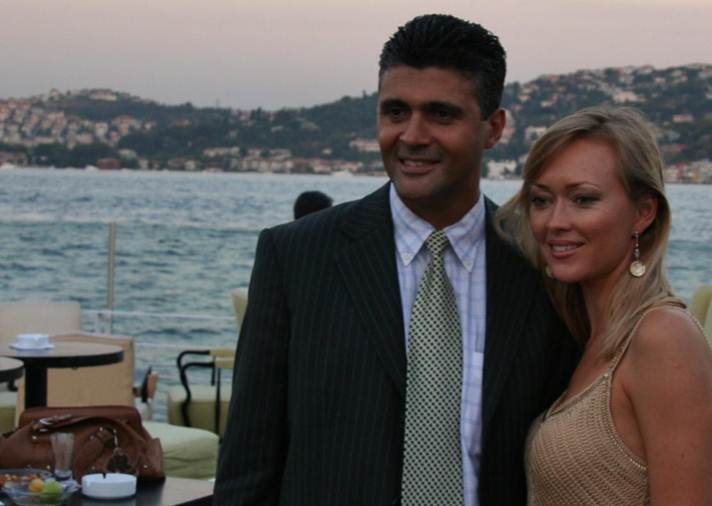
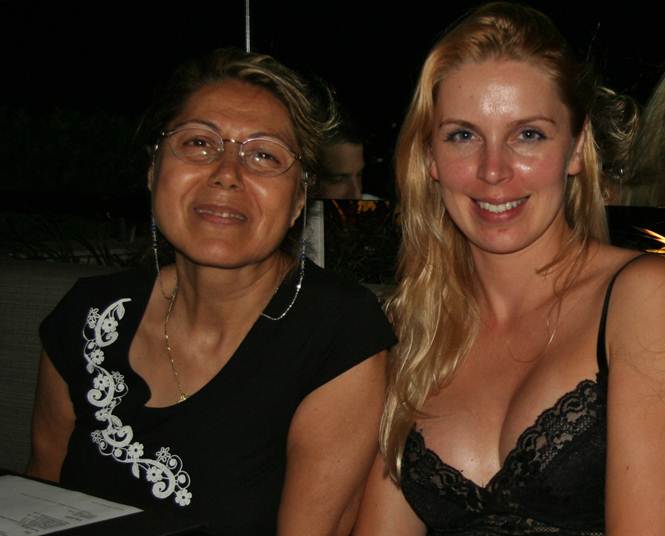
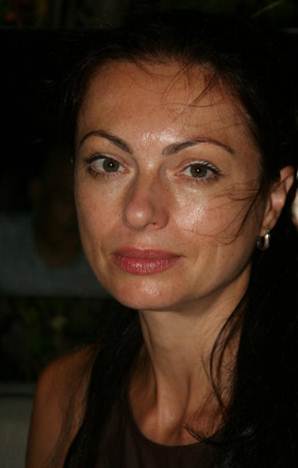
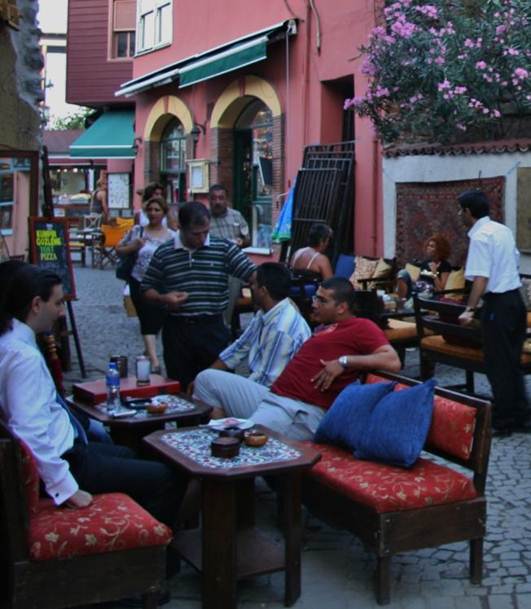
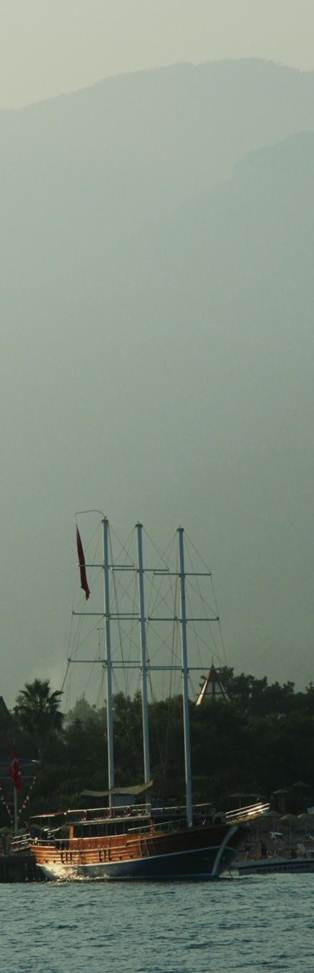
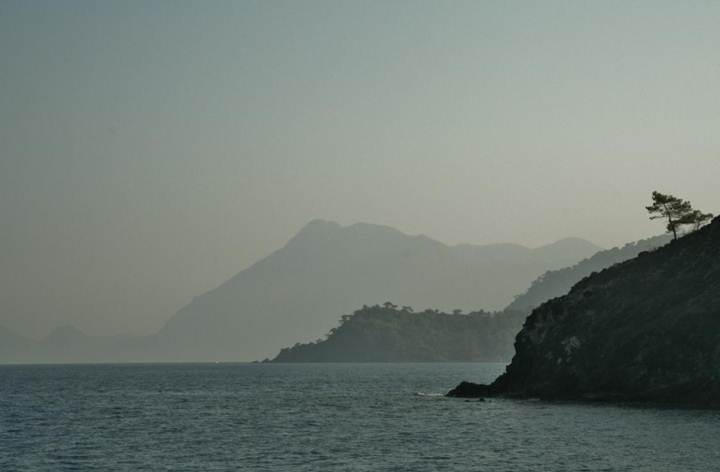
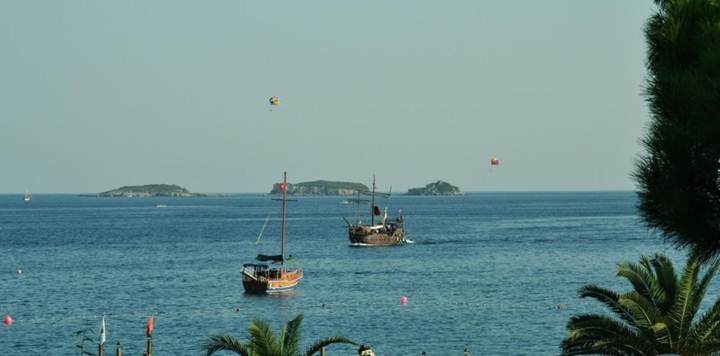
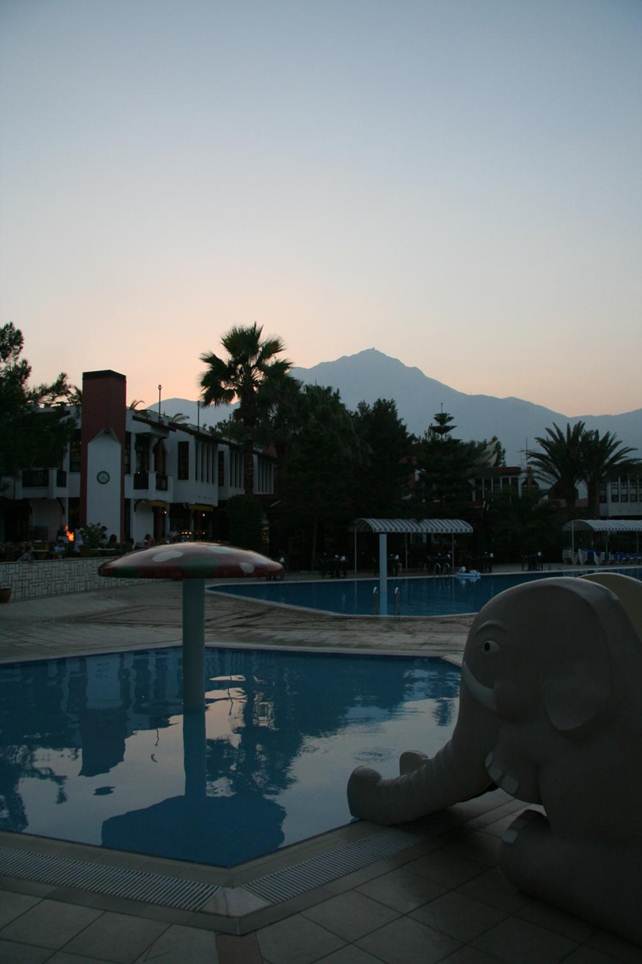
My views of Mediterranean Turkey
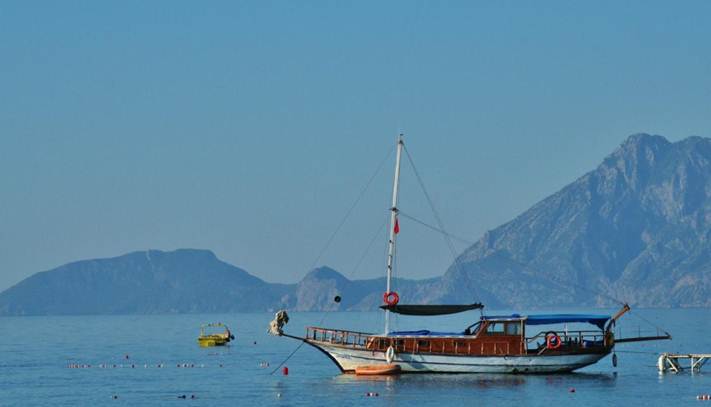
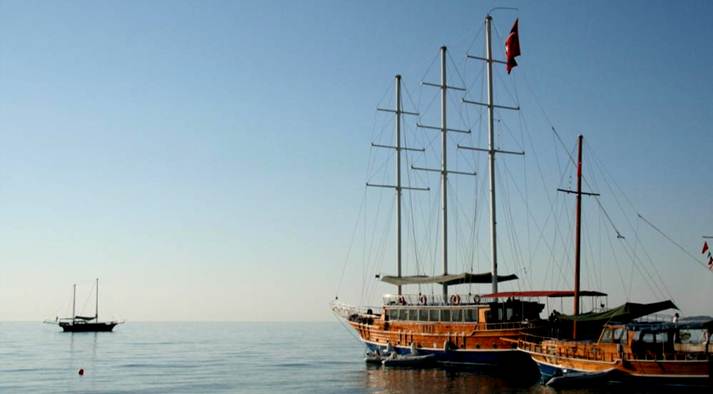
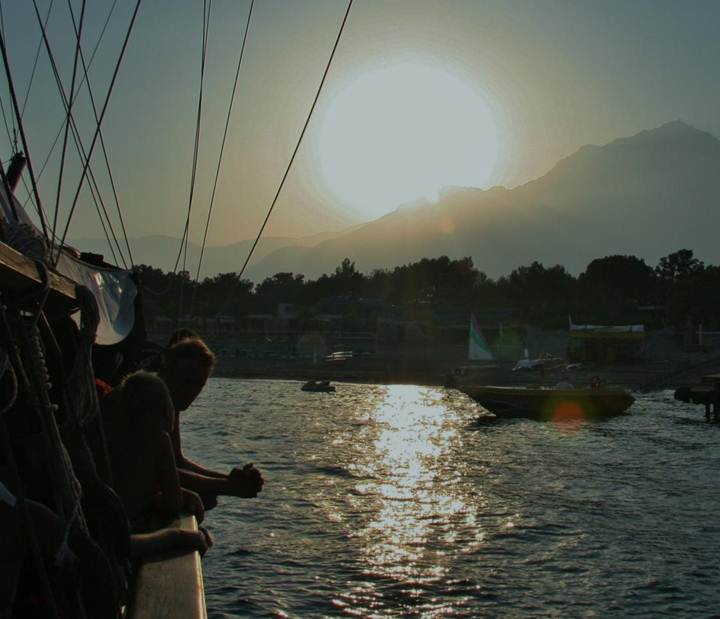
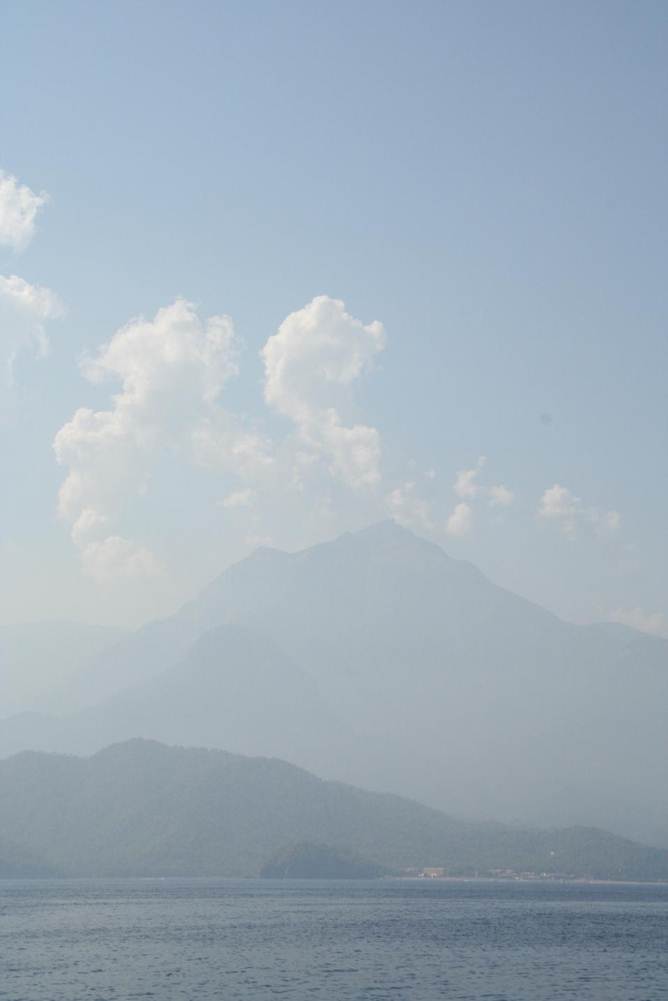
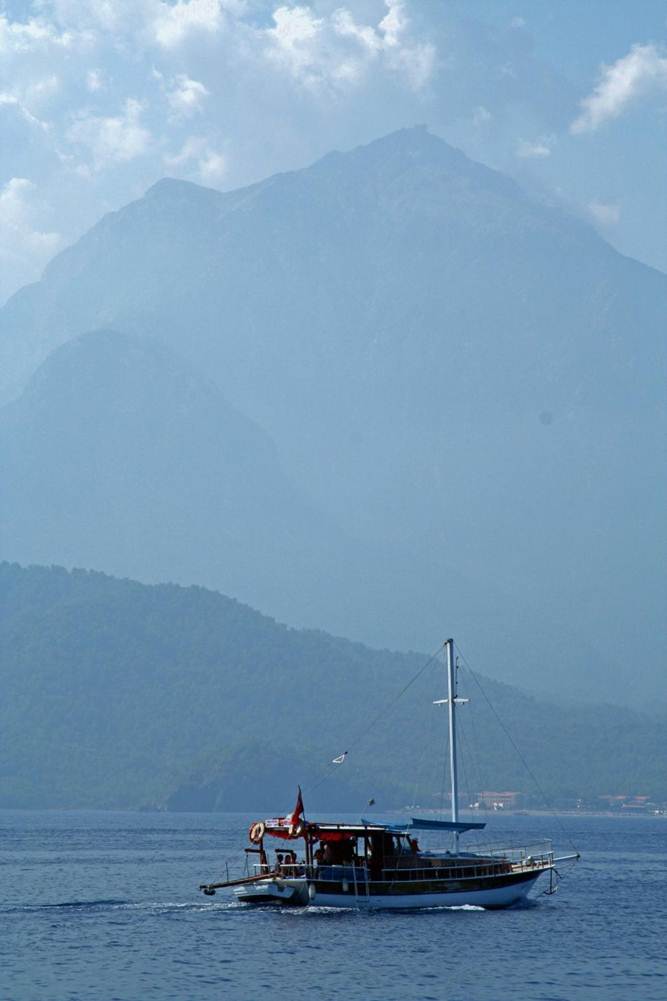
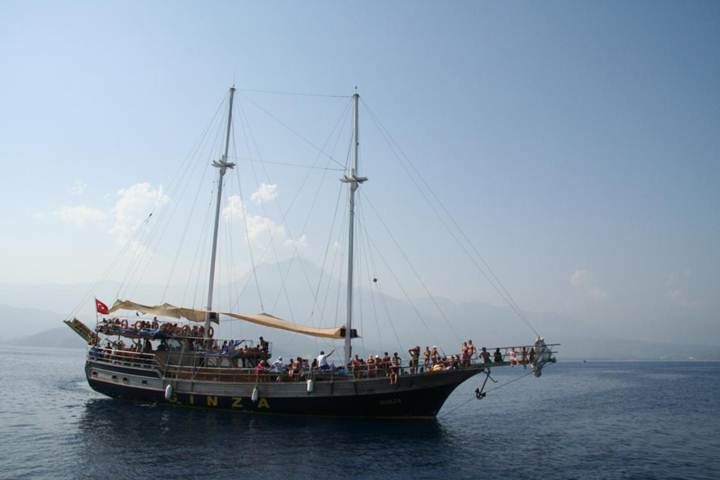
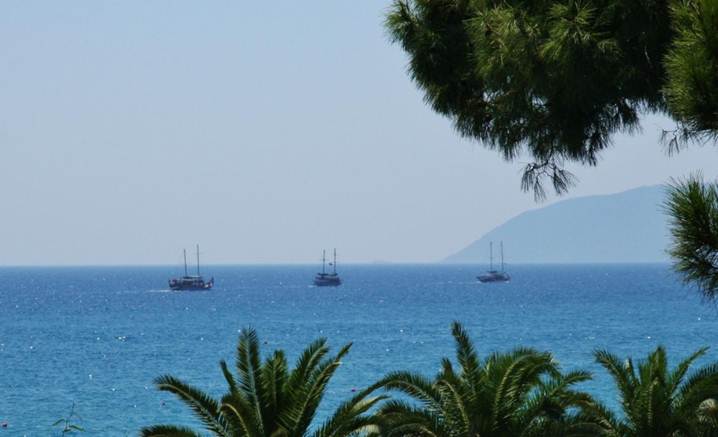
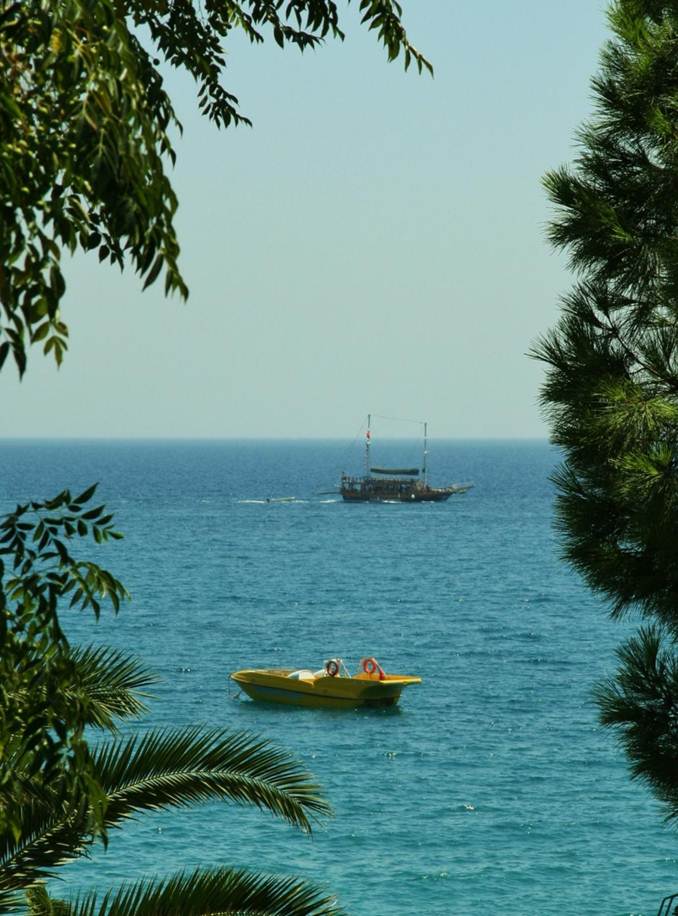
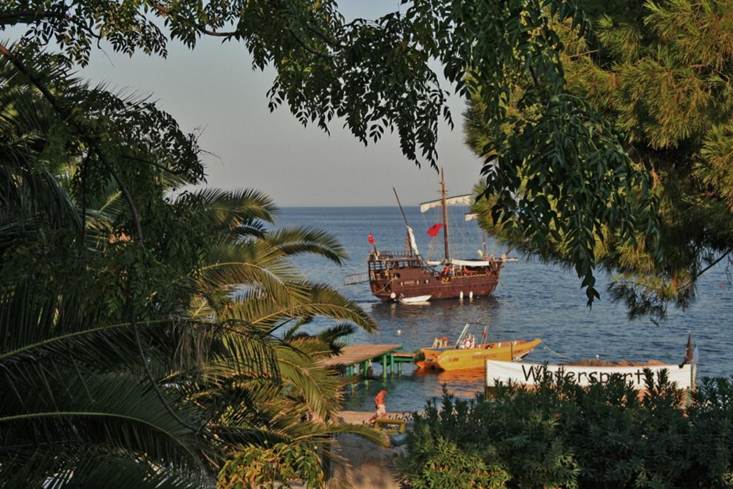
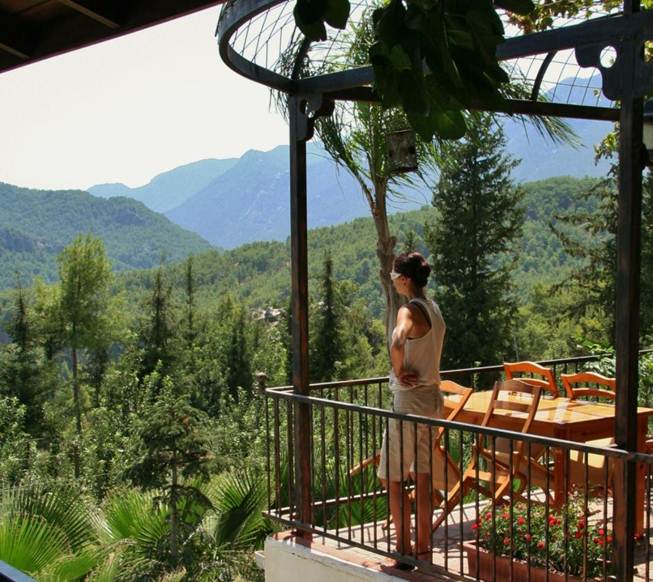
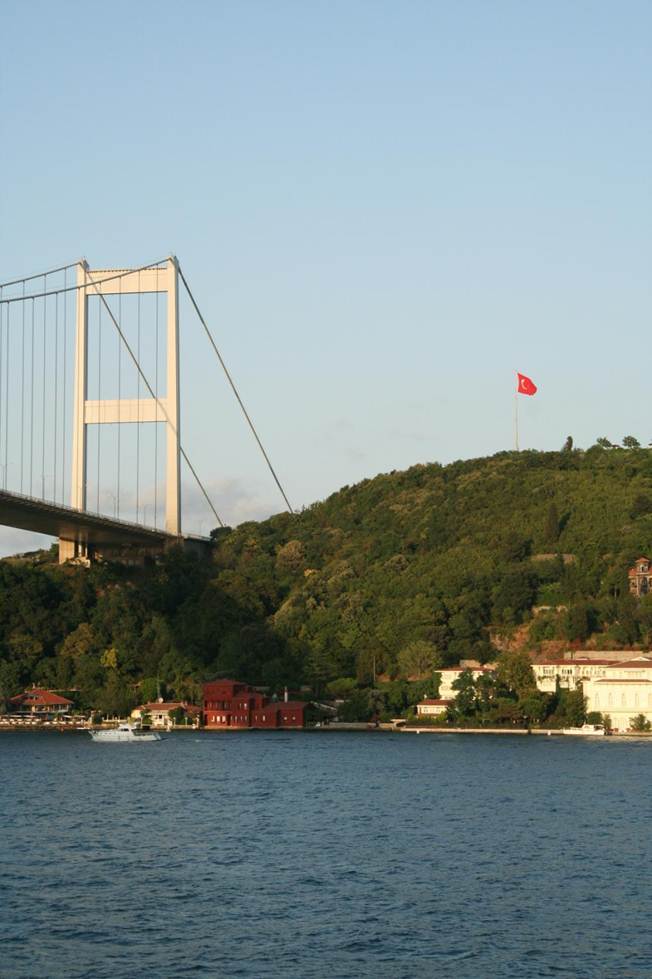
Bosporus – between Asia & Europe
- Bookmark :
- Digg
- del.icio.us
- Stumbleupon
- Redit it
Lithuania recognizes ‘fact of Turkish mass killings’ in Armenia during WWI
- Posted by - (0) Comment
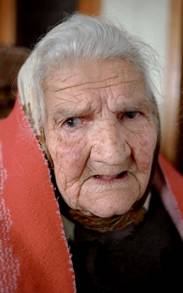
Genocide Survivor, Arax, Armavir Region, Republic of Armenia
Photo: http://globalvoicesonline.org
Diplomatic relations between France and Turkey are tending towards zero. That’s how Ankara has reacted to the French Senate’s approval of a bill that outlaws any public denial that the killings of Armenians which took place in the Ottoman Empire in 1915 were genocide. Turkey threatened to retaliate by introducing anti-French sanctions. The first blow came from the Turkish National Radio and Television Corporation which suspended cooperation with Euronews TV.
Earlier, Turkey recalled its ambassador from Paris, froze its political, military and economic ties with France and cancelled joint military exercises.
The bill imposes a punishment of up to one year in prison and a 45,000-euro fine on anyone who dares deny the Armenian genocide. President Nicolas Sarkozy has two weeks to sign it into law.
Turkey has vigorously protested the accusations of mass killings of Armenians during the First World War and reacted painfully to Western criticism. Meanwhile, the fact of genocide has been recognized by more than 20 countries, including Russia, Lithuania, Greece, Belgium, Canada and the majority of U.S. states. But that recognition envisaged no criminal penalties. Political analyst Stanislav Tarasov told the Voice of Russia that the fate of the genocide bill in France is still pretty vague and that 86 senators who voted against may attempt to block it:
"The Turks may try to play the French senator card. Senators can appeal the bill in the Constitutional Court. This would require just 60% of the votes. Turkey also fears that other countries may follow suit and pass similar genocide laws, which would derail its long-cherished hopes to join the European Union. Finally, Turkey and Armenia might return to the Zurich protocols they signed in 2009. They contain a very important provision, namely that Yerevan agrees to move the genocide issue from big politics to the academic sphere."
Some politicians in Ankara and in European capitals think that the past should be left in the past and that modern politics should be based on modern realities. And yet, genocide is too sensitive an issue for Armenia to be easily dropped. The Armenian government has already thanked Paris for support. The votes of 600,000 French Armenians whose representatives lobbied the new law will give President Sarkozy a significant boost in his bid for re-election.
- Bookmark :
- Digg
- del.icio.us
- Stumbleupon
- Redit it
BRAVO! It’s about time! All too often “historical” news and commemorations in Lithuania seem to be taken for granted – as if everyone there wasn’t interested or already knew about it…
- Posted by - (0) Comment
I try to follow all the English "press" from the Baltic Times to alfa.lt "English".
FINALLY I discover you! AND..... you place an article on Feb 16th Lithuanian Independence on the FRONT PAGE and feature an absolutely marvellous "historical" section.
BRAVO! It’s about time! All too often "historical" news and commemorations in Lithuania seem to be taken for granted - as if everyone there wasn't interested or already knew about it.
The fact is most of us are STARVED for this kind of information and even regular English speaking tourists need historical perspective to truly appreciate Lithuanian culture - if only to help understand a tragic and fragmented history. I will read you much and often.
Edward Kestas Reivydas,
M&R Americana Insurance Service Inc Santa Monica, California, USA
- Bookmark :
- Digg
- del.icio.us
- Stumbleupon
- Redit it
Your publication is one of the few remaining publications, where our English speaking Lithuanians can keep abreast of events and maintain their pride of being Lithuanian
- Posted by - (2) Comment
Jon Platakis.
We, at the National Lithuanian American Hall of Fame, are extremely appreciative of the superb job you did in prominently displaying our articles in your publication.
Your publication is one of the few remaining publications, where our English speaking Lithuanians can keep abreast of events and maintain their pride of being Lithuanian.
Sincerely,
Jon Platakis, Chairman, National
Lithuanian American Hall of Fame
- Bookmark :
- Digg
- del.icio.us
- Stumbleupon
- Redit it
- Posted by - (0) Comment

EUROPE – MY HOME & MY CASTLE (9 of 10)
Hanseatic Baltic
|
VilNews is on its way around Europe!
Tour guide: Aage Myhre To read today’s travel report, click HERE To read the previous articles, go to our SECTION 11 |
- Bookmark :
- Digg
- del.icio.us
- Stumbleupon
- Redit it
- Posted by - (2) Comment


EUROPE – MY HOME & MY CASTLE (9 of 10)
Hanseatic Baltic
|
VilNews is on its way around Europe!
Today our journey starts in the 'Danish city' of Tallinn, Estonia. We drive from there Tour guide: Aage Myhre
|
The Hanseatic League
|
|
|
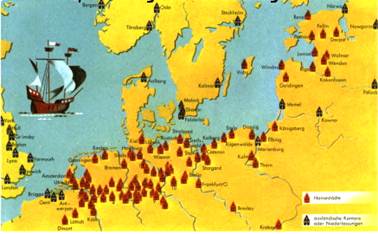
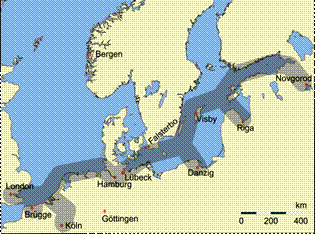
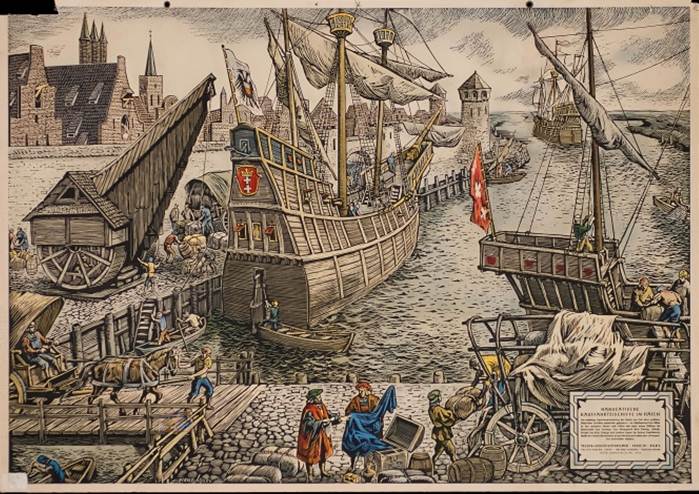
The Hanseatic League was an economic alliance of trading cities and their merchant guilds that dominated trade along the coast of Northern Europe. It stretched from the Baltic to the North Sea and inland during the Late Middle Ages and early modern period (c. 13th–17th centuries).
The League was created to protect commercial interests and privileges granted by foreign rulers in cities and countries the merchants visited. The Hanseatic cities had their own legal system and furnished their own protection and mutual aid. Despite this, the organization was not a city-state, nor can it be called a confederation of city-states; only a very small number of the cities within the league enjoyed autonomy and liberties comparable to those of a free imperial city.
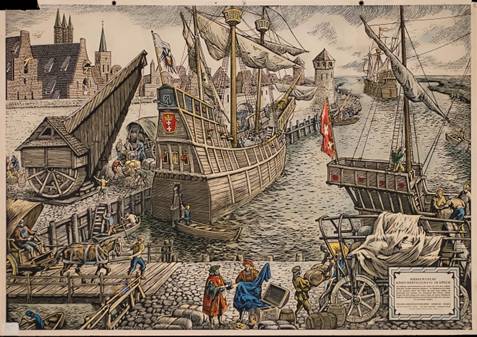
Lübeck in northern Germany became a main base for merchants from Saxony and Westphalia trading eastward and northward. Well before the term Hanse appeared in a document (1267), merchants in different cities began to form guilds or Hansa with the intention of trading with towns overseas, especially in the economically less-developed eastern Baltic. This area was a source of timber, wax, amber, resins, furs, along with rye and wheat brought down on barges from the hinterland to port markets. The towns raised their own armies, with each guild being required to provide levies when needed. The Hanseatic cities came to each other's aid, and commercial ships often had to be used to carry soldiers and their arms.
Lübeck's location on the Baltic provided access for trade with Scandinavia and Kiev Rus, putting it in direct competition with the Scandinavians who had previously controlled most of the Baltic trade routes. A treaty with the Visby Hansa put an end to competition: through this treaty the Lübeck merchants also gained access to the inland Russian port of Novgorod, where they built a trading post or Kontor. Other such alliances formed throughout the Holy Roman Empire. Yet the League never became a closely managed formal organisation. Assemblies of the Hanseatic towns met irregularly in Lübeck for a Hansetag (Hanseatic Diet), from 1356 onwards, but many towns chose not to send representatives and decisions were not binding on individual cities. Over time, the network of alliances grew to include a flexible roster of 70 to 170 cities.
Riga joined the Hanseatic League in 1282, and become the first Hanseatic City in Livonia. Tallinn was the next Livonian city to join the group. In Lithuania, local merchants were subject to the laws of the grand Duchy of Lithuania and were free to conduct trade with Hansa merchants, but the Hansa merchants found it difficult to secure a monopoly on Lithuanian trade. The Grand Duchy of Lithuania was hostile to the Germans after attempts at conquest. Tariffs were exacted at the Lithuanian borders with Poland and Livonia. Hansa merchants were tolerated, if they paid their tariffs, and developed trade routes through Lithuania all the way down to the Bug river where the Ukraine is today.
At the start of the 16th century, the League found itself in a weaker position than it had known for many years. The rising Swedish Empire had taken control of much of the Baltic. Denmark had regained control over its own trade, the Kontor in Novgorod had closed, and the Kontor in Bruges had become effectively moribund. The individual cities which made up the League had also started to put self-interest before their common Hanseatic interests. Finally, the political authority of the German princes had started to grow—and so to constrain the independence of action which the merchants and Hanseatic towns had enjoyed. By the late 16th century, the League had imploded and could no longer deal with its own internal struggles, the social and political changes that accompanied the Protestant Reformation, the rise of Dutch and English merchants, and the incursion of the Ottoman Empire upon its trade routes and upon the Holy Roman Empire itself. Only nine members attended the last formal meeting in 1669 and only three (Lübeck, Hamburg and Bremen) remained as members until its final demise in 1862.
Today’s tour:
 |
Estonia |
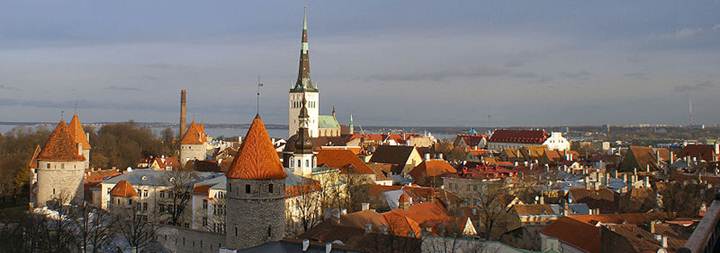
Tallinn, capital city of Estonia, was the northernmost city of the Hanseatic League.
Photo: Wikipedia.
Estonia is the northernmost Baltic State. It is bordered to the north by the Gulf of Finland, to the west by the Baltic Sea, to the south by Latvia (343 km), and to the east by Lake Peipsi and the Russian Federation (338.6 km). Across the Baltic Sea lies Sweden in the west and Finland in the north. The territory of Estonia covers 45,227 km2 (17,462 sq mi), and is influenced by a temperate seasonal climate. The Estonians are a Finnic people, and the official language Estonian, is closely related to Finnish.
Estonia is a democratic parliamentary republic divided into 15 counties. The capital and largest city is Tallinn. With a population of 1.34 million, Estonia is one of the least-populous members of the European Union, Eurozone and NATO. Estonia has the highest GDP per person among former Soviet republics. Estonia is listed as a "High-Income Economy" by the World Bank, as an "advanced economy" by the International Monetary Fund and the country is an OECD member. The United Nations lists Estonia as a developed country with a Human Development Index of "Very High". The country is also ranked highly for press freedom, economic freedom, democracy and political freedom and education.
There are seven Hanseatic League towns in Estonia and each summer everyone is welcome to join the Hanseatic Days which recreate the spirit of that era. On Hanseatic days people dress up in medieval clothing, cook medieval food and play medieval games and music. Handmade goods are offered at the medieval market. Masters demonstrate, and apprentices learn, how to make things using leather, wool, rope, cloth, wood, twigs and clay. These sessions are a lot of fun and highly educational – perfect for families.
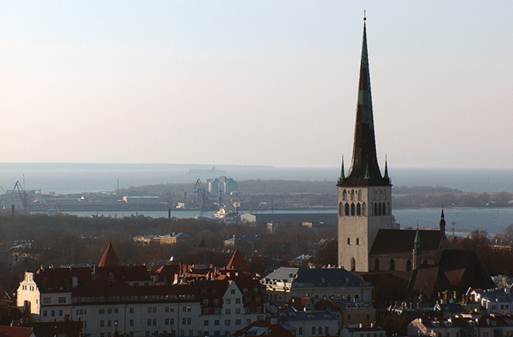
Tallinn’s St. Olaf's church was the tallest building in the world between 1549 and 1625.
Tallinn – the medieval 'Danish town’ that saw the world's first Christmas tree
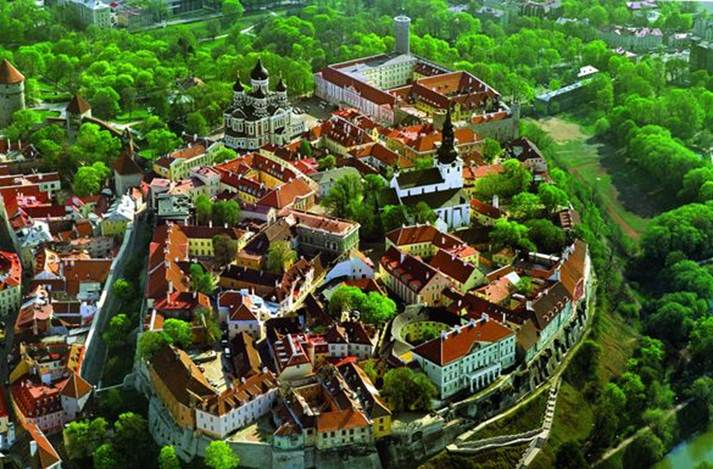
Tallinn means supposedly ‘The Walled Danish City 'in Estonian.
Photo: Tourism.tallinn.ee.
It was in 1219 that Danish crusaders, under the command of King Valdemar II (the victorious), won the crucial battle over Estonia’s pagans. During the last phase of this battle, says the legend, God gave the Danes the win by letting a red banner with a white cross fall from the sky, over the hard-pressed Crusaders. Inspired by this 'divine miracle' the Danes strength came back and they won the battle. The Danes are thus still ‘in debt’ to Estonia for its flag, Dannebrog, the world's oldest state flag still in use. The name Tallinn means supposedly the walled Danish city’. In Estonian, the legacy of Denmark lives, even today.
In 1285 Tallinn became the northernmost member of the Hanseatic League, which during the 1300s concerned the Danish kings more and more. The Hanseatic League power grew, and in 1346 the Danes ‘gave in’ and sold Tallinn, along with large areas of land in northern Estonia, to the Teutonic Order. The city, with a population of 8000, was at that time very well entrenched within a strong city wall with 66 defense towers.
In contrast to other capitals in Europe, Tallinn managed to preserve the totality and the structures of its medieval and Hanseatic origin. Most of the cobbled streets are still as they once were. Buildings, dated as far back as the 11th century, are preserved in their original form.
The City Hall - Town Hall Square - stands still, after seven centuries, as the ancient, well preserved heart of the city. The City Hall itself, the only intact Gothic town hall in Northern Europe, is now a museum and concert hall.
The Town Hall Square is also known for something Estonians themselves claim is a historical fact, that it was here the world's very first Christmas tree was born. Here Christmas lights were lit already in 1441...
The medieval feeling creeps over me as we walk along the old city wall and its 26 watchtowers. We stop at the narrow Müürivahe Street (near Viru Gate) where the old wall has been preserved in its original form. Further medieval I'm hardly ever.
|
Latvia |
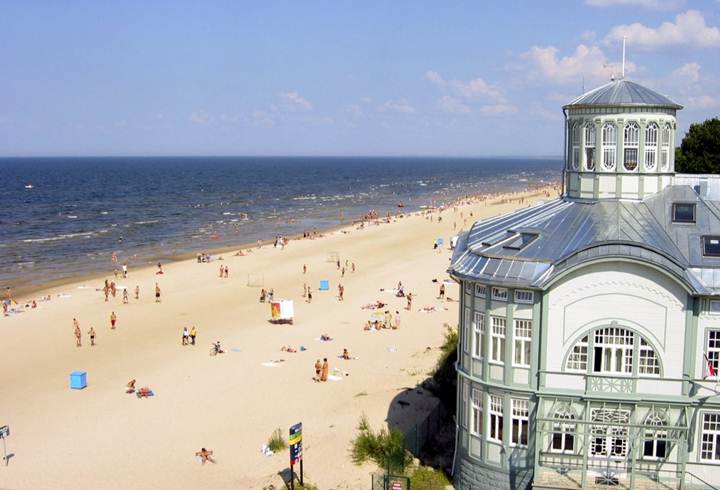
Jūrmala is a city in Latvia, about 25 kilometers west of Riga. Jūrmala is a resort town stretching 32 kilometres (20 mi).
It has a 33 km stretch of white-sand beach, and a population of 55,580.
Photo: Wikipedia.
Latvia is the Baltic State 'in the middle'. It is bordered to the north by Estonia (border length 343 km), to the south by Lithuania (588 km), to the east by the Russian Federation (276 km), to the southeast by Belarus (141 km), and shares maritime borders to the west with Sweden. With 2,067,887 inhabitants and a territory of 64,589 km2 (24,938 sq mi) it is one of the least populous and least densely populated countries of the European Union. The capital of Latvia is Riga. The official language is Latvian and the currency is called Lats (Ls).
The Latvians are a Baltic people, culturally related to the Lithuanians. Together with the Finno-Ugric Livs (or Livonians), the Latvians are the indigenous people of Latvia. Latvian is an Indo-European language and along with Lithuanian the only two surviving members of the Baltic branch. Indigneous minority languages are Latgalian and the nearly extinct Finno-Ugric Livonian language. Latvia and Estonia share a long common history: historical Livonia, times of German, Polish-Lithuanian, Swedish, Russian, Nazi German and Soviet rule, 13th century Christianization and 16th century Protestant Reformation. Both countries are home to a large number of ethnic Russians (26.9% in Latvia and 25.5% in Estonia) of whom some are non-citizens. Latvia is historically predominantly Protestant, except for the region of Latgalia in the southeast which is historically predominantly Roman Catholic.
Latvia is a unitary parliamentary republic and is divided into 118 administrative divisions of which 109 municipalities and 9 cities. There are five planning regions: Courland (Kurzeme), Latgalia (Latgale), Riga (Rīga), Vidzeme and Zemgale. The Republic of Latvia was founded on November 18, 1918. It was occupied and annexed by the Soviet Union between 1940–1941 and 1945–1991 and by Nazi Germany between 1941–1945. The peaceful "Singing Revolution" between 1987 and 1991 and "Baltic Chain" demonstration on August 23, 1989 led to the independence of the Baltic states. Latvia declared the restoration of its de facto independence on August 21, 1991.
Latvia is a member of the United Nations, European Union, Council of Europe, NATO, OSCE, IMF and WTO, and is part of the Schengen Area. It was a member of the League of Nations (1921–1946) and the Baltic Free Trade Area (1994–2004). Latvia is also a member of the Council of the Baltic Sea States and Nordic Investment Bank, and is together with Estonia and Lithuania involved in trilateral Baltic States cooperation and Nordic-Baltic cooperation.
After economic stagnation in the early 1990s, Latvia posted Europe-leading GDP growth figures during 1998–2006. In the global financial crisis of 2008–2010 Latvia was the hardest hit of the European Union member states, with a GDP decline of 26.54% in that period. Commentators noted signs of stabilisation in the Latvian economy by 2010. The United Nations lists Latvia as a country with a Human Development Index (HDI) of "Very High".
Riga – the Hanseatic city that became the world's leading Art Nouveau Centre
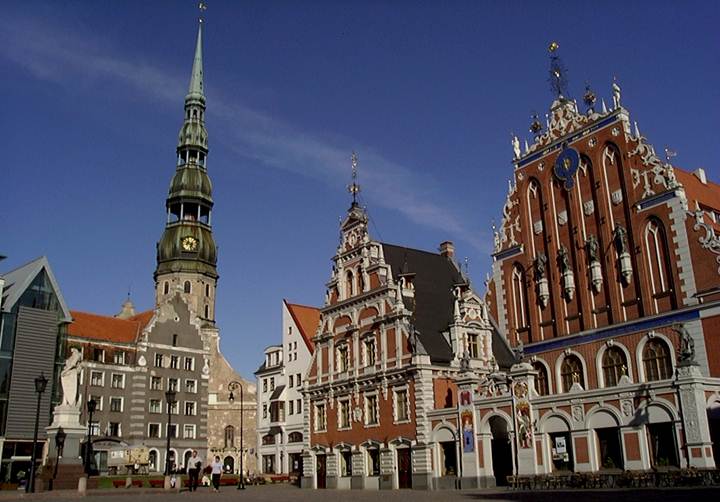
The Town Hall Square in Riga.
Photo: Rigalatvia.net.
Riga is the largest Baltic city. Around 700,000 live here. Riga is located at the mouth of the Daugava River, which has functioned as a trade route since ancient days. From here the Viking ships sailed up the rivers on their way to the Caspian Sea and Constantinople, today's Istanbul. Riga's history goes back to the 2nd century, but began to develop as a centre when the Viking trade took off in the early Middle Ages. In 1282 Riga became a member of the Hanseatic League. Hansa was instrumental in giving Riga economic and political stability, and the town has retained its position as the energy point of the Baltic Sea's southeastern shore.
Still today is part of the old wall from the 14th century intact. Most of the wall was originally removed to give the city room for expansion. As for the other two Baltic capitals, the old town is interesting. Soviet buildings outside the city centre is just sad stuff. Just a shame you see them too well when you drive into the old town; where cobbled streets, gabled houses, churches, shops and restaurants are creating a phenomenally warm, good atmosphere.
When I first came here to the old town, in January 1991, it was freezing cold outside. But the Latvians had lit bonfires, many, and made themselves a human wall around the parliament to prevent the Soviet forces, who stood around, to come in. It was while I was in Parliament here that I experienced the Soviet Union's propaganda lies. When I was in the Parliament the 17th of January 1991, Soviet television reported that their soldiers had taken over the parliament building. I, and many others, were inside the building, listening in disbelief as no single Soviet soldier was to see inside.
At the end of the 1800s, many European traders settled in Riga. They left their distinctive marks on the city, not least by raising many buildings in Art Nouveau style. This was the original French genre reflecting creative freedom; classic elements interwoven with flowing lines and decorative shapes and objects.
Riga is said to contain the largest concentration of Art Nouveau buildings in the world. And the Art Nouveau architecture
in Riga is truly fascinating. Many buildings have been restored in full glory, as they were built during the years 1894-1914. There are over 800 Art Nouveau buildings here, which makes it extremely interesting to walk around the streets here. I am overwhelmed by these wonders.
|
Lithuania |
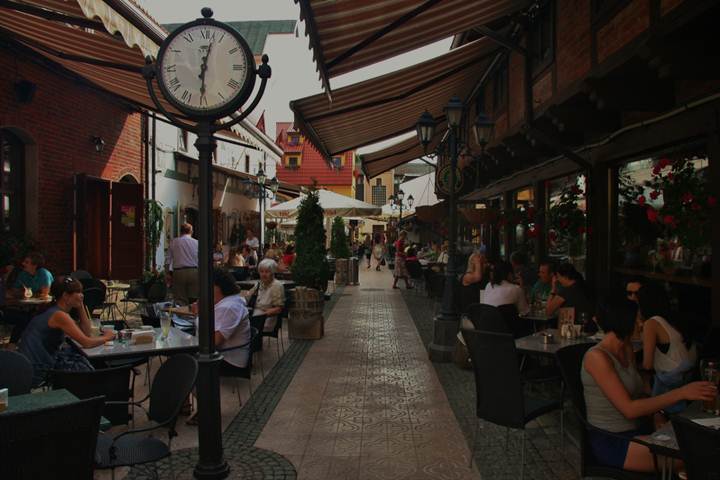
The Friedricho pasažas (Friedrich passageway ) is a unique restaurant complex in Lithuania’s coastal city Klaipėda.
Photo: Aage Myhre.
Lithuania is the southernmost and largest of the three Baltic states. It is situated along the southeastern shore of the Baltic Sea, whereby to the west lie Sweden and Denmark. It borders Latvia to the north, Belarus to the east and south, Poland to the south, and a Russian exclave (Kaliningrad Oblast) to the southwest. Lithuania has an estimated population of 3.2 million as of 2011, and its capital and largest city is Vilnius. The Lithuanians are a Baltic people, and the official language, Lithuanian, is one of only two living languages (together with Latvian) in the Baltic branch of the Indo-European language family.
For centuries, the southeastern shore of the Baltic Sea was inhabited by various Baltic tribes. In the 1230s the Lithuanian lands were united by Mindaugas, who was crowned as King of the Grand Duchy of Lithuania, the first Lithuanian state, on 6 July 1253. During the 14th - 16th century, Grand Duchy of Lithuania was the largest country in Europe: present-day Belarus, Ukraine, and parts of Poland and Russia were territories of the Grand Duchy of Lithuania. With the Lublin Union of 1569, Lithuania and Poland formed a voluntary two-state union, the Polish–Lithuanian Commonwealth. The Commonwealth lasted more than two centuries, until neighbouring countries systematically dismantled it from 1772 to 1795, with the Russian Empire annexing most of Lithuania's territory.
In the aftermath of World War I, Lithuania's Act of Independence was signed on 16 February 1918, declaring the re-establishment of a sovereign state. Starting in 1940, Lithuania was occupied first by the Soviet Union and then by Nazi Germany. As World War II neared its end in 1944 and the Germans retreated, the Soviet Union reoccupied Lithuania.
On 11 March 1990, the year before the break-up of the Soviet Union, Lithuania became the first Soviet republic to declare independence. Prior to the global financial crisis of 2007–2010, Lithuania had one of the fastest growing economies in the European Union. Lithuania is a member of NATO, the Council of Europe, and the European Union. Lithuania is also a full member of the Schengen Agreement. The United Nations Human Development Index lists Lithuania as a "Very High Human Development" country. In 2011, Lithuania hosted the European men's basketball championship, EuroBasket 2011, and the OSCE Ministerial Council Meeting.
Klaipeda – Lithuania's 'German' port city, with the best Baltic Sea beaches
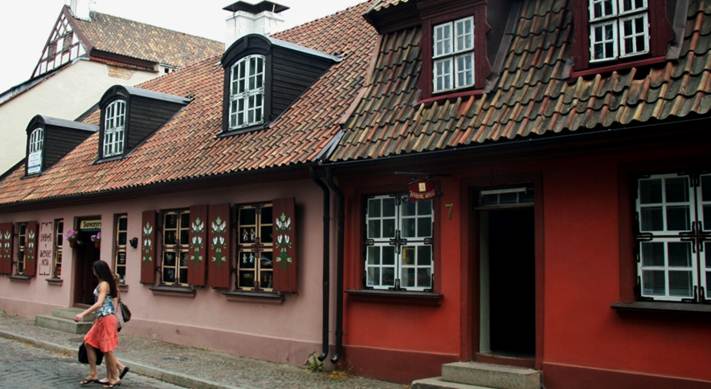
Photo: Aage Myhre.
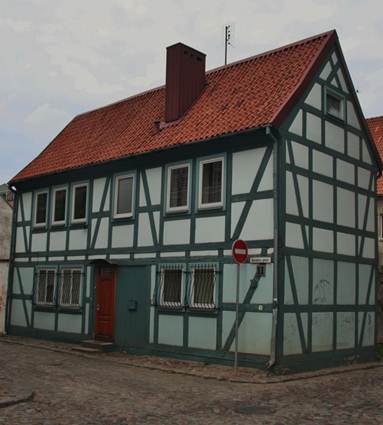
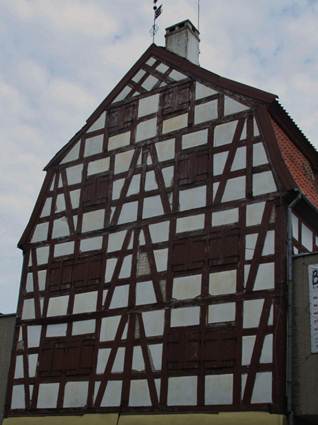
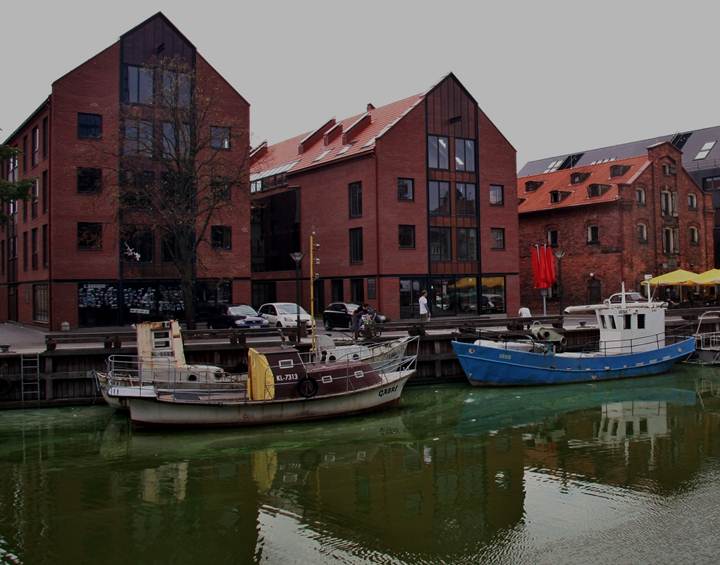
The image of the Baltic States as dull, gray and Soviet like is very much incorrect. This I learned already during my first visit here in 1990. Still, it surprised me to come to Klaipeda, a city quite different from the other Lithuanian cities. More German looking in a way. I soon learned that the Lithuanian port city once was called Memel and that the area out here on the Baltic Sea coast some time ago belonged to Germany.
A trip from Vilnius to Klaipeda takes less than three hours on the 4-lane motorway. But the difference in architectural style is as if to drive from Florence to Hamburg....
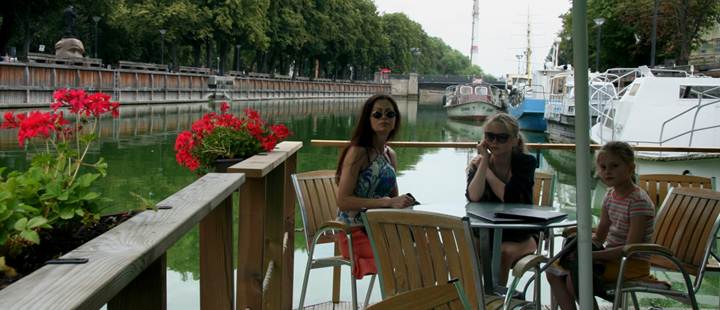
Klaipeda was founded in 1252, and in this old town you can see many, many buildings that each tells stories about the life and development over 700 years. Houses with timber frames and masonry, some pure brick houses, adorn the cobblestone streets side by side. Lithuania's 10 mil-long coast has also the Baltic Sea's most beautiful sandy beaches.
The two picturesque tourist towns, Nida and Palanga, are located just a few kilometres away from here.
|
|
|
Photos: Aage Myhre.
Kaunas – the Hanseatic town at the Nemunas River
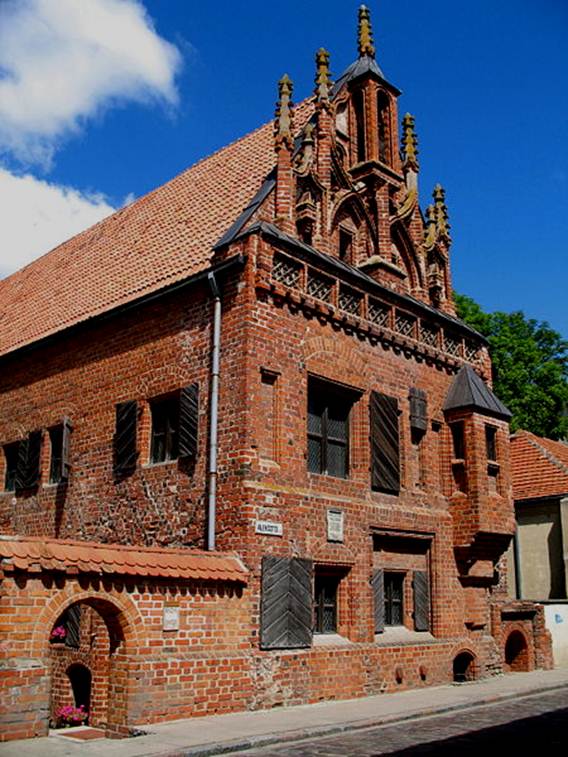
House of Perkunas (God of thunder and the sky), the most original and archaic Gothic secular
Building in the Old Town of Kaunas. Originally built by Hanseatic
merchants, serving as their office from 1440 till 1532.
Since the end of the 14th century, Lithuania's trading relationships with Königsberg and, especially, Danzig, which became the most popular of the Hanseatic towns in Northern and Eastern Europe, got increasingly significant. Lithuania and Danzig started their trading relationships already at the end of the 14th century. During Vytautas' term of office, Lithuania and Danzig maintained regular relationships. The waterway Nemunas (Lithuania’s largest river) - Kaunas Sea - Deimė - Prieglius - Aismarės - Vistula was the way transporting cheap staples from Lithuania to Danzig, which greatly profited the intermediates.
In order to improve accessibility of cheap goods, by the advantageous Nemunas quay the Hanseatic counting-house was established. The main outbound goods were wax, fur, leather, wood, mould, tar, and, since the 15th century, grain. What Kaunas used to receive was other goods, such as salt, which could not be substituted, and also ironware and baize. The office was open till the middle of the 16th century, and these were the most glorious and the most venerable times of Western Europe's city Kaunas.
Kaunas is the sole Lithuanian town that belongs to 'The new Hansa Union' that was established in 1980. It is an organisation of economically and politically active member-cities of the old Hanseatic League that aim for close cooperation. At the moment, the organisation unites more than 170 European towns international towns'. Every year, Kaunas presents itself at the annual event of the union "International Hansa Days" by introducing the heritage of cuisine, folk art, music, theatre, etc. Furthermore, since 2005, at the end of August, Kaunas draws crowds of people from the entire Lithuania, who can admire the unique Kaunas Old Town and lose themselves in the Middle Ages, i.e. try armour, play medieval games, taste the old European dishes, listen to the troubadours' songs, wield a sward, enjoy watching the night's sky coloured by amazing fireworks, and a lot more.
The public institution "Hansa Kaunas" and Kaunas local government that organise the festival already for the fourth time have managed to achieve that the festival be known not only in Lithuania but also outside. Now the event has become the priority of the town and it now has gained its face, traditions and lots of devoted supporters.
The festival has broadened: on the stage one can see not only Lithuanian performers but also guest artists from Germany, Poland, Russia, Latvia, Estonia, Belarus, Norway and Holland. Moreover, three documentary films have already been produced. Financing is increased as more and more supporters are found. Appropriations of both the local government and the Government of the Republic of Lithuania have been increased.
- Bookmark :
- Digg
- del.icio.us
- Stumbleupon
- Redit it
The above illustration is from a German web site with a lot of interesting information about Klaipeda (Memel) of those days!
In the early 1200s, the Teutonic Knights (‘Order of Brothers of the German House of Saint Mary in Jerusalem’) started building a castle in the Pilsāts Land of the Curonians and named it Memelburg; later the name was shortened to Memel.
From 1252-1923 and from 1939–1945, the town and city was officially named Memel. Due to political changes between 1923 and 1939, both names were in official use; since 1945 the Lithuanian name of Klaipėda is used.
The names Memelburg and Memel are found in most written sources from the 13th century onwards, while Klaipėda is found in Lithuania-related sources since the 15th century. The first time the city was mentioned as Caloypede in the letter of Vytautas in 1413, for the second time in the negotiation documents of 1420 as Klawppeda, and for the third time in the Treaty of Melno of 1422 as Cleupeda. According to Samogitian folk etymology, the name Klaipėda refers to the boggy terrain of the town (klaidyti=obstruct and pėda=foot). Most likely the name is of Curonian origin and means “even ground”: „klais/ klait“ (flat, open, free) und “ped“ (sole of the foot, ground).
Read more at: http://www.bork-on-line.de/Memel/index.htm
- Bookmark :
- Digg
- del.icio.us
- Stumbleupon
- Redit it
The Republic of Lithuania Port of Klaipeda and the Philadelphia Regional Port Authority (PRPA) signed an historic Memorandum of Understanding that promises to open Philadelphia ports to the European and Asian shipping trade via the ice-free port of Klaipeda, the Lithuanian port city on the eastern coast of the Baltic Sea.
Lithuania’s Transport and Communications Minister Eligijus Masiulis led a delegation of that country’s leaders to meet with Pennsylvania state and city officials, as well as Leo A. Holt, President of Holt Logistics Corp., and PRPA Chairman Charles Kopp and Executive Director James McDermott. Together, they signed the MOU, which pledges increased support for expanded trade between Philadelphia and Klaipeda. The delegation also included Lithuanian Ambassador to the United States Zygimantas Pavilionis and Eugenijus Gentvilas, the Director General of Klaipeda Seaport.
- Bookmark :
- Digg
- del.icio.us
- Stumbleupon
- Redit it
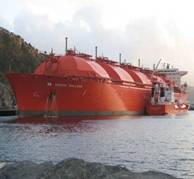
* Floating LNG platform to have 170,000 cubic meters capacity
* Operations expected to start at the end of 2014
* Terminal to reduce Lithuania's dependence on Russian gas
Lithuania took a step towards less dependence on Russian gas by deciding on Monday to pick Norway's Hoegh LNG to provide an offshore platform for liquefied natural gas (LNG) imports.
Majority state-owned oil terminal Klaipedos Nafta said in a statement that it chose Hoegh to supply a floating storage regasification unit (FSRU), and that operations were expected to start at the end of 2014.
An FSRU is cheaper and faster to build than a fixed LNG terminal on land.
Klaipedos Nafta said that the FSRU had been ordered in South Korea and will have a capacity of 170,000 cubic meters of LNG.
- Bookmark :
- Digg
- del.icio.us
- Stumbleupon
- Redit it
- Posted by - (0) Comment

EUROPE – MY HOME & MY CASTLE (8 of 10)
From east to west
in European Russia
|
VilNews is on its way around Europe!
Tour guide: Aage Myhre To read today’s travel report, click HERE To read the previous articles, go to our SECTION 11 |
- Bookmark :
- Digg
- del.icio.us
- Stumbleupon
- Redit it
- Posted by - (1) Comment
EUROPE – MY HOME & MY CASTLE (8 of 10)
From east to west
in European Russia
|
VilNews is on its way around Europe!
Our today's journey begins at the Ural River between Asia and Europe, where Tour guide: Aage Myhre
|
To Siberia – probably the only one ever going there voluntary, without a visa
|
It’s January 1992. I have been invited on a trip to Orenburg city on the border to Siberia. Together with two British business leaders that I early in the 1990s helped with contacts in Russia. As a Norwegian I cannot be issued a visa to Russia in Vilnius. But according to the Lithuanians, I can safely travel to Siberia without papers. Soviet rules are still valid. Lithuania and Siberia are both considered to be just regions, six months after the termination of the USSR. Orenburg Oblast is home to Orenburg Cossacks at the Ural River, considered the boundary between Europe and Asia... |
|
I decide to take the chance. Not long after we land in Moscow. Flights from Vilnius still belong to the category domestic, despite the months that have now passed since Lithuania was officially approved as an independent nation, also by Russia. Therefore, no passport control, neither in Vilnius nor on arrival Moscow. The very long journey around the metropolis, to the other airport, the one that operates flights to the east of Russia, is also fine. Not long after we are smoothly seated in a Yak-42 from the airline Aeroflot. This is a flight I will never forget. There is no food on board, so many of the passengers sit in the aisle to eat food brought along. Not to forget the drinks. The only thing missing is someone lighting a bonfire for cooking or frying food. Passengers have distinctive facial characteristics. Asian. Mongolian. The vodka they generously share with us is very handy in reducing anxiety for what might happen with this incredibly smelly plane...
|
|
|
|
|
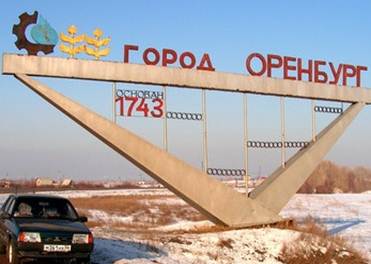
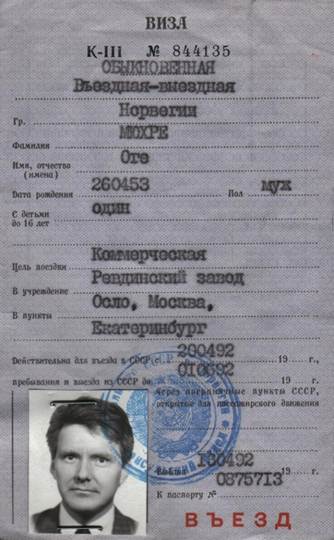
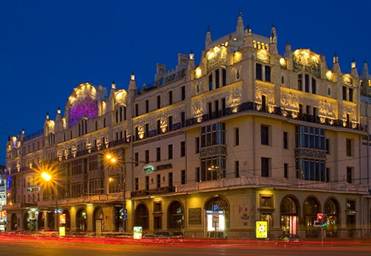
We land in winter dressed Orenburg a late, dark January evening. Two meters of snow. Cold of course. We are picked up by our hosts. One car in front, one behind, we in the middle. There is much here in the Russian wilderness that is about security and protection these days. The dacha, the house, which awaits us there, deep in the Ural forests, is brightly lit, surrounded by high barbed wire fences. German Shepherd Dogs barking persistently. I feel uncomfortable. This give me associations to a concentration camp, to Stalin prisons camps further east, on Siberia's frozen tundra. The Gulags.
Inside the house two lightly clad ladies are waiting in the lavishly decorated dacha that soon proves to be a small luxury hotel. Facial expressions of the young ladies are indescribable in what they see that I have brought with me my wife. But the food is good. The same is the cognac and whisky, all 'blue label'.
"Only one western delegation has visited the city before you, namely Swedish Volvo," tells our host. This is a fact that has made them nervous about our safety. They say that a whole army stood around the runway when we landed. All with sharp loaded Kalashnikov machine guns, ready to protect us. Just in case ... Over the next few days we visit the city's mayor and discuss possible business with the hosts. A total abundance of food and fine beverages always available...
The flight back to Moscow takes place during daytime, in sparkling sun over the endless snow-covered plains and forests west of the Urals. Soon we arrive in Moscow. We check in at the Hotel Metropol right on Red Square. Luxury for $500 per night. But it feels good after the trip to the Siberian gateway. No one checks my papers.
Moscow is enormous – but a city I do not easily become familiar with
About 10 million people live in Moscow. It makes the city to number seven in the world, largest in Europe.
Moscow is enormous. Everything is big here. Inhuman. The outskirts are characterized by gloomy gray block houses from the Soviet era, while the city centre has many historic and newer buildings that really deserve closer acquaintance. I have tried several times, but there is something about Moscow as a whole that I never feel comfortable with. The greyness. Doldrums. New rich oligarchs in expensive luxury cars, while the majority are living in rather poor conditions. The often harsh atmosphere of business at any cost. Culture The country Russia drowns in greed, corruption and fraud. Terribly sad, because Russia has so many good aspect and qualities to be proud of.
Moscow is the city with 'rush hour' round the clock. "Russia has two problems: fools and roads", said author Nikolai Gogol nearly two centuries ago. The Russians have a tendency to protest by saying that there are fools all around the world, but when it comes to roads they agree. Today's traffic is Russia's Achilles heel, a disaster that seems to have no salvation.
Moscow's endless traffic jams have become the icon that defines the Russian capital. More than the Lenin Mausoleum, the prostitute on Leningradskoe Shosse, and unregistered taxi drivers from various Stan Republics offering services from their abandoned car wrecks.
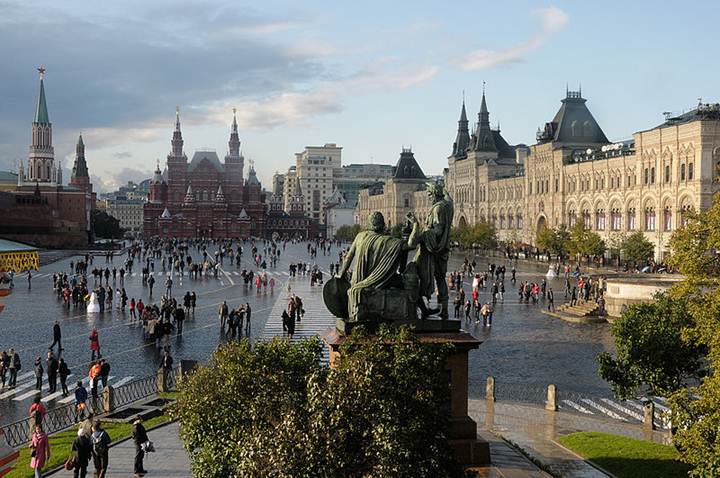
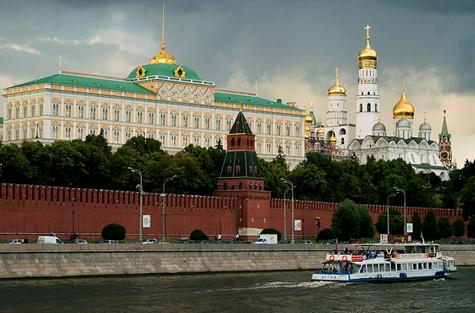
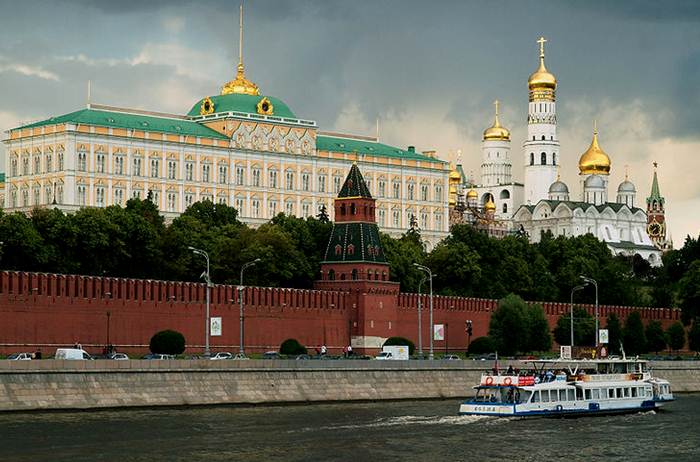
Kremlin and the Red Square in Moscow.
Photo: Wikipedia.
|
|
History of Russia |
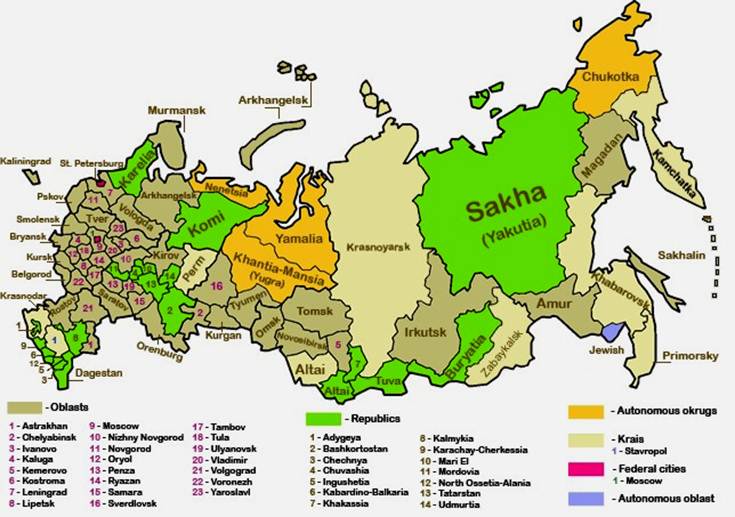
Russia, officially known as both Russia and the Russian Federation, is a country in northern Eurasia. It is a federal semi-presidential republic, comprising 83 federal subjects. From northwest to southeast, Russia shares borders with Norway, Finland, Estonia, Latvia, Lithuania and Poland (both via Kaliningrad Oblast), Belarus, Ukraine, Georgia, Azerbaijan, Kazakhstan, China, Mongolia, and North Korea. It also has maritime borders with Japan by the Sea of Okhotsk, and the United States by the Bering Strait.
At 17,075,400 square kilometres (6,592,800 sq mi), Russia is the largest country in the world, covering more than one eighth of the Earth's inhabited land area. Russia is also the eighth most populous nation with 143 million people. It extends across the whole of northern Asia and 40% of Europe, spanning nine time zones and incorporating a wide range of environments and landforms.
A Viking was the first Russian ruler
The history of Russia begins with that of the Eastern Slavs and the Finno-Ugric peoples. The state of Garðaríki ("the realm of towns"), which was centered in Novgorod and included the entire areas inhabited by Ilmen Slavs, Veps and Votes, was established by the Varangian chieftain Rurik in 862 (the traditional beginning of Russian history).
Scandinavian Norsemen, called "Vikings" in Western Europe and "Varangians" in the East, combined piracy and trade in their roamings over much of Northern Europe. In the mid-9th century, they began to venture along the waterways from the eastern Baltic to the Black and Caspian Seas. According to the earliest Russian chronicle Rurik was elected ruler before his successors moved south and extended their authority to Kiev, which had been previously dominated by the Khazars.
Thus, the first East Slavic state, Kievan Rus', emerged in the 9th century along the Dnieper River valley. A coordinated group of princely states with a common interest in maintaining trade along the river routes, Kievan Rus' controlled the trade route for furs, wax, and slaves between Scandinavia and the Byzantine Empire along the Volkhov and Dnieper Rivers
Kievan Rus', the first united East Slavic state, was founded by Rurik's successor Oleg of Novgorod in 882. The state adopted Christianity from the Byzantine Empire in 988, beginning the synthesis of Byzantine and Slavic cultures that defined Russian culture for the next millennium. Kievan Rus' ultimately disintegrated as a state because of the Mongol invasion of Rus' in 1237–1240.
Two tsars competing with the Grand Duchy of Lithuania
During that time a number of regional magnates, in particular Novgorod and Pskov, fought to inherit the cultural and political legacy of Kievan Rus'. After the 13th century, Moscow came to dominate the former cultural center. In the 15th century, the grand princes of Moscow went on gathering Russian lands to increase the population and wealth under their rule. The most successful practitioner of this process was Ivan III (the Great) who laid the foundations for a Russian national state. Ivan competed with his powerful northwestern rival, the Grand Duchy of Lithuania, for control over some of the semi-independent Upper Principalities in the upper Dnieper and Oka River basins.
The development of the Tsar's autocratic powers reached a peak during the reign (1547–1584) of Ivan IV (the Terrible). He strengthened the position of the monarch to an unprecedented degree, as he ruthlessly subordinated the nobles to his will, exiling or executing many on the slightest provocation. Nevertheless, Ivan is often seen as a farsighted statesman who reformed Russia as he promulgated a new code of laws (Sudebnik of 1550), established the first Russian feudal representative body (Zemsky Sobor), curbed the influence of clergy, and introduced the local self-management in rural regions.
Although his long Livonian War for the control of the Baltic coast and the access to sea trade ultimately proved a costly failure, Ivan managed to annex the Khanates of Kazan, Astrakhan, and Siberia.
By the 18th century, the Grand Duchy of Moscow had become the huge Russian Empire, stretching from the Polish–Lithuanian Commonwealth eastward to the Pacific Ocean. Expansion in the western direction sharpened Russia's awareness of its separation from much of the rest of Europe and shattered the isolation in which the initial stages of expansion had occurred. Successive regimes of the 19th century responded to such pressures with a combination of halfhearted reform and repression. Russian serfdom was abolished in 1861, but its abolition was achieved on terms unfavorable to the peasants and served to increase revolutionary pressures. Between the abolition of serfdom and the beginning of World War I in 1914, the Stolypin reforms, the constitution of 1906 and State Duma introduced notable changes to the economy and politics of Russia, but the tsars were still not willing to relinquish autocratic rule, or share their power.
The Russian revolution in 1917
The Russian Revolution in 1917 was triggered by a combination of economic breakdown, war weariness, and discontent with the autocratic system of government, and it first brought a coalition of liberals and moderate socialists to power, but their failed policies led to seizure of power by the Communist Bolsheviks on 25 October. Between 1922 and 1991, the history of Russia is essentially the history of the Soviet Union, effectively an ideologically based state which was roughly conterminous with the Russian Empire before the Treaty of Brest-Litovsk. The approach to the building of socialism, however, varied over different periods in Soviet history, from the mixed economy and diverse society and culture of the 1920s to the command economy and repressions of the Joseph Stalin era to the "era of stagnation" in the 1980s. From its first years, government in the Soviet Union was based on the one-party rule of the Communists, as the Bolsheviks called themselves, beginning in March 1918. However, by the late 1980s, with the weaknesses of its economic and political structures becoming acute, the Communist leaders embarked on major reforms, which led to the fall of the Soviet Union.
Following the Russian Revolution, Russia became the largest and leading constituent of the Soviet Union, the world's first constitutionally socialist state and a recognized superpower, which played a decisive role in the Allied victory in World War II. The Soviet era saw some of the most significant technological achievements of the 20th century, including the world's first human spaceflight. The Russian Federation was founded following the dissolution of the Soviet Union in 1991, but is recognized as the continuing legal personality of the Soviet state.
Today’s Russia
The history of the Russian Federation is brief, starting from the late 1991. Russia was recognized as the legal successor to the Soviet Union on the international stage. However, Russia has lost its superpower status as it faced serious challenges in its efforts to forge a new post-Soviet political and economic system. Scrapping the socialist central planning and state ownership of property of the Soviet era, Russia attempted to build an economy with elements of market capitalism, with often painful results. Even today Russia shares many continuities of political culture and social structure with its tsarist and Soviet past.
Russia has the world's 11th largest economy by nominal GDP or the 6th largest by purchasing power parity, with the 5th largest nominal military budget. It is one of the five recognized nuclear weapons states and possesses the largest stockpile of weapons of mass destruction. Russia is a great power and a permanent member of the United Nations Security Council, a member of the G8, G20, the Council of Europe, the Asia-Pacific Economic Cooperation, the Shanghai Cooperation Organisation, the Eurasian Economic Community, the Organisation for Security and Cooperation in Europe (OSCE), the World Trade Organisation (WTO), and is the leading member of the Commonwealth of Independent States.
Russia has the world's largest reserves of mineral and energy resources and is the number one natural gas producer as well as number one oil producer globally. Russia has the world's largest forest reserves and its lakes contain approximately one-quarter of the world's fresh water.
Russian-Lithuanian relations
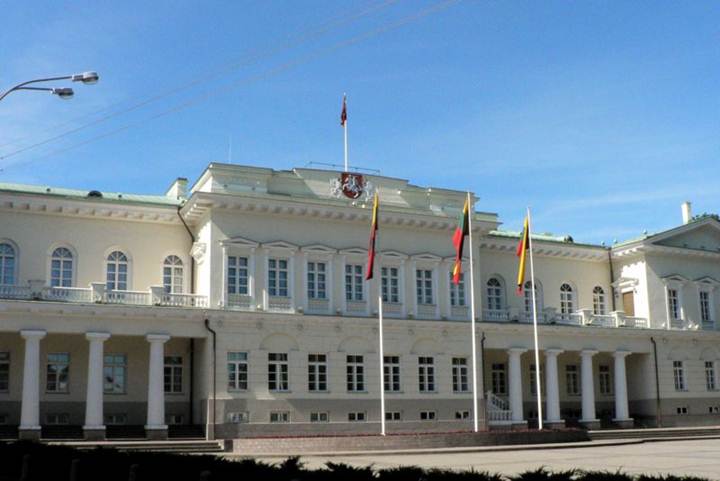
During the course of the 19th century, the Presidential Palace in Vilnius served as a residence for several Imperial Russian governors, such as Mikhail Muravyov, nicknamed "The Hangman". In 1812, both the Russian Tsar Alexander I and the French Emperor Napoleon Bonaparte used the Palace as their residence. During Napoleon's invasion of Russia, he organized military operations and Lithuanian army units from the Palace, including five regiments of infantry, four cavalry regiments, and the National Guard of Vilnius. He received Lithuanian noblemen, newly appointed officials of the administration, and other dignitaries in the Palace as well. After Napoleon's defeat in 1812, the Palace was used for ceremonial proposes; it was here that then-general Mikhail Kutuzov was awarded Russia's highest military award – the Order of St. George. During 1824-1834, the Palace was reconstructed by the prominent St. Petersburg architect Vasily Stasov in the Empire style, under supervision of Karol Podczaszyński. Stasov's reconstruction of the Palace has remained to this day.
During the Northern Wars (1655–1661), the Lithuanian territory and economy were devastated by the Swedish army. Before it could fully recover, Lithuania was ravaged during the Great Northern War (1700–1721). The war, plague, and famine caused the deaths of approximately 40% of the country's population.
Foreign powers, especially Russia, became dominant in the domestic politics of the Polish-Lithuanian Commonwealth that had been established in 1569 (Union of Lublin). Numerous factions among the nobility used the Golden Liberties to prevent any reforms. Eventually, the Commonwealth was partitioned in 1772, 1792, and 1795 by the Russian Empire, Prussia, and Habsburg Austria.
The largest area of Lithuanian territory were occupied by the Russian Empire in 1795. After unsuccessful uprisings in 1831 and 1863, the Tsarist authorities implemented a number of Russification policies. They banned the Lithuanian press, closed cultural and educational institutions, and made Lithuania part of a new administrative region called Northwestern Krai. These ruthless Russification policies failed owing to extensive network of book smugglers and secret Lithuanian home schooling.
The Russian domination was rather inconsistent with the direction of Lithuanian history. Russians were Orthodox
Christians, Lithuanians were Catholics, Lithuanians used Latin script, as opposed to Russia’s Cyrillic, Lithuanians felt culturally more related to Scandinavians, Poles and Germans, than to Russians, and Lithuania was united by trade routes through the Baltic Sea to Poland, Germany, the Netherlands and Great Britain, rather than through the great rivers and into Russia.
After the Russo-Turkish War (1877–1878), when German diplomats assigned what were seen as Russian spoils of war to Turkey, the relationship between Russia and the German Empire became complicated. The Russian Empire resumed the construction of fortresses at its western borders for defence against a potential invasion from Germany in the West.
On 7 July 1879 the Russian Emperor Alexander II approved of a proposal from the Russian military leadership to build the largest "first-class" defensive structure in the entire state – the 65 km2 (25 sq mi) Kaunas Fortress.
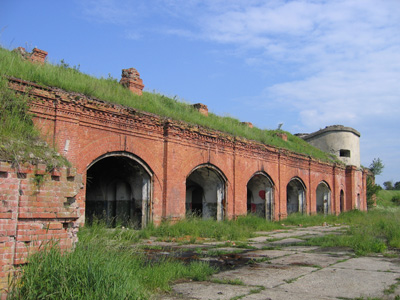
The Kaunas Fortress was constructed and renovated between 1882 and 1915 to protect the Russian Empire's western borders, and was designated a "first-class" fortress in 1887. During World War I, the complex was the largest defensive structure in the entire state, occupying 65 km2 (25 sq mi). The fortress was battle-tested in 1915 when Germany attacked the Russian Empire, and withstood eleven days of assault before capture. After World War I, the fortress' military importance declined as advances in weaponry rendered it increasingly obsolete. It was used by various civil institutions and as a garrison. During World War II, parts of the fortress complex were used by the governments of Nazi Germany and the Soviet Union for detention, interrogation, and execution. About 50,000 people were executed there, including more than 30,000 victims of the Holocaust. Some sections have since been restored; the Ninth Fort houses a museum and memorial devoted to the victims of wartime mass executions. The complex is the most complete remaining example of a Russian Empire fortress.
A more organised movement for independence of Lithuania emerged in the 1880s, with their own publications, and exile institutions, mainly in Prussia. The tsar allowed a Lithuanian nationalist congress to convene in Vilnius in 1905, and the congress demanded autonomy from Russia, restoration of previous borders, and restoration of Lithuanian language as language of instruction in schools.
Between 1868 and 1914, approximately 635,000 people, almost 20% of the population, emigrated from Lithuania. Large numbers of Lithuanians went to the United States in 1867–1868 after a famine.
Before any of Lithuania’s demands vs. Russia were met, World War I broke out and Lithuania was occupied by Germany. At the end of the war, Lithuania declared itself independent. The Bolshevik Red Army invaded and installed a puppet government, but by May 1920, Lithuanian and German forces had driven the Russians out. Lithuania was recognised as independent, and remained so until 1940.
In 1939, Germany took control of parts of Lithuania, but let the Soviets take over, in accordance with the Molotov-Ribbentrop Non-Aggression Pact. In 1940, the Soviet Union invaded Lithuania, installed a puppet Communist government, and the Lithuanian SSR was established (the Nazis re-invaded Lithuania for the period 1941-1944).
The Soviets immediately began various russification measures, and deported tens of thousands of ‘suspected’ Lithuanian people, first in 1941, then for the period 1944-1953 and later. The numbers of Lithuanians in Siberia and Central Asia increased dramatically when this large portion of Lithuanians were involuntarily deported into these areas. After de-Stalinization, however, most of them returned home. Some Lithuanian communities in certain regions of Soviet Union were formed during the Soviet occupation; Later, some Lithuanians were relocated to work in other areas of the USSR; some of them chose not to return to Lithuania, even after it became independent.
It is estimated that some 50,000 Lithuanians still live in Russia.
In 1944, Soviet forces "liberated" Lithuania, and Stalin immediately set about eliminating Lithuanian nationalism. Tens of thousands suspected nationalists were killed and several hundred thousand were sent to Gulag prison camps. All in all, during World War II and Stalin's reign of terror, around one third of the Lithuanian population was killed or deported. Lithuanian guerillas continued to fight the Soviets until around 1953.
Collectivisation and careless industrialisation severely damaged Lithuania's economy and ecology. Soviet rule also brought many Russians to Lithuania, with promises of good jobs and housing.
Both in the 1950s and the 1970s, there were political protests in Lithuania, but it was not until Gorbachev came to power in the mid 1980s, that the winds of change began to blow. Gorbachev himself, in 1987 began discussing more openly the possibility of more autonomy for the Baltic States, and in 1988, a popular front was established, under the name "Sajudis".
A strong expression of the Lithuanians’, Latvians’ and Estonians’ commitment to independence from the Soviet Union took place in 1989, when an enormous number of people from the three nationalities joined hands - literally - in a 600 kilometre (400 miles) chain from Tallinn via Riga to Vilnius, facing west towards Europe, and turning their backs at the Soviet Union.
In February 1990, multi-party elections were held, and the Sajudis movement won a majority in the new parliament. In March, they declared Lithuania independent. Gorbachev sent troops and introduced an embargo. An agreement was reached, by which Lithuania agreed to somehow "freeze" the independence declaration.
In the beginning of 1991, many crises between Moscow and Vilnius occurred over military conscripts and other issues, including the fatal Soviet attacks on Lithuania 11-13 January 1991. But the Soviet Union was falling apart, and in the wake of the failed coup in Moscow in August, Lithuanian independence became a reality.
|
Lithuania’s Prime Minister: The West should have no illusions about Russia
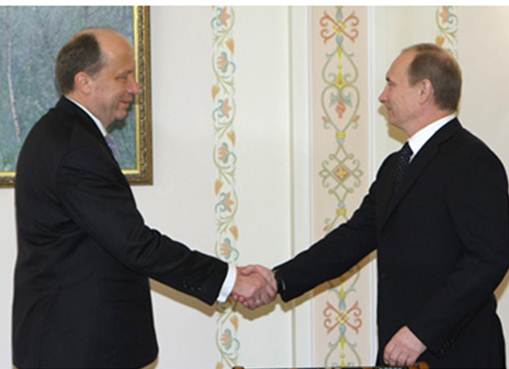
“Russia's decision on its leadership change this year has effectively buried any hopes of a renewal of relations with the West,” Lithuania's prime minister Andrius Kubilius told in an interview with Lithuanian Radio in 2011. "No one should have illusions about how Russia will be ruled for decades to come," he said. Lithuania is among Russia's harshest critics in the European Union and NATO. "All the restart policies or renewal of relations should now be locked in a deep drawer with a simple note attached: 'Here rest expired and naive dreams,'" Kubilius said. He said Putin's decision was not a surprise. Lithuania has most recently locked horns with Russia over natural gas prices. Kubilius' conservative government irked Russia earlier this year by using a EU rule that allows member states to split companies that supply and transport natural gas — a direct blow to Russia's state-runGazprom, which owns 37.1 percent of Lithuania's main gas company, Lietuvos Dujos.VILNIUS, Lithuania — Russia's decision on its leadership change next year has effectively buried any hopes of a renewal of relations with the West, Lithuania's prime minister said. "No one should have illusions about how Russia will be ruled for decades to come," Andrius Kubilius told Lithuanian Radio. Lithuania is among Russia's harshest critics in the European Union and NATO. "All the restart policies or renewal of relations should now be locked in a deep drawer with a simple note attached: 'Here rest expired and naive dreams,'" Kubilius said. He said Putin's decision was not a surprise. Lithuania has most recently locked horns with Russia over natural gas prices. Kubilius' conservative government irked Russia by using a EU rule that allows member states to split companies that supply and transport natural gas — a direct blow to Russia's state-run Gazprom, which owns 37.1 percent of Lithuania's main gas company, Lietuvos Dujos.
|
|
Russia-Lithuania relations should not be held hostage to the past
Lithuanian counterpart Audronius Azubalis.
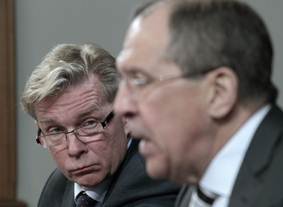
Relations between Russia and Lithuania should not become a hostage of the past, Russian Foreign Minister Sergei Lavrov said after talks with his Lithuanian counterpart Audronius Azubalis last year, ITAR-TASS reports.
“We do not want the historic truth to be forgotten, but we also have a common intention not to make our current relations hostage to the past and hostage to those events for which neither we nor Lithuanian leaders of this day bear responsibility,” he said.
“Assessment of the past events was made long ago – in the last years of the Soviet Union and now by the authorities of modern Russia,” the diplomat said. “We (Russia and Lithuania) have a commission of historians who work rather fruitfully, professionally, without emotions and provoking movements on our common history that had quite a few sad pages.” “Historians know well what a difficult task it is to do this work. But if we do not go along this difficult path, we will not get the historic truth in its entirety,” Lavrov said. “Therefore we agreed that discrepancies existing in the analysis of our common history – and we do not keep it secret – should remain an object matter for the commission of historians. We would like this work to be activated,” he said.
The Russian diplomat expressed confidence that “it will really help to step up contacts between civil societies of Russia and Lithuania, develop youth contacts and build relations for the future.”
Russkiy Mir Foundation Information Service
|
Deportations of Lithuanians to Siberia
The cruel deportations of hundreds of thousand Lithuanians to Siberia during and after World War II is the very saddest chapter in the relations between Russia (USSR) and Lithuania. An exhibition that right now is shown in the famous Balzekas Museum in Chicago shows the true face of these atrocities.
Let us also commend Dr. Audrius Plioplysa marvellous work to collect so many touching letters from some of the exiled Lithuanians. .
Exhibition in the Balzekas Museum of Lithuanian Culture, Chicago |
|
Location, Contact and Link |
|
|
 The life-long dream of Stanley Balzekas, Jr., to preserve for posterity the wealth of material pertaining to Lithuania's history and culture was realized when he opened the Balzekas Museum of Lithuanian Culture in a "two-flat" building next to his auto dealership on Archer Ave in Chicago on June 22, 1966. His personal collection of art, armor and rare maps was donated and placed on display. Still the president of the museum's board of directors, Stanley Balzekas has seen his museum grow to a major repository of publications, cultural artifacts, and arts not only of Lithuania, but also of the Lithuanian immigrants to the United States and the generations that followed them. The Museum quickly outgrew the available space on Archer Ave and moved to its present, greatly expanded facilities in 1986. With a substantial staff, many volunteers, and many hundreds of donors and members, the Balzekas Museum of Lithuanian Culture is a major player in the Lithuanian
Letters from Siberian Deportees
The Balzekas Museum's Hope & Spirit exhibit and program, commemorating 70 years since the start of Soviet deportations to Siberia, includes 157 original handwritten and personal letters from Lithuanian deportees to their relatives living in London, England; Sydney, Australia; Chicago, Illinois; Bogota, Columbia; Toronto, Ontario; and other cities. Among these letters are 20 written by children who were deported. The exhibit includes 218 original photographs from Siberia and 71 addressed envelopes. All of these items are extremely rare and of immense historical value and are being presented to the public for the first time.
|
|
||||
|
Letter examples, presented by the collector, Dr. Audrius Plioplys |
|
|
||
Family of 8 deported
Posted on October 10, 2011
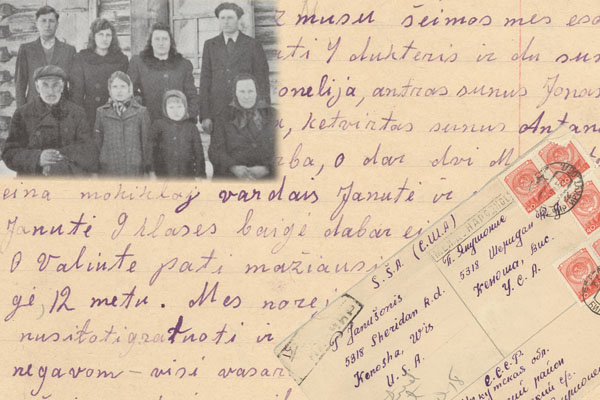
Kazimieras Janusonis with his wife Agota, and 6 children were deported to work in the same collectivized farm in Siberia. The location of the Bilchirsk kolkhoz was in the northerly portion of the Irkutsk region. Agota wrote letters to her brother-in-law, P. Janusonis, who was living in Kenosha, Wisconsin.
She wrote, “We work in the kolkhoz. Our family has 7 members: me, 4 daughters and 2 sons. (She notes 7 family members because when she wrote this letter, her husband had already died–AVP.) The oldest is my daughter Petronelija, then my son Jonas, thirdly my daughter Agota, and fourth, my son Antanas. All 4 work in the kolkhoz. My younger 2 daughters, Janute and Valiute, are students. Janute completed grade 9 and now attends grade 10. Valiute, my youngest, 12 years old, finished grade 4…We did not bring anything with us besides what were able to stuff into one bag. Adequate clothing is very difficult for all of us…Winters are very cold and summers very hot. We are surrounded by mountains and forests. There is little flat ground.”
In another letter she wrote, “We are surrounded by tall mountains which are covered with impenetrable forests. Wild animals live there–polar bears and wolves. We live in a valley near a small stream. We use it’s water because there is no well. Without fur coats, it is not possible to go outside, even for a brief period of time, in the winter. And then, the fur freezes solid as an animal’s horn. Thus, we wear cotton coats. We live with the Buriats (related to the Mongols–AVP).”
Kazimieras Janusonis died in Siberia, shortly after the photograph was taken. After serving 10 years of hard labor on the kolkhoz, Agota and her children were allowed to return to Lithuania. However, they were not allowed to return to their family farm.
On display we have 5 letters and 3 envelopes from the Janusonis family as part of the Hope and Spirit exhibit which I have organized. The exhibit is at the Balzekas Museum of Lithuanian Culture, in Chicago, and has been extended until the end of April, 2012.
Posted in Letters from Siberia
Mother buries her two infants in Siberia
Posted on October 10, 2011
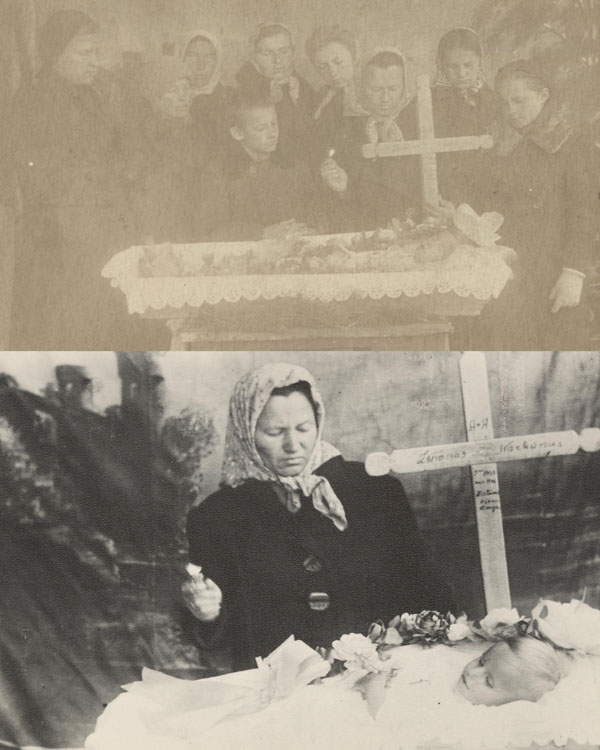
In these two photographs, Veronika Norkunas buries her two young children near the city of Barnaul, in Siberia.
In the top picture, 4 year old, Livija-Liucija Norkunaite is being buried. She was born in Lithuania, and died on September 21, 1941, in Siberia.
In the bottom picture, 16 month old Zenonas Norkunas is being buried. He was born in Lithuania, and died on September 22, 1941, in Siberia.
On one September day, Veronika buried her four year old, and on the next day, her 16 month old.
The pictures were sent to A. Norkunas who was living in Adelaide, Australia.
These young children survived only 3 months after their deportation in June, 1941. They only survived 3 months in Stalin’s new society.
There is no available further information about this Norkunas family.
These two images are from over 230 original deportee photographs from Siberia which are on display in the Hope and Spirit exhibit, which I have organized, at the Balzekas Museum of Lithuanian Culture, in Chicago. Quite literally, due to popular demand, the exhibit has been extended to the end of April, 2012.
Posted in Letters from Siberia
14 months old–deported to Siberia; 14 years old–dead
Posted on October 10, 2011
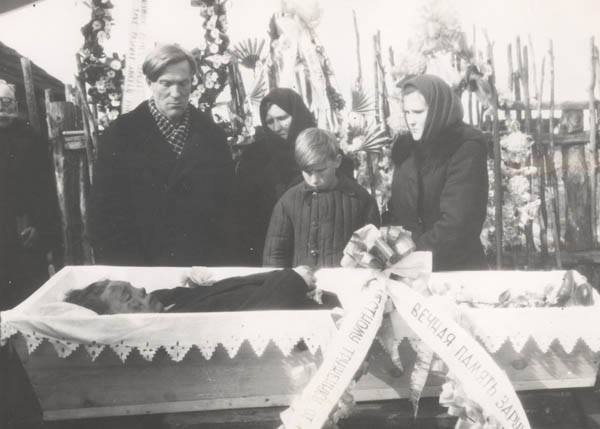
Zigmas Zarunskis was 14 months old when he, with his family, were deported to Siberia. At the age of 14 years, instead of attending school, he was assigned to work as a lumberjack. While chopping trees, a limb fell down on him, killing him. The photograph was mailed to a relative in Jackson Heights, New York. In it, standing from left to right, are Zigmas’ parents, Pranas and Ona, his younger brother Jonas (who was born in Siberia), and his older sister, Zita. No further information is available about the Zarunskis family.
This photograph is one over over 230 which are on display in the Hope and Spirit exhibit, which I have organized, at the Balzekas Museum of Lithuanian Culture, in Chicago. Quite literally, due to popular demand, the exhibit has been extended to the end of April, 2012.
Posted in Letters from Siberia
Health care and God’s will
Posted on September 2, 2011

Konstancija and Jonas Marmas, with their three children, in the Krasnoyarsk Region of Siberia
The Marmas family was deported, from their family farm in Griskabudis to work as lumberjacks for 10 years. The uncle of Jonas Marmas was Dr. Vincas Kudirka, the author of the Lithuanian national anthem. Possibly it was because of this familial relationship that they were deported.
In this letter, written to Alfonsas Lietuvninkas, in Chicago, Mr. Marmas comments about the health care system. Apparently Mr. Lietuvninkas was having health issues. Mr. Marmas writes: “You wrote that health care costs are expensive. For us, from one aspect, it is very good–we do not have to pay for anything. Along with this, there also are no medicines available. It would be better to pay and at least feel that your health is improving, instead of waiting to see if the illness clears or not. What can you do, if that is God’s will?”
He further wrote that during the winters, temperatures were frequently -55 to -60 degrees Centigrade (-75 degrees F) with 5 to 6 feet of snow. During the short summers the temperature would reach 50 degrees Centigrade (120 degrees F), and at night fall to freezing, destroying even the potatoes that were their main food source. There is no further available information about the Marmas family.
The Marmas family letters and photographs are currently on display as part of the Hope and Spirit exhibit which I have organized, at the Balzekas Museum of Lithuanian Culture, in Chicago. This exhibit, and extensive programs, will continue into January 2012.
Posted in Letters from Siberia
10th grade graduation present: 167 hard labor jobs and meningitis
Posted on August 9, 2011

Dobilas Ralys and his mother in Siberia. The letter was written by his sister, Ramune Ralys, and was sent to their uncle, V. Cizinas, in Paterson, New Jersey. In this letter she details some of her own life events upon being exiled to Siberia with her family. She was attending the 7th grade at the time of deportation. In the Krasnoyarsk District’s farm labor camp (kolkhoz) the middle school was located 2 miles away, which she attended until completing grade 10. At that time, she took over the labor tasks of her mother, who was too ill to work.
The Ralys family had been living in Kaunas, where Mr. Ralys worked as a bank accountant. In 1910 and into the 1920′s he wrote general interest articles under the pseudonym of Vargovaikas (Child of Misery). The family was deported to a forced labor camp to serve a 6 year term. Upon returning to Kaunas, the family was allowed to live in the house that they had previously owned, but only in a portion of the basement. Mr. Ralys died within a year of returning to Lithuania. He was 66 years old at the time of deportation.
In this letter, Ramune details some of the tasks that she had to do. “Shoveled snow…worked as a camp cook…collected and burned straw, planted corn, weeded wheat fields, collected silage, transported logs, transported grains, cleaned grains, and so on. In all, I did 167 different jobs.” During September of the second year’s hard labor, she became ill with what appears to have been a form of meningitis/encephalitis. She suffered the entire winter, but was able to return to labor in the spring.
This letter, and several hundred like it, are on display as part of the Hope and Spirit exhibit that I have organized at the Balzekas Museum of Lithuanian Culture in Chicago. The exhibit will continue through mid-January 2012.
Posted in Letters from Siberia
$4 for one egg, $70 for a pound of butter
Posted on July 18, 2011

Morta Abromaviciene, at the age of 67, was deported to Siberia with her husband Stasys, who was 74. Mr. Abromavicius died 3 years later, while Mrs. Abromaviciene was able to serve her prison term in Tinsk, in the Krasnoyarsk District. After 7 years of hard labor, her health was broken–she was so frail and weak that she was transferred to the Tupik sanatorium, in the Shirinsky District of Khakassia, for one year to recover. It was while she was in the sanatorium, that she was able to write letters to one of her daughters, who was living in Chicago.
In the early 1900′s, Mr. and Mrs. Abromavicius had both, independently, traveled to work in the United States. They met in Braddock, Pennsylvania, where they were married in 1906. With their two young daughters they returned to Lithuania in 1913, and bought a small family farm. All totaled, they had 2 daughters and 4 sons. During the war, one son died, and the other children moved to the United States.
When she returned to Lithuania from Siberia, she found all of her farmhouses burned to the ground. She went to the nearby larger city, Marijampole, where she lived and died 10 years later. She was able to survive only because her children continued to send her packages.
In her letters from Siberia she notes that the winters are very cold, with the temperature frequently minus 40 degrees Centigrade (which is exactly minus 40 degrees F).
She is thankful to her children for the packages that she has received, and mentions the items that she needs to obtain. She notes that when packages arrive, the other residents of the sanatorium crowd around as the package is opened. She gives most of the contents to the other residents, keeping only the essential items for herself.
One time, her daughter made an error and sent her $50 in cash (I am changing the actual amounts into what would be current US$ value, given years of inflation). To exchange this currency into rubles, she had to travel to a bank in a distant city. The travel cost was $32, leaving her very little.
In another letter she notes how expensive even the most basic items are. One egg cost $4. One kilogram of butter, $140–which means $70 for one pound of butter!
Why was this family treated like criminals? Landowners, because they might object to Stalin’s new political system, needed to be either exterminated or deported. This was genocide, pure and simple, on the basis of political motives. This happened to the Abromavicius family, and to millions of other families across Eastern Europe.
The letters of Morta Abromaviciene are on display as part of the Hope and Spirit exhibit, which I have organized, at the Balzekas Museum of Lithuanian Culture, 6500 S. Pulaski Rd., Chicago, Illinois. The exhibit has been extended, and will continue until mid-January, 2012.
Posted in Letters from Siberia
|
Russia and Three Baltic States By Arturas JURGELEVICIUS |
|
The period was extremely difficult for Europe as well as for Russia, and the consequences are being felt in today’s realities. To solve economic and political disputes between these countries, the historical perspective should be taken into account.
Baltic States recklessly seek “Historical justice” Many believe that Soviet Union did a huge damage to the humanity under the presidency of Stalin. Of course, this view might be debated but it is obvious that the victory of Nazis would have brought much more human devastation and bigger tragedy to the whole Europe. Anyway, official political line of the Baltic States claims that after World War II, Soviet Union and now Russia as legitimate successor of Soviet Union was/is responsible for what happened and have to apologize and reimburse the damage done during that era. As history has shown Soviet Union delegates and even modern Russia’s officials have already done so at least four times. First, Stalin’s cult and crimes were publicly denounced and condemned during the 20th Congress of Communist Party of Soviet Union by speech made by Nikita Khrushchev, the leader of Communist party and the Soviet Union. That is to say that this is the first time after Stalin’s epoch when officials of Soviet Union revealed and criticized the dictatorship of Stalin and faulty policy led by him towards some human and economic activities. Secondly, special Soviet commission under Alexander Nikolaevich Yakovlev, in December 1989, the commission concluded that the protocol had existed and revealed its findings to the Soviet Congress of People's Deputies. As a result, the first democratically elected Congress passed a declaration in December 1989 admitting the existence of the secret protocols, condemning and denouncing them. In 1992, the document itself was declassified only after the dissolution of the Soviet Union. Third, the sovereignty and independence of the Baltic States was recognized by the first democratically elected president of Federation of Russia: B. Yeltsin. He recognized the independence of the Baltic States and invited the rest of the world to do the same. That is to say that by recognizing sovereignty of the Baltic States, Russia automatically rejected the idea of its bid to pretend to restore the influence in this region. Russia recognized all freedoms and respects towards these countries establishing diplomatic and economic relations with Lithuania, Latvia and Estonia. Fourth, during EU-Russia summit in 2008 president V. Putin was asked by an Estonian journalist “why is that so hard to recognize the fact of the occupation of the Baltic states?”. The answer of the president was as following: "<…...>The conspiracy happened in 1939 between Russia and Germany. I believe it was a conspiracy. What can we do now? It was the reality at the time when small countries were involved in the reality of those days. <…> in 1989 the Soviet Congress of People's Deputies declared that Molotov and Ribbentrop pact did not reflect the real will of Soviet people and recognized the illigitimate action taken by them. It was condemned. What more accurate is possible to say about this? What else? How many times can we repeat that? Every year? We think that everything possible is said about that and this question is already closed". As it is seen both Soviet government and the government of modern Russia recognized de facto and de jure the independence and territorial sovereignty of the Baltic states which actually means that all claims to get this territories back is faulty and there is no foundation for such claims. Moreover, it is recognized that conspiracy between two states (Nazi German and Soviet Union) had no legal foundation, it was in conflict with international law and it is absolutely illegitimate. Consequently the destruction of the sovereignty of the Baltic States was condemned and sovereign power of the national states was recognized.
First, to restore the supply of the crude oil via Druzhba (Friendship) pipeline which broke down in 2006 and Russian officials said it would take at least several years to restore it. Of course, since Russia is being considered as “aggressor” and seeking to rebuild its power in the Baltic States, it was accepted as political blackmail. At that moment Lithuanian president pointed out that "Today we know that oil will not flow through this pipeline any more", he told during a conference. Meanwhile, Russian technical watchdog Rostekhnadzor said in September that Transneft would need at least another 18 months for repairs, meaning that the pipeline could not be reopened before the end of 2009. Even if this technical problem was politicized and it was being tried to create the image of Russia as an “unreliable partner”, the pipeline was reopened on the same time as technical experts predicted. Second, to solve the conflicts between Georgia and Moldova: it is valuable to stress that it is difficult to unmask the real interests of the Baltic States in Caucasus and Moldova. It is more seen as trials to damage Russian security interests at the same time harming EU foreign policy. Third to encourage Russia to cooperate in criminal cases of the killings in 13th of January 1991 when Omon (Russian special intelligence service) killed the rebellions. Russia commented on it proclaiming that according to the then law Omon protected the interest of Soviet Union and acted accordingly to its constitution. Apparently all these issues might be solved bilaterally, but the Baltic States use Europe Union as an instrument to solve their chronic problems. For example Lithuanian conservative party “Union of homeland” passed “The reimbursement for occupation damage” law in 1999 before going to step down from the ruling government. Anyway this law has been never implemented or at least it has been never trying to be implemented because Russian officials ardently respond to these attempts. After more than a decade of playing a cat with a mouse, newly appointed minister of foreign affairs of Lithuania Audronius Ažubalis retreated and said that, “at first Lithuania should do its homework and estimate what real damage has been done and then deliver the claim“. Unofficially some representatives speak about 25 billion (almost three times more than the annual budget of the country) euro harm. Recently new numbers showed up. Latvia's Foreign Minister Maris Riekstins estimated the losses from Soviet occupation are $18.5 billion. Is money dearer than national pride? But it is not clear how this number is estimated. If we follow this logic, then Russia has the right to claim for compensation for building roads, manufactures, the world biggest nuclear plant in Lithuania (in 2010 it was closed as precondition for membership in EU), harbors, Mazeikiu refinery (Lithuania), hundreds of apartments and dozens of various buildings etc. These initiatives of reimbursements of “losses” might set precedent for other countries which were involved in these historical games. If all 15 former member states of Soviet Union claimed for the compensation for “damage” done during Soviet epoch what would Russia do? There are tremendously huge problems within Russia as well and economic ones. So if Russia would try to reimburse the claims of former member states, it would take many decades of payments at the cost of own Russian citizens. Anyway there is very little chance that these initiatives will come true in the nearest future. It is worth mentioning that former Soviet Union’s states try to use different international organizations to do harm to Moscow.
What is so offending for the Russian audience in this document? In fact, Russians don't dispute the totalitarian character of Stalin's rule, mostly informed about the order in their country in that time from their grandparents. This fact does not need approval from European neighbors. Russians are rather outraged with the obvious hypocrisy: the document suggests that only the USSR and Germany were the evil states of the XX century, while other Europeans were "warm and fuzzy", never being involved in infringement of human rights, and in military atrocities. But if other Western powers were so impeccable, why did they concede half of Europe to Hitler, leaving Russians alone with the totalitarian adversary? Why did they hesitate for such a long time before establishing the anti-Hitler Coalition? Was it Stalin who paid for this hesitation, or millions of Russian families? Have our Western neighbors really followed the UN Human Rights Declaration since the times of the Crusade? Have all of them condemned Hitler in his cradle? "Our respected partners forget that the subject of totalitarianism is much broader, and that totalitarian regimes existed also in Spain, Portugal, and Greece, and that the European history is far more variable to reduce it to the times of World War II", reminds Mr. Kosachov. Other disputes arise when it comes to the Baltic States. In the last few years, a new idea of rewriting European history appeared. That is to say that the most debatable event of last century is the World War II. The Baltic States claim that the most brutal and humiliating war was initiated not by Germany but also by the Soviet Union. This brings harsh and operative responses from Moscow. In modern politics history is attached to political realities that is to say that by putting blame on Russia as one of the initiator of World War II, western countries want to diminish Russia’s growing influence in Europe and in the world and restore its reputation which they lost after “Munich agreement” in 1938. It is seen how former members and the Baltic States are using international organizations as the instruments to revenge to Russia for so-called “occupation”. This adopted resolution is only a segment of the strategy. By accepting resolution of anti-Russian coalition will have at least some sort of legitimate basics for the claim of the compensation in the future. Concluding historical perspective in the relations between the Baltic States and the Federation of Russia it is important to notice that even professional historians are not able to properly evaluate or interpret the extraordinary events of the 20th century. Any trials of rewriting history or the use of the history for political purpose will be strongly rejected by Moscow and will not bring any neither political nor economic benefits for the Baltic States or any other country in the relations with Russia. As a result all these disputes caused by extraordinary and harsh historical circumstances reflect themselves on economic and political agenda as well. With collapse of Soviet Union, Baltic states always tried to “escape” from Russia’s sphere of influence. Finally they became a part of European Union and NATO in 2004. Notably this happened relatively in a short period of time. Probably that is because Western countries wanted to gain influence over Eastern European countries sooner than it would do Russia and diminish its dominance. As it is seen now, Baltic States started using their opportunities in western organizations in order to widen their own old wounds.
Contrary to Estonia, Russia remained the main export market for Latvia also during 1990s. In 1996 exports to Russia comprised nearly 25% of Latvia’s total exports. The share of goods imported from Russia remained slightly smaller, staying near 20%. In 2004, the trade deficit between Latvia and Russia was 8.5 times greater than the deficit of Latvia’s total external trade. The volume of Lithuanian exports to Russia amounted to 3.4 billion LTL (nearly 1 billion euros). Compared to 2004, exports increased almost 44%, which indicates that Lithuanian trade with Russia grew faster than Lithuanian trade in general. Altogether, Lithuania imported goods from Russia in the sum of 11.9 billion litas (3.4 billion euros). Within a year, imports grew 51.3%. In comparison with previous years, Russia’s share in Lithuanian imports has been rising steadily, almost reaching the 1996 level in 2005 (29%). As it is seen Baltic States and Russia have a great trade turnover in general. Anyway the trade balance with Russia always remained negative. That is mainly because Baltic States import oil, gas and other raw materials from Russia. Negative trade balance was emphasized in the recent years mainly due to the growing oil prices. Also this fact could be explained that export to Russia is more difficult than export to Baltic States which apply EU rules because Russia implies many non-tariff barriers such as quotas, strict licensees. Also, the devaluation of rubles in the last decade caused the cheaper Russian export to Baltic states meanwhile the commodities from Baltic region became more costly in Russian market. The same must be said about present economic crisis, when Russian government gradually devaluated rubles to keep its export alive. So these reasons caused deep trade deficit for Baltic countries. Only Lithuania had higher volume of foreign trade with Russia than other Baltic neighbours (Estonian exports to Russia were 155.9 million EUR and imports from Russia 491.4 million EUR in 2003, for Latvia respective figures were 137.5 million EUR and 405.3 million EUR, for Lithuania 548.5 million EUR and 1931.6 million EUR). As it is known now, Russia, Kazakhstan and Belarus have formed the Common Custom Union which came into force on July 1st. This growing custom wall nearby the Baltic States’ borders will affect their economies as well. For example, Lithuanian Ministry of foreign affairs has estimated that national exporters will pay 65 million litas (20 million euro) additional taxes only because of new tax system appeared in the Custom Union. That is to say some industries of the Baltic States might be seriously damaged and probably will get no prerogatives or exceptions from Russian government. Such policies might distance the Baltic States from trade dependence on Russia in the long term, since Baltic States will be forced to search for new markets and make their industries more efficient. On the other hand, these industries will gain big loses in short term. It might be more painful in the light of current economic crises since unemployment rate is one of the highest among the European Union member states. In any case the Baltic States will heavily be depended on Russian natural resources including oil and gas. Countries pay the world price for these recourses even though they are located close by Russian borders. All of three Baltic States get nearly 90% of oil and 100% of gas from Russia. Moreover, the closure of the nuclear plant, built by Soviet, in Lithuania, in 2010 increased the energy dependency upon Russia. As following Lithuania is planning to build new nuclear power plant and in this way to create common energy policy of the Baltic Sea region including the Baltic states, Poland and some of Scandinavian countries. Anyway, the real future of this project seems to be vague. There was an attempt to create some companies responsible of managing and organizing this program but it was disbanded since it did not fulfill the requirements of the European law. Also countries do not agree on the distribution of the electricity among countries which causes the absence of the strategic investors since this project was extremely expensive. As a response to such energy policy Russia has suggested to participate to building up the nuclear power plant in Kaliningrad exclave. However this proposal has not received any serious attention. Russia tries to promote very expensive and important project called Nord Stream which will go under the Baltic bypassing the Baltic States and Poland. Even if it is much more expensive to build pipeline under the sea it is much safer geopolitically for Russia. This might be considered as a response of Russia because of unfriendly posture of Baltic States towards it.
This happened soon after Georgia-Russia military conflict as a symbol of mutual trust between Russia and France and response to Georgian aggression. Anyway, the Baltic States raised their concern about this warship that might be used against them. As a result NATO declared its plans about military exercises in the Baltic States, although NATO claimed there is no link between these two cases.
|
 The relations between the Baltic States (Lithuania, Latvia and Estonia) and Russia are complicated not only nowadays but in the past as well. The geographical location of the Baltic States makes them strategically important for Russia’s national security as today as in the past. Probably all problems of these countries are laid down in the 20th century’s history.
|
The Baltic Kaliningrad By Grant Heard From Prussia to Russia: a history of the region The Kaliningrad region was originally called the Samland, which was originally inhabited by the Prussian tribes whose language and culture, although has since died out, was similar to Lithuanians and Latvians of today. The Prussians, before the arrival of the Germans, were not Christianized, nor were they highly organized in trade or military. It was when these tribes proved to be difficult to defeat that the Teutonic Knights were called in to take over. They were tempted by the prospect of land and privileges from both the German Empire and the Catholic Church, which included grants to the Teutonic Order of full sovereignty over all the land it would conquer from the Prussians. The Prussians resisted the Teutonic Knights. An early account of the conquest of the Samland comes from the Livonian Rhymed Chronicle, which describes the conquest of Master Anno of the Teutonic Knights as he led the crusaders into the wilderness of the Samland: The land is almost surrounded, being on the peninsula, by the wild seas, which had been a protection for it. No army had ever invaded there, and on the other sides no one can fight against it because a wild stream, wild and deep, flows along it… A narrow peninsula extends toward Memel, and there the Christians came with their stately army. The Christians rejoiced. They found the great forest of the Samites there. It was wide and thick, not of puny saplings, but trees so large that they served as a bulwark… The Christians came upon it and vowed not to rest till it had been cut in two… Then, when they had cut and slashed through the forest, the army advanced directly into the land. The Samites learned that they were visited by guests who wished to do them harm. Although this raid was a success, as the crusaders passed deeper into the forest, they were ambushed and all but annihilated. However, the crusaders pressed on, and new attacks were launched, but from Prussia in the south, instead of Livonia to the north. The Teutonic Knights conquered the region and advanced their frontiers from Prussia to the south bank of the Memel River. It was then that Koenigsberg was founded in 1256, named in honor of King Ottokar of Bohemia, who had brought large armies on crusade to Prussia. Prussians were granted a great deal of rights under the Teutonic Order. Prussians were much more numerous than the Germans, mainly because it was difficult to convince Germans to immigrate to this land because of its harsh, swampy landscape. Thus, the Prussian peasants were treated like German peasants and even lived side by side with each other. In the Samland region, the Prussian language and customs survived until the seventeenth century, being the last region where the Prussian died out. The Prussian culture died out because of Germanization. The Prussian peasants could even rise to the status of freemen. These freemen were allowed to own land and estates. They enjoyed many rights that the Germans did and were even treated like Germans. This helped to facilitate the Germanization of the Prussians. It also helped Prussia to become a country of peasants and landowners, a country in which the rest of the nobility was less important and less elevated above the rest of the population than it was elsewhere. And Koenigsberg was to remain quite autonomous from the rule of higher nobility in the years to come. Under the Teutonic Order Prussia grew rich, and as the prosperity and freedom of the aristocracy and peasantry grew, the more the people began to feel “dominated” by the Teutonic Order, who was felt to be an alien ruler. So when the Order found itself in a long war with the Duchy of Lithuania and Poland in the fifteenth century, its people were sometimes on the side of the enemy. This is because the Polish had a more liberal form of government where the nobility were becoming much more powerful and the start of republicanism were forming. The Teutonic Order lost a number of battles, including the Battle of Tannenberg, which soon led to the Second Peace of Thorn in 1466. Here the Order lost its independence to Poland. West Prussia, which included the major trading center of Danzig, was given to Poland. However, East Prussia was left to the Order, but only as a Polish feoff. The Order was finally dissolved during the Reformation in 1525 by the last Grand Master of the Order, and he then became ‘Duke of Prussia’, though still under Polish feudal supremacy. Koenigsberg was one of Prussia’s most important trading centers up till the sixteenth century, second only to the port of Danzig. Some of Koenigsberg’s main export items included rye, corn, hemp malt and waxes, and it had many guilds. The city had about 30-40,000 inhabitants at the time, which was even larger that Berlin. Politically, Koenigsberg was organized on a fairly democratic basis, base on the Third Estate system. Because of their power and privileges, the town did not hesitate to oppose the nobility. This in turn caused struggles between Koenigsberg and the nobility, and helped to prevent Prussia from becoming a noblemen’s republic. Even after the famines and the Plague hit the region during the mid-sixteenth century and their trade had declined, the town still would not relinquish its autonomy. It wasn’t until 1674 that the town finally surrendered much of its autonomy and agreed to pay higher taxes to the nobility when Fredrich William marched several thousand troops by surprise into the city. In 1701 Koenigsberg became part of the Prussian Empire. The city became the focal point of the unification of the Prussian empire when Fredrick I was crown King of Prussia in Koenigsberg. Under this new rule immigrants flooded into Eastern Prussia, mainly to escape religious prejudice. People from all over Europe, including Jews, were welcomed into the Prussian state. They were then settled in East Prussia to help replace the losses experienced by the plague. There was not the overwhelming harassment and discrimination, either ethnic nor religious, then that would be experienced in the German Reich. This was also a time of the rise of the great Prussian militarism. The military became a powerful force as loyal, professional soldiers replaced mercenaries. In 1756 Koenigsberg and East Prussia came under the brief rule of Russia, as the Seven Year’s War left the area almost completely defenseless. But this occupation would be short lived as the Prussian army reclaimed the territory after the battle of Zorndorf in 1758. This brief occupation did not bring about radical change in the population. As Sabastian Haffner writes, “the war, in a manner of speaking, passed over the heads of the people; they ducked and let the storm blow over.” By the nineteenth century, the tide of nationalism swept throughout Prussia. This nationalism helped the great Prussian politician, Otto von Bismarck, to channel power in order to establish the first German Reich by 1871, after a series of wars with Austria, France and Denmark. From this time on Koenigsberg and East Prussia were to be absorbed into Germany, where it would remain as such until 1945. After World War I, East Prussia was then separated from the German mainland by Poland by the Versailles Treaty, connected only by a corridor through Polish territory. However, prior to World War II, Hitler connected the German mainland with East Prussia. When Poland resisted, Hitler was given an excuse to attack Poland to reconnect the region with Germany. This fact still weighs very heavily on the memory of many Poles and is part of the reason why Poland fears a Russian corridor to Kaliningrad. Koenigsberg fell to the Red Army in April 1945. The population was completely wiped out of Koenigsberg during the war. All the inhabitants of Koenigsberg were killed by the advancing Soviet Army, deported to other parts of the Soviet Union, or escaped to the German mainland. Koenigsberg was surrendered to the Soviet Union in 1945 at the Potsdam Conference, when the Western leaders agreed to the Soviet proposal …That pending the final determination of territorial questions at the peace settlement, the section of the western frontier of the USSR which is adjacent to the Baltic Sea should pass from a point on the eastern shore of the Bay of Danzig to the east, north of Braunsberg-Goldap, to the meeting point of the frontiers of Lithuania, the Polish Republic and East Prussia. Stalin did not have any historical or legal basis for his desire to control Koenigsberg, but he did present a justification: the territory would be a just compensation for the efforts and losses experienced by the Red Army during World War II and the region was to serve as a vital base for Soviet military power. The strategic view that Koenigsberg served was the Russian Soviet Socialist Republic now possessed an ice-free port located closer to the region of potential confrontation with the West than the Soviet bases before the war and that was much less vulnerable than the Soviet facilities in the Finnish Gulf. Of the other ice-free ports that were acquired by the Soviet Union by the annexation of the Baltic States, Kaliningrad was considered to be superior to the rest. The town of Koenigsberg was almost completely destroyed by 1944 by the devastating air bombing of the British Royal Air Force. In fact, almost 90% of the buildings were completely destroyed by the British air campaigns. When the red Army arrived, the rural areas surrounding the city suffered great damages. When the Soviet Union claimed the territory, the first order of business was to clear away the rubble that was left and to eradicate the area’s German past and to replace them with a Russian veneer. One method of doing this was to rename the cities and towns that were in the region. Koenigsberg was renamed Kaliningrad after the former president of the Soviet Union, Mikhail Kalinin. Soviet-style architecture and concrete housing blocs then replaced many of the buildings in the city. Today little remains of the features of the former Koenigsberg. However, as Romuald Misiunas and Rein Taagepera have claimed, the bulk of the construction carried out in Kaliningrad dates from the 1970s or later, and by the early 1990s, a lot of destruction still remained outside of the city. During the Soviet period, the bulk of the economy was centered around the military establishment in the region, even though the fishing industry and paper processing were also important. Kaliningrad was considered one of the most heavily militarized regions in all of Europe during the Cold War. This is why the region was cut off to foreigners and most Soviet citizens until the late 1980s. The region’s population remained isolated from the West because no ships were even allowed to dock in the Kaliningrad port. AFTER THE FALL THE MILITARY INSTITUTION This has caused many politicians to stress the importance of the Kaliningrad region to the military security of the region, while at the same time, has caused some anxiety among its neighbors Poland and Lithuania. In fact, Polish Foreign Minister Bronislaw Geremek, in 1998, said that Kaliningrad “is a threat not only to Poland but also to European security.” The amount of forces in Kaliningrad is unknown. However, the International Institute for Strategic Studies in London estimates a total number about 20,000 soldiers currently in Kaliningrad, of which 14,500 belong to the ground forces, and the rest to naval and border forces, and the interior troops. There are two Russian submarines, two destroyers, four frigates and 30 other surface ships in the Baltic Sea. It is this military complex in the region that Russia might use to further its image as a superpower and a bargaining chip to mark its influence within the Baltic Sea region. ECONOMIC TROUBLES AND OUTLOOK However, the region is among the 5 regions with the Russian Federation with the greatest number of enterprises with foreign capital. Kaliningrad has a Special Economic Zone, which allows foreign countries to produce goods in the region and then transport them to the Russian mainland without having to pay the higher export duties and taxes they usually have to pay to Russia. At the beginning of the decade Kaliningrad had a Free Economic Zone, in which foreign companies and ventures could transport goods free of duties and tariffs, but this was changed in 1996 to the Special Economic Zone when Russia began to lose millions of dollars (and other forms of hard currency from the West) and wanted to bring the oblast under tighter federal control. The federal government has invested almost 1 billion rubles into the program, but it still needs foreign investment to modernize its economy. The Special Economic Zone, in theory, is to help the Kaliningrad region in several ways. First, it eases the problems faced by Kaliningrad in being separated from Russia. Second, it supports a region that is severely lagging behind the rest of the Baltic states economically. Third, it improves European access to Russian markets. This last point is important because Kaliningrad relies heavily on its trade with foreign countries for its economic need. This was having an adverse effect on the economy of Kaliningrad because many local producers could not compete with the goods that were flooding the market from other countries. In 1999 there were 6,150 registered small enterprises and firms in the oblast, which accounted for only 20 percent of the economic activity of the population of the region, bringing in only about 12 million dollars of taxes. In fact, 80% of Kaliningrad’s consumer goods are imported. Kaliningrad needs to build up its own large scale industry in order to compete with its neighbors Poland and Lithuania, but to do this foreign investment is needed to help build up the region’s industrial infrastructure. SOCIAL ILLS AND IDENTITY The Kaliningrad exclave’s ethnic make-up is unmistakably Russian. Today the population of the Kaliningrad oblast numbers around 927,000 people, of this 683,600, or 78.5%, are ethnic Russians. The other countries that may have possible claim to the territory (Poland, Lithuania and Germany) combined to only about 2% of the population. After over half a century, many of the local Russians were born and raised in the Kaliningrad region, which gives the region its Russian ethnicity, although with special characteristics. Anna Romanovna, a Kaliningrad resident, says that: “All these reasons (political situation, economics, and ethnicity) make Kaliningrad looking more like Moscow (relatively, of course), just because it differs from other typical Russian cities in many ways: they don't have border problems which we have with several states between us and the main territory of Russia, it differs ethnically, it looks different because of its specific architecture, etc. But, anyways, it's certainly a Russian city!” The overwhelming Russian population would make it extremely difficult for any country to acquire the region from Russia. FOREIGN RELATIONS WITH KALININGRAD’S NEIGHBORS “The geographical location of the Kaliningrad region makes different speculations about the enclave's future possible… Some of them speculate about the region being separated from the "coastal" Russia and being autonomous. Others speak in favor of the enclave being integral part of the country. Sometimes we hear rumors from Moscow about our region being sold to Germany in order to cover Russian debts. I still remember the example of my younger brother when it came time to choose between the English and German languages to study at school (we are offered to choose one of them to be "the main" and the other to be "the bonus one"). My mother insisted on him learning German, because we could not predict the way the things would go. To best understand the concerns that Kaliningrad has with other countries, we must first look at the relationship that Kaliningrad has with its other neighbors. POLISH IRRITATION AND CONCERN One of the biggest sore spots has to be the calling for a corridor by the Russians between Belarus and Kaliningrad. Russia would like to build a corridor from Belarus for the transportation of military equipment and troops and goods to the isolated exclave. For many Poles, a Russian corridor through Polish territory sparks many memories of the German connection to East Prussia through the Polish Corridor before the war and the period of Soviet domination during the second half of the Twentieth Century. There has been a loud outcry from many Polish politicians that no corridor will be built on Polish soil, thereby furthering the mistrust of the two countries. However, Poland finds it is not in its interest to be anti-Russian, especially with Kaliningrad. Poland has maintained that Kaliningrad is an inseparable part of Russia and has made no claims to the region. For membership into the EU, Poland has to maintain well-defined borders with its neighbors, which it has done. Any dispute with Russia for Kaliningrad will only weaken its plea for admission. Additionally, there is a sense of cooperation between Kaliningrad and Polish officials to help to lessen the amount of smuggling along their mutual border. LITHUANIAN FRIENDSHIP “Following the re-establishment of Lithuania’s independence, Kaliningrad was perceived as a risk and a threat to the stability of the region. Over recent years, Lithuania has been deliberately working to make the Kaliningrad region be seen as an opportunity for regional and European co-operation. Our national interest is to co-operate with neighbors that share the same values. We should like the Kaliningrad region to become an attractive partner for economic and cross-border co-operation and a ‘window of opportunity’ for wider co-operation between Russia and the enlarging EU.” Like Poland, Lithuania does not have any territorial disputes with Kaliningrad and has been working hard to maintain good relations. At the present time, Lithuania is one of the Kaliningrad region’s largest investors. Twelve percent of Lithuania’s overall trade is with Russia and has invested about 3.9 million dollars and has established 32 new enterprises in the Kaliningrad region within the last year. Lithuania has worked very closely with the EU and the Council of Baltic States to help implement reform in Kaliningrad. It also has implemented a visa-free regime with the citizens of Kaliningrad. Citizens of Kaliningrad and Lithuania are allowed to travel back and forth across each other’s borders and stay in the other country or oblast for a month without the need for a visa. Lithuania has stated that it will not abandon the visa free regime of the Kaliningrad region’s residents, but has maintained that as Lithuania is integrated into the EU it will eventually have to review the issue of the visa free travel with non-EU countries. Lithuania also allows the Russian military to use a corridor that runs through its country to Kaliningrad, but under certain restrictions. GERMAN INTERESTS Germany has been involved in economic ventures in the exclave, although rather hesitant because of the uncertainty of laws and poor infrastructure. One such venture was with the German automobile manufacturer, BMW. In 1999, the German car company BMW created a 25 million dollar joint venture in Kaliningrad. The company has taken over a Soviet naval factory that was first built by the Germans before the war to make U-boats. This will hopefully have a good effect on the economy of Kaliningrad and Russia. The venture employs about three hundred workers, with an average wage of about 3,500 rubles a month (USD $130), and the cars that are produced in Kaliningrad will be sold in Russia with 30% of the cost of each car will stay in Russia. BMW’s strategy focuses on advanced sales and tax breaks. Duties comprise 60% of the price of imported BMWs in Russia. But Kaliningrad, with its special economic zone, grants importers immunity. Moreover, BMW’s Russian partner in Kaliningrad is assembling the cars cheaply. In all, BMW hopes that costs will be about 20% less than BMW cars that are imported into Russia. The success of this venture may create more interest of other companies looking to take advantage of the Russian market. This is one reason why the Russian presidential administration has bought 130 cars from Kaliningrad for about seven million dollars and plans on restraining from taxing the firm until the operation is on firm ground. Of course, this firm is starting small but success could attract other investors that have been wary of venturing into Kaliningrad due to the financial crisis of 1998 and Kaliningrad’s high crime rate and social problems. Conclusion
|

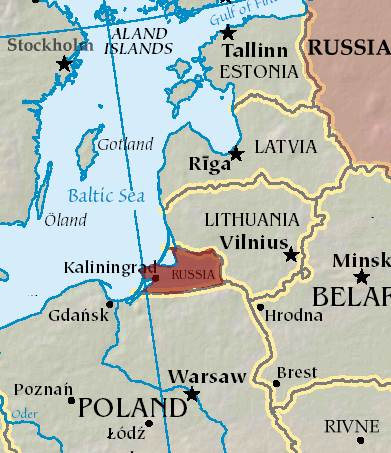
- Bookmark :
- Digg
- del.icio.us
- Stumbleupon
- Redit it

OPINIONS
Have your say. Send to:
editor@VilNews.com
Ph. D., Chicago
A wave of unity sweeps the international Lithuanian community on March 11th every year as Lithuanians celebrated the anniversary of the Lithuanian Parliament's declaration of independence from the Soviet Union in 1990. However, the sense of national unity engendered by the celebration could be short-lived.
Human beings have a strong tendency to overgeneralize and succumb to stereotypical us-them distinctions that can shatter even the strongest bonds. We need only search the internet to find examples of divisive thinking at work:
- "Those who fled Lithuania during World II were cowards -- and now they come back, flaunt their wealth, and tell us 'true Lithuanians' how to live."
- "Lithuanians who work abroad have abandoned their homeland and should be deprived of their Lithuanian citizenship."

In Lithuania Christmas Eve is a family event and the New Year's Eve a great party with friends!
Lithuanian say "Kaip sutiksi naujus metus, taip juos ir praleisi" (the way you'll meet the new year is the way you will spend it). So everyone is trying to spend New Year's Eve with friend and have as much fun as possible.
Lithuanian New Year's traditions are very similar to those in other countries, and actually were similar since many years ago. Also, the traditional Lithuanian New Years Eve party was very similar to other big celebrations throughout the year.
The New Year's Eve table is quite similar to the Christmas Eve table, but without straws under the tablecloth, and now including meat dishes. A tradition that definitely hasn't changes is that everybody is trying not to fell asleep before midnight. It was said that if you oversleep the midnight point you will be lazy all the upcoming year. People were also trying to get up early on the first day of the new year, because waking up late also meant a very lazy and unfortunate year.
During the New Year celebration people were dancing, singing, playing games and doing magic to guess the future. People didn't drink much of alcohol, especially was that the case for women.
Here are some advices from elders:
- During the New Year, be very nice and listen to relatives - what you are during New Year Eve, you will be throughout the year.
- During to the New Year Eve, try not to fall, because if this happens, next year you will be unhappy.
- If in the start of the New Year, the first news are good - then the year will be successful. If not - the year will be problematic.
* If New Year's night is cold and starry - look forward to a good summer!
* If the during New Year Eve trees are covered with frost - then it will be a good year. If it is wet weather on New Year's Eve, one can expect a year where many will die and dangerous epidemics occur.
* If the first day of the new year is snowy - the upcoming year will see many young people die. If the night is snowy - mostly old people will die.
* If the New Year time is cold - then Easter will be warm.
* If during New Year there are a lot of birds in your homestead - then all year around there will be many guests and the year will be fun.
Christmas greetings
from Vilnius
and epic battle for the
future
Philosopher, political theorist, historian of
ideas, social analyst, and political
commentator
Ukraine was and continues to be perceived by the EU political class as a sort of grey zone with its immense potential and possibilities for the future, yet deeply embedded and trapped in No Man's Land with all of its troubled past, post-Soviet traumas, ambiguities, insecurities, corruption, social divisions, and despair. Why worry for what has yet to emerge as a new actor of world history in terms of nation-building, European identity, and deeper commitments to transparency and free market economy?
Right? Wrong. No matter how troubled Ukraine's economic and political reality could be, the country has already passed the point of no return. Even if Vladimir Putin retains his leverage of power to blackmail Ukraine and the West in terms of Ukraine's zero chances to accede to NATO due to the problems of territorial integrity, occupation and annexation of Crimea, and mayhem or a frozen conflict in the Donbas region, Ukraine will never return to Russia's zone of influence. It could be deprived of the chances to join NATO or the EU in the coming years or decades, yet there are no forces on earth to make present Ukraine part of the Eurasia project fostered by Putin.
want to learn about the
new, scary propaganda
war between Russia,
The West and the
Baltic States!
believe their government
is corrupt
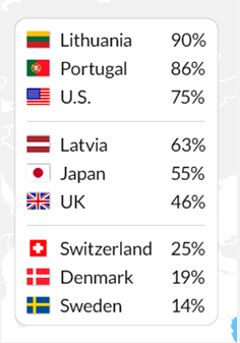
students say no to
bribes for doctors
During Soviet times, government was administered for the people in control, not for the local population, court decisions were decreed, they were not the administration of justice, and academia was the domain of ideologues. 25 years of freedom and openness should have put those bad experiences behind Lithuania, but that is not so.
Today, it is a matter of expectation that court pronouncements will be governed by ideological dictates. Few, if any Lithuanians expect real justice to be effected. For foreign companies, doing business in Lithuania is almost impossible in a situation where business people do not expect rule of law, so, surely Government would be a refuge of competence?
Lithuanian Government has not emerged from Soviet styles. In an attempt to devolve power, Lithuania has created a myriad of fiefdoms of power, each speaking in the name of the Government, each its own centralized power base of ideology.
Chepstow, Wales
Doesn't that sound suspiciously like Lithuania? Ah, but I didn't mention the mountains of Snowdonia, which would give the game away.
I'm talking about Wales, that part of the UK which Lithuanians used to call "Valija", but later named "Velsas" (why?). Wales, the nation which has welcomed two Lithuanian heads of state to its shores - firstly Professor Vytautas Landsbergis, who has paid several visits and, more recently, President Dalia Grybauskaitė who attended the 2014 NATO summit which was held in Newport, South Wales.
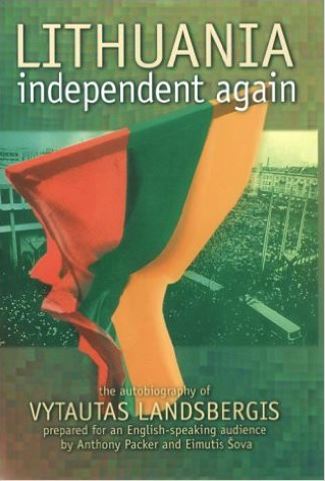
ENGLISH VERSION OF THE
AUTOBIOGRAPHY OF VYTAUTAS LANDSBERGIS.
Although Lithuanian activities have thinned over the decades as that postwar generation died out, the Lithuanian Martyrs' parish hall is crowded with many, many hundreds of visitors who come to the Lithuanian cemetery for All Souls' Day. Similarly, the Franciscan parish has standing room only for Christmas Eve mass.
Although I am firmly embedded in the literary culture of Canada, my themes are usually Lithuanian, and I'll be in Kaunas and Vilnius in mid-November 2015 to give talks about the Lithuanian translations of my novels and short stories, which I write in English.
If you have the Lithuanian language, come by to one of the talks listed in the links below. And if you don't, you can read more about my work at
www.anatanassileika.com
http://www.vdu.lt/lt/rasytojas-antanas-sileika-pristatys-savo-kuryba/ https://leu.lt/lt/lf/lf_naujienos/kvieciame-i-rasytojo-59hc.html
"My love and best wishes to all. As long as VilNews exists, there is hope for the future,"" she writes.
Irena Veisaite means very much for our publication, and we do hereby thank her for the support and wise commitment she always shows.
You can read our interview with her
Facing a new reality
Dear readers of VilNews,
For a number of years, the EU and Russia had assumed the existence of a strategic partnership, based on the convergence of values, economic integration and increasingly open markets and a modernisation agenda for society.
Our agenda was positive and ambitious. We looked at Russia as a country ready to converge with "European values", a country likely to embrace both the basic principles of democratic government and a liberal concept of the world order. It was believed this would bring our relations to a new level, covering the whole spectrum of the EU's strategic relationship with Russia.
The likelihood of Putin
invading Lithuania
.jpg "lithuania today")
Founding Director at Summer Literary Seminars
Are all Lithuanian energy
problems now resolved?
Lithuania as a country does not have significant energy resources. Energy consuming infrastructure after WWII was small and totally supported by energy imports from Russia.
First nuclear reactor begins power generation at Ignalina in 1983, the second reactor in 1987. Iganlina generates enough electricity to cover Lithuania's needs and about 50%.for export. As, prerequisite for membership in EU, Ignalina ceases all nuclear power generation in 2009
The Klaipėda Sea terminal begins Russia's oil export operations in 1959 and imports in 1994.
Mazeikiu Nafta (current ORLEAN Lietuva) begins operation of oil refinery in 1980.
Have Lithuanian ties across
the Baltic Sea become
stronger in recent years?
The two decades that have passed since regaining Lithuania's independence can be described as a "building boom". From the wreckage of a captive Soviet republic, a generation of Lithuanians have built a modern European state, and are now helping construct a Nordic-Baltic community replete with institutions intended to promote political coordination and foster a trans-Baltic regional identity. Indeed, a "Nordic-Baltic community" - I will explain later in my text the meaning of this catch-phrase.
Since the restoration of Lithuania's independence 25 years ago, we have continuously felt a strong support from Nordic countries. Nordics in particular were among the countries supporting Lithuania's and Baltic States' striving towards independence. Take example of Iceland, country which recognized Lithuania in February of 1991, well in advance of other countries. Yet another example - Swedish Ambassador was the first ambassador accredited to Lithuania in 1991. The other countries followed suit. When we restored our statehood, Nordic Countries became champions in promoting Baltic integration into Euro-Atlantic institutions. To large degree thanks Nordic Countries, massive transformations occurred in Lithuania since then, Lithuania became fully-fledged member of the EU and NATO, and we joined the Eurozone on 1 January 2015.
Have you heard about the
South African "Pencil Test"?
But that is exactly what happened to me when I came back from South Africa. I will tell you how.
VilNews e-magazine is published in Vilnius, Lithuania. Editor-in-Chief: Mr. Aage Myhre. Inquires to the editors: editor@VilNews.com.
Code of Ethics: See Section 2 – about VilNews. VilNews is not responsible for content on external links/web pages.
HOW TO ADVERTISE IN VILNEWS.
All content is copyrighted © 2011. UAB ‘VilNews’.